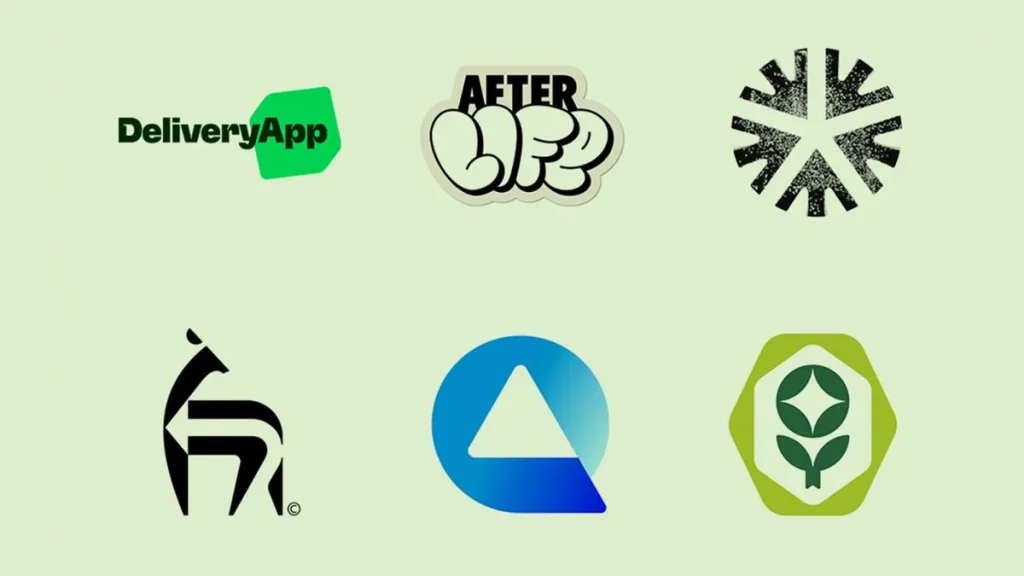
11 Modern Logo Design Trends: The Future of Visual Branding
The world of logo design is constantly changing. Designers have more tools to create stunning brand identities as visual communication methods and technologies progress.
We can expect logo design trends that leverage new digital capabilities while honouring timeless design principles.
This article will explore some of the most exciting modern logo design trends poised to make an impact this year and beyond.
Whether you’re a designer looking for inspiration or a brand manager hoping to revamp your company’s visual identity, read on for an insider’s guide to what’s heating up in logo design.
- Minimalism: Embrace clean, simple marks for recognisability, versatility across media, and timeless appeal.
- AI-augmented workflows: Use AI for ideation but retain human-in-the-loop refinement to ensure legal protection and originality.
- Accessibility first: Design high-contrast, WCAG 3.0-compliant variants and neurodiverse-friendly palettes for visual equity.
- Dynamic & spatial branding: Prioritise adaptable logos for animation, AR/3D, and responsive contexts to future-proof identities.
Simplicity and Minimalism Reign Supreme

Less is more regarding modern logo design.
Brands today recognise the power of simplicity – clean, sparse designs that immediately convey a brand’s essence. We’re moving away from complicated graphics in favour of stripped-down, minimalist logos that feel fresh and modern.
Some benefits of simple, minimalist logo design include:
- Easy to recognise and remember
- Flexibility across different media and sizes
- A timeless aesthetic that withstands shifting design trends
- Allows the brand personality to shine through.
Minimalism also enables more creative use of space and colour. By eliminating excessive decorative elements, designers allow key graphic features to stand out for maximum impact.
Expect minimalism to continue reigning in 2026 as the dominant logo design trend.
Hand-Drawn and Handcrafted Styles
While technology has opened up new frontiers for logo designers, there has also been a revival of interest in handcrafted imperfection.
Today’s brands seek authenticity and approachability, driving demand for hand-drawn logo styles. The organic, handmade aesthetic connects with consumers who crave individuality and human touches in branding.
Key characteristics of the hand-drawn logo trend:
- Loose, sketchy lines with natural imperfections
- Appearance of watercolours, markers, coloured pencils and other physical media
- Variations in stroke width and intensity
- Artisanal touches like paper textures or stamps
Designers today can deploy digital tools like Illustrator to recreate the hand-drawn look.
When paired with a minimalist approach, the resulting logo feels nostalgic, warm, and curiously anti-tech – an appealing contrast with most brands’ heavily digital identity.
The AI-Augmented Workflow: From Prompt to Pivot
In 2026, the question is no longer whether to use AI, but how to integrate it into a professional Design Systems framework.
The shift has moved from “text-to-image” to “structure-to-vector.” Professional designers now utilise Stable Diffusion v3 and Midjourney v7 not for finished marks, but for “Latent Ideation.”
The Professional Prompting Framework.
To move beyond generic outputs, designers use a multi-stage workflow:
- Seed Ideation: Using Adobe Firefly to generate mood boards based on specific brand archetypes.
- Structural Control: Utilising ControlNet within Stable Diffusion to force the AI to follow a hand-sketched composition, ensuring the “human” skeleton of the design remains intact.
- Vector Conversion: Using tools like Vector Magic or Illustrator’s enhanced “Text to Vector” (Beta 2026) to transform pixel-based AI hallucinations into scalable, production-ready files.
The Legal Landscape in 2026. A critical consideration is the “Human-in-the-Loop” requirement for copyright. Current UK Intellectual Property Office guidelines suggest that purely AI-generated works lack the “creative spark” required for trademark protection.
By using AI only for the process—and hand-refining the output—brands ensure their visual identity is legally defensible.
Vibrant, Expressive Colour Palettes

Why use muted shades when vibrant hues feel so fresh and fun? Brand designers today realise that colour conveys powerful cues about a company’s personality.
Boosting colour saturation and combining unexpected colour combos creates youthful, lively logos that reflect modern aesthetics. From bright neon hues to audacious duotone pairings, expect designers to embrace colour in bold new ways.
This move towards bolder palettes includes the rise of “dopamine colours”: highly saturated, joyful hues like electric yellow, magenta, and turquoise, designed to evoke an immediate sense of energy and optimism.
It’s a direct psychological response to a collective desire for positivity and fun in a complicated world. We’re also seeing gradients evolve beyond simple two-tone fades.
The trend now favours complex, multi-hued “aurora” gradients that create a fluid, almost iridescent effect. These shifting colours feel native to the digital world, adding depth and movement that flat colours can’t match, a principle famously applied in Instagram’s iconic logo.
Strategies for using colour creatively in logo design:
- Boost saturation levels of primary brand colours
- Combine complementary or contrasting shades that pop.
- Use colour gradients for dimension and visual interest.
- Add or alter colours seasonally for a variety
- Keep black and white as graphic neutrals.
Vibrant colours feel celebratory and optimistic – perfect for a brand hoping to make a confident statement while standing out. Danish brewery Mikkeller applied this principle beautifully in their colourful, expressionistic logo update.
Abstract Shapes and Optical Illusions
Today’s logos frequently incorporate dimensional shapes or optical illusions within their graphic marks. Dimensionality adds depth and layers to a logo’s layout using principles of mathematical perspective.
From 3D spheres to abstract shapes that play tricks on viewers’ eyes, contemporary logos often have an intriguing quality that hooks the eye.
Benefits of dimensional shapes and optical illusions in logo design:
- Creates visual interest and intricacy
- Imbues logo with a sense of breadth and depth
- Feels unexpected compared to flat graphics
- Captivates viewers by challenging their spatial perception
- Leverages mathematical principles to strike visual harmony
A great example is the FedEx logo, which cunningly hides an arrow shape within the negative space between the “E” and “X.” This hidden dimension enthrals viewers while evoking the brand’s dynamic, forward-thinking nature.
Expect more designs in 2026 to activate underutilised dimensions in similarly subtle yet show-stopping ways.
Hand-Rendered Typography

Custom-drawn letterforms are another way designers add an original flair to modern logo design.
Typographic logos will remain prevalent in 2026, but brands increasingly request display and script typefaces over default system fonts.
Hand-rendering letterforms open exciting opportunities for injecting brand personality – from flows and ligatures to tiny illustrative embellishments.
Advantages of bespoke hand-lettering in logo design:
- Distinctive and proprietary typography
- Reflects the designer’s unique creative vision
- Harmonises perfectly with accompanying graphic elements
- Wide variety of font personalities to match brand voice
- Physical media can be incorporated for an organic look
Custom lettering requires glyphs from the entire alphabet, but digital tools have shortened this process. The finished letters sing with the brand’s essence while offering viewers typographic details to pore over.
As system fonts become overexposed, hand-drawn fonts help build brand recognition and loyalty through stylishly bespoke letters.
Geometric Shapes and Patterns
Another modern trend is the use of geometric shapes and patterns in logo layouts. Circles, triangles, diamonds, grids – structured graphic shapes feel stable and balanced, conveying order even when daringly arranged.
Patterns also bring motion and depth to a design. Combined, geometric patterns energise a logo with hints of mathematical ponderousness – strangely pleasing to our pattern-loving brains.
How geometric shapes bring logo design power:
- Circles and curves = approachability, community, inclusiveness
- Squares and angles = stability, balance, professionalism
- Triangles = energy, action, forward movement
- Grids and line frameworks = structure, connectivity, networks
Leafy greens company Verival artfully deploys geometric minimalism in their logo update. See how shapes and lines communicate freshness and vitality in an abstract botanical pattern.
Expect this combination of geometric and natural elements to thrive in 2026 for maximum visual metaphoric meaning.
Retro Revival and Nostalgic Aesthetics
Nostalgia is a powerful connector, and brands are tapping into it by reviving aesthetics from past decades.
This isn’t just about looking old; it’s about using familiar visual language to create an immediate sense of comfort, authenticity, and coolness.
It works especially well for Millennial and Gen Z consumers, who feel an attachment to these eras, whether they experienced them firsthand or through cultural osmosis.
The revival is pulling from several distinct periods, each with its own flavour:
- 1970s Funk: Characterised by bubbly, rounded letterforms with no sharp edges, thick, confident lines, and earthy colour palettes of mustard yellow, burnt orange, and avocado green. It communicates a handmade, friendly, and groovy feeling that feels refreshingly analogue.
- 1990s Grunge and Pixels: This brings back the raw energy of early digital culture. Think pixel art, anti-design sensibilities with distressed textures, and a general rejection of clean corporate style in favour of something more individualistic and rebellious.
- Y2K Futurism: The early 2000s are back with a vengeance, bringing with them glossy metallic sheens, 3D chrome effects, futuristic fonts, and a digital-first aesthetic full of blues and silvers. It feels both nostalgic for the early days of the internet and, in its execution, strangely modern.
A perfect example of this done right is Burger King’s rebrand. They leaned heavily into their 1970s identity, using a rounded font and warm colours to ditch the cold, corporate blue they’d been using for decades.
The result feels confident, warm, and unapologetically focused on the product. It proves how a retro look can be modernised to feel both fresh and timeless.
Accessibility First: The WCAG 3.0 Logo Standard
In 2026, inclusive design is a legal requirement in many jurisdictions, including the UK and the EU.
Logo design has shifted to prioritise “Visual Equity,” ensuring that brand marks are legible to users with low vision, colour blindness, or neurodivergence.
The Contrast and Clarity Framework
The new WCAG 3.0 (Silver) guidelines focus on the APCA (Advanced Perceptual Contrast Algorithm). Unlike the old 4.5:1 ratio, APCA considers font weight and context.
- Variable Contrast: Logos must now include high-contrast “Accessibility Variants” that automatically trigger when a user has “Increase Contrast” enabled in their OS settings.
- Neurodiverse Palettes: Avoiding “Visual Vibration” (the jarring effect of high-saturated complementary colours) is now a standard practice. Using tools like Colour Oracle, designers simulate deuteranopia and protanopia to ensure the logo’s silhouette remains distinct.
Authentic Reflections of Culture and History

While prevailing trends provide helpful style inspiration, most brands seek a logo that authentically reflects their cultural heritage and brand backstory.
The most impactful logo designs capture a nuanced symbolic visual language brimming with contextual references that only the target audience will fully appreciate.
History and culture remain invaluable anchor points for logo creation, from symbolic icons to regional typographic styles incorporating vintage design motifs.
Tips for culturally contextual logo design:
- Research brand origins, vision and target consumers for guidance
- Reflect geographic heritage through landscape palettes and regional design styles
- Reimagine or modernise historical brand assets or archives
- Stylise product ingredients or company heritage in illustrations
- Speak to the audience’s values and passions through conceptual associations
By conveying cultural authenticity and insider flair, logos spark immediate consumer rapport and recognition.
For example, see how Apple’s original logo evoked Isaac Newton’s encounter with gravity through the famous falling apple, linking the brand with revolutionary innovation and human progress.
Responsible Design and Sustainability
With eco-consciousness at an all-time high, branding today must also convey a commitment to responsible design and sustainability principles—logos in 2026 aim to feel ethically considered, not exploitative or culturally appropriative.
Graphic production should honour green best practices – recyclable packaging, eco-friendly inks and dyes, and minimal waste. The sustainability movement also means creating minimalist but adaptable logo assets focused on longevity vs trends.
Strategies for sustainable logo design:
- Prioritise versatility and flexibility for maximum lifespan
- Design responsibly using eco-friendly, non-toxic materials and methods
- Streamline visual assets to reduce production waste
- Use graphic symbols meaningfully vs appropriating cultural IP
- Ensure all graphic elements tie directly to the brand strategy and vision
2022’s Mexico City Design Biennale sets an example by requiring all branding design partners to publicly share their sustainability commitments.
Expect more brands to recognise ethical imperatives and transparency behind logo design processes rather than focusing purely on visual outcomes.
Anti-Branding and Deconstructed Forms
In response to polished, perfect corporate identities, an “anti-branding” trend has emerged. This style is a deliberate move away from the clean, safe, and often predictable look we’ve come to expect from major brands.
It’s about embracing imperfection to appear more human, transparent, and relatable, especially to younger, media-savvy audiences who are naturally sceptical of anything that looks like slick marketing.
Key characteristics of the anti-branding approach include:
- Fragmented or deconstructed letterforms that look broken, stretched, or incomplete.
- Intentionally raw, gritty, or pixelated textures that mimic analogue or early digital processes.
- Asymmetrical layouts that ignore traditional rules of balance, creating a sense of unease or energy.
- An overall unfinished aesthetic that feels more like a work-in-progress or an artist’s sketch than a final, polished product.
The strategy here is simple: reject corporate perfection. Instead of presenting a flawless facade, it offers an artistic and honest feel.
It says, “We’re creative and a bit messy, not a faceless corporation.” This approach is most common in industries like high-fashion streetwear, with brands like Vetements and Off-White leading the charge, as well as in the independent music and art scenes, where raw expression is valued far more than a polished corporate image.
Dynamic Brand Marks

Print media and signage no longer constitute the only surfaces for brand logos today. Logos must pop on mobile screens and in apps while remaining cohesive across print touchpoints.
This expansion means logos must function more dynamically and be able to adapt, transition, transform and respond to shifts in sizing or layout. Dimensional logos and generative visual systems enable brands to exist fluidly across contexts.
Benefits of dynamic logo designs:
- Flexibility across digital and physical touchpoints
- Visually compelling motion design applications
- Allows for seasonal iterations or special editions
- Reduces production waste from static design assets
- Creates intriguing interactive potential
Additional logo animation and transformation methods to watch:
- Responsive logos that shift colours or layout at specific interaction trigger points
- Generative logos with algorithmic abilities to endlessly evolve and transform
- Augmented reality (AR) and virtual reality (VR) applications that bring static logos alive
- Logos that utilise machine learning to optimise their presentation format across contexts
- Fluid or liquid logos that morph, stretch, and flow in a continuous animation. These are designed to retain their core recognisable features while in motion, conveying adaptability and creativity, particularly in digital loading sequences. The Melbourne Symphony Orchestra’s identity, which visually reacts to music, is a fantastic real-world example of this principle.
As digital environments become more immersive, brands can think beyond static logo design to dynamically experience their identity.
Designing for the Spatial Era: 3D and AR Logos
As spatial computing becomes mainstream through devices like the Apple Vision Pro, logos are escaping the “flatland” of 2.D screens. A modern logo must now exist as a “Spatial Entity” that reacts to lighting, shadows, and user proximity.
From 2D Marks to Glassmorphism
The “Glassmorphism” trend has evolved into “Depth-Aware Branding.” Logos are no longer just shapes; they are materials.
- Refractive Surfaces: Using Three.js or Unity, designers create logos that catch virtual light as a user moves their head.
- Adaptive Z-Axis: In a VR environment, a logo might “unfold” or show more detail as the user approaches it, a concept known as Progressive Disclosure Design.
Scenario: The Retail Metaverse.
Imagine a user walking past a virtual storefront. The brand logo doesn’t just sit on a sign; it pulses with a soft “haptic glow” and subtly rotates to face the user. This level of interaction requires designers to think in USDZ and glTF file formats rather than just PNGs or SVGs.
Cross-Cultural Cohesion with Variable Fonts
Global brands like Samsung and LG are now using Variable Font technology to solve the “Translation Gap.”
A single font file can now contain multiple weights, widths, and even different language scripts (Arabic, Kanji, Cyrillic) while maintaining the exact same “Visual Weight.”
- Optical Sizing: Modern logos use “Optical Sizing” scripts that automatically adjust letter thickness based on screen size, ensuring a logo in Dubai looks just as authoritative as one in London, regardless of the script’s complexity.
Contextual Communication Through Animation

Once logos enter digital environments, animated movement unlocks game-changing modes of communication.
From animated explainers to video intros, logo animation directly spotlights branding meaning and personality traits through sound, motion and temporal narrative.
This contextual layering can efficiently relay brand origins, vision, services, voice and more to aligned audiences.
Benefits of logo animation:
- Conveys an interactive, engaging brand experience
- Brings static marks to life with dynamism and energy
- Allows introduction of audio for enhanced storytelling
- Offers flexibility for long or short-format content
- Captures viewer attention amid endless digital noise
For example, the Canadian web development studio Line47 animated its logo, transforming it from graphics to CSS code. This simple motion creatively links their name to their actual service offering in a delightfully memorable way.
Expect more brands in 2026 to discover their ‘origin story’ through lively logo animation tailor-made to introduce and humanise their mission.
Technical Execution: Beyond the GIF
Animation is no longer a video file; it’s code. In 2026, the industry standard is Lottie and Rive. These formats support “Interactive Animation,” where the logo can react to a user’s mouse movement or scroll depth without slowing down the website.
- State Machines: Using Rive, a designer can build a logo that has different “states”—for example, a “Waiting” state, a “Hover” state, and a “Success” state.
- Performance First: These vector-based animations are usually less than 50kb, ensuring they don’t slow page load times on mobile-first websites.
Critical Considerations For Modern Logo Design and Updates
Creating an on-trend modern logo that stands the test of time requires carefully balancing current design elements with strategic branding principles.
While daring creativity fuels cutting-edge style, the logo’s effectiveness depends on laying solid, functional foundations.
As we’ve seen, logo design trends come and go, but a few tried-and-true practices reliably nurture memorable, compelling brand marks regardless of ephemeral aesthetics.
Timeless Design Fundamentals Still Rule
Exciting stylistic trends provide helpful creative jumpstarts but never overshadow design fundamentals.
Composition, colour theory, grid systems, scale and ratios, visual hierarchy, negative space, and typographic clarity – these foundational principles always underpin effective branding.
Start by reviewing design basics rather than fixating solely on transient trends. Analyse why existing brand marks captivate response through form, shape, texture and colour arrangements.
Establish how graphical elements interact to create symbolic meaning before introducing eye-catching ornamentation.
While modern logo design leverages cutting-edge digital capabilities for animation, transformation and beyond, its success relies on the designer skillfully implementing universal design fundamentals first.
Mastering the basics frees creativity to evolve visually in response to contemporary cultural moments and brand needs. But anchoring innovations in long-tested creative building blocks ensures substance beyond passing style.
Validating Vision: AI-Powered Performance Testing
In 2026, “gut feeling” is backed by data.
Before a logo is launched, it undergoes Biometric Validation using AI tools like Attention Insight or Hotjar for Branding. These systems predict where a user’s eye will land within the first 500 milliseconds of exposure.
The “Saliency” Test: A successful modern logo must have a high “Saliency Score.” This means the most important part of the brand mark (usually the symbol or the first letter) captures the most “heat” in a predictive eye-tracking map.
If the data shows users are distracted by a decorative flourish, the designer can prune the design before it ever reaches the market, ensuring maximum Brand Salience.
Simplicity and Memorability Reign Supreme

Another classic principle retaining priority is simplicity for memorability.
When logos get overcomplicated for fanciful details, effectiveness and recognition suffer. As explored earlier, today’s design strategies favour minimalism because streamlined logos are more easily comprehended, recognised and recalled.
With brand visibility heavily dependent on audiences quickly connecting with a logo’s symbolic meaning, the sparse yet strategic design enables rapid cognitive connections.
This means evaluating whether each visual component pulls clear branding weight in an application. Final logo designs should strip away decorative elements that lack strategic representational purpose. If components only exist for aesthetic reasons or current trendiness, reassess their necessity.
If visual features don’t directly communicate desired brand attributes or enhance consumer connections, restrain the impulse to include them merely for graphic excitement.
Prioritising simplicity is an act of design confidence and respect for the audience’s ability to engage. When executed thoughtfully, minimalism draws viewers’ attention to rich symbolic details worthy of sustained consideration.
Master minimalist brands like Nike and FedEx demonstrate how stripped-down logos activate viewers’ imaginations while conveying core values.
Savvy modern logo updates will artfully balance the latest visual daring with timeless simplicity for original yet easily comprehended outcomes.
Future-Proof Adaptability is Key
With change accelerating faster than ever, no logo remains static. Evaluating logo lifespan means anticipating further into the future than brands traditionally have.
Logos serving for 50+ years exemplify what longevity requires – built-in adaptability to enable flexible application as contexts evolve.
Critical strategies for resilient, future-proof logo design:
- Prioritise typographic marks for language flexibility
- Design modular graphic elements that allow rearrangement
- Utilise versatile geometric shapes rather than trendy icons
- Enable the logo to responsively scale without losing clarity
- Avoid culturally specific references that could become insensitive
Rather than constantly undergoing costly redesigns, logos should withstand the uncertainties of the next decades through steadfast, meaningful design. Imagine political, cultural, and technological shifts when making 2026 design choices—test visualisation capacities under various scenarios.
Building innate responsiveness and resilience helps logos remain identifiable yet dynamic civic entities, enabling greater impact over time.
Evaluating Modernisation of Existing Logos

Improving recognition and alignment with modern aesthetics is alluring yet risky for established brands considering logo redesigns.
Revitalising brand marks that have existed for years presents unique design challenges requiring thoughtful evaluation. How can legacy brands freshen stagnant visuals while retaining equity and consumer connections?
To Update or Not Update? Key Questions to Ask
With redesigns costing hundreds of thousands in associated brand collateral updates, the decision to modernise cannot be taken lightly. Begin by clarifying the primary reasons for change using the helpful framework of questions below.
Why modernise?
- Does the existing logo misalign with the evolved brand values or offerings?
- Does it feel outdated, or does it lag visually behind competitors?
- Has the industry or cultural context changed drastically since its last design?
- Have technical requirements for reproduction specs or file formats changed?
Why not modernise?
- Does the existing logo still strongly resonate with target consumers?
- Would long-time customers negatively perceive change as abandoning heritage?
- Is aesthetic datedness not currently hurting performance or recognition?
- Are visuals still consistently reproducible and effective digitally?
Carefully balancing the pros and cons of change is imperative before implementing updates solely for trendiness. Determine the specific misalignments, weaknesses, or technical hurdles the redesign aims to address first.
Weigh these urgent needs against risks of disrupting existing resonance. Use market research, testing and visual audits to demand evidence one way or another.
Especially for brands with long legacies, making limited refinements to improve reproduction while retaining heritage makes more sense than total stylistic overhauls.
Change is unavoidable, but make strategic choices based on brand goals rather than react mindlessly to each passing design trend.
Modernisation Best Practices
Upon confirming, through analysis, that a redesign is essential for progress, focus extra attention on respecting existing equity and consumer relationships.
Maintain visual consistency wherever possible to ease transition shock. Brand marks are like dear old friends — even refreshed appearances take time to feel familiar again after years of loyalty and positive experiences.
Helpful methods for smoothly modernising legacy brand marks:
- Retain and highlight the most recognisable existing graphical assets that still resonate strongly today.
- Keep original typography or colour palettes largely intact for consistency.
- Overlay new stylistic elements carefully to enhance rather than overwhelm existing foundations.
- Add dimensional elements, such as gradients or shadows, to increase depth vs. flat graphics.
- Adjust layout or spatial balance. Improved modern reproductions can make overly intricate vintage engravings or early digital vector shapes feel cleaner and more focused.
Small incremental shifts are often more successful than sudden, dramatic visual departures. Allow target audiences to participate via surveys to guide change direction.
Test consumer response early and often. Brand Marks, beloved for generations, deserve special care when receiving modern facelifts to maintain their heritage.
Industry-Specific Logo Evolutions
While general trends apply to everyone, specific sectors in 2026 are carving out unique visual languages:
- B2B SaaS: Moving away from “Corporate Blue” towards “Hyper-Flat” designs with ultra-thin lines and high-end typography from foundries like Pangram Pangram.
- FinTech: Transitioning from “Security Shields” to “Fluid Connectivity” icons, symbolising the borderless nature of digital finance.
- Sustainable Tech: Using “Bio-Mimicry”—logos that use patterns found in nature (like the Fibonacci Sequence) to signal a harmony with the environment.
Conclusion: The Future of Logo Design Looks Bright
The secret to navigating 2026’s logo trends is simple: ignore the flash-in-the-pan gimmicks and double down on timeless fundamentals.
While new tools give us infinite ways to overcomplicate things, the brands winning right now are those staying adaptable, meaningful, and brutally simple.
Why Fundamentals Win Every Time
Designers often get distracted by the “shiny stuff”—I’ve seen it a thousand times. But even as trends cycle faster than ever, the core pillars of solid concept and composition remain your only real safety net.
If a logo doesn’t work as a tiny favicon or a massive billboard, it’s failed, regardless of how “modern” it looks.
In my experience, the most successful marks in 2026 share these traits:
- Adaptability: It has to thrive in AR, VR, and physical spaces simultaneously.
- Cultural Authenticity: Glossy, generic corporate vibes are out; real, resonant storytelling is in.
- Visual Clarity: If you have to explain the logo, the logo isn’t doing its job.
- Sustainability: Designing with a “digital-first” mindset to reduce physical waste isn’t just a trend anymore—it’s an ethical mandate.
Beyond the Aesthetic
At its heart, logo design is just compressed communication. We’re taking an entire brand universe and crystallising it into a single, striking mark. When you get this right, you aren’t just making a graphic; you’re launching a relationship.
A well-executed logo signifies quality and community belonging, influencing real-world behaviour in a way a fancy font alone never could.
Most brands skip the “deep work” phase and later regret it. They chase a specific 2026 aesthetic—maybe something ultra-minimalist or hyper-kinetic—without asking if it actually speaks to their customers’ values.
This usually backfires. You need to know who you’re talking to before you decide what you look like.
FAQs about Modern Logo Design Trends:
How do I ensure my logo is ‘AI-Proof’ for 2027?
Focus on “Signature Oddities.” AI is excellent at average, symmetrical designs. To remain distinct, incorporate “Human Imperfections” or unique hand-drawn ligatures that current generative models struggle to replicate without appearing “uncanny.”
What is the best file format for a logo in 2026?
For static use, SVG (Scalable Vector Graphics) remains king. However, for interactive and animated marks, .riv (Rive) or .json (Lottie) are the 2026 standards, offering interactivity that standard video formats cannot match.
Does ‘Anti-Branding’ work for traditional businesses like Law or Finance?
Generally, no. Anti-branding is a “disruptor” strategy best suited for fashion, music, and creative tech. Professional services still benefit most from Geometric Minimalism, which conveys stability and trust.
How much should a professional logo cost in 2026?
For a freelance professional, expect to pay £1,500–£5,000. For a mid-sized agency, including strategy and brand guidelines, budgets typically range from £15,000 to £50,000. AI-assisted “budget” options exist, but often lack the strategic depth needed for trademarking.
What are ‘Dopamine Colours’ and should I use them?
These are highly saturated, optimistic hues like electric lime and vibrant magenta. They are excellent for consumer-facing brands (B2C) looking to stand out on social media feeds, but should be used sparingly in B2B contexts where “Professional Calm” is preferred.