Law Firm Rebranding After a Merger: The Trust-Transfer
A law firm rebrand after a merger or partner exit is not a visual refresh. It is a controlled transfer of trust, responsibility and recognition — telling clients, referrers and search engines who is now accountable, what has changed, and why the combined firm still merits their confidence and fees.
 By Stuart Crawford
 Reviewed by Tabitha Ayers
Updated 13 min read
On this page13 min left
When Hutchinson & Gray becomes Hutchinson Vaughan overnight, the client who has trusted the same partner for eleven years is not admiring your new colour palette.
They are asking one question: Is my matter still in safe hands?
Answer it badly, and they call a competitor before your rebrand announcement has finished loading. That question — not the logo, not the typeface — is what a post-merger rebrand exists to resolve.
Most guidance on law firm rebranding treats it as a design and communications exercise: update the website, refresh the palette, send a considered email. That advice is not wrong. It is aimed at the wrong problem.
A merger or a partner exit does not primarily change how the firm looks. It changes who is accountable — and every client, referrer and search engine now has to relearn where responsibility, expertise and reputation sit.
Get the sequence of that relearning wrong, and the fee erosion is quiet, delayed, and hard to reverse.
Law-firm consolidation makes this a live commercial issue rather than a rare one.
According to Fairfax Associates, 59 completed mergers involving US-based firms were recorded in 2025, an 18% increase on the 50 recorded in 2024, with 16 further combinations already announced for completion in 2026.
Brand integration is now a recurring task for firms of every size — and the branding foundations that make it survivable are the same ones covered across Inkbot Design's work on law firm branding.
How a Post-Merger Rebrand Is Actually Achieved
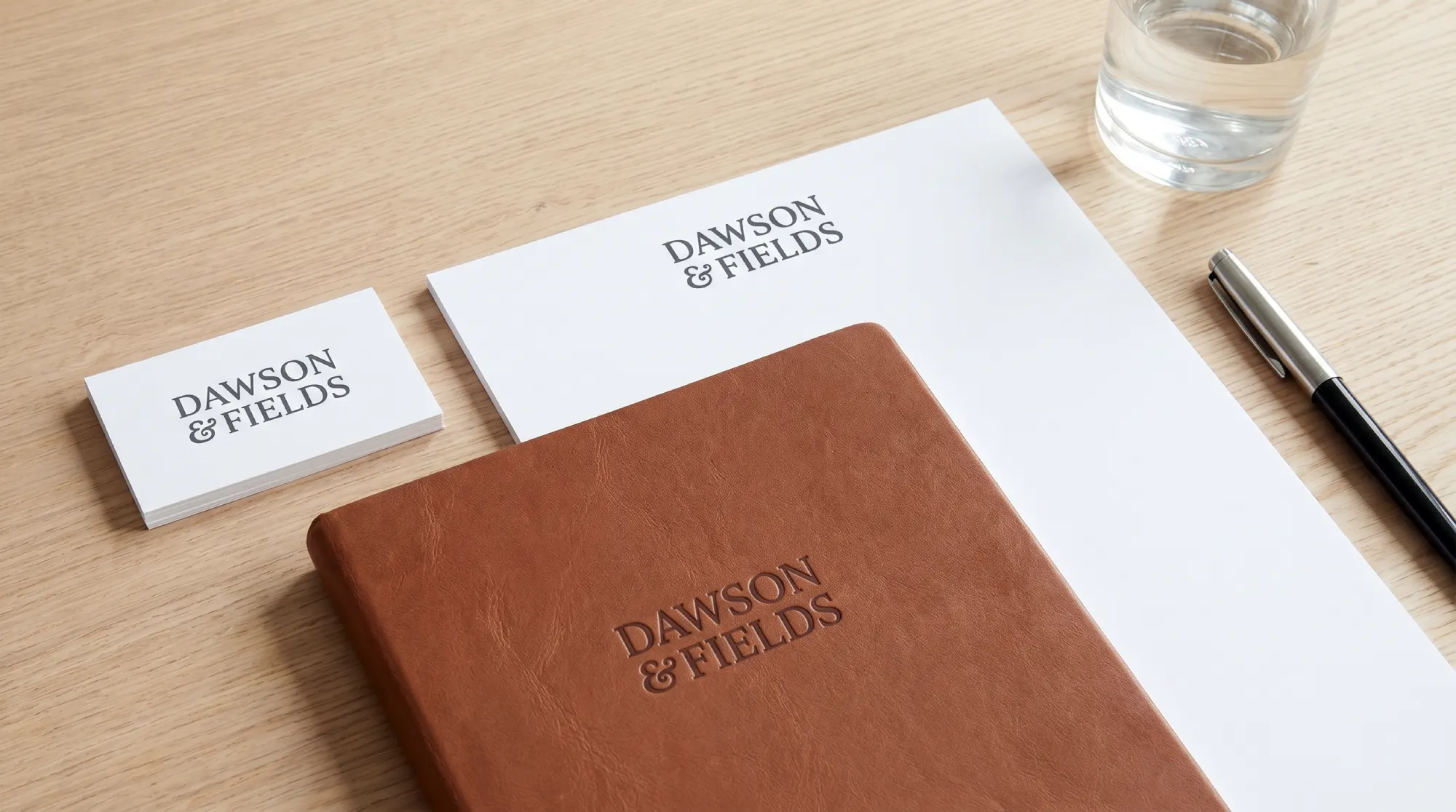
A law firm rebrand after a merger or partner exit is achieved in five stages: establish accountability, transfer trust, decide brand architecture, transfer recognition, and then embed the change. Each stage answers a specific question the market is asking about who now owns the work.
- The rebrand's real job is to reassign responsibility for existing client matters, not to modernise the visual identity.
- The stages are strictly sequenced: naming and design decisions made before the accountability question is answered will encode the wrong answer.
- The failure mode at every stage is silence — clients and referrers fill an unanswered question with their own worst assumption.
Law firm rebranding after a merger or partner exit is a controlled transfer of trust, responsibility and recognition — not primarily a visual identity change.
What You Need in Place Before You Touch the Logo
You need three things settled before any design work begins: a clear internal answer to who is now responsible for each client relationship, a decision on which reputational assets survive the change, and honest agreement among partners on what the combined firm actually offers.
Skip these, and the rebrand will look decisive while communicating confusion.
Most guides start at the website. They start three decisions too late. In seventeen years of brand work, the pattern I see most often is a firm that commissions a logo before it has agreed internally on what the merged entity is meant to do.
The entry condition most firms fail is the smallest one: unanimity on the offer. When three partners describe the merged firm differently, the market hears three firms.
Stage 1 — Establish Accountability Before Anything Else
Accountability is established when every active client matter has a named, communicated owner in the new structure.
This is the foundation on which the entire rebrand rests, and it is invisible in the finished website — which is exactly why firms skip it.
A client whose long-standing partner has departed does not care what the firm is now called. They care who picks up their file on Monday.
The Fairfax Associates data shows why this bites hardest at smaller firms. According to Fairfax Associates, 76% of recorded 2025 mergers involved at least one firm with between five and 20 lawyers, up from 69% in each of the two prior years.
For a smaller practice, a merger or partner departure can affect a larger proportion of the firm's visible identity because recognition is concentrated among a few people, locations, or specialisms. Lose one, and you have not lost a person — you have lost a chunk of the brand.
The failure mode here is treating accountability as an internal HR matter to sort out later. Clients sense the gap first.
Stage 2 — Transfer Trust, Because a Departed Partner Takes Reputation With Them
Trust transfers when clients and referrers have an explicit reason to extend their confidence in a departed or absorbed partner to the people now doing the work.
It does not transfer automatically because you announce it.
Reputation in a law firm is often held personally — in a named partner's relationships, referral network and reputation with the courts — and when that partner leaves, those assets try to leave with them.
Partner movement is reshaping smaller practices, not just the giants. According to NALP, lateral hiring at firms with 250 or fewer lawyers increased by nearly 44% in 2025.
For a firm whose reputation is strongly associated with a handful of senior lawyers, the arrival or departure of one partner has real consequences for positioning, client expectations and online visibility.
This is a figure for lateral hiring, not proof that 44% of lawyers changed firms — but the direction is unambiguous: the people who are the brand are moving.
When a partner leaves, the firm does not lose a headshot on the team page. It loses a share of the trust clients placed in a name. A rebrand that does not deliberately re-anchor that trust in the remaining team is not a rebrand — it is a slow-motion client handover to whoever the departed partner joins next.
The related discipline here is personal branding for CEOs and firm leaders: the more deliberately a firm has built recognisable individual profiles across its senior team, the less catastrophic any single departure becomes.
The failure mode is assuming loyalty is to the firm when it is often to the person. Test that assumption before you rely on it.
Stage 3 — Decide Brand Architecture, Not Just a Name
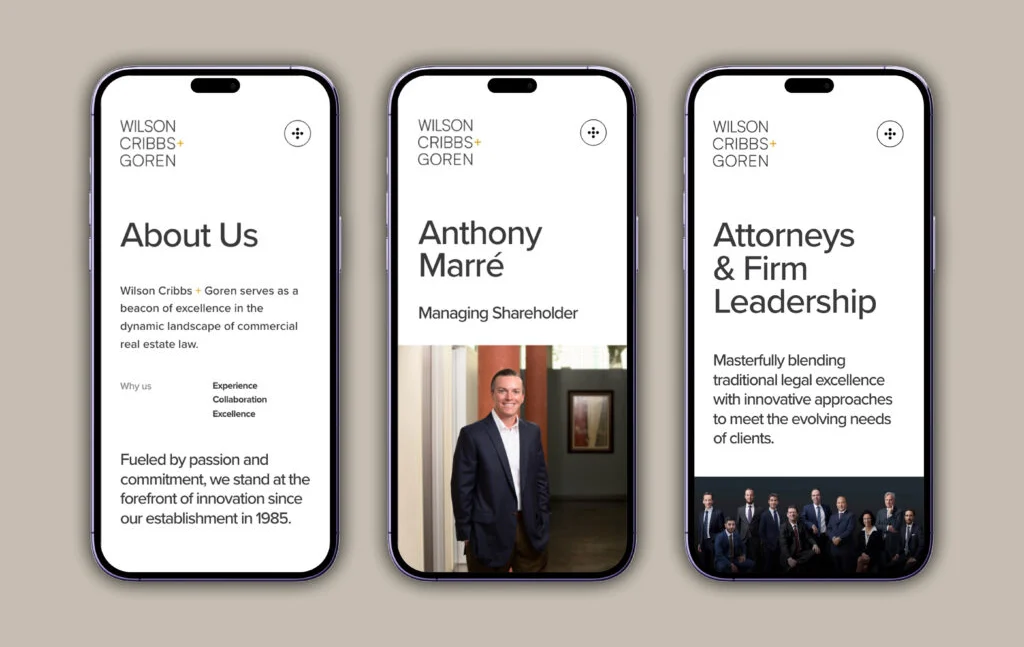
Brand architecture is decided when you have chosen, deliberately, whether the combined firm presents as one unified identity, a lead name with an endorsed sub-brand, or retained separate names in different markets.
This is a strategic choice about how trust is distributed, and it must precede naming — because the name is the output of the architecture decision, not the input.
Cross-border combinations make this sharper.
According to Fairfax Associates, 10 cross-border mergers were recorded in 2025, compared with 3 in 2024, noting that many had been announced in 2024 but took longer to complete.
Different legal environments, multiple office brands and varying naming conventions all force the same question: does the combined firm need one global identity, or a more flexible architecture that preserves local recognition where it still carries commercial weight?
Scale changes the proposition, too.
Reuters highlighted the proposed Hogan Lovells–Cadwalader combination as a firm of roughly 3,100 lawyers and about $3.6 billion in annual revenue — a case where the new brand has to explain not a name change but a different proposition entirely: what the combined firm can now do, where, and why clients should believe the integration improves their experience.
That is market-scale, not proof that bigger is always better-branded.
The lesson is narrower and more useful: the bigger the change behind the name, the more the brand has to explain, not just display.
The failure mode is choosing a name first and reverse-engineering the strategy to fit it.
Stage 4 — Transfer Recognition, Including to Search Engines
Recognition transfers when clients, referrers and search engines can all follow the thread from the old identity to the new one without losing the connection. Humans need continuity signals — “the team you know, now part of…”.
Search engines need technical ones: 301 redirects on every changed URL, consistent business information across directories, and preserved authority on the pages that ranked.
A name change with broken redirects does not just confuse Google. It hands your hard-won local visibility to the firm that kept its URLs intact.
This is where firms with a strong individual-profile presence recover fastest, because recognition is distributed rather than concentrated in a single domain — the logic behind sustained personal branding on LinkedIn for senior lawyers, where partner-level profiles carry recognition through a transition, the firm-level brand is still rebuilding.
The failure mode is treating the website migration as an IT task disconnected from the brand strategy. The redirect map is the trust map, rendered in technical form.
Stage 5 — Embed the Change Where Judgement Beats Process
Embedding is complete when the new identity holds consistently under pressure — in a pitch, a referral conversation, a difficult client call — without partners reverting to describing the old firm.
This is the stage no checklist can run for you, because it depends on judgment: knowing which client relationships need a personal call rather than an email, which referrers must hear it from a partner directly, and which market genuinely does not care.
The wider forces make embedding harder.
The 2025 Report on the State of the US Legal Market, published by the Thomson Reuters Institute, identifies changing client expectations, competition and generative AI as forces reshaping law-firm business models, including pressure on the traditional equity-partnership and billable-hour structures.
A rebrand launched into that turbulence has to signal stability precisely when the underlying model feels least stable. That is a judgment call about tone and pace, not a template.
Where 17 years show is in the sequencing — knowing that a referrer told too early, before accountability is settled, spreads uncertainty faster than saying nothing.
The Step Everyone Does in the Wrong Order

Here is the sequence correction that the standard advice misses.
The prevailing view — held by capable marketers for good reason — is that you should establish the visual identity first, then communicate it.
Terry M. Isner of Jaffe has argued, reasonably, that a firm with a proper brand should rarely need to rebrand at all, except in the case of a merger or a major service change. That view is sound about frequency. It is silent about the sequence.
The order that actually works inverts the instinct: answer the accountability and trust questions first, in plain internal language, and let the visual identity express the answer you have already reached.
Most firms do it backwards — they design the identity, launch it, and only then discover that partners disagree about what it means. The logo becomes a lid on an unresolved question rather than its resolution.
A post-merger rebrand fails not when the design is weak, but when it is launched before the firm has decided who is accountable for the work. The market reads the confusion straight through the polish. Design cannot paper over an unanswered question — it can only make the unanswered question look more expensive.”
The replacement directive is simple: do not commission a single design asset until every active client relationship has a named owner and every partner tells the same story about the merged firm's offer. Resolve the trust question first. Everything visual is downstream of it.
A sceptical Managing Partner will raise two objections here.
First: “We don't have time for a strategy phase — the merger completes next month.” Fair — but the accountability decisions are ones you must make anyway to operate; the rebrand forces you to make them visible rather than let clients guess.
Second: “Our clients are loyal to the firm, not individuals.” Perhaps. But that is a testable assumption, not a given — and the NALP lateral-hiring data suggests the market increasingly runs on individual reputation. Test it with your top ten clients before you bet the transition on it.
The Verdict
A law firm rebrand following a merger or a partner's exit is not a logo job.
It is a controlled transfer of trust, responsibility and recognition — and the firms that survive it well are the ones that treat the design as the last expression of an answered question, not the first attempt to dodge one.
The evidence points one way. Merger activity is rising, with Fairfax Associates recording 59 US law-firm mergers in 2025 and 16 more announced for 2026. Lateral movement is reshaping even smaller firms, with up to 44% of practices of 250 lawyers or fewer, according to NALP.
And the reputation at stake is increasingly held in named individuals, not the letterhead. Every one of those forces points to the same conclusion: the brand problem is a trust-custody problem wearing a design brief.
Do the difficult internal work in the right order. Decide who is accountable for each client matter. Agree unanimously on what the combined firm offers. Choose your brand architecture deliberately. Only then let the visual identity speak out loud what you have already resolved privately.
A rebrand built in that sequence transfers trust. One built backwards merely announces that something has changed and leaves clients to guess whether it changed for the better.
The single action to take today: before you brief a designer, write down the name of the person now responsible for your five largest client relationships.
If you cannot, your rebrand is not ready — and a free Brand Equity Audit™ will show you exactly where the trust is leaking before you spend a pound on design.
Frequently asked questions
Why is a law firm's rebranding after a merger more than a design project?
Because a merger changes who is accountable for client work, not just how the firm looks. Clients, referrers and search engines all have to relearn where responsibility and expertise now sit. The design expresses that answer — it cannot substitute for reaching it first.
How do you rebrand a law firm without losing clients?
Answer the accountability question before touching the visual identity. Assign a named owner to every active client matter, agree internally on what the combined firm offers, and then personally communicate continuity to your most valuable relationships before any public launch.
What's the difference between a rebrand and a website refresh for a law firm?
A refresh modernises visual elements while the name, positioning and accountability stay the same. A rebrand changes the firm's identity and, after a merger, shifts responsibility for the work. A refresh cannot resolve a trust-custody question that a merger creates.
When should a law firm rebrand rather than refresh?
When the underlying accountability has changed — a merger, a significant partner exit, or a major shift in service offering. Cosmetic updates suit an unchanged firm. A structural change in who owns client relationships requires the deeper trust transfer that a full rebrand performs.
Is it true that a partner leaving damages the firm's brand?
Yes — where reputation is concentrated in that individual. According to NALP, lateral hiring at firms of 250 or fewer lawyers rose nearly 44% in 2025. When a named partner holds key client and referrer relationships, their departure removes a share of the brand, not just a person.
How do you decide whether a merged firm should use one name or two?
Decide brand architecture before naming. Choose between one unified identity, a lead name with an endorsed sub-brand, or retained separate names by market — based on where recognition still carries commercial weight. The name is the output of that decision, not the starting point.
Why do post-merger rebrands fail?
They fail when launched before the firm has agreed on who is accountable and what it now offers. The market reads the internal confusion straight through the design. A polished identity applied to an unresolved question makes the confusion look expensive rather than fixing it.
How do you protect Google rankings during a law firm rebrand?
Map 301 redirects for every changed URL, keep business information consistent across directories, and preserve authority on pages that already rank—a name change with broken redirects hands local search visibility to competitors who kept their URLs intact.
What should happen first in a law firm rebrand?
Establishing accountability comes first: every active client matter needs a named, communicated owner in the new structure. This is invisible in the finished website, which is why firms skip it — and why clients sense the gap before the brand ever launches.
How long does a law firm's rebrand after a merger take?
It depends on how quickly partners reach a genuine agreement on accountability and offer. The design and website work is fast by comparison; the internal alignment is the constraint. Firms that rush the alignment to hit a launch date usually relaunch within two years.
What does cross-border merger activity mean for brand architecture?
According to Fairfax Associates, cross-border mergers rose to 10 in 2025 from three in 2024. Different legal environments and naming conventions force a deliberate architecture choice: one global identity versus a flexible structure that preserves local recognition, where it still drives fees.
Who should communicate a rebrand to key clients?
A responsible partner should communicate directly with the firm's most valuable relationships — by call, not email. Referrers and major clients place their trust in people, not letterheads. A personal conversation transfers that trust; a mass announcement asks them to transfer it themselves, and many will not.