SRA Transparency Rules: A Brand Test Your Firm Is Already Sitting
SRA transparency rules are usually treated as website admin — prices, complaints, a regulatory badge, dropped in the footer. That framing costs firms instructions. The mandatory disclosures are the proof layer beneath a firm’s positioning, and they decide whether the brand survives the moment a prospect compares providers and chooses one.
 By Stuart Crawford
 Reviewed by Tabitha Ayers
Updated 12 min read
On this page12 min left
A prospect three firms into a shortlist lands on your website, clicks through to check your pricing, and finds a PDF from 2023 buried under “Regulatory,” a fee range that contradicts the “premium, partner-led service” line on your homepage, and a complaints procedure written in a tone no one at the firm would ever use out loud.
They don't email to raise it. They just move to the next firm on the list. You never hear about the instruction you didn't win.
That is the real exposure in the SRA Transparency Rules, and almost no one writing about them names it. The rules are usually explained as a website-admin task — publish four things, add a badge, tick the box.
Handled that way, the mandatory disclosures quietly work against the brand they sit beneath.
Between May 2023 and August 2024, the Solicitors Regulation Authority's compliance work produced 439 warning letters and 36 fixed penalties, so the box-ticking view carries a regulatory cost too. But the fine is the smaller risk.
The larger one is that your transparency information is the first place your brand promise meets unfiltered scrutiny — and for most firms, the two have never been in the same room.
If you're weighing how the firm presents itself to buyers, this falls within the discipline that a law firm branding agency operates in.
What SRA Transparency Rules Require
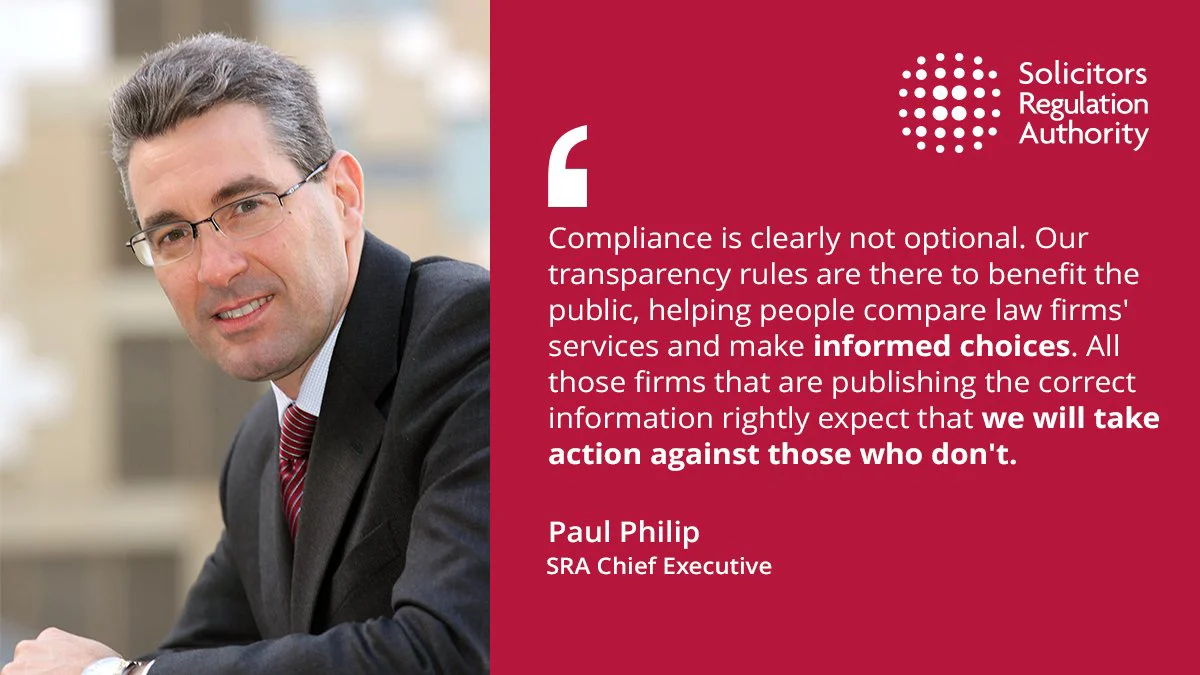
SRA Transparency Rules require firms and solicitors offering services to the public in England and Wales to publish clear information on costs, complaints handling and regulatory status so that consumers and small businesses can make informed choices before instructing. The current version has been applied since 11 April 2025.
- Cost information: clear price and service details for specified services offered to individuals and small businesses.
- Complaints information: how a client complains, how it's handled, and how to reach the Legal Ombudsman and SRA.
- Regulatory information and badge: SRA authorisation statement and the clickable SRA digital badge, published prominently or available on request.
SRA Transparency Rules require law firms in England and Wales to publish clear prices, services, complaints and regulatory information so consumers can make informed choices.
What You Need in Place Before You Touch the Page
Most firms start editing the transparency page before they've decided what the firm actually stands for — which is why the page ends up arguing with the homepage.
Settle three things first, in this order.
- Know what the firm is for and who it's for, because every disclosure either evidences that or undercuts it — a firm that sells “senior counsel, start to finish” and then publishes a fee that only makes sense with the work pushed downward has lost the argument on its own site.
- Have figures you'll defend out loud, signed off by whoever owns pricing; a range you'd wince at in a pitch is worse published than unpublished.
- And know where prospects actually look, because “prominent” is a requirement and prominence is a design call, not a compliance one.
The SRA's Year Three evaluation found that 55% of individual consumers and 60% of SMEs compared providers' prices and services before making a choice, up from 46% and 48% at Year One. This is decision material. Build it before you format it.
Stage One: Audit What a Prospect Actually Finds
Start where the buyer starts, not where the compliance file sits.
Open your own site as a stranger would — from a search result, on a phone — and try to find the price of a service you offer. Time it. Note every dead end.
This is the stage firms skip, and the data says why it matters.
Among people with a legal issue covered by the rules, 55% found the information easy to find, and 73% found it easy to understand — but almost one-third seeking price information in a mandated area did not find it on their solicitor's website.
Compliance and discoverability are different tests. A firm can publish everything the SRA asks and still fail the prospect's journey entirely.
Failure mode here: confusing “it exists on the site” with “a buyer found it.” You're auditing the second.
Stage Two: Reconcile the Disclosures With the Brand Promise
Line up what the homepage claims against what the transparency page reveals, side by side. The gap between them is where instructions leak.
A firm positioned on senior, partner-led service whose fee page implies work is pushed to junior fee-earners has just contradicted itself at the decision point.
“The SRA Transparency Rules do not force a law firm to commoditise itself. They expose whether the firm's brand can survive contact with the buying decision. Pricing, scope, timescales, team credentials and complaints information are not footer admin. Together they are the proof layer beneath the firm's positioning — and a prospect reads them as evidence, not decoration.”
This reconciliation is where the work earns its keep.
When the promise and the proof align, the disclosure sells. When they diverge, the disclosure issues a warning.
Failure mode: editing the transparency page in isolation, so it complies perfectly and coheres with nothing.
Stage Three: Design for the Journey, Not the Footer
Prominence is a requirement, not a preference — so treat placement and clarity as part of compliance itself.
The rules ask for information that is clear, accessible and prominent, which makes at least part of this a communication-design problem rather than a legal one.
The commercial case for getting this right is growing, not shrinking.
The Legal Services Board's 2025 research found a 20% increase in providers prepared to offer services remotely, and 54% of individuals with a legal issue now use online services to seek information.
When a client may never have entered your office before instructing, the website does more of the trust-building work — and the transparency content is part of that.
A PDF behind a “Regulatory” link fails that job. A clear, readable pricing section that matches the firm's voice does it.
Failure mode: meeting the letter of “published” while burying the information so that the journey never reaches it.

Stage Four: Make the Numbers Do Positioning Work
Publishing structured pricing does not drag a firm to the floor — it can have the opposite effect.
IDR Legal, a B2B debt-recovery firm, publishes fixed fees openly: £700 plus £150 disbursements for a statutory demand, a fully itemised £4,649.50 total for a winding-up petition, including the returnable Official Receiver's deposit.
The precision reads as competence. It signals a firm that knows its own process cold.
There's a defensible commercial reading, and it needs to be stated carefully because the obvious objection is right.
The LSB found firms displaying prices — particularly fixed fees — tended to offer more predictable pricing, with mean fixed prices £150 lower for a standard will, £386 lower for a joint divorce application and £435 lower for a leasehold purchase than mean estimated prices in those scenarios.
That is almost certainly selection, not causation: firms confident enough to fix a fee are firms that understand the work.
But the direction still kills the reflex that transparency drags everyone to the floor — the firms publishing clearly are not the desperate ones.
Clarity lowers the prospect's perceived risk, and a lower-risk decision justifies a fee rather than eroding it.
Stage Five: Where Judgement Beats the Checklist
The judgement calls are where the checklist runs out.
How much to publish beyond the minimum is an editorial decision, not a legal one.
The SRA's own guidance encourages firms to provide more than the minimum where it helps clients understand the service and costs, and notes that unclear costs — or costs that differ from an early estimate — are among the most common complaints the Legal Ombudsman handles.
Judgement, not a template, decides where “more” becomes “too much.”
The Objection Every Managing Partner Raises
“Publishing our prices will make us look like a commodity and let competitors undercut us.”
It's the most reasonable objection there is, and intelligent partners hold it for good reason: in a crowded market, showing your hand feels like surrendering the negotiation.
The evidence doesn't support the fear.
The LSB's Year Three data show buyers are already comparing — 55% of individuals and 60% of SMEs do so before choosing — so the choice isn't whether to be compared, but whether you shape the comparison or leave it to guesswork.
A firm that presents pricing with clear scope, named seniority, and defined timescales isn't commoditising; it's giving the buyer a reason to prefer it.
The second objection — “we don't have time to rebuild this” — is fair, but the LSB found 40% of providers raised prices in the preceding year while just 1% cut them. If you're already revising fees, the transparency review is the same job, done once, properly.
The Sequence Error That Ruins the Result

Here is the step almost every firm does in the wrong order.
They build the brand — the positioning, the site, the messaging — and then, months later, treat the transparency disclosures as a separate compliance exercise handled by a different person against a different brief. The two never reconcile.
The polished promise and the mandatory proof are designed in isolation, and prospects encounter the seam.
Intelligent teams do this for understandable reasons: brand is “marketing,” transparency is “compliance,” and the org chart keeps them apart.
But the rules explicitly require the price and service information to be clear, accessible and prominent — which means the SRA has already made disclosure a communication problem, whether the firm treats it as one or not.
The correction is simple to state and disciplined to execute: design the brand and the transparency layer as one system, in that order, so the proof is built to substantiate the promise rather than contradict it.
“Treat the transparency page as the last slide of the pitch a prospect gives themselves. It's where they decide whether the firm they read about on the homepage is the firm they'll actually get. Design it separately, and you let a stranger draw that conclusion for you.”
Where This Stands Now
The regulatory picture is shifting, and it's easy to misread. The SRA said in its 2025–26 Business Plan that it would publish a five-year Transparency Rules evaluation and consider enhanced rules, particularly better consumer information about the quality of legal services.
Then its draft 2026–27 Business Plan, consulted on through 22 June 2026, proposed pausing further work building on that evaluation to focus resources on client-money protection, high-volume consumer claims and proactive supervision.
Don't read the pause as permission to deprioritise. The trajectory is unchanged; only the sequencing has moved.
The Legal Services Board's 2025 State of Legal Services report says that transparency has improved in some areas. Still, gaps remain in price display, service information and accessibility of regulatory details — and that consumers are choosing more actively.
Progress is uneven by practice area: 88% of conveyancing providers displayed prices online in 2024, up from 73% in 2020, but only 47% of divorce providers did, down from 52%.
The next frontier the LSB names is quality information — evidence of competence, people and outcomes, not just price.
A firm that waits for new rules will be behind firms that already treat transparency as part of their brand.
The Verdict
The four rules take an afternoon to comply with. The reframe takes a decision. SRA Transparency Rules were written as consumer protection, but for a firm that feels its brand undersells its capability, they're something more useful: an honest mirror.
They show a prospect exactly whether the firm's promise holds up under the one kind of scrutiny that marketing can't stage-manage — the moment someone compares, in private, with a competitor's page open in the next tab.
Treated as a footer admin, the disclosures contradict the brand and cost instructions that no one ever reports losing.
Treated as the proof layer beneath positioning, the same information does the opposite: pricing that reads as competence, scope that reads as confidence, credentials that substantiate the premium the firm wants to charge.
The evidence supports this — buyers already compare; a third still can't find what they're comparing; and clarity lowers the perceived risk that would otherwise justify a fee. Nothing in the rules forces commoditisation.
They only reveal whether the brand can withstand close reading.
Do one thing today: open your own transparency page as a prospect on a phone, and ask whether it sounds like the firm your homepage promises. If the answer is no, you've found where instructions are leaking.
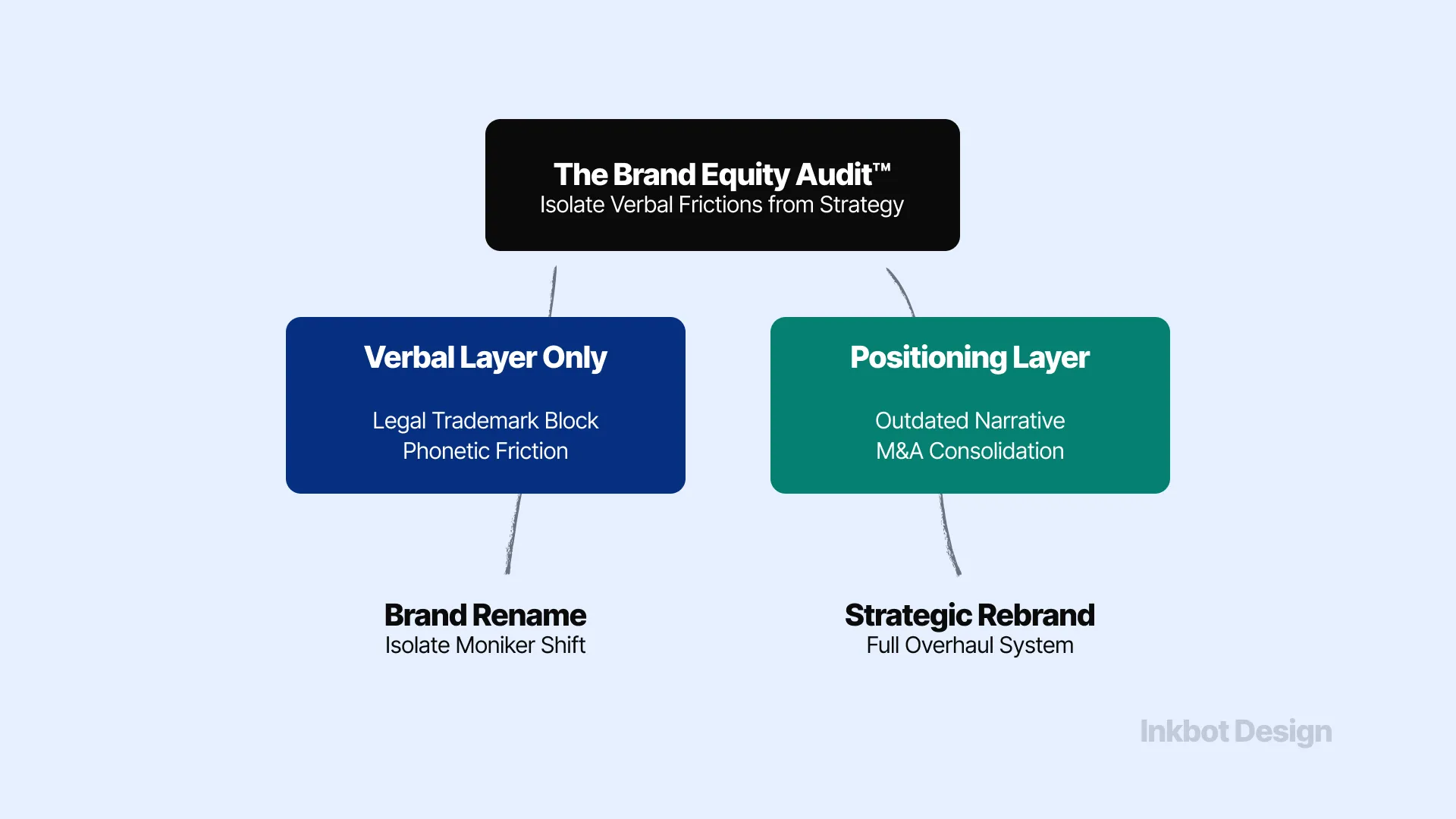
A free Brand Equity Audit™ will show you exactly where the brand is losing commercial ground and what to do about it — no sales call.
Frequently asked questions
What are the SRA Transparency Rules?
SRA Transparency Rules require firms offering legal services to the public in England and Wales to publish clear cost, complaints and regulatory information so consumers and small businesses can make informed choices. The current version has been applied since 11 April 2025, following SRA Board approval in December 2024.
Which services are covered by the SRA price transparency rules?
They cover specified services, including residential conveyancing and probate for individuals, as well as certain services for businesses. Complaint-handling and regulatory transparency duties apply to all firms regardless of whether the price rules cover a given service.
What happens if a firm breaches the SRA Transparency Rules?
The SRA can issue a £750 fixed penalty for a first specified breach and £1,500 for a further breach within three years. Between May 2023 and August 2024, SRA compliance work produced 439 warning letters and 36 fixed penalties. The SRA weighs the circumstances and may issue a warning rather than a fine.
Do publishing prices force a law firm to compete on cost?
No — publishing structured pricing does not commoditise a firm. LSB Year Three data shows buyers already compare providers before choosing, so clear pricing shapes a comparison that happens anyway. Precise scope, seniority and timescales differentiate a firm rather than reducing it to a number.
Is complying with the rules the same as clients being able to use the information?
No, they are different tests. LSB research found that almost one-third of people seeking price information in a mandated area did not find it on their solicitor's website. A firm can publish everything required and still fail the prospect's journey through poor placement or unclear presentation.
How prominent does the information have to be?
The rules require price and service information to be clear, accessible and prominent, and mandate the clickable SRA digital badge. Prominence is a design decision, not just a publishing one — burying disclosures behind a low-visibility “Regulatory” link risks failing the prominence requirement in practice.
When should a firm review its transparency information?
Whenever pricing changes and at least annually. The LSB found 40% of providers raised prices in the preceding 12 months while 1% cut them, so displayed figures date quickly. Treat the review as ongoing governance, not a one-time project.
Why does transparency matter more for remote legal services?
Because the website does more of the trust-building work, LSB 2025 research found a 20% rise in providers offering services remotely and that 54% of individuals now use online services to seek legal information. When a client may never visit the office, transparent content carries more of the decision.
What is the difference between the SRA and the Legal Ombudsman here?
The SRA regulates firms and enforces the Transparency Rules, including penalties for non-compliance. The Legal Ombudsman handles unresolved client complaints. Firms must publish how to reach both. Unclear or changing costs are among the most common complaints the Legal Ombudsman handles.
Are the SRA Transparency Rules likely to change soon?
Possibly later rather than imminently. The SRA's draft 2026–27 Business Plan, consulted on through 22 June 2026, proposed pausing further work building on its five-year evaluation to prioritise other areas. The long-term direction toward enhanced rules and quality information remains, so the pause is sequencing, not reversal.
How does transparency compliance connect to a firm's brand?
Directly. Pricing, scope, timescales, credentials and complaints information are the proof layer beneath a firm's positioning. When they align with the brand promise, they reinforce it at the decision point; when they contradict it, they cost the firm instructions it never sees itself lose.
Is it worth publishing more than the minimum required by the SRA?
Yes — where it genuinely helps clients. The SRA's guidance encourages firms to provide more than the minimum where it aids understanding of service and cost. Additional clarity on scope and timescales reduces perceived risk and lowers the chance of cost-related complaints.