Challenger Brand Archetype: Which One Works for a UK Law Firm?
Challenger brand archetypes give law firms a framework for strategic differentiation – but only when the archetype matches the firm’s actual operating model. Most firms applying this framework choose the wrong type.
 By Stuart Crawford
 Reviewed by Tabitha Ayers
Updated 17 min read
On this page17 min left
- What Is the Challenger Brand Archetype?
- The Origin of Challenger Brand Archetypes – and Why Legal Services Changes Everything
- The 5 Challenger Archetypes That Actually Work in Legal Services
- The Myth That Challenger Law Firm Brands Must Be Provocative to Be Effective
- State of the Challenger Brand Archetype in Legal Services
- What I See Law Firms Get Wrong
- Challenger Brand Archetype vs Conventional Law Firm Positioning – Decision Framework
- The Verdict
- FAQ: Challenger Brand Archetypes for Law Firms
Picking the boldest challenger brand archetype for your law firm and hoping the positioning holds is one of the most expensive branding mistakes a Managing Partner can make.
The archetype must match how your firm actually operates – not how you wish it were perceived – or you create a promise the business cannot keep, and sophisticated buyers notice immediately.
Most discussion of challenger brand strategy in legal services imports frameworks designed for Oatly and Liquid Death and applies them wholesale to regulated professional services. The result is a category error dressed up as bold thinking.
Firms end up with confrontational visual identities and no substantive differentiation, which is worse than the safe, undifferentiated positioning they were trying to escape.
If your firm's brand positioning does not reflect your genuine operational model, you are not a challenger. You are performing challenger aesthetics, and General Counsel see through that in the first five minutes of a pitch.
The financial stakes are not abstract. According to Bain & Company's 2025 analysis, insurgent and challenger brands hold less than 2% of market share but drove 39% of category growth in 2024 – more than double their impact from the previous year.
That growth is not evenly distributed. It goes to firms whose challenger positioning is coherent and credible, not to firms that redesigned their logo and rewrote their “About” page.
What Is the Challenger Brand Archetype?
A challenger brand archetype is a strategic positioning type that defines what a brand challenges – its direct competitor, a category convention, or a cultural norm – to achieve significant growth beyond what its resources would conventionally allow.

Key components:
- A challenger brand is not the market leader and is not operating as a niche player
- A challenger brand holds ambitions that exceed its conventional resource base
- A challenger brand must identify a specific target of challenge: competitor behaviour, category assumption, or cultural norm.
A challenger brand archetype is a strategic positioning type that defines what a firm challenges – its competitor, category convention, or cultural norm – to grow market share beyond its resource base.
The Origin of Challenger Brand Archetypes – and Why Legal Services Changes Everything
Adam Morgan introduced the challenger brand concept in 1999 in his book Eating the Big Fish, and the framework, eatbigfish, subsequently developed with PHD Media, identified 10 distinct challenger brand archetypes, each targeting a different object of challenge.
The ten archetypes are: The Feisty Underdog, The Enlightened Zagger, The Local Hero, The Missionary, The Irreverent Maverick, The People's Champion, The Real & Human, The Dramatic Disruptor, The Democratiser, and The Next Generation.
Every one of those archetypes was developed by observing consumer-facing brands. Not a single founding case study from this framework comes from a regulated professional services firm. That is not a reason to dismiss the framework – it is a reason to apply it carefully.
Legal services impose constraints that consumer markets do not. The Solicitors Regulation Authority restricts comparative advertising.
Law Society guidelines govern client communication. Professional reputation travels through tight referral networks, where a single ill-judged positioning move can circulate for years.
The Irreverent Maverick archetype that works for a canned water brand will destroy a law firm's referral pipeline in twelve months.
The question is not which archetype looks most exciting. The question is which archetype maps to what your firm genuinely does differently – and which of those translates into language that senior in-house counsel, HNW individuals, or business owners find credible rather than alarming.
The challenger brand archetype framework gives law firms a structured vocabulary for strategic differentiation. The mistake is treating all ten archetypes as equally viable. In regulated professional services, the viable subset is defined by what your firm demonstrably does differently – not by what aesthetic you want to project. Pick the wrong archetype, and you create expectation debt that undermines every client interaction that follows.
The 5 Challenger Archetypes That Actually Work in Legal Services
Not all ten archetypes are viable for a regulated professional services firm. The following five have operational equivalents in the legal sector and are supported by client purchasing data.
The Enlightened Zagger as a Law Firm Positioning Type
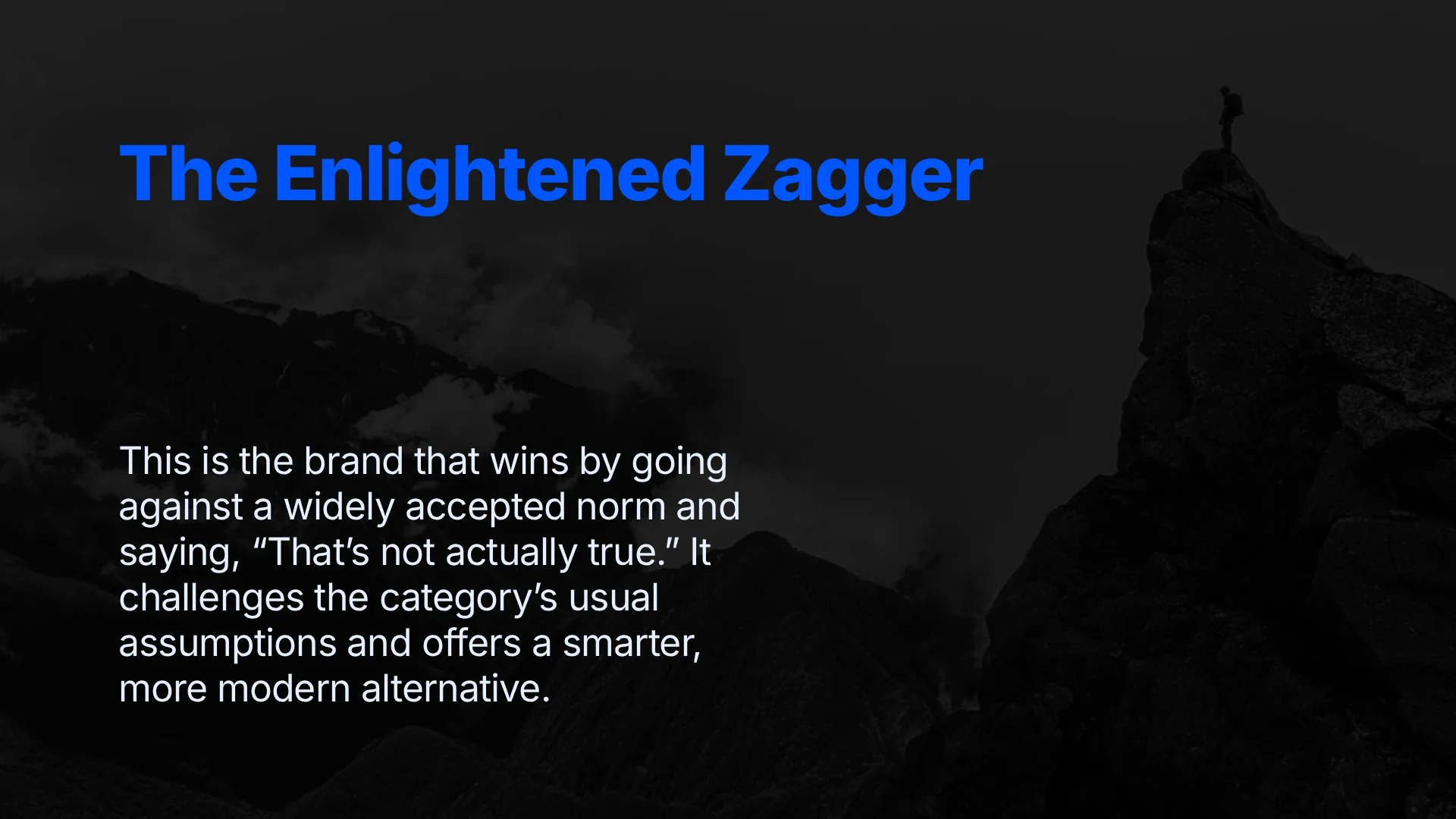
The Enlightened Zagger challenges the category's dominant convention rather than its dominant competitor.
In legal services, the dominant convention is the billable-hour model, fee opacity, and the assumption that complexity justifies cost.
Firms adopting The Enlightened Zagger positioning publish transparent pricing frameworks, offer fixed-fee or Alternative Fee Arrangement (AFA) structures as a primary offer rather than a reluctant accommodation, and build their brand around the claim that legal services should not require a finance director to interpret the invoice.
This maps directly to current GC purchasing priorities. According to AdvanceLaw's 2025 research, 43% of General Counsel named cost savings and more AFA structures as their top outside counsel management goal.
A firm that makes fee transparency the centre of its identity is not merely responding to market demand – it is occupying a positioning space most Magic Circle and Silver Circle firms cannot credibly occupy without dismantling their profit model.
The risk: this archetype requires your firm to actually operate differently. Putting “transparent fees” on a website while maintaining opaque billing structures creates the worst possible outcome – challenger branding that actively damages trust when the operational reality contradicts the promise.
The Missionary as a Law Firm Positioning Type
The Missionary challenger brand is driven by a cause that extends beyond the commercial transaction. The challenge is directed at a cultural norm – usually one that the category has historically reinforced rather than questioned.
In legal services, Missionary positioning works for firms whose practice genuinely centres on a transformative purpose: access to justice, ESG-integrated corporate governance, climate liability, or the commercial and social empowerment of underrepresented business founders.
The Missionary archetype is not about having a CSR programme. Every mid-size firm has a CSR programme. Missionary positioning means the cause is structurally embedded in how the firm selects clients, prices work, and hires talent.
When Mishcon de Reya built its reputation around high-profile civil liberties and human rights work alongside its commercial practice, the combination created a coherent positioning that was impossible for firms with different values to replicate. That is Missionary positioning done with integrity.
Internally link: B2B branding context is relevant here – the Missionary archetype is particularly powerful in B2B legal contexts where the client's own ESG commitments create alignment.
The Next Generation as a Law Firm Positioning Type
The Next Generation challenger brand positions the incumbent approach as outdated and offers the replacement model. The challenge is directed at category convention, framed as evolutionary rather than confrontational.
In legal services in 2026, Next Generation positioning is credible for firms that have genuinely restructured around technology-augmented service delivery.
According to the 8 am Legal Industry Report published in March 2026, 69% of legal professionals now use general-purpose AI tools for work, and 61% report measurable weekly time savings – yet fewer than half of firms provide training on responsible use.
The gap between AI adoption and structured capability is a positioning opportunity. A firm that has built rigorous AI governance, implemented supervised AI workflows, and can demonstrate what that means for client turnaround times and cost efficiency has a genuine Next Generation claim. A firm that has installed a chatbot on its homepage does not.
The Local Hero as a Law Firm Positioning Type
The Local Hero challenger positions against national or international competitors by making geographic and community embeddedness a strategic asset rather than a limitation. The challenge is against the assumption that scale equals quality.
This archetype is underused by UK regional law firms that have built genuine deep-sector expertise serving a specific geography, and then spend their marketing budget apologising for not being London-based.
Local Hero positioning reframes the firm's regional footprint as an advantage: deeper knowledge of local commercial and regulatory environments, faster access to decision-makers, relationships built over decades.
For a 15–30 partner firm in Belfast, Bristol, Leeds, or Edinburgh, this archetype is often the most defensible and the most credible to regional GCs and owner-managed businesses that large-firm partner-bait-and-switch engagement models have burned.
The People's Champion as a Law Firm Positioning Type
The People's Champion challenges the power structures of an industry, positioning itself on the client's side against the complexity, cost, and opacity the category has historically imposed.
This is distinct from the Enlightened Zagger in that it is explicitly adversarial toward the category's conventions rather than offering an alternative. People's Champion positioning names the problem loudly and claims to solve it.
In legal services, this is viable for firms serving individuals and SMEs who feel systematically underserved by the legal establishment. It is risky for firms serving large corporates because it implies the client is a victim, which is not a flattering framing for an FTSE 250 General Counsel.
The five viable challenger archetypes for UK law firms – Enlightened Zagger, Missionary, Next Generation, Local Hero, and People's Champion – share one characteristic: each targets something the firm can genuinely change about the client's experience.
The remaining five archetypes from the eatbigfish taxonomy are either too confrontational for regulated services or require consumer brand budgets and media strategies that bear no relation to how law firms build reputation. Applying the wrong archetype is not just ineffective – it actively misrepresents the firm to the market.
The Myth That Challenger Law Firm Brands Must Be Provocative to Be Effective
Provocative positioning was reasonable advice in consumer markets where attention was the scarcest resource.
When Oatly plastered its packaging with confrontational copy attacking the dairy industry, it worked because Oatly operates in a low-involvement purchase category where risk tolerance is high and the downside of a wrong choice is a box of oat milk you do not enjoy.
Law firms do not operate in low-involvement purchase categories. They operate in high-stakes, high-trust, relationship-dependent markets where the cost of a wrong hiring decision is measured in failed transactions, litigation exposure, and reputational damage.
According to AdvanceLaw's 2025 research, 72% of General Counsel review law firm partnerships every year. That review is not driven by which firm had the most interesting social media presence – it is driven by demonstrated competence, client service quality, and fee predictability.
Provocative challenger branding in legal services signals poor commercial judgment to exactly the buyers you most want to impress. The problem is not that law firms should play it safe – it is that provocation and differentiation are not the same thing.
A firm can be sharply, unmistakably positioned without being loud.
Choose the archetype that best aligns with your firm's genuine operational model. If your differentiation is fee transparency, your challenger brand is quiet but specific – The Enlightened Zagger does not need to shout. If your differentiation is cause-driven practice, the Missionary leads with purpose, not personality. Bold positioning and provocative positioning are different things. The first builds long-term premium pricing power. The second builds attention that your firm cannot always sustain.
State of the Challenger Brand Archetype in Legal Services
The case for challenger positioning in UK law firms has moved from the theoretical to the empirical over the past 24 months.
AdvanceLaw's 2025 research – drawing on General Counsel surveys across major markets – provides the clearest picture yet of how law firm purchasing decisions are shifting.
Over 50% of GCs now direct at least half of their outside legal spend to challenger firms: those sitting in the bottom half of the Am Law 100 and the Am Law Second Hundred.
Am Law 20 firms – the closest UK equivalent to the Magic Circle – account for less than 25% of GC outside counsel budget.
The mid-market is growing. Mid-size firms led the market with 2.4% demand growth in 2023, while Am Law 100 firms recorded zero growth. Am Law Second Hundred firms recorded 4.7% litigation demand growth in Q1 2024 alone.
This is not happening because mid-size firms are cheaper. Elite firms now charge hourly rates above $2,400, and hourly rates increased 9% in the first half of 2024.
GCs are not moving spend because the premium firms are too expensive to consider – they are moving because the challenger firms are demonstrably better positioned against the criteria GCs actually use to evaluate outside counsel.
What are those criteria? According to AdvanceLaw's 2025 data, 31% of GCs named client service approach as the most important factor after rates and legal capabilities. Over 40% cited technology innovation as a key evaluation criterion.
That data maps directly to two challenger archetypes: The Enlightened Zagger (client service model and fee structures) and The Next Generation (technology capability and AI adoption).
The 8 am Legal Industry Report from March 2026 adds critical texture. As of early 2026, 69% of legal professionals use general-purpose AI tools for work.
Sixty-one per cent report AI saves them measurable time each week – yet fewer than half of firms provide structured training on responsible use. This gap between AI adoption and AI governance is an explicit positioning opportunity for Next Generation challenger firms.
Firms that do not act on this data are not neutral. They are actively ceding ground in positioning to competitors who are. According to AdvanceLaw's 2025 research, 72% of GCs review law firm partnerships annually.
A firm with no discernible challenger positioning is being evaluated – and eliminated – every twelve months by the buyers it most needs to retain and attract.
The market has made its direction clear. The question is which archetype your firm will claim – and whether you will claim it before a competitor in your space does.
In 2026, challenger positioning in legal services is no longer a differentiation play. It is a defensive one. GC purchasing data confirms that the shift of mandate spend toward challenger firms is accelerating. A UK law firm that continues positioning as the safe, established, traditional choice is not maintaining market share – it is slowly becoming invisible to the buyers who have already decided what kind of firm they want to work with.
What I See Law Firms Get Wrong
I worked with a mid-sized firm that had exactly this problem. They occupied the worst possible commercial position: too large to be a boutique specialist, too small to compete with the national heavyweights on headline brand recognition.
Their response was to double down on the positioning that had got them there: 25 years of experience, trusted by families, here when you need us.
The mistake was structural, not tactical. Their website looked identical to those of 20 competitors. Their photography was the same stock handshake and gavel library that their competitors used.
Their messaging had no point of view on anything – no position on how legal services should work, no opinion on what clients deserved that they were not getting, no specific claim about what made working with this firm different from working with the firm three doors down.
They had adopted challenger aesthetics – slightly bolder typography, a darker colour palette – without challenger substance. The result was a firm that looked like it was trying to be edgy while communicating nothing of commercial value.
The fix was to align the archetype with reality. Their partners spent 40% of their time acting as ongoing legal counsel to owner-managed businesses – far beyond the transactional instruction model.
That made them a Missionary firm in practical terms: they were genuinely embedded in clients' commercial decisions in a way that large national firms could not be structurally.
When that became the central positioning – “we function as your in-house legal team, not your solicitor” – their pitch win rate increased, and their average matter value rose because they were no longer competing on price with firms offering a fundamentally different service model.
Stuart Crawford has led brand identity and positioning projects for professional services firms across 21 countries for over 17 years. The pattern I see most often is not a lack of ambition – it is ambition applied to the wrong archetype.
Challenger Brand Archetype vs Conventional Law Firm Positioning – Decision Framework
Decision Point | The Conventional Approach | The Challenger Approach | Why It Matters |
|---|---|---|---|
Fee model messaging | “Competitive rates available” | “Fixed fees published upfront for defined work types” | AdvanceLaw 2025: 43% of GCs cite AFA access as top outside counsel priority |
Differentiator claim | “25 years of experience” | “We function as your in-house team, not your retained solicitor” | Experience is table stakes; the relationship model is a genuine differentiator |
Visual identity | Stock handshake, gavel, glass building | Brand system that reflects a specific positioning claim | Undifferentiated visuals signal undifferentiated capability in the pitch room |
Client service framing | “We're here when you need us” | “You have a named partner contact who knows your business” | 31% of GCs name client service approach as a primary evaluation criterion |
Technology positioning | No mention or vague reference | Specific AI workflow capability with a governance framework stated | 8 am Legal Industry Report (2026): 40%+ of GCs cite technology innovation as an evaluation criterion |
Size framing | Apologetic or silent about firm size | Regional embeddedness or sector depth was made into an explicit advantage | Local Hero and Missionary archetypes outperform generic scale claims in mid-market |
Competitive stance | “We work with firms of all sizes” | “We're built for [specific client type] who need [specific outcome]” | Specific ICP positioning improves pitch conversion and reduces fee negotiation pressure |
The Verdict
Most UK law firms applying challenger brand thinking are using the wrong archetype. Not because the framework is wrong – the ten archetypes Adam Morgan and eatbigfish identified are genuinely useful strategic tools.
Firms are choosing the archetype that feels most exciting rather than the one that reflects how they actually operate.
That mismatch creates expectation debt. Sophisticated buyers – General Counsel, senior executives, HNW individuals – evaluate brand positioning against operational reality within the first two interactions.
A firm that positions itself as a fee-transparency Enlightened Zagger and then presents an hourly rate invoice with no alternatives has not just failed to differentiate. It has actively undermined trust in everything else it has said.
The data makes the commercial case without ambiguity. AdvanceLaw's 2025 research shows that mid-size challenger firms are growing litigation demand by 4.7% quarterly, while elite firms record zero growth.
GCs review law firm partnerships every 12 months. Over 50% of outside legal spend is already flowing to challenger firms. The market has already decided it wants challenger options – the only question is whether your firm will be a credible one.
Pick the archetype that maps to your genuine operational differentiation. If you offer true fee transparency, commit to The Enlightened Zagger. If your firm is structurally embedded in client businesses, build the Missionary positioning.
If you have real AI capability with real governance behind it, claim The Next Generation now before your competitors do.
If you want to understand exactly where your firm's current brand is losing commercial ground, the Brand Equity Audit™ is a structured diagnostic that identifies the gap between your positioning and your operational reality – and maps a direct path from where you are to where your fees should be.
FAQ: Challenger Brand Archetypes for Law Firms
What is a challenger brand archetype in the context of a law firm?
A challenger brand archetype is a strategic positioning category that defines what a law firm challenges – a competitor behaviour, a category convention, or a cultural norm – to grow beyond what its resources would conventionally allow. Adam Morgan introduced the challenger brand concept in 1999, with ten distinct archetypes subsequently identified by eatbigfish and PHD Media.
How many challenger brand archetypes exist, and which apply to legal services?
Ten challenger brand archetypes exist. Five are operationally viable for regulated UK professional services firms: The Enlightened Zagger, The Missionary, The Next Generation, The Local Hero, and The People's Champion. The remaining five require either consumer brand budgets or a level of provocation that carries regulatory and reputational risk in legal markets.
What does it mean for a law firm to be “The Enlightened Zagger”?
The Enlightened Zagger challenges the category's dominant convention rather than its dominant competitor. For a law firm, this means structurally rejecting the opacity and billable hour model that defines most of the sector – publishing transparent pricing, offering fixed fees or Alternative Fee Arrangements, and making fee clarity a central brand claim rather than a reluctant client accommodation.
How does challenger brand positioning help law firms command higher fees?
Challenger brand positioning shifts selection criteria away from price comparison and toward specific value differentiation. A firm positioned as The Enlightened Zagger or The Missionary is not competing on rate against generic competitors – it is occupying a positioning space that those competitors cannot credibly enter without changing their business model. AdvanceLaw's 2025 research shows that mid-size challenger firms are growing at 4.7% quarterly, while elite firms are growing at 0%.
Is challenger brand positioning risky for a law firm's professional reputation?
Challenger positioning carries risk when the chosen archetype does not align with the firm's operational reality. The risk is not in being differentiated – it is in over-promising and under-delivering. A firm that claims challenger positioning through bold aesthetics but no substantive operational difference creates expectation debt with sophisticated buyers. The risk is managed by selecting the archetype that reflects actual practice, not desired perception.
What is the difference between challenger brand positioning and just having a strong brand?
A strong brand can be built on market-leader or niche-specialist positioning. Challenger brand positioning specifically describes a strategic choice to compete by targeting an assumption the category has normalised – a convention, a competitor behaviour, or a cultural norm. A strong brand that does not make this targeting explicit is not a challenger brand, regardless of how well designed or consistently applied it is.
How do General Counsel evaluate challenger firms differently from established ones?
According to AdvanceLaw's 2025 research, 31% of GCs name client service approach as their most important selection criterion after rates and legal capability, and over 40% cite technology innovation. These criteria map directly to challenger archetypes – The Enlightened Zagger (service model) and The Next Generation (technology). GCs are not evaluating challenger firms on provocation or boldness; they are evaluating on demonstrable operational differentiation.
Can a law firm use more than one challenger brand archetype?
Using more than one challenger archetype simultaneously typically produces an incoherent positioning. Each archetype targets a different object of challenge and requires different operational commitments. A firm attempting to be simultaneously The Missionary (cause-driven) and The Irreverent Maverick (provocative) will produce conflicting signals that confuse buyers rather than differentiating the firm. The most effective challenger positioning in professional services is singular and specific.
What is the connection between challenger brand strategy and the Challenger Sale model?
Gartner (formerly CEB) research on B2B sales performance identified that 54% of high-performing B2B salespeople are “Challengers” – defined by their ability to teach clients new information, tailor communication, and take control of conversations around value rather than responding to requirements. The Challenger Sale model and the Challenger brand archetype framework share a common principle: differentiation through a specific, assertive point of view rather than through responsiveness or relationship maintenance alone.
How does AI adoption in law firms relate to challenger brand archetypes?
According to the 8 am Legal Industry Report from March 2026, 69% of legal professionals use general-purpose AI tools and 61% report measurable weekly time savings – yet fewer than half of firms provide structured training on responsible AI use. This gap creates a specific opportunity for The Next Generation archetype: firms that have built genuine AI capability with governance frameworks have a credible, specific differentiator that GCs actively evaluate.
How long does it take to build a credible challenger brand position in legal services?
Building a credible challenger position in legal services typically requires 12–24 months of consistent positioning, supported by operational changes that substantiate the claim. The brand identity, messaging, and communications can be repositioned within a single project cycle. The operational model – fee structures, client service approach, technology infrastructure – takes longer to establish. Repositioning before the operational changes are in place creates the expectation debt that undermines challenger positioning.
What should a Managing Partner do first to identify the right challenger brand archetype?
The first step is an honest audit of the firm's operational differentiation: what does the firm genuinely do differently from direct competitors in the same geography and sector? That list – not the desired positioning – is the input to archetype selection. A structured brand positioning review maps operational reality to the available challenger archetypes and identifies the one with the strongest claim to credibility.