Brand Strategy for Professional Services: The Risk Your Clients Are Buying
When a prospect chooses between your firm and a competitor, they are not weighing which logo they prefer. They are trying to work out which decision is least likely to go wrong on their watch.
Get that one idea straight, and most of what passes for professional services branding reorganises itself around something useful.
Cost is the deciding factor only 8% of the time. That figure, from Hinge Marketing’s research into how buyers select professional services firms, is the most important number in this article.
It means roughly nine in ten buying decisions turn on something other than price – and that something is, overwhelmingly, the reduction of risk.
A good brand strategy is the mechanism that does the reducing.
- Clients choose the least risky option; cost decides only 8% of the time, per Hinge Marketing.
- Effective brand strategy names a specific risk with clear positioning, verifiable proof and a single message hierarchy.
- Clear positioning lowers perceived failure, shortens long sales cycles, and justifies premium fees.
What Is Brand Strategy for Professional Services?
Brand strategy for professional services is the deliberate effort to make a specific buying risk feel smaller, so that a qualified client chooses your firm with less hesitation and pays a premium for the reduced uncertainty. It is not a visual identity, a tagline, or a tone of voice. Those are outputs. The strategy is the decision about which risk you are willing to remove.
Three components carry the load:
- The risk you address – the specific fear (regulatory exposure, a failed transaction, reputational damage, missed deadlines) your ideal client is trying to avoid when they hire your category.
- The proof that you remove it – the evidence, positioning and message hierarchy that make your firm the safest, most credible choice for that risk.
- The premium it justifies – the higher fee a client will pay once the perceived risk of choosing you drops below the perceived risk of choosing anyone else.
Brand strategy for professional services is the work of making a specific buying risk feel smaller, so a qualified client chooses your firm with less hesitation.
Why This Matters When You’re 50–200 People and Growing
The commercial stakes rise exactly at your firm’s stage.
New business is getting harder: in RSW/US’s 2025 survey, 51% of professional services firms said winning work was harder than the year before, and only 43% were satisfied with their new-business strategy – the lowest level in five years.
When the market tightens, the firms that most convincingly reduce buyer risk take a disproportionate share.
Sales cycles compound the problem.
RSW/US reports that 78% of firms say a deal takes up to six months to close. That is six months in which a prospect can talk themselves out of you, get outmanoeuvred by a clearer competitor, or default to the incumbent.
A brand built around risk reduction shortens that window by giving the prospect fewer reasons to hesitate at each stage.
Consider how Deloitte uses its Greenhouse spaces – immersive environments where clients work through problems with the firm rather than being pitched at.
Stripped of the branding language, that is a risk-reduction device: it lets a nervous buyer experience the firm’s judgment before committing millions.
The Greenhouse is not a decoration. It is proof, delivered early, that the decision is safe.
The Anatomy: How a Professional Services Brand Actually Reduces Risk
Positioning Names the Risk You Own
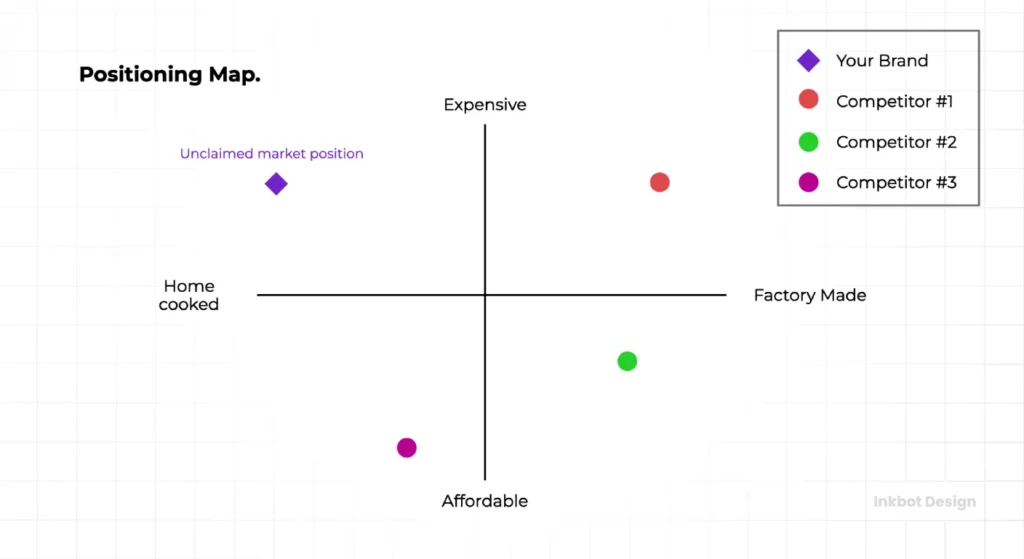
Positioning for a professional services firm is the act of claiming that, for a specific risk, you are the safest choice to remove.
A firm that positions itself around everything reduces no risk in particular, because a buyer cannot map a generalist onto a specific fear. Alvarez & Marsal built a global practice by owning turnaround and restructuring, the risk of a business failing.
When a board faces that exact fear, the firm’s narrowness is the reassurance. A firm three times its size that “also does restructuring” cannot make the same risk feel as small.
Positioning is not about being different for its own sake; it is about being unmistakably the safe answer to one question. Positioning that names a risk beats positioning that lists capabilities, every time.
Proof Points Convert Claim Into Evidence
Proof points are the specific, verifiable facts that turn “we reduce your risk” from an assertion into something a buyer can check.
A claim of expertise reduces no risk until it is backed by named cases, sector-specific results, or credentials the buyer recognises. This is where referrals do their work: Hinge’s research found that 71% of buyers found a firm by asking someone, compared with 11% who searched online.
A referral is a borrowed proof point – someone the buyer trusts has already absorbed the risk. Your brand’s job is to make that same reassurance available to the 89% who arrive without a referral, through visible, specific evidence rather than adjectives.
Firms that publish concrete outcomes reduce risk more than those that publish promises.
Message Hierarchy Keeps Every Partner Saying the Same Thing
Message hierarchy is the ranked order of what your firm says about itself, so that every partner leads with the same risk-reducing message rather than their personal favourite.
In a 50–200-person firm, this is where brands fail. I audited a professional services consultancy where the business was capable, but the market saw it as just another option – and the root cause was that different partners described the firm differently in the same meetings.
A prospect hearing three versions of who you are experiences that inconsistency as risk.
Message hierarchy fixes the sequence: this is the one risk we remove, said first, by everyone, in every pitch.
Consistency is not a cosmetic virtue; it is a risk signal a buyer reads unconsciously.
Where Firms Get It Wrong: Solving a Positioning Problem With a Prettier Identity
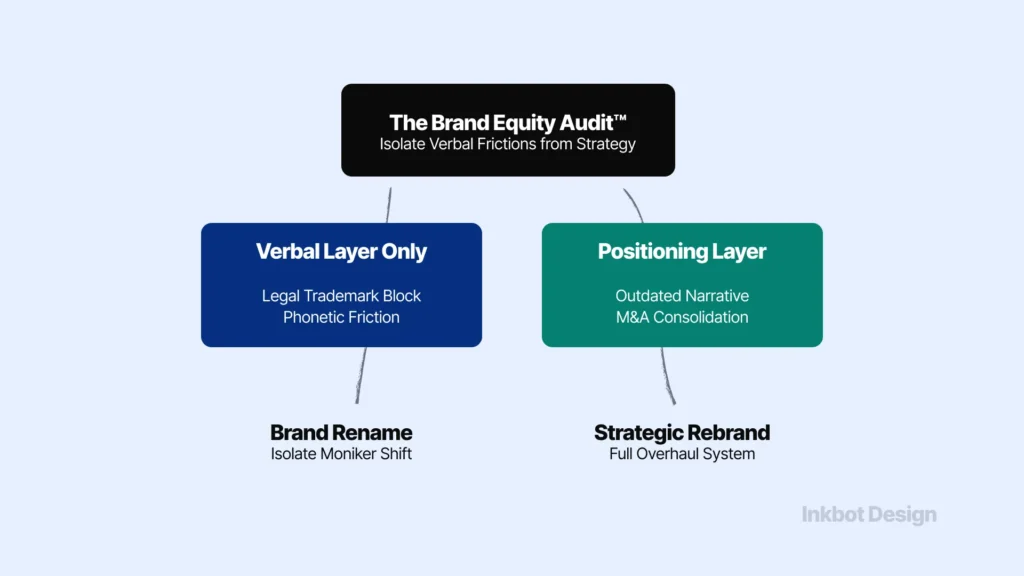
The most common and expensive mistake is treating a risk problem as a design problem.
A firm senses it is losing ground, so it commissions a new logo, a new website, a refreshed colour palette – and changes nothing about the risk it helps clients avoid.
The market still sees “just another option,” now in a nicer typeface.
This is understandable. A visual refresh is tangible, faster to approve, and easier to point at in a board meeting than the harder work of narrowing your position and rebuilding your proof.
But a prettier identity applied to an unclear position simply makes the confusion more legible. The buyer’s core question – “Is choosing this firm the safe decision?” – goes unanswered.
You will reasonably object: surely a professional, credible identity does reduce risk? It does, at the margin – a shabby brand signals a shabby firm.
But identity is a threshold, not a differentiator.
Once you clear the bar of looking competent, further polishing yields little. The risk-reduction that wins the work happens at the level of position and proof, not at the level of palette.
The Fee-Premium Mechanism: Why Clearer Positioning Commands Higher Fees
A clearer position lets you charge more because it lowers buyers’ perceived risk, and buyers pay to reduce it.
Here is the causal chain, step by step.
A prospect facing a high-stakes decision – a six-figure engagement with real consequences, as Hinge’s research on the sector describes – is pricing two things: the fee, and the probability the engagement goes wrong.
When your positioning makes you the unmistakable safe choice for their specific risk, the second number falls.
A lower probability of failure is worth money. The prospect will pay a premium to move from a firm that might handle it to the firm that obviously removes the exact risk they fear.
This is why cost decides only 8% of the time. The other 92% is the buyer paying for certainty.
A firm competing on price is quietly telling the market it has nothing better than price to offer – which, for a risk-averse buyer, reads as a warning.
“Price competition in professional services is a confession. It signals that a firm has failed to make its expertise feel safer than the alternative, leaving the client nothing to weigh but the invoice. The firms commanding premium fees are not more expensive. They are less risky, and they have made that legible.”
The Sharper Lens: Build the Brand Around the Client’s Risk, Not the Firm’s Self-Image

The prevailing advice is to build a professional services brand from the inside out – start with internal culture, purpose and values, and let the external brand flow from them.
Intelligent people hold this view for good reason: a brand promise the firm cannot deliver is worse than no promise, and internal alignment is genuinely load-bearing for consistency.
Siegel+Gale is right that a promise unsupported by the people delivering it collapses on contact with the client.
But for a firm mid-rebrand under commercial pressure, the sequence is wrong. Starting from the firm’s self-image produces exactly the generic claims already saturating the sector – “trusted,” “client-focused,” “results-driven” – because that is how firms see themselves.
Every firm believes it is trustworthy. None of those words reduces a specific risk, because they are not built on the buyer’s fear.
Start from the outside in instead. Name the precise risk your ideal client is trying to avoid, then build the brand – position, proof, message hierarchy, and yes, identity – as the answer to that risk. Culture still has to deliver on it.
But the organising question is the buyer’s, not yours. This is where the ROI of brand strategy actually comes from: not from expressing who you are, but from removing what the client fears.
When a professional services consultancy came to us, seen as “just another option,” we did not start with their values. We started with the buyer’s risk.
We rebuilt the brand around the specific uncertainty their clients were trying to eliminate, sharpened the proof points, and imposed a single message hierarchy across the partners.
The trap they had fallen into was the common one – reaching for a prettier identity instead of a clearer position.
Once the position was built around the client’s risk rather than the firm’s self-description, enquiries came in better qualified, sales conversations became easier because prospects arrived already reassured, and the firm had a defensible foundation for premium pricing.
The Verdict
Every capable firm that keeps losing to less capable competitors is losing the same argument. Not the argument about who is better – the argument about who is safer to choose.
That is the argument that brand strategy for professional services exists to win, and it is won on the buyer’s terms, not the firm’s.
The competitor’s ranking for this topic will tell you branding is more than a logo, that reputation and visibility matter, and that you should build from the inside out.
None of that is wrong.
All of it misses the mechanism.
A professional services brand is a risk-reduction device. It works by making a specific buying fear feel smaller than it does when a prospect considers anyone else – and because buyers pay to reduce risk, that reduction justifies a premium fee and shortens a six-month sales cycle. Cost decides 8% of the time.
Everything you build should be aimed at the other 92%.
So here is the one thing to do before your rebrand goes anywhere near a designer. Write down, in a single sentence, the specific risk your ideal client is trying to avoid when they hire a firm like yours.
If your partners cannot agree on that sentence, you do not yet have a brand strategy – you have a design brief waiting for a foundation. Fix the sentence first.
If you want an outside read on where your brand is currently losing commercial ground, request a free Brand Equity Audit™ – a structured, written diagnostic that identifies exactly which buying risks your firm is failing to reduce, and what to do about it.
FAQs
What is the brand strategy for a professional services firm?
Brand strategy for a professional services firm is the deliberate effort to make a specific buying risk feel smaller, so qualified clients choose the firm with less hesitation. It defines which risk the firm removes, proves it, and uses that to justify premium fees – distinct from visual identity, which is an output of the strategy.
How is professional services branding different from consumer branding?
Professional services buyers face higher stakes, cannot trial the service before buying, and must be confident on the first choice. Hinge’s research shows cost determines only 8% of the time, meaning the brand’s job is risk reduction rather than the awareness-building that drives most consumer branding.
Why do clients choose a competitor when our firm is clearly better?
Being better is not the same as being obviously safer to choose. If your positioning does not name the specific risk you remove, a prospect cannot map your superiority onto their fear. They default to whichever firm makes the decision feel the least likely to go wrong, which is often the clearer communicator rather than the stronger practitioner.
Is it true that cost rarely decides professional services purchases?
Yes – Hinge Marketing’s research found cost was the deciding factor only 8% of the time. The remaining 92% turns on trust, proof and perceived risk. Firms competing primarily on price are signalling they have nothing more reassuring to offer, which risk-averse buyers read as a warning.
How does brand strategy shorten a long sales cycle?
RSW/US’s 2025 survey found 78% of firms take up to six months to close. A brand built around risk reduction gives prospects fewer reasons to hesitate at each stage because the firm has already answered the buyer’s underlying question-“Is this the safe choice?”-before the objection forms.
Should we rebrand before a growth phase or an acquisition?
A rebrand is worthwhile before a growth phase only if it sharpens the risk you help clients avoid, not merely the visuals. An acquisition changes what the combined firm can credibly claim, making it a strong moment to rebuild positioning around the buyer’s risk – provided you start from that risk, not the new logo.
What’s the difference between positioning and a tagline?
Positioning is the strategic claim that your firm is the safest choice to remove a specific risk. A tagline is a short expression of that claim. Positioning is load-bearing; a tagline is decoration on top of it. Firms fail when they write the tagline before deciding the position.
How do I justify higher fees for professional services?
Justify higher fees by lowering the buyer’s perceived risk. A prospect prices both the fee and the probability of engagement failure. When your positioning makes you the unmistakable safe choice for their specific risk, that failure probability drops, and buyers pay a premium to reduce it.
When should message hierarchy be a priority?
Message hierarchy becomes urgent whenever multiple partners represent the firm, which is standard for firms with 50–200 people. If partners describe the firm differently in the same pitch, prospects read the inconsistency as risk. A ranked hierarchy ensures everyone leads with the same risk-reducing message.
Why isn’t a new logo enough to fix our brand?
A new logo applied to an unclear position makes the confusion more legible, not less. Identity is a threshold – clearing “looks competent” matter, but further polish yields little. The risk-reduction that wins work happens at the level of positioning and proof, not palette.
How much does referral still matter for professional services?
Referral remains dominant: Hinge found 71% of buyers found a firm by asking someone, versus 11% who searched online. A referral is a borrowed proof point. Brand strategy’s job is to supply that same reassurance – through visible, specific evidence – to buyers who arrive without one.
Are professional services firms behind on digital?
Yes – CBIZ reports 70% of professional services firms believe they are behind on digital transformation, and 77% of workers expect AI to significantly affect the sector. This raises the premium on visible expertise and differentiation, because clients increasingly evaluate firms through digital proof before ever making contact.
