Brand Language Guardrails: How to Stop a Rebrand Reverting to Type
A rebrand can fail in practice when people keep using the language that supported the old positioning. That is why brand governance guardrails matter: they give writers clear boundaries for claims and category terms, so the new strategic meaning is protected as content is produced rather than corrected afterwards.
That is not a copywriting failure. It is a governance failure, and a banned-word list is the instrument most firms reach for without understanding what it is actually for.
Generative AI has made it trivial for every employee, agency and platform to produce on-brand-looking copy at speed. Yet in June 2026, Gartner found that nearly half of surveyed US consumers say generative AI has made the quality of available content worse.
The problem is rarely the prose itself. It is that too much of it is permitted to make generic claims, repeat category language, and imitate a brand without obeying the strategic choices that made the brand distinct in the first place.
If you are steering a professional services firm through a rebrand, that is your exposure.
brand voice and copywriting system
- Treat guardrails as a decision-rights system that governs claims and category language, protecting strategic positioning at the moment content is produced.
- Banned-word lists alone are insufficient; each restriction needs a named owner, a leadership mandate and a documented positioning reason to enforce it.
- Decide which words re-file you into old categories by asking which category, whose concern and whether you can substantiate the claim here and now.
What a Brand-Language Guardrail Actually Governs

A brand-language guardrail is a decision-rights system that controls which claims, category terms and positioning choices a firm’s writers may use – protecting strategic meaning at the moment content is produced, not correcting it afterwards. It governs meaning, not merely style.
- It stops anyone writing for the firm – partners, BD, recruiters, agencies, junior marketers, AI tools – from making a claim that the business has not earned, defined, or agreed to.
- It attaches each restriction to a reason rooted in positioning, so the rule survives contact with someone who disagrees.
- It decides which vocabulary is appropriate where, for whom, and under what evidence conditions.
A brand-language guardrail is a decision-rights system that governs which claims and category language a firm’s writers may use, protecting positioning at the moment content is produced.
Why “Just Cut the Clichés” Is the Wrong Instruction
Most guidance on this topic is a copywriting cleanup exercise: strike out “innovative”, “world-class”, “passionate”, “disruptive”.
Sensible enough. Intelligent marketers hold this view for a good reason – those words are empty, everyone uses them, and removing them does make the copy read better. So the advice isn’t wrong.
It’s just shallow. Banning “world-class” because it’s unfashionable treats the symptom.
The real problem is that “world-class” lets a recruiter, a partner, or an AI draft assert a market position the firm has never actually agreed to hold – without anyone having to confront the strategic question underneath. The word is a way of skipping a decision.
Cutting it for being a cliché fixes the aesthetics and leaves the decision unmade.
Here is the shift that matters for a firm mid-rebrand: the most valuable word to restrict is often one that is perfectly accurate. It is dangerous precisely because it is defensible, so nobody challenges it, and it quietly pulls the brand back toward a category you are trying to leave.
How to Decide What a Word Is Really Doing
The test is not “Is this word tired?” It is “what decision does this word let the writer avoid?” Run every candidate term through three questions.
First: which category does this word file us under? Language is how buyers classify you. A term that is standard in your old category will keep sorting you into it, one sentence at a time, no matter what the new logo says.
Second: whose concern does this word describe – ours or the buyer’s? Inside-out vocabulary is the most common leak. Firms describe the problem in their own operational language; buyers experience it as a life or business consequence. When the two diverge, the internal term almost always obscures the thing the buyer is actually paying to solve.
Third: Does this word make a claim we can substantiate here, to this reader? A word that asserts market leadership, or a result, or a category position belongs only where the firm has agreed to it and can stand behind it. Governance is the system that decides where, because a term that is right in an investment-research note can be wrong on a homepage.
None of these questions can be answered by a junior marketer using a style guide. That is the point. The list is downstream of decisions only the firm’s leadership can make.
When a Finance Brand Banned Its Own Jargon

Here is where I stop speaking in principle.
When Inkbot Design repositioned The Technical Traders – moving it from a trading-led proposition toward a premium wealth-stewardship category we defined as Asset Revesting, aimed at private investors with roughly $1m–$10m in investable wealth – we did not simply give the firm a calmer tone of voice.
We instituted verbal guardrails. And the words we banned were not clichés. They were accurate.
“Drawdown”, “alpha”, and “volatility” were prohibited across most external communication. Every one of them is a valid, precise financial term. That was exactly the problem.
“Drawdown” frames the client’s experience as an abstract institutional event; we replaced it with “lost years”, because that is how a mature investor actually experiences a severe loss – disrupted plans, reduced freedom, damage to a life.
“Alpha” invites comparison to speculative market-beating; the precise game we were leaving was the language of protection and stewardship.
“Volatility” keeps attention on market turbulence; “peace of mind” and “fewer setbacks” describe the outcome the client is buying.
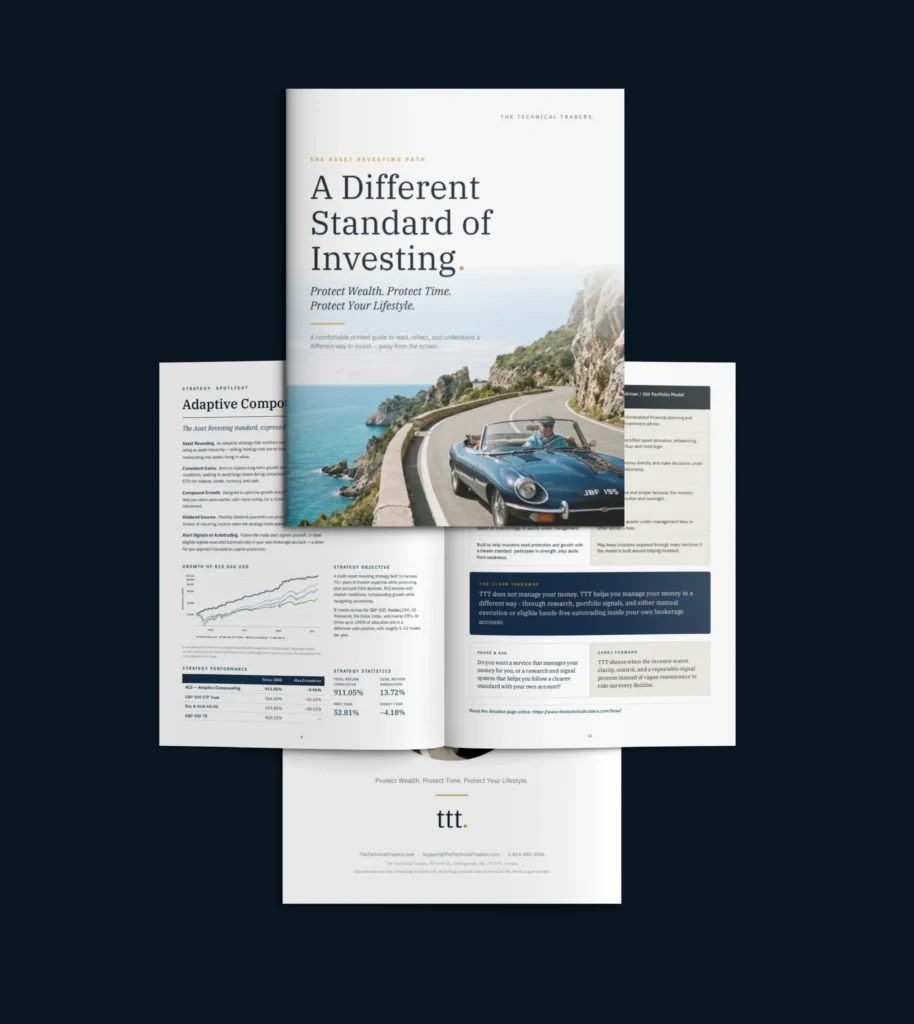
The mistake we were guarding against was subtle and constant. A portfolio manager, a content writer or an AI-drafted article would default to familiar terms – each uses factually defensible, collectively teaching prospects to file The Technical Traders back under “trading platform.
That is the association the entire reposition existed to displace. The guardrail’s job was to prevent every sentence from quietly reopening a category question we had already closed.
Ruling out speculation-led language made the premium perception easier to hold across the website, member interfaces and print – because the range of acceptable expression was narrow enough to stay coherent.
“A banned-word list does not protect tone. It protects the category buyers place you in. Its purpose is not to make every sentence identical – it is to stop every sentence reopening a strategic question the business has already answered and paid to own.”
This is also where the buyer-psychology mechanism shows.
A clearer, consistently held position reduces the perceived risk of hiring you because the buyer never encounters a contradiction that makes them hesitate.
Reduced risk is what justifies a premium fee. The guardrail is not decoration on that mechanism; it is what keeps the mechanism intact across a thousand touchpoints written by different hands.
Who Holds the Decision Rights

A guardrail with no owner is a wish.
The reason banned-word lists fail in professional services firms is not that the words are wrong – it is that nobody has the authority to enforce a restriction against a senior partner who prefers the old term.
So the honest first move is not writing the list. It is deciding who owns it.
That owner needs two things: a mandate from leadership and a documented reason for each restriction tied to the positioning. “We don’t say ‘alpha’ because it re-files us as a trading business” survives an argument.
“Marketing prefers we avoid it” does not.
The distinction between the language the firm uses internally – in research, risk documentation, and expert commentary – and the language permitted externally is itself a governance decision, and it requires a named person to make it.
“But won’t this slow everyone down and strip out our personality?” It is a reasonable objection, and the answer is the opposite of what people expect.
A guardrail with clear reasons removes the debate that actually slows firms down – the endless per-piece argument about whether this word is on-brand.
And it protects personality by safeguarding the position that gives it meaning.
You are not adding a bureaucrat to every draft. You are deciding once, so nobody has to relitigate it in the margins of a brochure.
The Verdict
A banned-word list is only as valuable as the decision it protects. Treat it as a style accessory, and you get tidier copy that still drifts back to type within a year.
Treat it as a decision-rights system – each restriction owned by someone, justified by the positioning, enforced at the moment of writing – and it becomes the thing that holds your rebrand together while fifty different people, and an unknown number of AI tools, write in your name.
Do one thing this week: take the single term most likely to re-file you under your old category, and decide, at the leadership level, whether it is permitted externally at all.
That one decision will tell you whether you have a guardrail or a wish.
If you want to see exactly where your current language is undermining the position you have chosen, request a free Brand Equity Audit™. This structured diagnostic identifies where your brand is losing commercial ground and what to do about it.
It pairs naturally with defining your firm’s tone of voice against its positioning and, for firms expanding abroad, screening brand language across markets.
FAQs
What is a brand-language guardrail?
A brand-language guardrail is a rule that restricts specific claims or category terms in a firm’s external communication, each tied to a positioning decision. It governs which words writers may use and where, protecting strategic meaning at the point of content creation rather than editing it afterwards.
How is a banned-word list different from a style guide?
A style guide standardises grammar, formatting and tone. A banned-word list, used for governance, restricts words that would make unearned claims or reclassify the firm into the wrong category. One protects consistency of appearance; the other protects the strategic position behind the words.
Should we ban words just because they are clichés?
No – cutting clichés like u0022world-classu0022 improves readability but misses the point. The words worth restricting are often accurate ones that quietly pull the brand back toward a category it is leaving, or let writers assert positions the firm has never agreed to.
Who should own our brand language guardrails?
A named owner with a leadership mandate, not marketing alone. Enforcing a restriction against a senior partner requires authority, and each rule needs a documented reason tied to positioning. Without an owner, a guardrail is a preference nobody can uphold.
Will guardrails make our writing rigid and strip out personality?
No – clear guardrails remove the per-piece argument about what is on-brand, which is what actually slows firms down. By protecting the position, they protect the personality that the position gives meaning. Restriction, used well, makes a brand more distinctive, not less.
