
Semantic Design System: Enterprise Governance Guide
When a mid-market professional services firm expands from 50 to 200 fee-earners, the executive team typically invests heavily in a refreshed identity to reflect its market stature. Yet within twelve months of launch, the brand experience fractures.
The corporate website displays crisp typography, but the client portal uses outdated button styles. Pitch decks created by the corporate finance team look completely disconnected from the digital tools built by product engineers.
The brand identity design has not failed at a visual level; it has failed at a system level.
Static brand guidelines are executive artifacts that engineers and practice heads ignore. Enterprise scale-ups break not because they lack visual components, but because they lack an automated architecture that preserves meaning across digital touchpoints.
According to a 2026 enterprise survey on semantic layers, 44.5% of organisations plan to increase spending on semantic infrastructure over the next 24 months, with an additional 14.4% preparing for first-time adoption.
These firms are discovering that traditional design systems—libraries filled with static colour hex codes and isolated UI buttons—do not protect commercial brand equity.
Protecting that equity requires transitioning from visual asset storage to a semantic design system that embeds operational intent directly into technology.
To protect that equity, leadership must integrate their foundational brand identity design into a structured, code-backed governance layer.
- Adopt a semantic design system that maps raw primitive tokens to context-aware semantic tokens, preserving strategic intent across code and design.
- Automate token pipelines via CI/CD so updates propagate across Figma, web, mobile and legacy systems, preventing manual refactors and drift.
- Embed governance rules to enforce WCAG accessibility, UX copy standards and responsive behaviour programmatically, not as static style guides.
- Prioritise meaning governance over component volume to protect brand equity, accelerate M&A integration and achieve high design-to-code parity.
What Is a Semantic Design System?
A semantic design system is an architectural framework that translates visual design tokens and user interface components into functional software code based on their underlying purpose rather than their appearance. It establishes an active translation layer between strategic brand intent, digital application code, and cross-channel content delivery.
Blue-500 (#0055FF)
Font-Size-16
Spacing-12color-surface-interactive
text-body-primaryA semantic design system relies on three atomic architectural components:
- Primitive Base Tokens: Raw visual values (such as
#0055FFor16px) stored without functional context. - Semantic Alias Tokens: Context-aware variables (such as
color-surface-interactiveortext-body-primary) that define why and where an asset is applied. - Component Governance Rules: Programmatic constraints that enforce accessibility standards, responsive behaviour, and verbal tone across independent software environments.
A semantic design system is an architectural layer that maps visual and functional UI elements to underlying strategic meaning using contextual tokens.
The Commercial Stakes for Scaling UK Professional Services
For a UK professional services practice employing 100 people across London, Belfast, and Manchester, brand inconsistency carries a direct financial cost.
During an acquisition, growth push, or market repositioning, buyers evaluate organisational maturity through every digital interface they encounter. When pitch materials, software portals, and public web pages express inconsistent visual and functional languages, perceived institutional risk rises.
Zeroheight’s 2026 Design Systems Report reveals the operational disconnect plaguing mid-market firms: while 85% of design teams now employ semantic tokens, only 11% report that their code, design, and documentation match perfectly.
A staggering 38% confirm that their production interfaces match design intent only sometimes or rarely.
Design-to-Code Parity in Enterprise Scale-ups (2026)
Consider a 120-person legal or management consultancy repositioning its practice from regional fee-for-service work to national corporate advisory. The firm commissions a sophisticated brand identity design, complete with custom typography and refined colour palettes. Six months later:
- The marketing team deploys landing pages using third-party web builders that incorrectly approximate the visual styles.
- Engineering teams building the proprietary client portal hardcode legacy colour values to meet launch deadlines.
- Practice group leaders assemble proposal templates using outdated typographic hierarchies.
The rebrand fails commercially because the firm lacks a semantic layer to automatically govern brand execution. The £80,000 invested in visual strategy yields a fragmented digital footprint that undermines market trust.
The Architecture of a Semantic Design System
Transitioning from static visual guidelines to an automated semantic architecture requires establishing three distinct, highly structured operational layers.
Commercial Strategy, Voice, Positioning & Authority
Context-Aware Variables: Action, Surface, Feedback
Figma Kits • Web Frontend • Client Portals
1. The Primitive Base Layer
At the foundational level sit primitive design tokens. Primitive tokens store explicit values without describing their functional purpose. Examples include blue-500, gray-100, font-family-serif, and spacing-16. Primitive tokens must remain isolated from product code and user interface components; they act purely as raw material storage.
2. The Semantic Alias Layer
The semantic layer abstracts primitive tokens into contextual variables. Instead of assigning blue-500 directly to a primary button inside Figma or React, developers and designers assign color-action-primary-default.
If the firm updates its primary brand palette during a market repositioning, engineers do not perform manual code searches across dozens of repositories. They re-point the primitive token linked to color-action-primary-default the system root. Every digital surface updates automatically without breaking interface hierarchy or accessibility ratios.
3. The Surface Component Layer
Components represent operational UI elements: navigation bars, data tables, search inputs, and modal boxes. In a semantic design system, components consume only semantic tokens. A data table header does not read #1E293B; it reads color-text-header-table. This ensures that dark mode variations, high-contrast accessibility modes, and co-branded enterprise portals inherit appropriate styles without structural code changes.
Where Scaling Firms Misunderstand Semantic Tokens
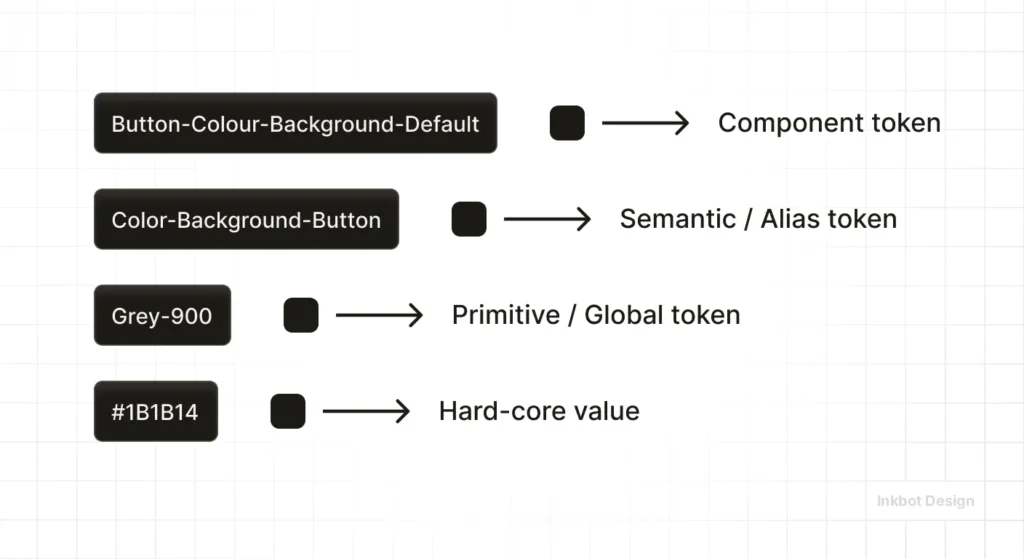
Most scale-ups mistake design system implementation for a software tooling upgrade. They purchase Figma enterprise licenses, install token plugins, and declare the project complete. Within two quarters, internal adoption stalls.
Zeroheight’s 2026 Design Systems Report highlights that executive buy-in for standard design systems is declining across enterprise firms precisely because systems focus on asset management rather than operational governance.
Furthermore, less than half of enterprise design systems include accessibility standards or UX copy guidelines, leaving major compliance and communication gaps unaddressed.
Standard design systems manage visual assets. Semantic design systems govern operational meaning. If your system cannot enforce WCAG compliance, brand voice, and cross-platform token inheritance automatically, it is a UI kit masquerading as infrastructure.
The disconnect stems from four systemic implementation errors:
- Naming Tokens by Appearance Instead of Purpose: Naming a token
color-light-blueforces code refactoring the moment brand guidelines change. Naming the tokencolor-surface-informationalpreserves code integrity regardless of aesthetic evolution. - Ignoring Verbal and Copy Semantics: Microcopy, error states, and call-to-action phrasing carry brand positioning. Isolating UI components from UX copy guidelines leads to inconsistent client communication.
- Failing to Automate Token Pipeline: Storing tokens manually in Figma variables without automated build tools (such as Style Dictionary) and exporting directly to GitHub repositories guarantees design-to-code drift.
- Treating Accessibility as an Afterthought: A semantic system binds accessibility ratios directly to token mappings. The token
color-text-on-action-primarymust programmatically enforce WCAG AAA contrast compliance against its background container token.
Rebranding a 120-Person Professional Services Practice
To understand how a semantic design system operates in practice, consider an ongoing project for a mid-market financial advisory firm operating across the UK.
Audited 14 digital surfaces across 3 practice groups. Identified 42 non-compliant color variations in production.
Created 112 semantic tokens. Bound WCAG AAA contrast ratios directly to contextual alias tokens.
Automated CI/CD build pipelines. Design-to-code parity reached 98% across all live web platforms.
The Challenge
The firm was launching a wealth management arm alongside its institutional audit services. Their goal was to introduce a refined brand identity across three web properties: a client portal and a custom portal used for document sign-offs. Their existing digital ecosystem relied on static brand guidelines published as a 60-page PDF four years prior.
The Execution Pipeline
- Audit & Token Map Creation: We audited 14 digital touchpoints and identified 42 distinct, unapproved colour variations across production environments. We consolidated these into 18 primitive base tokens and 112 semantic alias tokens.
- Contextual Binding: We defined surface, feedback, and typography tokens. The key primary action colour was assigned to
color-brand-primary. For the wealth management portal, this token inherited a deep navy blue (#0A192F); for institutional audit, it inherited a dark slate (#1E293B). - Automated Continuous Delivery: Using Style Dictionary, we automated token exports directly from Figma into CSS variables, iOS Swift packages, and React component libraries.
The Commercial Outcome
When the firm acquired a regional boutique wealth management practice eight months later, integrating the new division’s digital client portal required three weeks of frontend configuration instead of a complete four-month rebuild. Design-to-code parity reached 98% across all production environments, and total maintenance overhead dropped significantly.
Meaning Governance Over UI Standardisation
The prevailing view in design system management holds that success equals component volume—more buttons, complex input fields, and exhaustive component states. This approach is fundamentally flawed.
Building hundreds of UI components without a unified semantic layer merely accelerates the rate at which teams publish unaligned user interfaces.
Nielsen Norman Group’s 2026 Maturity Framework reframes design system maturity across six independent dimensions rather than a simple component-count ladder:
Nielsen Norman Group Maturity Dimensions (2026)
Enterprise scale-ups must move beyond treating design systems as digital UI kits. The path forward requires adopting meaning governance:
- Steelman Position: Advocates of component-first systems argue that providing engineers with pre-built UI components guarantees visual consistency faster than abstract token layers.
- The Strategic Breakdown: Pre-built components work effectively within a single monolithic codebase. However, when an enterprise operates multiple web frameworks, mobile applications, legacy portals, and third-party SaaS integrations, component code cannot be shared across them. Semantic tokens can.
- Replacement Directive: Replace visual component libraries with a central semantic token framework. Treat code variables as the single source of truth for brand positioning, accessibility, and visual authority.
Current State & Industry Benchmarks
Field data confirms that design system practice is undergoing a major structural shift. Standard design tokens have become commoditised, and leading development teams are actively extending semantic architecture into AI-native interaction models and cross-channel content surfaces.
Enterprise Semantic Layer Trajectory (2026 Survey)
Key performance metrics for modern enterprise systems include:
- High Adoption of Semantic Tokens: 85% of design systems now integrate semantic tokens to decouple visual values from software architecture.
- Significant Investment Expansion: 59% of surveyed enterprises are actively expanding or initiating investments in semantic layer technology over the next 24 months.
- Operational Adoption Friction: Stalling system adoption and declining C-suite buy-in highlight the failure of classic, non-semantic UI kits to demonstrate tangible commercial return.
Structural Comparison: Traditional UI Kits vs. Semantic Systems
| Dimension | Traditional UI Kit / Design System | Semantic Design System |
| Core Architecture | Visual component libraries and static colour hex codes | Context-aware alias tokens mapped to strategic intent |
| Primary Objective | Visual standardisation across design files | Meaning governance across cross-departmental codebases |
| Change Management | Manual code refactoring across individual repositories | Automated token pipeline deployment via CI/CD build tools |
| Multi-Brand Scaling | Requires duplicating design kits for each subsidiary | Parent-child token inheritance across regional practice groups |
| Accessibility Enforcement | Manual QA testing during post-development reviews | Programmatic WCAG contrast enforcement at the token mapping layer |
| Cross-Channel Parity | Low (38% report poor code-to-design parity) | High (Automated synchronisation across design and code) |
| Executive Value | Asset storage (frequently viewed as cost-centre overhead) | Brand equity protection and accelerated M&A integration |
The Verdict
A professional services rebrand cannot survive on visual style guides alone. As your practice scales across regional offices, digital products, and client touchpoints, static guidelines crumble under operational friction.
A semantic design system transforms brand strategy into an automated, self-governing technology layer. By mapping primitive design values to contextual semantic tokens, you protect visual authority, enforce accessibility standards, and accelerate product development without expanding management overhead.
The Strategic Next Step
Before investing in additional digital assets or launching a strategic repositioning, evaluate the technical health of your existing brand touchpoints.
Request a structured diagnostic through our Brand Equity Audit™, where we analyse your digital footprint to identify exactly where your firm is losing commercial ground and how to fix it.
FAQs
What is a semantic design system?
A semantic design system is an architectural layer that maps visual and functional UI elements to underlying strategic meaning using contextual tokens. It decouples raw design values from product code, allowing teams to govern brand consistency, accessibility, and user interaction automatically across software platforms.
How does a semantic token differ from a primitive token?
A primitive token stores a raw design value, such as a specific colour hex code (#0055FF). A semantic token stores contextual intent, such as color-surface-interactive. Semantic tokens reference primitive tokens, ensuring that when brand styles evolve, design code updates automatically across all applications without breaking UI functionality.
Why do traditional design systems fail as companies scale?
Traditional design systems fail because they focus on storing visual assets rather than on meaning governance. As organisations add practice groups, software tools, and product surfaces, manual design updates become unmanageable. Without a semantic token layer, design-to-code parity breaks down across engineering environments.
Is a semantic design system necessary for a mid-market professional services firm?
Yes — mid-market professional services firms operating across multiple practice groups, regional offices, and client portals face a high risk of brand fragmentation. A semantic design system protects brand equity by automatically enforcing unified visual and functional standards across every client touchpoint.
Can a semantic design system automate WCAG accessibility compliance?
Yes — by binding accessibility contrast ratios directly to semantic token alias mappings (such as enforcing specific background-to-text contrast rules), system architects guarantee that every component inheriting those tokens meets WCAG AAA standards programmatically before deployment.
How do semantic design systems support M&A brand integration?
During M&A activities, integrating an acquired entity’s digital surfaces typically requires rebuilding software frontends. A semantic design system allows engineers to re-skin acquired web platforms and portals rapidly by remapping their root semantic tokens to the parent brand’s token architecture.
Does implementing semantic tokens require replacing our existing technology stack?
No — semantic design tokens are tech-agnostic variables. Build tools like Style Dictionary compile semantic tokens into native CSS variables, React themes, Swift packages, or Android XML files, allowing seamless integration with legacy codebases and modern software stacks alike.
What percentage of enterprise design teams currently use semantic tokens?
According to Zeroheight’s 2026 industry research, 85% of design system teams now utilise semantic tokens in production environments, making semantic token architecture a standard requirement for enterprise-grade digital products.
How does a semantic design system integrate UX copy and voice guidelines?
A semantic design system incorporates UX copy tokens and microcopy rules alongside visual components. By defining standardised text variables for system alerts, form labels, and call-to-action triggers, the system ensures that verbal brand tone matches visual brand identity.
What is the first step in building a semantic design system for a rebrand?
The first step is conducting an inventory and diagnostic audit of all client-facing digital touchpoints. This process identifies legacy design debt, maps visual inconsistency, and establishes the primitive-to-semantic token architecture required to support firm growth.
