
Law Firm Brand Architecture: How to Stop Partners Competing With Your Firm’s Equity
A prospect sits across from three partners of your firm and, over the course of one pitch, hears three different accounts of what the firm actually is.
The corporate partner sells reach. The litigator sells tenacity. The private-client partner sells discretion. Each is impressive. Together, they cancel out — the prospect leaves with an impression of competence and no idea what the firm stands for, so the decision defaults to price.
That is not a messaging failure. It is a brand architecture failure, and it is costing you the premium your capability should command.
Law firm brand architecture is the operating model that governs when your firm leads the client relationship, when a practice group leads, and when an individual partner leads — without any of the three competing for the same client’s trust.
Most guides treat it as a design question: which practice group gets a logo, a sub-brand, a separate brochure? That framing is why so many firms end up with a tidy visual system sitting atop a chaotic commercial one.
The design is downstream. The operating model comes first. Getting a coherent structure right is the core work of any serious law firm branding agency, and it starts long before anyone opens a design file.
The stakes are not abstract. According to the Thomson Reuters Institute and Georgetown Law “2026 Report on the State of the US Legal Market,” profits per lawyer at the largest firms have risen 53.7% since 2019, and the report characterises the industry as undergoing a “tectonic shift” in technology, talent and client demand.
Record prosperity does not fix this. It makes it worse — the more valuable a partner becomes, the harder their personal equity pulls against the firm’s.
- Brand architecture is an operating model that decides whether the firm, practice or partner leads a client relationship; design is downstream.
- Write and ratify explicit governance rules before any visual work; test by reviewing recent pitch documents to confirm who leads.
- Map firm, practice and partner assets honestly; ask clients, not partners, and craft distinct practice-group propositions.
- Adopt an endorsement model such as masterbrand-led for mid-size firms; govern partner equity to avoid competing micro-brands and fee leakage.
How Law Firm Brand Architecture Works

Law firm brand architecture is achieved in five stages: set the governance rules first, map your existing brand assets, define the practice-group propositions, decide the endorsement model, and then design the visual system last. The sequence is the value. Most firms run it backwards — designing first and governing never.
- The masterbrand, the practice-group proposition, and the individual partner are three distinct brand tiers, and architecture decides which one leads in any given client situation.
- The rules matter more than the logos: a firm can share a single visual identity and still have incoherent architecture if nobody knows when the firm speaks and when the partner does.
- Architecture is an operating model, not a design output — it governs behaviour, pricing, and pitch language, not just letterheads.
Law firm brand architecture is the operating model that sets rules for when the firm, a practice group, or an individual partner leads the client relationship.
The Honest Entry Conditions
Most guides skip the prerequisites because they are uncomfortable with them. You cannot structure a brand architecture until you can answer, honestly, who actually owns the client relationships in your firm.
If your top five rainmakers were to take their clients with them tomorrow, you would not have a firm brand — you would have five personal franchises operating out of a serviced office.
That is not a moral failing; it is a diagnostic fact, and it changes everything about the architecture you can realistically build.
A firm with genuinely institutional client relationships can afford a strong masterbrand that leads most situations. A firm whose value lies in a handful of partners must build an architecture that deliberately harnesses partner equity rather than pretending to ignore it.
You also need partner buy-in before design, not after. Architecture reallocates who gets to lead a pitch.
That is a political decision dressed as a marketing one, and presenting a finished visual system to partners who were never consulted on the governance is the fastest way to see the whole project quietly ignored.
Stage One: Set the Governance Rules

Decide the rules before you touch a single visual asset. Governance is the set of explicit answers to one question: in a given client situation, who leads — the firm, the practice, or the partner?
A working rule set is specific.
It says the masterbrand leads on first contact, panel pitches, and any cross-practice mandate, because that is where institutional credibility reduces the buyer’s perceived risk.
It says the practice-group proposition leads when a client is buying a specialism they can name — a competition investigation, a contentious probate matter — because at that point the specialism is the product.
It says the individual partner leads where a personal relationship or a documented track record is the actual reason the client is buying.
You know this stage is done right with a concrete test: pull three live pitch documents from the last quarter and check whose promise sits at the top of each. If the same firm can’t decide — one led with the partner’s CV, one led with the firm’s history, one led with the practice’s win record — the rules aren’t set, whatever the brand book says.
The failure mode is a rule set so vague that it resolves nothing. “We lead with the firm but celebrate our people” is not a rule. It is a wish.
“Brand architecture is not the diagram of your sub-brands. It is the set of rules that decides, in every real client moment, whose reputation carries the weight. A firm that cannot answer that question in a live pitch does not have an architecture problem it can design its way out of.”
Stage Two: Map the Brand Assets You Already Have
Inventory the existing equity before deciding what to build. Most firms discover they have more valuable practice-group and partner equity than they have firm equity, and that changes the architecture.
Map three tiers honestly.
- At the firm level: what does the market reliably associate with your name, if anything beyond the city and the headcount?
- At the practice level, which specialisms have a reputation that precedes a specific partner?
- At the partner level, which individuals carry a market reputation that clients would follow out the door?
This is not flattering work. A £20m regional firm often finds that its firm-level brand is a near-blank — recognised, but standing for nothing in particular — while two or three practice groups carry real, specific reputation.
The failure mode here is measuring what you wish were true. Ask clients, not partners, what they associate with each tier. The gap between the two answers is your actual architecture problem.
Stage Three: Define the Practice-Group Propositions
Write a distinct, defensible proposition for each practice group before deciding how it connects to the firm. The practice-group tier is the one most firms skip entirely, collapsing straight from firm to partner — and it is the tier that does the most commercial work.
A practice-group proposition answers the question of why a client buys this specialism from this firm rather than from anyone else. It is narrower than the firm promise and broader than any one partner.
When corporate legal departments are consolidating spend, the Association of Corporate Counsel’s 2026 Law Department Management Benchmarking Report found total legal spend fell to 0.43% of company revenue, a six-year low.
The firms that win are the ones whose practice propositions make it obvious who does what, without the client having to decode an org chart.
You know a proposition is working when a partner in that group can say it in a sentence and a partner in a different group would recognise it as accurate. The failure mode is a marketing proposition that fee-earners do not believe and will not say.
Stage Four: Decide the Endorsement Model
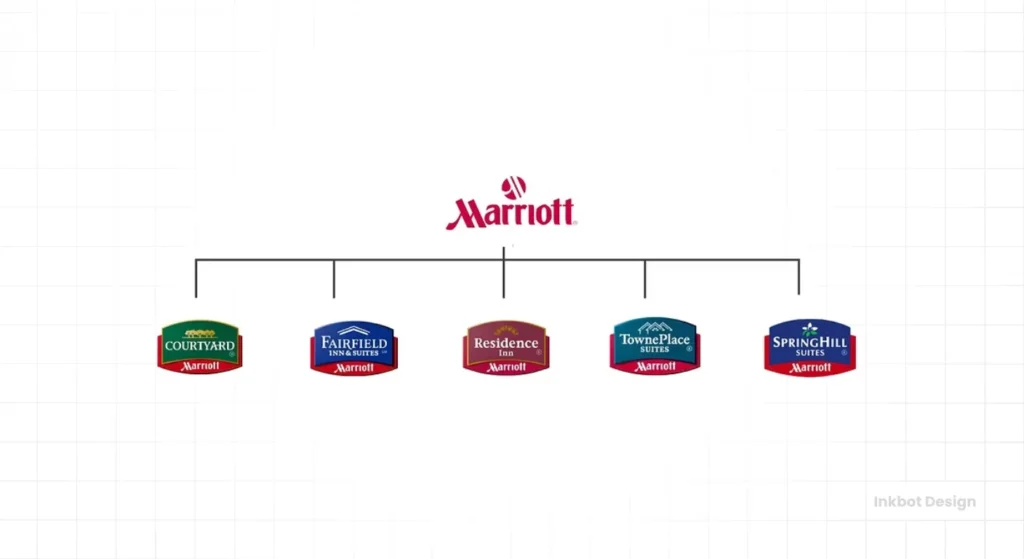
Choose how the three tiers visibly relate — masterbrand-led, endorsed, or a controlled house of brands. This is the decision competitors make for the whole of brand architecture, but it is only the point at which the governance you have already set becomes visible.
For almost every UK firm in the 10–50 partner range, the answer is a masterbrand-led or endorsed model — one firm identity, with practice groups and partners endorsed by it rather than standing apart from it.
A true house of brands, where sub-brands operate with separate identities, rarely serves a firm this size; it fragments a limited marketing budget and confuses a market that is already struggling to tell mid-market firms apart.
The endorsement model works because it allows a partner’s authority to be recognised without detaching it from the firm that guarantees it.
The failure mode is drifting into an accidental house of brands — where each practice group and rainmaker has, over the years, built its own look, its own language, its own client list, and nobody decided this on purpose.
Where the Judgement Comes In
The stages are a sequence, but the hard calls within them are judgments, not procedures. In 17 years of brand work, the pattern I see most often is a firm that has followed every step mechanically and still produced an architecture that does not hold, because the real decisions were judgment calls dressed as process steps.
The judgment is this: how much individual partner equity to make visible. Suppress it entirely, and you flatten your best people into generic corporate language, losing the exact authority clients are buying. Let it run unchecked, and you build an architecture where every rainmaker is a micro-brand that walks when they walk.
The skill is calibrating tier by tier — which partners get elevated, in which practice, under what firm guarantee. No framework decides that for you.
A Worked Example
Take a live pattern I see repeatedly in UK commercial firms of this size: a 14-partner firm where the corporate group carries real market reputation, one litigation partner is a genuine rainmaker, and the firm name signals only longevity.
Run the stages against it.
- Governance: the firm leads panel pitches and cross-practice mandates; the corporate proposition leads when the client is buying deal capability; the litigation rainmaker leads only in contentious mandates where their track record is the reason for the call.
- Asset map: thin firm equity, strong corporate-practice equity, one very strong partner.
- Endorsement: masterbrand-led, with both the corporate proposition and the named partner tied visibly to the firm.
The outcome is an architecture in which the rainmaker’s authority enables them to sell work without becoming a liability on the day they retire.
The Step Everyone Runs in the Wrong Order
Here is the sequence error that ruins the result: firms design the visual system first and never set the governance rules.
The whole exercise gets handed to a design studio, which delivers a handsome identity, a practice-group colour system, maybe a sub-brand or two — and none of it is anchored to any rule about who leads the client relationship, because that rule was never written.
The prevailing view — that brand architecture is the visual system — is held by intelligent people for a reasonable reason: the visual output is the only part that is tangible and reviewable, so it is where attention goes.
But the evidence from lateral movement shows why designing first fails. A 2026 summary of Boston Consulting Group and NALP data reports roughly 3,009 lateral partner hires in 2025, a five-year high, with lateral partner hiring at smaller firms up nearly 89%.
Every one of those moves imports a partner with an existing personal franchise. A firm with governance rules absorbs that partner into a defined tier.
A firm with only a visual system absorbs a competing micro-brand — and no colour palette fixes that.
The two objections a Managing Partner will raise here are fair.
- First: “Our partners will never accept the firm leading — their names are the business.” That is precisely why governance comes before design; the rules make partner authority visible and rewarded within the firm’s guarantee, rather than suppressing it.
- Second: “This sounds like a big-firm problem.” It is the opposite. Magic-circle firms have institutional equity to fall back on. A 30-partner firm whose value lies in six people is far more exposed when one of them leaves — which makes the architecture more urgent, not less.
The replacement directive is blunt: write the governance rules first, ratify them with the partners, and only then commission the design. Reverse that order, and you have bought decoration.
Where This Stands Now
The pressure on architecture is intensifying, not easing. The Thomson Reuters Institute and Georgetown Law “2026 Report on the State of the US Legal Market” describes a “tectonic shift” driven by technology, talent and client demand, with average law firm technology investment up 9.7% in 2025, much of it in generative AI.
That shift directly affects brand architecture through what the same body of research calls an AI trust gap.
A 2026 Thomson Reuters study on AI in professional services found that 41% of law firms say their teams already use generative AI, yet 68% of corporate clients do not know whether their outside firms use it at all.
That disconnect is a brand-architecture question before it is a technology one: does your AI-enabled capability sit in the firm-level promise, in a practice-group proposition, or in a few partner personal brands?
A firm without an architecture cannot answer, so the capability remains invisible to the client — a question of competitiveness that this specific firm has to resolve deliberately, which connects directly to the broader discipline of law firm branding.
The Verdict
Brand architecture is not the diagram of which practice group gets a logo.
It is the operating model that decides, in every real client moment, whose reputation carries the weight — the firm’s, the practice’s, or the partner’s — and it either makes your capability legible to a buyer or leaves it scattered across three competing accounts of who you are.
That is the difference between a firm that commands a premium and a firm that defaults to price.
The firms that get this right do not suppress their partners or flatten their specialists into corporate wallpaper.
They set explicit rules for when the masterbrand leads, when the practice proposition leads, and when a partner’s individual authority is the commercial asset — and they set those rules before anyone designs anything.
The lateral-hiring surge of 2025 makes the cost of getting it wrong concrete: every imported partner is either absorbed into a defined structure or left to operate as a micro-brand competing with the firm that pays them.
The single most important thing to do today is not a design brief. It is a sentence. Write down, for your firm, the rule that decides who leads a live pitch — firm, practice, or partner — and take it to your next partners’ meeting.
If you cannot write that sentence cleanly, that is your finding, and it is worth knowing before you spend a penny on identity work.
If you want to see exactly where your current brand is losing commercial ground — and what to do about it — request a free Brand Equity Audit™. It is a structured diagnostic that shows where your architecture is incurring fees and the specific changes that can recover them.
FAQs
What is law firm brand architecture?
Law firm brand architecture is the operating model that sets rules for when the firm, a practice group, or an individual partner leads the client relationship. It governs pitch, language, pricing, and positioning — not just visual identity — and determines whether a firm’s capabilities read as coherent or scattered.
How is brand architecture different from a logo or visual identity?
The visual identity is the output; brand architecture is the operating model beneath it. A firm can share one logo across every practice and still have broken architecture if nobody knows when the firm speaks versus when a partner does. Design is downstream of governance.
Should individual partners have their own brand?
Yes — but within the firm’s guarantee, not detached from it. Individual partner authority is a genuine commercial asset, especially where clients buy a specific track record. The risk is uncontrolled partner branding, which turns rainmakers into micro-brands that compete with the firm and leave when the firm does.
Why does our firm’s brand undersell our capability?
Usually, because three partners describe the firm in three different ways, no single proposition reaches the buyer. When capability is scattered across competing accounts, the client cannot price coherence and defaults to an hourly rate. Brand architecture consolidates those accounts into one legible structure.
When should the masterbrand lead instead of the partner?
The masterbrand should lead on first contact, panel pitches, and cross-practice mandates, where institutional credibility reduces the buyer’s perceived risk. The individual partner should lead only where a documented personal track record is the specific reason the client is buying.
What is the difference between a masterbrand and a house of brands?
A masterbrand-led model uses a single firm identity that endorses its practices and partners. A house of brands runs separate sub-brand identities operating semi-independently. For UK firms of 10–50 partners, a house of brands almost always fragments budget and confuses the market; an endorsed masterbrand fits better.
Is it true that individual lawyer branding always helps the firm?
No, only when it is governed. Uncontrolled individual branding builds personal franchises that compete with firm equity and walk out with the partner. When governed correctly, partner authority is elevated within the firm’s guarantee, thereby strengthening the firm rather than draining it.
How do lateral hires affect brand architecture?
Every lateral partner arrives with an existing personal franchise. A firm with governance rules absorbs them into a defined tier; a firm without rules absorbs a competing micro-brand. With roughly 3,009 lateral partner hires recorded in 2025, this absorption problem is now a routine architecture decision.
What is a practice-group proposition?
A practice-group proposition is the reason a client buys a specific specialism from this firm rather than from anyone offering it. It sits between the firm promise and the individual partner, and it is the tier most firms skip — collapsing straight from firm to partner and losing commercial clarity.
How does brand architecture affect the fees we can charge?
A legible structure reduces the buyer’s perceived risk, and risk is what buyers actually price. When a general counsel cannot tell who is accountable for a mandate — the firm, the practice, or the individual — they hedge against that uncertainty the only way procurement allows: by pushing on rate. A clear architecture removes the hedge. The buyer can see who owns the outcome, so the ambiguity discount disappears and the premium holds. That is the mechanism competitors assert but never explain.
What should a law firm do first when fixing its brand architecture?
Write the governance rule that determines who leads a live pitch — the firm, the practice, or a partner — and ratify it with the partners before any design work begins. Setting visual identity before governance produces decoration that collapses the first time a key partner departs.
Does a small firm really need brand architecture, or is this a big-firm problem?
Smaller firms need it more. Large firms hold institutional equity that survives departures; a 30-partner firm whose value lies in six people is far more exposed when one leaves. The fewer people your equity depends on, the more urgent the architecture.
