How to Conduct a Brand Audit That Tells You Whether Your Brand Can Still Win
Most brand audits inventory assets and miss the point. A brand audit exists to test whether your brand still wins fees, pitches and referrals. Six stages, run in strict order, starting with commercial signals rather than logos. The output is a business diagnosis, not a consistency report. Here is the method.
 By Stuart Crawford
 Reviewed by Tabitha Ayers
Updated 20 min read
On this page20 min left
- How a Brand Audit Is Actually Conducted
- Before You Start: The Entry Conditions Most Guides Skip
- Where the Process Needs Judgement, Not Steps
- What This Looks Like in Practice
- Where This Stands Now: The Rebrand Failure Data
- The Sequence Error That Ruins Most Brand Audits
- How to Conduct a Brand Audit (6-Steps)
- The Verdict
- Frequently asked questions
You are three weeks from signing off on a rebrand budget, and the honest reason you are reading this is that nobody in the building can tell you what is actually wrong.
The website looks dated. The partners each describe the firm differently. Fees are being questioned in ways they were not two years ago.
None of that is a diagnosis. It is symptom collection, and a brand audit that only collects more symptoms will hand you a hundred-page document confirming what you already suspected, while telling you nothing you can act on.
The cost of getting this wrong is documented. A 2026 analysis by PwC and Brand Finance covering 614 rebranding campaigns run between 2022 and 2025 found that 40% failed to deliver a positive return on investment.
The leading cause was not bad design. Insufficient pre-launch testing was present in 61% of failed campaigns, followed by misalignment with existing customer expectations.
Those firms did not have an aesthetics problem. They had a diagnosis problem, and the audit that preceded the spend never caught it because it was never designed to.
A brand audit exists to answer one question: Can this brand still win? Everything else — the asset inventory, the tone-of-voice review, the competitor grid — is evidence gathered in service of that question. When the question is missing, the evidence becomes an end in itself.
That is how a firm ends up with a beautiful new identity and a declining pipeline, which is a specific failure mode with a specific cause: the audit measured brand equity by looking at what the brand owned rather than what the market rewarded.
How a Brand Audit Is Actually Conducted
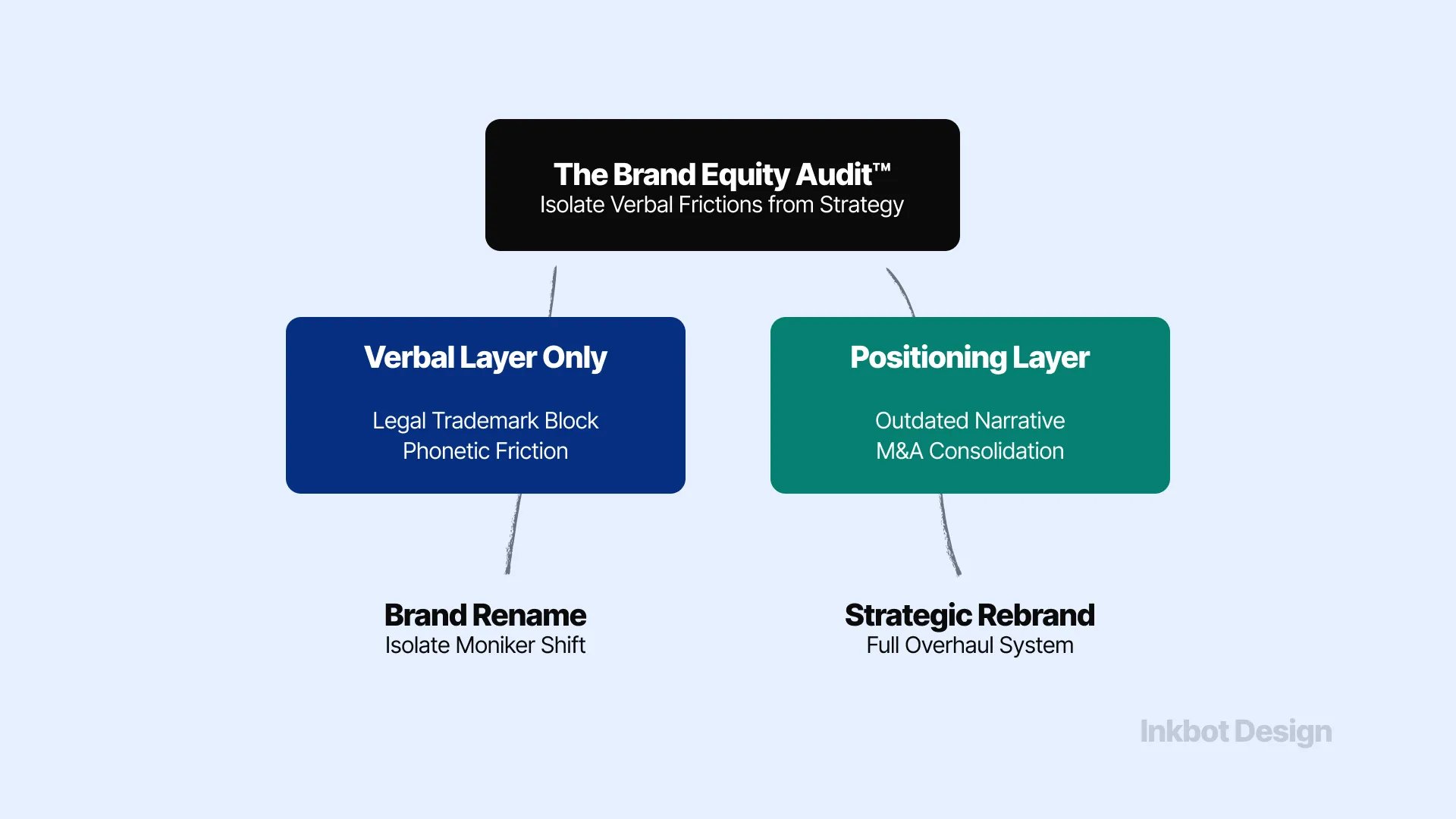
A brand audit is conducted in six stages, in strict order: define the commercial question, gather the evidence, read the three truth-bearing signals, test the positioning against the market, audit the assets against the position, then prioritise findings by revenue impact. The sequence is the method. Run it backwards, and you get a consistency report.
- Stage 1 defines what commercial decision the audit must inform, because an audit without a decision attached produces a document nobody opens.
- Stages 3 and 4 carry the diagnostic weight — fee resistance, referral language and pitch loss reasons reveal more than any asset review.
- Stage 5 audits assets last, because assets are downstream evidence of a position, not the position itself.
A brand audit is conducted in six stages: define the commercial question, gather evidence, read the three truth-bearing signals, test positioning, audit assets against position, and then prioritise by revenue impact.
This method sits within Inkbot Design's broader work on brand audits for professional services firms, and rolls up to the wider discipline of building brand equity as a commercial asset.
Before You Start: The Entry Conditions Most Guides Skip

Three conditions must be true before a brand audit produces anything usable. Miss any one and the audit becomes an expensive opinion.
Condition one: You have access to commercial data, not just marketing data.
The audit needs win/loss records, fee realisation by service line, and referral source data going back at least eight quarters. Google Analytics and a follower count will not do it. In a 90-partner accountancy firm, the single most revealing document is usually the pitch log, and it usually sits with a business development manager who has never been asked for it.
Condition two: a named decision-maker who can act on the finding.
If the audit's likely conclusion is “your positioning is too broad, and three service lines should go”, the person commissioning it must have the authority to make that call. Audits commissioned by marketing directors in partnership structures routinely die at the partner meeting because the findings require a decision that the commissioner cannot make.
Condition three: a realistic time window.
Industry-standard timelines put data collection at two to four weeks and reporting at a further four to eight weeks. That is six to twelve weeks before you have a defensible answer. Firms that compress this to a fortnight are not conducting an audit. They are conducting a review, which is a different and less significant matter.
“An audit commissioned without a decision attached to it is not a diagnostic. It is a document. The firms that get value from brand audits decide, before the work begins, what findings would change their behaviour and who holds the authority to act on it. The ones that do not will read a competent report, agree with it, and change nothing.”
Stage 1: Define the Commercial Question
Write down the single business decision this audit must inform, in one sentence, before any evidence is gathered. “We need to know if our brand is working” is not a question. We need to know whether our positioning supports a 15% fee increase across our corporate finance line before we take it to the partnership in October” is a question, and it determines every subsequent stage.
The question does the filtering. A firm auditing before an acquisition needs to know whether the acquirer's market will recognise the name, an entirely different evidence set from a firm auditing because it lost four pitches to a smaller competitor. Both are legitimate brand audits. They share almost no methodology beyond stage one.
How to know it is done right: the question names a decision, a date, and a decision-maker.
The failure mode here: a question phrased so broadly that any finding satisfies it. If your audit question cannot be answered “no”, it is not a question.
Stage 2: Gather the Evidence Set
Collect five things, and resist the urge to collect more. Win/loss records for the last eight quarters with stated reasons. Fee realisation data by service line. Referral source data. Every asset a prospect encounters before a first meeting. Verbatim language from three client conversations conducted by someone the client will be honest with.
That last item is where most internal audits fail. When a Managing Partner asks a client how the firm is perceived, the client is polite. The useful version is conducted by a third party, unattributed, asking one question: what did you tell the colleague you referred us to? The answer is the brand. Everything on the website is the brand's claim about itself.
How to know it is done right: you can point to a source document for every input.
The failure mode here: substituting a survey for conversations. A 2026 Nielsen analysis of 29 major rebrand failures across FMCG, retail and technology between 2023 and 2025 found the average post-rebrand sales decline was 22.7% in the first quarter, with a typical 14-month recovery and $4.2m in corrective marketing spend. Surveys do not catch the objection that produces that. Conversations do.
Stage 3: Read the Three Truth-Bearing Signals

Three commercial signals tell you more about your brand than every asset you own, because each one is a market verdict rather than a self-report.
Signal One: Fee Resistance
Fee resistance measures whether your position reduces perceived buyer risk enough to justify your price. Track the point in the sales conversation where price is questioned. If it arrives before the scope is agreed, the buyer has not distinguished you from a cheaper alternative, and the brand has failed to do its commercial job. If it arrives after the scope, you are being negotiated with — a different and healthier problem.
The mechanism matters here. A professional services buyer is not purchasing a deliverable. They are purchasing the reduction of a risk they cannot fully assess, which is why a clearer position commands a premium: it lets the buyer substitute your specificity for their own judgement. A firm that says “we do commercial law” gives the buyer nothing to substitute. A firm that says “we handle contested shareholder exits in owner-managed businesses” has done the buyer's risk assessment for them and can charge for it.
Only 25% of brands have a clearly defined and communicated position, according to HubSpot's marketing statistics compilation cited in the 2026 analysis. Which means roughly three in four firms are asking buyers to do work the brand should be doing.
Signal Two: Referral Language
Referral language reveals what your brand actually is, as distinct from what your brand guidelines say it is. Ask three clients what they said when they recommended you. If the sentences differ substantially — “they're good value”, “they're the ones who did our earn-out”, “they're just responsive” — the firm has no position. It has a reputation, which is not the same asset and cannot be priced.
The diagnostic value is in the variance, not the content. Uniform referral language, even unflattering language, means the market has a clear read on you. Scattered referral language means the market has no read at all, and no amount of visual consistency will fix that. Inkbot Design has audited firms with immaculate brand guidelines and six mutually incompatible referral sentences from six clients.
Signal Three: Pitch Loss Reasons
Pitch loss reasons expose whether the brand is losing on price, on fit, or on being invisible at the shortlist stage. The three losses require entirely different responses, and firms routinely misdiagnose which one they are suffering. Losing on price after a shortlist means the position is not differentiated. Never reaching the shortlist means the brand is not legible to the market at all — a discovery problem, not a persuasion problem.
Pull the last twenty pitches. Categorise every loss into one of those three. The distribution is your diagnosis, and it will usually contradict the assumption the firm has been operating on for two years.
Stage 4: Test the Positioning Against What the Market Rewards
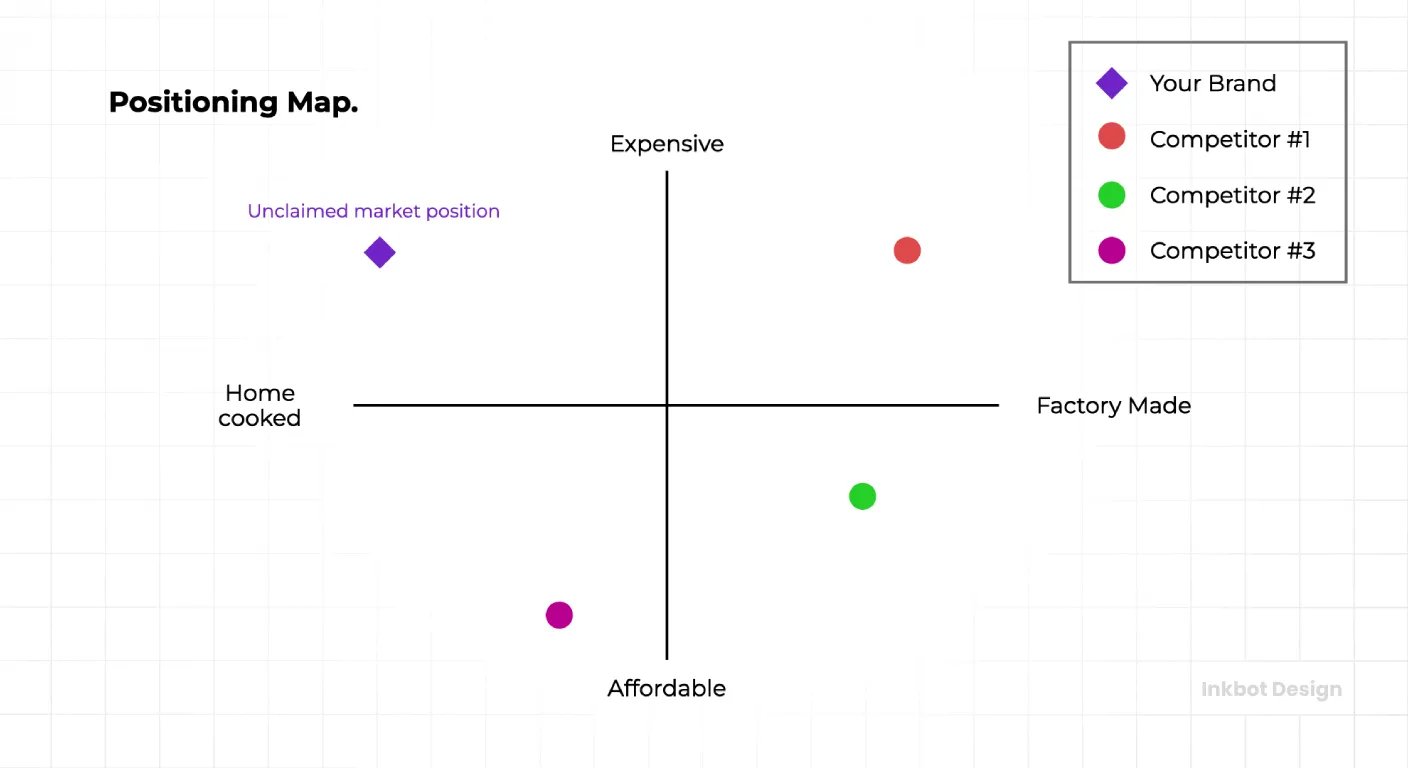
Positioning is tested by comparing what you claim against what buyers in your market actually pay a premium for. Both halves are required. Most audits do the first half, compare it to competitors, and call it positioning analysis. Comparing your claim to your competitors' claims only tells you whether you sound different from firms that may all be equally wrong.
Take your three closest competitors and, for each, identify what they charge a premium for and whether the market pays it. Then identify what you charge a premium for. Where those overlap completely, you have a commodity problem no rebrand will solve. Where your premium claim sits in a space nobody pays for, you have a relevance problem, which is more dangerous because it looks like differentiation.
How to know it is done right: you can name a specific service, a specific buyer type, and a specific reason that the buyer pays more for it from you.
The failure mode here: confusing a difference with an advantage. Being the only firm in your market that offers something is not a position if the reason you are the only one is that nobody wants it.
Stage 5: Audit the Assets — Against the Position, Not in Isolation
Assets are audited last and judged by one criterion: does this asset make the position more legible or less? Not “is it on-brand”. Not “is it consistent”. The consistency question is answerable only once you know what the brand is supposed to be consistent about.
Run through everything a prospect touches before a first meeting: the website's top ten entry pages, the pitch deck, partner LinkedIn profiles, the proposal template, and email signatures. For each, ask whether it communicates the position identified in Stage 4 or merely fails to contradict it. Most assets in most professional services firms merely fail to contradict. That is not a pass.
This is where the B2B brand audit checklist earns its place — as a completeness check applied after the diagnosis, not as the diagnosis itself. Used in the wrong order, a checklist guarantees you will inventory everything and conclude nothing.
How to know it is done right: every asset is marked “communicates the position”, “neutral”, or “contradicts”, with no fourth category.
The failure mode here: the audit becomes a design critique. The moment someone says the word “dated”, the room stops diagnosing.
Stage 6: Prioritise by Revenue Impact
Every finding is ranked by one measure: what it costs the firm in revenue per quarter, and what fixing it would return. Findings without a number attached do not make the report.
A firm with scattered referral language and an outdated website fixes the referral language first, every time, because one is costing pitch conversions and the other is costing nothing measurable. Monigle's research indicates the majority of rebrands hit a wall within 18 months of launch — largely an adoption problem, not a design one. Which means the highest-value finding in most audits is not an asset finding at all. It is a governance finding: no one owns the brand, so no one enforces the position.
How to know it is done right: the top three findings each carry an estimated quarterly revenue figure and a named owner.
The failure mode here: ranking by effort rather than impact, which produces a report where every quick win is at the top, and nothing consequential ever happens.
Where the Process Needs Judgement, Not Steps
Two points in this process cannot be run by rote, and both are where 17 years of doing this actually show.
The first is deciding whether scattered referral language indicates a positioning failure or a portfolio problem. In a 140-person firm with four genuinely distinct practice areas, six different referral sentences may be correct — the firm may need four positions, not one.
Reading that wrong and forcing a single position onto a legitimate portfolio destroys revenue in the practice areas that were working. The test is whether the sentences scatter within a practice area or across them. That distinction is a judgment call, made from pattern recognition, and no checklist encodes it.
The second is knowing when the audit's finding is a brand finding at all. Some firms with declining pipelines do not have a brand problem. They have a business development problem wearing a brand problem's clothes, and the honest audit says so.
Telling a Managing Partner that the £80k rebrand they were ready to authorise will not fix their issue is the least commercially convenient conclusion available. It is also roughly one in five times the correct one.
“Half the value of a brand audit is knowing when the answer is ‘your brand is not the problem. An agency that has never returned that finding is not running audits. It is running qualification calls with a report attached, and the report always concludes that you need what they sell.”
What This Looks Like in Practice
A UK professional services firm came to Inkbot Design having spent £50,000 on a comprehensive brand refresh. A new logo they liked. Modern colours. A hundred-page guidelines document that a designer would admire. Six months after launch, organic leads were down 40%.
The refresh had done exactly what it was commissioned to do. The brand was consistent. It was also commercially vague — no defined niche, no proprietary methodology, and a website that read as generic to both human buyers and to the AI systems increasingly mediating discovery. The audit had never asked whether the position could win because it had been an asset review. Everything it examined passed. The firm was losing anyway.
What we did: repositioned the firm around a narrow, high-value niche rather than the broad service claim it had been defending; rewrote the primary pages around specific client outcomes instead of capability lists; and fixed the technical authority signals that made the firm invisible to systems ranking expertise. Within months, the lead decline reversed, and pipeline quality — the metric that actually pays partners — improved.
The directive: before you authorise a penny of design spend, make somebody prove the position works. If they cannot, you are not buying a brand. You are buying a repaint, and a repaint on a firm that is losing commercial ground accelerates the decline by making the vagueness look deliberate.
Where This Stands Now: The Rebrand Failure Data
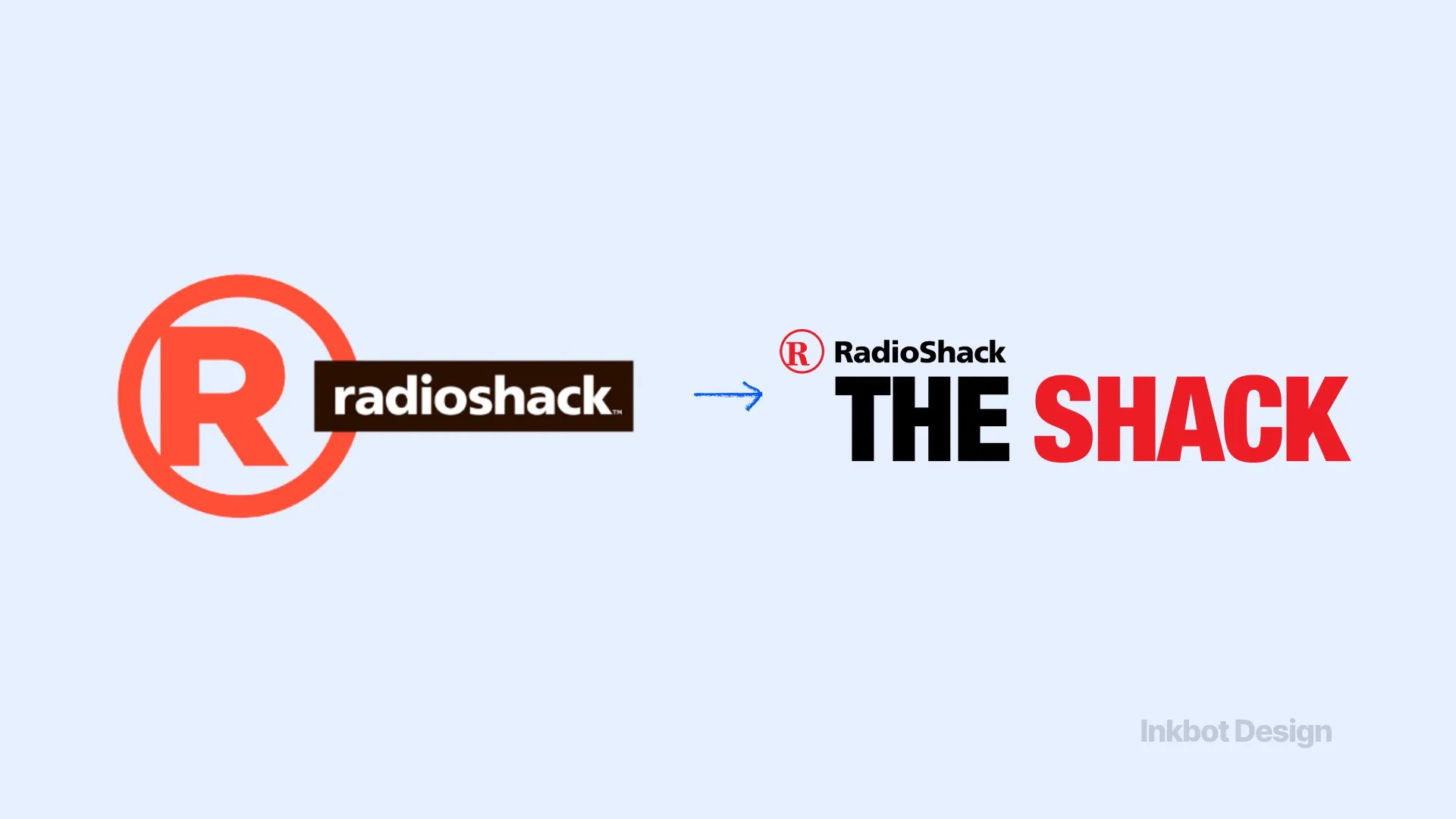
The evidence on rebrand outcomes has moved, and it has moved against the consistency-first audit.
The 2026 PwC and Brand Finance analysis of 614 campaigns run between 2022 and 2025 found 40% failed to deliver a positive return on investment.
The failure causes were ranked as follows: insufficient pre-launch consumer testing appeared in 61% of failed campaigns, followed by misalignment with existing customer expectations and underestimated rollout costs. Read that list again. Not one of those failures is a consistency failure.
Every one of them is a diagnosis failure — a brand changed before anyone confirmed the change would be rewarded.
The 2026 Nielsen analysis of 29 major rebrand failures across FMCG, retail and technology between 2023 and 2025 quantifies what that costs: a 22.7% average sales decline in the first quarter after a poorly received rebrand, a typical recovery time of 14 months, and $4.2m in corrective marketing to stabilise the brand.
Those are consumer-brand figures, and a 90-person law firm will not spend $4.2m correcting a misfire. The proportional damage is comparable, and the recovery period in a referral-driven professional services market is longer, because a professional services brand recovers at the speed of its clients' memory rather than the speed of its media budget.
Set that against HubSpot's finding, cited in the 2026 analysis, that only 25% of brands have a clearly defined and communicated position. Three-quarters of the market is undifferentiated. Which means the median firm walking into a rebrand has no position to be consistent about, and an audit that checks for consistency will return a clean bill of health to a firm that is dying.
Two objections a Managing Partner will raise here, both fair.
“Our clients tell us they love working with us — surely that means the brand is fine.”
Client satisfaction and brand strength are different assets. Satisfaction retains the clients you have. Brand acquires the ones you do not, and the firms with the highest satisfaction scores are frequently the ones with the weakest acquisition, because no one within the firm feels the problem until a renewal cycle exposes it. Your existing clients are the worst available witnesses to your brand's condition. They already bought.
“We are a partnership. We cannot narrow the position without a fight.”
Correct, and that is the finding, not an obstacle to it. In a partnership, the brand audit is partly a governance audit — if four partners each defend a different position, the firm has a decision-rights problem that a rebrand will paper over for eighteen months. Monigle's finding that most rebrands hit a wall within 18 months of launch describes exactly this: the launch is fine, the adoption fails, because the disagreement was never resolved, only redesigned.
The Sequence Error That Ruins Most Brand Audits
Intelligent practitioners start brand audits with the assets, and their reasoning is sound. Assets are visible, finite, and available on the first day. Every auditor can open the website. The commercial data requires access, negotiation, and someone's cooperation. Starting with assets means immediate action and yields a satisfying volume of findings within a week.
Harvard Business School's brand audit guidance begins with inventorying brand equity assets. Bynder's eight-step process begins with the mission statement. Canny Creative's B2B process begins with internal strategic documents. All three start inside the building.
The problem is that assets are downstream evidence. A logo, a tone of voice, a website — each one is a record of a decision about position that was made at some point, possibly by someone who has left. Auditing them first tells you what was decided. It cannot tell you whether the decision was right, because the evidence for that is not in the building. It is in the pitch log, the fee negotiation, and the sentence a client used when they referred you.
The PwC and Brand Finance data settle this. When 61% of failed rebrands failed on insufficient pre-launch testing, the failure occurred at the point where somebody should have checked whether the market would reward the new position and did not.
An asset-first audit structurally cannot catch that, because by the time you reach the market-testing step — step six of eight in Bynder's process, step four of six in Canny Creative's — you have already spent five weeks building a narrative about what the brand is, and the market data arrives as a challenge to a conclusion rather than as the input to one. The order changes the finding. It is not a preference.
“Assets do not tell you whether a brand works. They tell you what it was trying to do. The market tells you whether it succeeded, and the market's evidence lives in your fee negotiations and your pitch losses — not in your brand guidelines. Audit the verdict before you audit the argument.”
Run stages one to four before anyone opens the brand guidelines. Set the position question, gather commercial evidence, read fee resistance, referral language and pitch loss reasons, test the position against what the market pays for. Only then does the asset review mean anything, because only then do you know what the assets are supposed to be doing. Firms building their brand equity deliberately treat assets as the last stage of an audit and the first stage of a build.
How to Conduct a Brand Audit (6-Steps)
Stage | What You Are Testing | Done Right When | Failure Mode |
|---|---|---|---|
1. Commercial question | Whether the audit has a decision attached | The question names a decision, date and a decision-maker | A question that cannot be answered “no” |
2. Evidence set | Whether you have market data, not marketing data | Every input has a source document | Substituting a survey for client conversations |
3. Three signals | Fee resistance, referral language, pitch loss reasons | All three read from at least eight quarters of data | Reading one signal and generalising |
4. Position test | Whether the market pays for what you claim | You can name service, buyer and premium reason | Mistaking a difference for an advantage |
5. Asset audit | Whether assets make the position legible | Each asset marked communicates / neutral / contradicts | The audit turns into a design critique |
6. Prioritisation | What each finding costs per quarter | The top three findings carry a revenue figure and an owner | Ranking by effort rather than impact |
The Verdict
The firm that spent £50,000 on the refresh did nothing careless. They hired competent people, approved and considered work, and launched a brand that was consistent in every respect. Leads fell 40% anyway, because consistency was never the thing that was broken, and the audit that preceded the spend was never built to find out what was.
That is the whole argument. A brand audit that inventories assets produces a description of your brand. A brand audit that reads fee resistance, referral language and pitch loss reasons produces a verdict on whether your brand can still win — and those are not the same document, do not cost the same to produce, and do not lead to the same decision.
The PwC and Brand Finance finding that 40% of rebrands fail to recoup their costs, with 61% of those failures attributable to insufficient testing, is not a design statistic. It is a diagnostic statistic, and every firm inside it had assets that passed inspection.
Six stages. Strict order. Commercial question, evidence, the three signals, the position test, the asset review, and prioritisation by revenue. The order is the method, and it works because it forces the market to speak before the building does.
Do one thing today: pull your last twenty pitch outcomes and categorise every loss as lost-on-price, lost-on-fit, or never-shortlisted. That distribution takes an afternoon to produce and will tell you more about your brand's commercial condition than the last two years of marketing reporting. If it contradicts what you believed — and in most firms it does — you have found your audit question.
If you want the diagnosis to run properly, request a free Brand Equity Audit™ from Inkbot Design. It is a written diagnostic delivered within 48 hours that identifies exactly where your brand is losing commercial ground and what to do about it. No call required.
Frequently asked questions
What is a brand audit?
A brand audit is a structured diagnostic that tests whether a brand still wins commercially, using fee resistance, referral language and pitch loss data alongside an asset review. The output is a business diagnosis with revenue figures attached to each finding, not a consistency report.
How long does a brand audit take?
Data collection typically runs two to four weeks and reporting a further four to eight weeks, putting a defensible brand audit at six to twelve weeks end-to-end. Firms compressing this into a fortnight are conducting a review, which cannot access the commercial data the diagnosis requires.
Why do brand audits fail to prevent rebrand failure?
Most brand audits examine assets rather than commercial signals. The 2026 PwC and Brand Finance analysis of 614 campaigns found that 40% of rebrands failed to recoup their costs, with 61% of failures traced to insufficient pre-launch testing — a gap that an asset-focused audit cannot detect.
What is the difference between a brand audit and a brand review?
A brand audit tests commercial performance using win/loss records, fee realisation and referral data, and takes six to twelve weeks. A brand review examines assets for consistency and takes days. Both are legitimate; only one tells a Managing Partner whether the positioning still supports the fee.
Is it true that brand consistency is the main output of a brand audit?
No — consistency is only meaningful once the position is confirmed to be worth repeating. HubSpot's marketing statistics compilation, cited in the 2026 analysis, found that only 25% of brands have a clearly defined position, meaning most consistency findings apply to a position the market has never rewarded.
When should a professional services firm conduct a brand audit?
Conduct a brand audit before authorising rebrand spend, ahead of an acquisition, or when pitch losses shift from lost-on-price to never-shortlisted. The trigger is a commercial decision requiring evidence — not a calendar interval or a website that looks dated.
How do I conduct a brand audit internally?
Internal brand audits work for stages one, two and six — defining the commercial question, gathering evidence and prioritising findings. Stages three to five are harder internally, because clients will not give a Managing Partner honest referral language and partners cannot assess their own positioning objectively.
What data does a brand audit need?
A brand audit needs win/loss records with stated reasons across eight quarters, fee realisation data by service line, referral source data, every asset a prospect touches before a first meeting, and verbatim language from three third-party client conversations. Marketing analytics alone are insufficient.
Why do most rebrands fail after launch?
Monigle's research indicates the majority of rebrands hit a wall within 18 months of launch, which is an adoption failure rather than a design failure. In partnerships, the underlying cause is usually unresolved disagreement about positioning that the rebrand redesigned instead of settling.
What does a rebrand failure actually cost?
The 2026 Nielsen analysis of 29 major rebrand failures between 2023 and 2025 found an average 22.7% sales decline in the first quarter, a typical 14-month recovery, and $4.2m in corrective marketing spend. Professional services firms recover more slowly, at the speed of client memory.
Should the brand audit start with the logo?
No — assets are downstream evidence of a positioning decision and should be audited last, at stage five. Auditing assets first produces findings about what the firm decided, not whether the decision still works. The commercial evidence sits in pitch logs and fee negotiations.
Can a brand audit conclude that the brand is not the problem?
Yes — roughly one audit in five concludes that a declining pipeline is a business development failure rather than a brand failure. An agency whose audits always recommend the service it sells is running a qualification call with a report attached.