Competitor Messaging Framework: Stop Looking for White Space
A competitor messaging framework is not a copywriting exercise; it is market research. This guide shows professional services leaders how to stop looking for imaginary white space and start finding the claims your market no longer believes.



On this page7 min left
- What Does a Competitor Messaging Framework Actually Do?
- Spotting the Difference Between Conventions and Platitudes
- Evaluating Competitor Language: The Credibility Audit
- What If You Have No Obvious Difference?
- Who Needs to Be Involved in the Process?
- Measuring the Impact of New Messaging
- The Verdict
- Frequently asked questions
For professional services firms, differentiation is rarely about capability; it is about communication.
Thinksmart’s 2026 analysis found competitive differentiation was the lowest or equal-lowest metric in 92% of the 100 B2B brands reviewed.
This happens even when a firm possesses strong case studies and capable people. The root cause is almost always language.
When every consultancy claims to be a "trusted partner" delivering "innovative solutions", buyers stop listening to the words and start looking at the price.
Buyers use an average of seven information sources before making contact, which means your language operates in a fiercely competitive environment. You cannot out-market a generic proposition.
A competitor messaging framework fixes this, provided you use it correctly.
Most existing articles treat this analysis as a spreadsheet of taglines, value propositions, and tone guidelines. That is useful, but it stops at description.
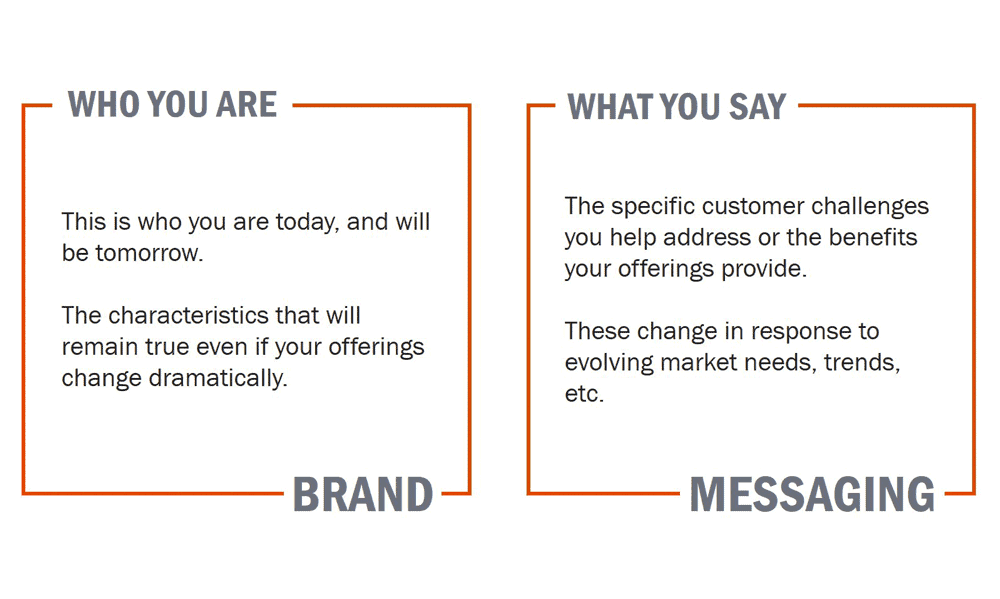
Competitor messaging is not a copywriting exercise; it is brand positioning research. Language reveals the market’s settled assumptions.
Differentiation begins where those assumptions have become generic, unverifiable, or exhausted.
What Does a Competitor Messaging Framework Actually Do?

A competitor messaging framework evaluates the exact language rival firms use to identify exhausted market claims and uncover specific, provable positioning gaps.
- It documents the precise promises rivals make across homepages, product pages, and sales collateral.
- It filters out category conventions that every firm defaults to.
- It exposes the claims that customers no longer believe because they lack substantiation.
Gartner’s view that a single vendor receives only 3–6% of a buyer’s total purchase-journey time makes concise, distinctive language a commercial necessity rather than a brand-team preference.
If your core message requires a ten-minute explanation, you have already lost the pitch.
Spotting the Difference Between Conventions and Platitudes
How do we distinguish between a category requirement and a generic platitude?
A category requirement is a non-negotiable fact a buyer needs to see before proceeding.
A generic platitude is an adjective trying to do the work of a fact. You must separate the two before conducting any serious competitive analysis.
"Regulated by the FCA" is a category requirement. You must say it. "Client-focused financial experts" is a platitude. It wastes space.
Many firms conflate the two. They build a competitive messaging matrix, look at the words their rivals use, and assume they must use them too.
"Trusted partner," "innovative solutions," "customer-first," "results-driven," and "tailored approach" are not differentiation gaps merely because competitors use them.
They are the linguistic furniture of a market.
Do not look for what competitors are not saying. Look for what everyone is saying so similarly that it has stopped meaning anything.
Evaluating Competitor Language: The Credibility Audit

How do we evaluate what our competitors are saying?
You evaluate competitor language by testing it for provability.
If a competitor's claim cannot be proven before a purchase is made, it holds no strategic weight and can be outflanked by a firm willing to provide evidence.
A standard framework categorises messaging. A credibility audit breaks it down.
When you review a rival's sales collateral, press releases, and homepage headlines, you are looking for the exact moment their language turns vague.
If a competitor claims "industry-leading response times", that is an assertion. If they claim "we return all technical audits within 48 hours", that is a provable standard.
“Competitor messaging is not a copywriting exercise; it is market research. The strongest opportunity is not to find an empty gap, but to identify the claim the category makes that customers no longer believe.”
You must subject your own language to the same test. TrustRadius found that 94% of AI-using buyers fact-check AI responses at least sometimes.
Buyers verify rather than accept. If your position cannot survive a five-minute due diligence check, it is not a position.
What If You Have No Obvious Difference?
How do professional services firms differentiate when the service itself is largely similar?
Professional services firms differentiate by making the invisible visible.
When the service is identical, you must create a choice criterion that is more important to the right buyer than the lowest cost, or buyers will reduce the decision to a price comparison.
This reframes the entire exercise from "find white space" to "find credibility space."
A position is only defensible when the market can understand it, the brand can substantiate it, and competitors cannot credibly copy it.
When you discover that your firm lacks an obvious difference from the competition, you have three strategic choices regarding your current claims:
- Retire the claim: Drop it entirely because it no longer differentiates. Everyone expects a law firm to be "professional". Stop wasting prime website real estate saying it.
- Make it specific: Adjust the claim so it becomes provable in a way rivals cannot match. Move from "experienced consultants" to "led exclusively by former Big Four partners".
- Replace it with: Introduce a more precise belief about how the buyer should make their choice. Dictate the buying criteria.
This requires understanding exactly who you are speaking to.
A tight target audience archetype ensures you are not trying to sound different to everyone, but credible to someone specific.

Who Needs to Be Involved in the Process?
Who should own the competitor messaging analysis?
Involve the people who create promises, deliver them, and hear buyer objections.
This typically includes leadership, sales, marketing, and client delivery specialists.
Delegating this entirely to a junior marketer guarantees failure. A marketer can collect the data, but judging the validity of a competitor's claim requires someone who has actually lost a pitch to them.
Furthermore, the framework must bridge departments. Research shows 69% report website-versus-sales inconsistencies.
When marketing promises a "strategic partnership", and sales pitches a "discounted block of hours", the buyer instantly detects the friction.
Sales must validate the language, because sales must defend it in the room.
Measuring the Impact of New Messaging
How do we know whether the new messaging is working?
Track changes in message association, qualified enquiry quality, sales conversations, win rate, deal size, and repeat purchase metrics. Do not rely simply on website traffic.
If your new messaging works, you will likely see a temporary drop in unqualified leads. This is a success metric. Clear, highly specific language repels the wrong buyer just as efficiently as it attracts the right one.
The ultimate commercial payoff of clarity is distinctiveness. Kantar’s data demonstrates a nine-times volume-share advantage for brands possessing Meaningful Difference and Salience.
If your sales team reports that prospects are quoting your own positioning statements back to you on discovery calls, the framework has succeeded.
The Verdict
A competitor messaging framework fails when it is treated as a creative exercise.
The words your competitors use are data points revealing what the market assumes to be true.
If you build your positioning around the same exhausted platitudes, you volunteer to compete on price. Your job is not to invent a clever new tagline.
Your job is to audit the category, discard the claims nobody believes, and substantiate a position your rivals cannot match.
Stop looking at your competitors to see what you should say. Look at them to see what you must stop saying.
The first action to take today is to strip the adjectives from your homepage. Read the nouns and the verbs that remain. If they do not accurately describe a specific, valuable business outcome, your positioning is invisible.
If your firm is preparing for a strategic rebrand and requires an objective evaluation of its current market language, request a free Brand Equity Audit™ at https://inkbotdesign.com/services/brand-audits/.
This structured diagnostic identifies exactly where your brand is losing commercial ground and details what to do about it.
Frequently asked questions
What is the difference between a competitor messaging framework and competitive intelligence?
A competitor messaging framework focuses strictly on the public and private language rivals use to position themselves in the market. Competitive intelligence is broader, covering pricing structures, operational capabilities, financial health, and strategic market moves.
How often should a business update its competitor messaging framework?
Update the framework quarterly. Competitor language shifts rapidly, especially before major product launches or industry events. Annual reviews are too slow, leaving your sales team relying on outdated battlecards against evolving competitor claims.
Why do most competitor messaging analyses fail?
Most fail because they stop at data collection. Teams gather competitor taglines into a spreadsheet but lack the critical judgement to determine which claims are actually believed by the market and which are just generic category conventions.
Can AI completely automate competitor messaging analysis?
No. AI can efficiently gather and categorise public data from competitor websites and press releases, but it cannot evaluate the credibility of those claims in a live sales environment. Expert human judgement is required to interpret the data.
What is the most important part of a messaging hierarchy?
The positioning statement is the most critical element. Proof points and key messages support the narrative, but the positioning statement defines the precise, defensible differentiator that sets the firm apart from every other provider in the category.