Brand Positioning Research: The 4-Stage Method for Evidence
A professional services firm can spend 12 weeks and a five-figure budget on positioning research and end up with a document that describes its clients back to it in slightly better prose. Nothing in it can be defended in a pitch.
Nothing in it tells the managing partner what the firm should now refuse to be.
That is the most common outcome of positioning work, and it is not a failure of effort. It is a failure of what the research was asked to do.
Most brand positioning research is not, in fact, positioning research. It is audience description, competitor comparison, or messaging preference testing, all under the same job title.
Useful inputs, all three. But a firm preparing to rebrand ahead of a growth phase or an acquisition does not need a richer description of the world it already operates in.
It needs a decision: a commercially valuable space it can credibly own, prove to a sceptical buyer, and hold as competitors move. That is a different piece of work, and it is what proper brand positioning research is built to produce.
The distinction matters commercially.
Nearly three in four B2B decision-makers told LinkedIn, in research conducted with Edelman, that thought leadership is a more trustworthy way to judge a company’s capabilities than its marketing materials or product sheets.
Read that as a positioning instruction rather than a content one: buyers no longer take a claim at face value. A position you assert but cannot prove now works against you.
Research has to find the position and the evidence that makes it credible — or it has done half a job.
- Define the decision before collecting data: pre-specify candidate positions, target segment, and evidence thresholds to force a commercial choice.
- Research must find a provable, defensible market space, not merely describe audiences or test preferred messages that competitors can copy.
- Validate the proof with the wider buying group and AI sources so evidence, not wording, persuades sceptical buyers and machines.
What Brand Positioning Research Actually Is
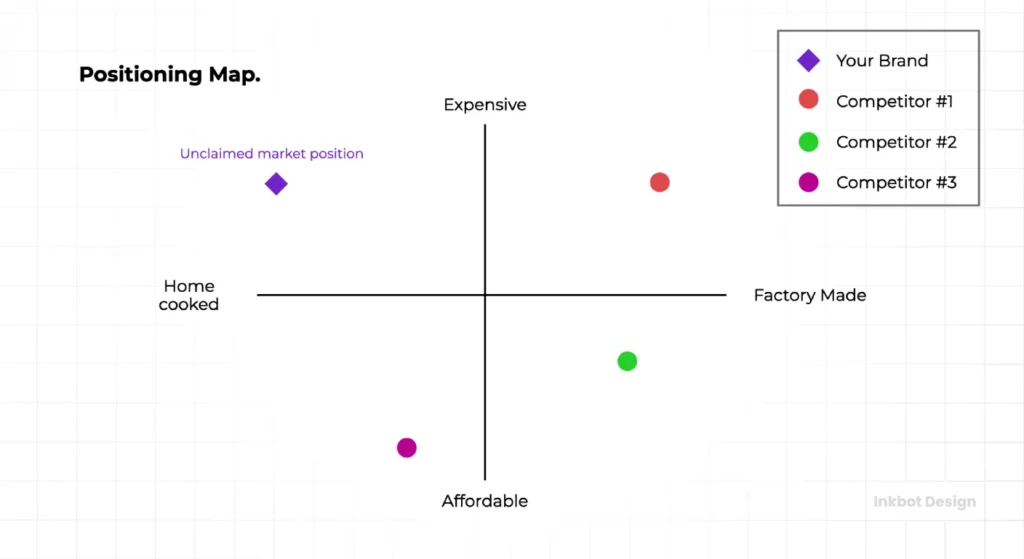
Brand positioning research is the structured process of identifying a commercially valuable market space a brand can credibly own, prove with evidence, and maintain over time.
It is not a survey of what customers think, and it is not a competitor audit — though it uses both. Its output is a decision about what the brand should mean to a valuable audience, and the proof that stands behind that meaning.
- It establishes a position the brand can credibly own — not merely one it would like to claim.
- It surfaces the proof a sceptical buyer needs before believing the claim — because in professional services, the evidence, not the wording, moves the decision.
- It is a decision system, not a collection of inputs — the value is in the choice it forces, not the data it gathers.
Brand positioning research is the structured process of identifying a commercially valuable market space a brand can credibly own, prove with evidence, and maintain over time.
The Four Stages of Brand Positioning Research
Positioning research runs in four stages: define the decision, map the real perception, test for defensible space, and validate the proof. The sequence is the value.
Run them out of order — and most firms do — and you get description instead of a decision.
Stage One: Define the Decision Before You Collect Anything
The first stage is not research. It is deciding what question the research must answer, and most positioning studies skip it.
A study that begins “what do our clients think of us?” will return an answer to exactly that question — interesting, unactionable, and impossible to lose a pitch over.
A study that begins “which of three defensible positions should we commit to, and what would have to be true for each to hold?” returns a decision.
Define the candidate positions before fieldwork, not after. Name the audience segment that actually holds commercial value — for a 120-person accountancy firm that is rarely “SMEs” and often something as narrow as “owner-managed businesses approaching a sale in the next three years.”
Write down what evidence would make you abandon each candidate’s position. You now have a research design that can produce a decision rather than a report.
The failure mode here is starting with methods. A firm that opens by commissioning focus groups has already ceded the decision to whatever the groups say.
Stage Two: Map the Perception That Actually Exists
The second stage establishes the gap between how the firm sees itself and how the market describes it — in the market’s own words, not the firm’s.
This is the stage the competitor content gets right in principle and thin in practice: internal perception rarely matches market reality, and the useful signal is the specific language buyers reach for unprompted.
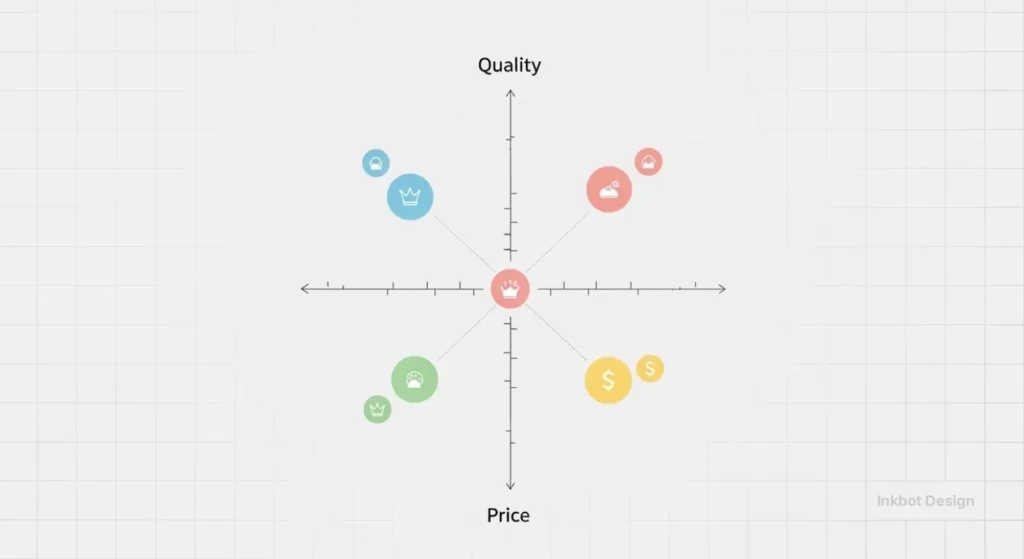
Perceptual mapping belongs here — plotting the firm against named competitors on the attributes buyers actually use, not the attributes the firm wishes they used. Do it with qualitative depth first (what do buyers mean by “responsive”?), then quantify.
The output is not a chart. It is a list of attributes currently unowned by any competitor in the set — the only raw material from which a defensible position can be built.
Stage Three: Test for Space You Can Defend, Not Just Occupy
An appealing position that three competitors could claim by next quarter is worth little as a position, whatever its merits as a message.
Testing has to ask two questions of each candidate: does the audience value it, and can this firm prove it in a way rivals cannot?
Quantitative preference methods earn their place here. MaxDiff and conjoint analysis force trade-offs, which is what separates a position buyers say they want from one they will actually choose a firm for.
But preference testing alone repeats the field’s central mistake — it tells you what buyers prefer, not what you can own. Cross every preferred attribute against a single question: what would we have to show a sceptical buyer to make this claim believable?
An attribute that scores highly and can only be substantiated by your firm is a position. An attribute that scores highly and that anyone can claim is a slogan.
Stage Four: Validate the Proof, Not Just the Message
The fourth stage validates that the evidence behind the position actually shifts a buyer, because the claim and the proof are two different things, and only one of them is testable on a prospect.
Message validation, as the field practises it, tests whether a value proposition resonates. That is necessary and insufficient. What moves a professional-services buyer is not the claim but the credibility behind it.
The evidence for this is direct. LinkedIn reports that 95% of hidden buying-group stakeholders — the people who never take the sales call but shape the decision — say strong thought leadership makes them more open to outreach.
The proof reaches people, the pitch never will. Validate that your evidence, not just your wording, survives contact with the wider buying group, because that group decides more of the outcome than the person who signs.
How AI Systems Now Describe Your Brand — And Why It’s a Positioning Input
AI systems now describe your brand to buyers before you get the chance to, and whether their description is accurate has become a positioning question.
Kantar reports that 74% of people who regularly use AI assistants actively seek AI-driven recommendations — so a meaningful share of your buyers are forming a view of your firm from a synthesis you never wrote and cannot see.
Adobe’s 2026 analysis describes brand discovery shifting from ranked search results toward AI-generated answers assembled from multiple sources.
The same analysis reports that generative-AI referral traffic in the United States grew more than tenfold between July 2024 and February 2025, and that AI-referred visitors viewed 12% more pages per visit with a 23% lower bounce rate than non-AI referrals.
Those are engaged, high-intent visitors arriving via a description of your firm that a machine composed.
The positioning implication is concrete. Traditional research asks what customers think of the brand. It now has to ask: how do AI systems and third-party sources currently describe this firm, and is that description accurate?
Adobe frames AI representation as a matter of brand governance rather than an SEO channel, recommending that brands prioritise extractability, verifiability and contextual clarity so external systems interpret them correctly.
For a firm mid-rebrand, that means a positioning strategy now has to confirm the organisation has enough consistent, structured, authoritative evidence in the world for a machine to describe it correctly — because if the machine gets it wrong, buyers inherit the error.
This is where positioning research meets the mechanics of brand development strategy at scale: the position has to be legible to systems, not only to people.
Where Positioning Research Goes Wrong
Most positioning research fails not in execution but in sequence — the firm collects data before it has defined the decision the data is meant to serve.
Run in the wrong order, every stage still happens, and the result is a well-produced description that decides nothing. Two errors do most of the damage.
The first is treating research as an input pile rather than a decision system.
A firm commissions interviews, a competitor audit, and a survey, receives three deliverables, and is left to synthesise a position from them, which means the most consequential act, the actual decision, happens in a room with no method at all.
The research industrialised the easy part and left the hard part to a hunch. Define the decision first, in Stage One, and every subsequent input is a test of a candidate rather than a fact in search of a use.
The second is confusing a position with a preference. Preference testing tells you which message buyers like. It cannot tell you which position you can defend, because likability and ownability are unrelated.
A 40-partner consultancy can discover that buyers love the idea of “senior people on every engagement,” commit to it, and find two competitors saying the identical thing within the year — because the attribute was preferred but not ownable.
The correction is to gate every preferred attribute through the proof question before committing to it.
“A position you can assert but not prove is not an asset. It is a liability that a sceptical buyer, or an AI summary, will eventually expose. Positioning research earns its cost only when it hands you a space you can defend on the evidence, not a claim you happen to like the sound of.”
What the Method Can’t Tell You
The four stages produce evidence. They do not make the decision — a person does that — and this is where the method reaches its limit and experience takes over.
Positioning research narrows the field to a small number of defensible candidates. Choosing between them is a commercial judgement about where the firm wants to be in five years, which risks it will accept, and what it is willing to stop doing. No dataset settles that.
The method gets you to a defensible shortlist. Everything commercially interesting happens after that, which is the part that 17 years of brand work across professional services firms in 21 countries teaches you, and no study can.
The judgement in this section is drawn from that work, not from the method alone — the method gets you to a defensible shortlist, and everything commercially interesting happens after that.
The Verdict
Positioning research is not there to describe your audience or catalogue your competitors.
It is there to hand you a commercially valuable space you can credibly own, prove to a sceptical buyer, and defend as the market shifts — and if a study does not end in a decision of that kind, it has collected inputs, not done research.
The sequencing is what separates the two: define the decision first, then let each stage test a candidate against the standard of can we prove this, not do people like this.
If you are preparing to rebrand ahead of a growth phase or an acquisition, the first action is to write down, before any fieldwork, the candidate positions your firm might commit to and the evidence that would justify each.
If you cannot yet name them, that is the finding — and it is the one worth acting on today.
A free Brand Equity Audit™ will identify exactly where your brand is losing commercial ground and what to do about it before you spend a penny on research that decides nothing.
FAQs
What is brand positioning research?
Brand positioning research is the structured process of identifying a commercially valuable market space a brand can credibly own, prove with evidence, and defend over time. It differs from audience or competitor research because its output is a decision about what the brand should mean, not a description of the market.
How is brand positioning research different from market research?
Market research describes what exists — who buyers are, what competitors do, what people prefer. Brand positioning research uses those inputs to make a single decision: which defensible space the brand should commit to owning. The distinction is between gathering information and forcing a choice that the evidence can support.
How long does brand positioning research take?
Typically four to six weeks, extending to eight or nine when qualitative fieldwork is included, according to research providers such as Relevant Insights. The larger variable is not the method but whether the decision was defined before fieldwork began — undefined studies run longer and decide less.
What methods are used in brand positioning research?
Common methods include in-depth interviews and focus groups for qualitative depth, perceptual mapping to plot a brand against competitors, and quantitative trade-off techniques such as MaxDiff and conjoint analysis to test which attributes buyers will actually choose. The method matters less than whether it tests a defined candidate position.
Is brand positioning research worth it for a firm under 200 people?
Yes — particularly before a rebrand, growth phase or acquisition, when the cost of committing to an unprovable position is highest. A firm this size usually cannot out-spend larger rivals on awareness, so a defensible, well-evidenced position is one of the few durable advantages available to it.
How do AI systems affect brand positioning research now?
AI assistants increasingly describe brands to buyers before the brand speaks for itself, and Kantar reports 74% of AI-assistant users seek AI-driven recommendations. Positioning research now has to assess whether AI systems accurately describe the firm and whether sufficient structured, authoritative evidence exists to support that description.
