Building Brand Equity in B2B: How to Become the Easy Choice on Every Shortlist
Brand equity in B2B service firms is not an awareness layer sitting above sales. It is the asset that decides pricing power, shortlist inclusion and referral quality when your service cannot be sampled before purchase. Five stages build it, in strict order. Most firms run stage four first, and stall.
 By Stuart Crawford
 Reviewed by Tabitha Ayers
Updated 16 min read
On this page16 min left
Three partners walked into a pitch and described the firm three different ways. Nobody in the room noticed except the buyer, who scored them fourth of four and told the winning firm why.
That is what brand equity looks like when it is absent: not a dated logo, but a prospect doing arithmetic on your behalf and getting the wrong answer.
Fixing it is a five-stage process, and the most common reason firms fail at it themselves is that they start at stage four.
New website, refreshed identity, LinkedIn programme – visibility bought before there was anything coherent to be visible about. The result is a firm that is now more efficiently misunderstood.
The stakes are measurable. One widely cited B2B brand-equity analysis reported that only 14 per cent of B2B marketing decision makers treat brand equity as a key KPI. That is not evidence that the metric doesn't matter. It's evidence that 86 per cent of firms are competing on price without knowing they chose to.
Meanwhile, a 2024 systematic literature review of industrial brand equity found a considerable surge in its importance across B2B markets over the past decade – the academic field caught up before the market did.
If you want the wider commercial argument for why this asset behaves differently in professional services, start with the underlying economics of brand equity.
How Brand Equity Is Built in B2B Service Firms
Brand equity in B2B service firms is built in five stages, in strict sequence: positioning clarity, proof assembly, internal alignment, market prominence, and commercial measurement. Each stage is a prerequisite for the next. Running them out of order produces visibility without preference, which costs money rather than making it.
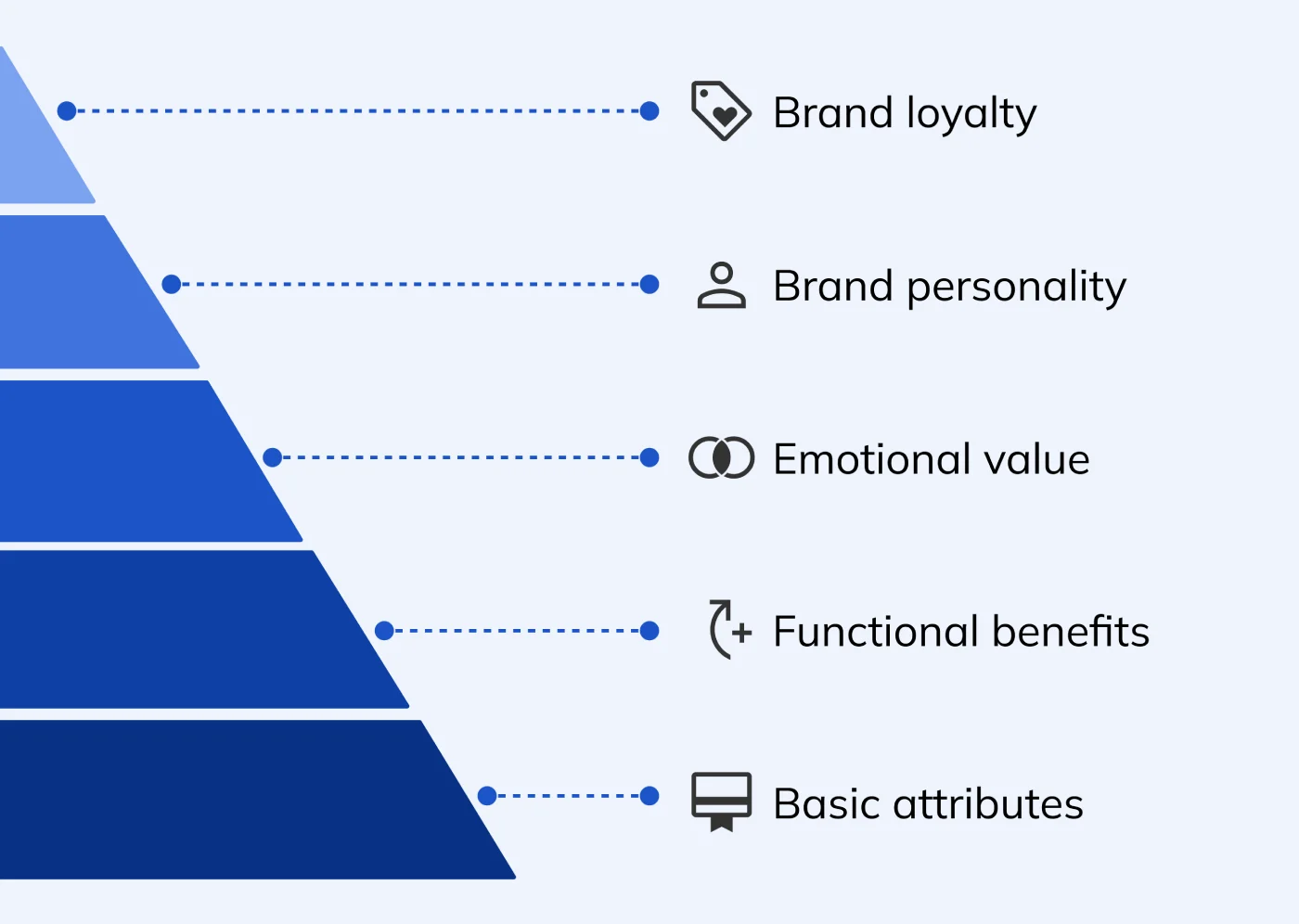
- Positioning clarity decides what you are the obvious answer to, and what you decline.
- Proof assembly converts claims into evidence that a buying committee can forward to a sceptic.
- Internal alignment makes the delivery team the brand asset, because in services, there is nothing else.
- Market prominence buys attention – only after there is something worth attending to.
- Commercial measurement ties the whole thing to fee levels, win rates and firm value.
Building brand equity in B2B service firms is achieved in five stages: positioning clarity, proof assembly, internal alignment, market prominence, and commercial measurement.
For a structured way to establish where your firm currently sits across these five stages, the brand audit process is designed to produce exactly that map.
What Has to Be True Before You Start
Three conditions. Most guides skip all three because they are unglamorous and they lose clients.
One: your partners must agree on who you decline. Not who you serve – anyone can agree on that, because agreeing costs nothing. Agreement on refusal is the only agreement that has been tested. If your equity partners cannot name a client type, they will turn away, positioning work will produce a document, not a position.
Two: You need eighteen months of pitch data. Won, lost, and the stated reason. Without it, stage five has no baseline, and you will be arguing about brand equity based on anecdotes, which partners rightly ignore.
Three: Someone other than the marketing manager must own it. In a 50–200-person firm, brand equity is determined in the delivery rooms by fee earners. A marketing manager cannot instruct a senior partner. If the owner is not on the board, the project is decorated with a budget line.
“Brand equity in a professional services firm is not built by the marketing function. It is built by fee earners who behave consistently under commercial pressure, and marketing merely reports on whether they did so. Any brand programme that does not have a partner's name attached to it will produce a website and no change in fee levels.”
Stage 1: Establish Positioning Clarity

Positioning clarity means a buyer can state, in one sentence and without your help, why your firm is the obvious choice for them. Test it by asking three clients. If you get three sentences, you do not have a position – you have a service list.
The 2019 mixed-methods study published in Marketing Intelligence & Planning identified five sources of B2B brand equity: prominence, solutions, accessibility, relationships, and network strength. Read that list again.
Four of the five are structural facts about how the firm operates. Only prominence relates to expression. This matters because it tells you where the work is: brand equity in B2B is largely built by what the firm is, not by how eloquently it describes itself.
How you know it's done right: the position survives a hostile paraphrase. If a competitor could describe their firm using your positioning statement without lying, it isn't one.
The failure mode at this stage: consensus positioning. Twelve partners each remove the sentence that excludes their favourite client type, and what emerges is a statement no one objects to and no one remembers. Consensus is how positioning dies – quietly, with everyone's approval.
Stage 2: Assemble Proof
Proof assembly converts assertions into artefacts that a champion inside the buyer's organisation can forward without adding commentary. This is the stage that separates B2B services from every product-based brand model.
Harvard Business School's brand equity framework – invest in marketing, educate consumers, develop customer behaviours, build firm-based equity, increase shareholder value – assumes consumers form associations through product usage.
Your buyer cannot use your service before buying it. There is no trial, no sample, no unboxing. Every association they form before the engagement is formed from proxies: case documentation, named results, who else has bought, and how you conducted yourself in the process.
That is why the intangibility of professional services inverts the standard model. Where a product brand builds equity through repeated experience, a service firm must build it through evidence of other people's experience, assembled and made portable.
How you know it's done right: a prospect's finance director, who has never met you, can read one document and understand why choosing you is defensible.
The failure mode: proof that flatters the firm rather than de-risking the buyer. Case studies written in the passive voice about “delivering a comprehensive solution” prove nothing. A named outcome with a number and a client willing to be phoned proves everything.
Stage 3: Align the Firm Internally
Internal alignment means the brand a client experiences in month seven of an engagement matches the brand they were sold in the pitch. In a service firm, this is not a communications problem. It is a staffing and behaviour problem.
A 2016 empirical study of Chinese B2B service firms found that brand orientation improves brand equity through internal branding, customer experience, word-of-mouth, and stronger brand associations.
Note the chain: brand orientation does not act directly on equity. It acts through internal branding and customer experience, which in turn generates word-of-mouth.
Separate research on B2B services confirms the same direction – customer experience positively affects all four core dimensions of brand equity: awareness, associations, perceived quality, and loyalty.
The mechanism matters. Word-of-mouth in professional services is not an output you harvest at the end. It is an input you manufacture by ensuring the third-year associate running the day-to-day work behaves like the partner who won it.
How you know it's done right: a client's referral describes your firm in language close to your positioning statement, without prompting.
The failure mode: the pitch-delivery gap. The firm wins on senior expertise and delivers with juniors. Equity does not merely fail to build – it goes negative, because a disappointed referrer is a more efficient communicator than a satisfied one.
Stage 4: Build Market Prominence
Prominence is the stage everyone starts with, and it belongs fourth. Prominence means the firm surfaces in the buyer's consideration set before a formal search begins – in the shortlist that exists in a general counsel's head at 7 am, not the one procurement writes at 2 pm.
Basis Global's B2B brand analysis notes that mid-sized buying committees typically comprise around seven people, and that buyers now consider substantially more brands than they did five years ago.
Both facts push the same way: your name has to arrive early, because by the time an RFP exists, the shortlist is a formality confirming a decision already half-made.
But prominence bought before stages one to three are complete does something worse than nothing. It scales an unclear proposition.
Seven committee members each form a slightly different impression, then meet, discover they disagree about what your firm actually does, and settle on the competitor everyone described identically.
How you know it's done right: you get invited to pitches you didn't know were happening.
The failure mode: reach without relevance. A thought leadership programme addressed to “business leaders” reaches everyone and moves no one.
Stage 5: Measure Commercial Effect, Not Awareness
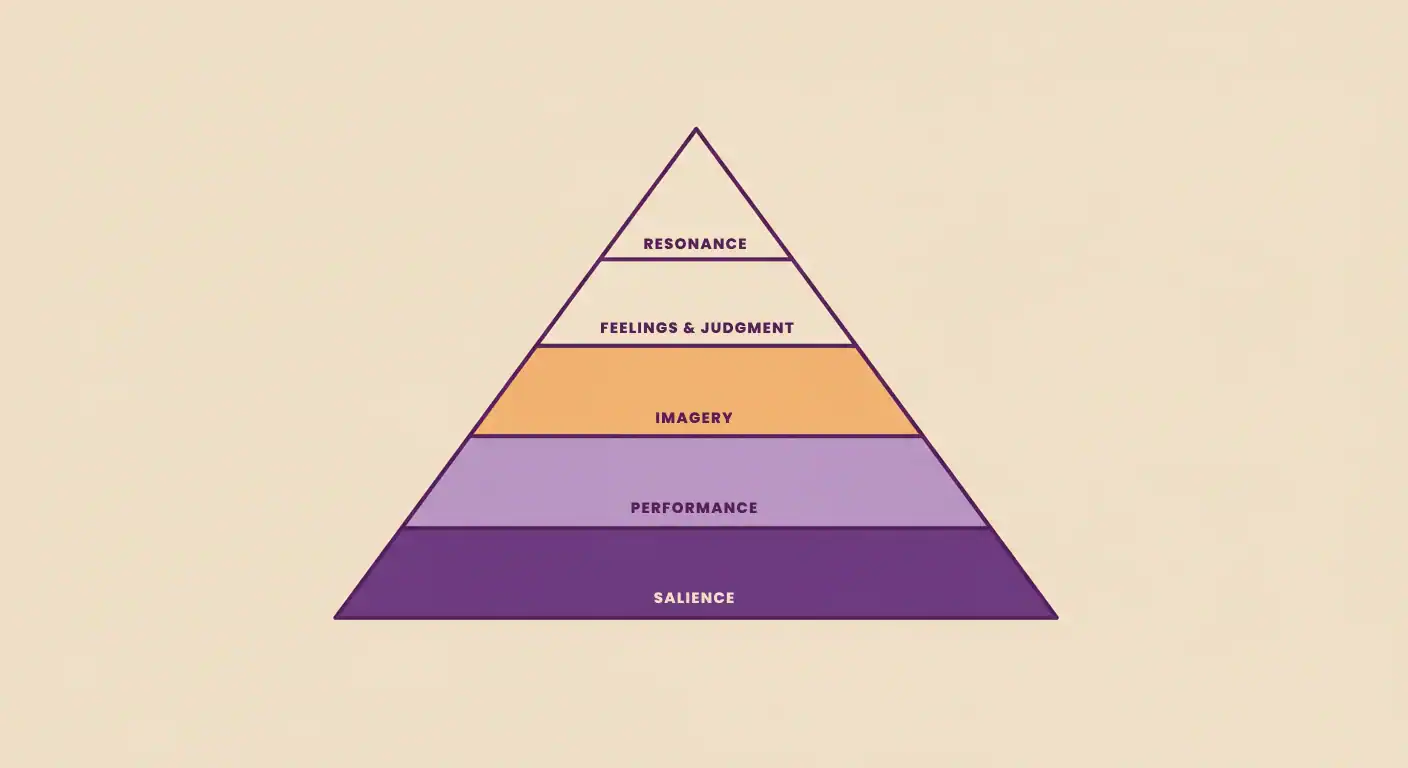
Measure brand equity through fee premium tolerance, shortlist inclusion rate, and referral quality. Awareness surveys measure whether people have heard of you, which is the least commercially useful thing you can know about a professional services firm.
There is a finance-linked proof point here that partners take seriously. A 2019 study of B2B service firms found that stronger brand management efficiency is associated with higher firm value, measured using Tobin's Q. Efficiency, not expenditure.
That distinction is the entire argument for doing stages one to three before stage four: the ratio of brand outcome to brand investment correlates with firm value, and spending on prominence before positioning is the fastest way to wreck that ratio.
Broader empirical research on brand equity shows effects on customer acquisition, retention, and profit margin, which is why brand equity is a commercial variable and not a communications one.
Additional work on B2B brand value finds that both functional and emotional components contribute, meaning service firms are not chosen on logic alone, even when every buyer in the room believes they are.
How you know it's done right: you can show a partner a number that moved.
The failure mode: measuring at month three. Positioning changes fee tolerance over quarters, not weeks. Pull the plug early, and you have paid for the cost with none of the return.
Stage | Checkpoint | If you can't pass, stop here |
|---|---|---|
1. Positioning clarity | Three clients describe the firm in the same way | Do not commission design |
2. Proof assembly | One document convinces a finance director you've never met | Do not commission a website |
3. Internal alignment | Referral language matches positioning, unprompted | Do not commission advertising |
4. Market prominence | Invited to pitches you didn't know about | Do not scale spend |
5. Commercial measurement | Fee premium tolerance measured against baseline | Do not declare success |
Where This Needs Judgement Rather Than Steps
Two objections come up in every boardroom, and both are reasonable.
“We already have a strong brand – our clients love us.”
Client love is retention equity. It is real, and it is not the same asset. Retention equity is held by the people who have already experienced your service. Acquisition equity is held by people who haven't. A firm can have exceptional NPS and still be invisible to the shortlist, because the mechanism that built the love – delivery – is unavailable to a buyer who hasn't bought. If you are preparing for a growth phase or an acquisition, it is the second asset you are short of.
“This is immeasurable, so it's unaccountable.”
Partly fair. You cannot attribute a single won pitch to positioning work. You can attribute a shift in the distribution of your pitch outcomes over eighteen months – win rate at unchanged fee, frequency of discount requests, proportion of pitches where you're the incumbent-favourite rather than the price check. That is accountable. It just isn't attributable, and confusing the two is why finance directors kill brand programmes that were working.
The judgment call sits at stage one, and it cannot be systematised: how narrow to go.
Too broad, and no one recalls you. Too narrow, and you have built a beautiful position in a market of nine firms. There is no formula.
There is only someone who has watched this go wrong enough times to feel where the edge is.
What Happened When a Client Treated Identity as Decoration
A professional services client came to us at the launch stage, wanting a brand identity that looked credible. That was the brief. “Looked.”
The mistake underneath it was one I see monthly: treating brand identity as a visual exercise rather than a positioning system. Design alone is a commodity – you can buy competent design in three days for a few hundred pounds.
What you cannot buy quickly is the decision about what the firm is for, which client it declines, and how those decisions show up in every artefact afterwards. We stopped the design work and went back to positioning and brand architecture first.
The outcome was not a metric I could put in a chart, but it was concrete: the client told us the resulting identity was compelling enough to motivate them to accelerate their launch.
A brand had stopped being a cost line waiting to be approved and started being the reason to move faster. That is what stage one buys you that stage four never will.
The directive: if your brand brief contains the word “looks”, rewrite the brief. We measure this work through lead quality, internal alignment, brand recall, and premium pricing tolerance – four things a logo cannot move on its own.
The Step Everyone Runs Too Late
The prevailing view is that B2B service firms build equity by becoming more expressive—through better storytelling, sharper messaging, and a more consistent tone.
Intelligent practitioners hold this for good reason: in consumer markets, it's largely true, and the evidence base for distinctive brand assets in FMCG is strong and well documented.
It transfers badly to professional services, and the Marketing Intelligence & Planning five-source model shows why. Prominence, solutions, accessibility, relationships, and network strength – expression touches one of those five.
The other four are structural: what you offer, how easy you are to reach and engage, who vouches for you, and who else you're connected to. A firm can be magnificently expressive about a proposition no one can act on.
B2B service firms do not build equity by being more interesting.
They build it by being easier to choose under uncertainty. Your buyer is not confused about brands. They are exposed to career risk on a purchase they cannot inspect before committing, made jointly with six colleagues who will remember if it goes wrong.
Reputation, proof and decision simplicity are risk-reduction instruments. Storytelling is not.
“Every B2B services buyer is running one calculation you never see: what happens to my standing if this goes wrong. Brand equity is simply the accumulated evidence that it won't. Firms that understand this stop writing about their values and start assembling the specific proof that makes a champion's internal argument for them, in a meeting they will never attend.”
That is the sequence correction. Expression is stage four's tool. Run it at stage one, and you have paid to broadcast an unresolved question.
The replacement directive is straightforward: before you approve any expressive work – website, identity, campaign – require the person requesting it to state which of the five sources of brand equity it strengthens. If the answer is only prominence, it is premature.
If you want to see how your firm's positioning holds up against this test before spending anything, the B2B brand audit checklist walks the same ground stage by stage.
The Verdict
The firm that wins the pitch is rarely the best in the room. It is the firm that made itself easiest to select without anyone having to take a risk, explaining why.
That is what building brand equity in B2B actually purchases: not admiration, but permission – a buying committee's permission to stop searching and choose you at your number.
Five stages, in sequence. Positioning clarity, so there is one sentence rather than twelve. Proof assembly, so your champion can argue for you in your absence. Internal alignment, so the firm delivered matches the firm sold.
Market prominence, so you arrive before the RFP does—commercial measurement so that partners can see the return in fee tolerance rather than impressions.
The evidence points one way. The Marketing Intelligence & Planning five-source model puts four of five sources outside expression.
The 2019 Tobin's Q finding rewards brand management efficiency, not brand spend.
The 2016 Chinese B2B services study routes brand orientation to equity through internal branding and customer experience, not messaging.
Every one of those findings says the same thing: the structural work comes first, and the expressive work is what you do once the structure can carry it.
Most firms will read this and commission a website anyway. Stage four is visible, quotable at partner meetings, and finishes in a quarter. Stage one is an argument about who you turn away, and it finishes when the partners stop flinching.
Start there today: get your partners in a room and ask each to write down, privately, the client type the firm should decline. Compare the answers. The distance between them is the size of your brand equity problem, measured in a single afternoon.
If you'd rather have that measured properly, request a free Brand Equity Audit™—a written diagnostic delivered in 48 hours that identifies exactly where your brand is losing commercial ground and what to do about it—no sales call.
Frequently asked questions
What is brand equity in B2B?
Brand equity in B2B is the commercial value a firm's reputation adds to its pricing power, shortlist inclusion and referral quality. Empirical research links it to customer acquisition, retention and profit margin, which makes it a commercial variable rather than a communications concept.
How long does building brand equity in B2B take?
Measurable movement takes 18 months to 2 years in professional services because fee tolerance shifts over pitch cycles rather than campaign cycles. Positioning clarity can be reached in eight weeks. Proof assembly takes a quarter. The prominence and measurement stages account for the remaining time.
Why do B2B service firms struggle with brand equity more than product companies?
Professional services cannot be sampled before purchase. Harvard Business School's brand equity model assumes associations form through product usage, which is unavailable to a buyer choosing a law firm. Service firms must instead build equity through portable evidence of other clients' experiences.
What's the difference between brand awareness and brand equity in B2B?
Awareness measures whether buyers have heard of a firm. Brand equity measures whether that recognition changes what they will pay and who they shortlist. A firm can be widely known and still lose on price, which is awareness without equity.
Is it true that only 14% of B2B marketers track brand equity?
One widely cited B2B brand equity analysis reported that 14 per cent of B2B marketing decision-makers treat brand equity as a key KPI. The figure indicates the metric is underused rather than unimportant, since separate research links brand strength to firm value and profit margin.
When should a professional services firm start brand equity work?
Start when partners can agree on which client type the firm declines, when 18 months of won-lost pitch data are available, and when a board-level owner is assigned. Without those three conditions, brand work produces documents rather than commercial change.
Does brand equity actually affect firm value in B2B?
Yes – a 2019 study of B2B service firms found that stronger brand management efficiency is associated with higher firm value, measured using Tobin's Q. The finding rewards the ratio of brand outcome to brand investment, not the size of the brand budget.
How is brand equity measured in a professional services firm?
Measure fee premium tolerance, shortlist inclusion rate, referral quality and internal alignment against an eighteen-month baseline of pitch outcomes. Awareness surveys are the weakest available proxy because recognition without preference produces no commercial effect in a considered, high-risk purchase.
What are the five sources of B2B brand equity?
A 2019 mixed-methods study in Marketing Intelligence & Planning identified five sources: prominence, solutions, accessibility, relationships, and network strength. Four of the five are structural properties of how a firm operates. Only prominence relates to expression, which is why messaging alone rarely moves equity.
Should we rebrand before or after fixing positioning?
Afterwards, visual identity commissioned before positioning clarity scales an unresolved proposition, producing recognition without preference. The sequence is positioning clarity, proof assembly, internal alignment, then expressive work – running it backwards is the most common and most expensive error.
Does word-of-mouth build brand equity, or does it result from it?
Both, but the causal direction matters. A 2016 empirical study of Chinese B2B service firms found brand orientation improves equity through internal branding, customer experience and word-of-mouth. Word-of-mouth functions as a mechanism, meaning it is manufactured through delivery consistency rather than harvested afterwards.
Can a small firm build brand equity against larger competitors?
Yes – narrowness beats budget in considered purchases. A 40-person firm that is the obvious answer to one specific problem reaches the buyer's internal shortlist before a formal search begins. In contrast, a larger generalist competes on price in a procurement process that it did not shape.