B2B Positioning Statement Examples: 12 Frameworks, 12 Different Trade-Offs
The best positioning statement you’ll read this year is not the most polished one. It’s the one that names what the firm refused to do.
Most guides to positioning statement examples hand you twelve versions of the same sentence and call it variety. They aren’t a variety. Each is built on a different framework, and each framework quietly encodes a different sacrifice — the market you’ll walk away from, the buyer you’ll ignore, the claim you’ll stop making so a sharper one lands.
Choosing the wrong framework for your situation doesn’t just produce a weak statement. It misallocates the one thing a mid-market firm can’t overspend: its brand positioning budget, the finite attention you get to shape how buyers file you in their heads.
The stakes are measurable. According to Forrester’s 2023 B2B Marketing Survey of 633 marketing leaders, only 41% of B2B organisations maintain a current, documented positioning framework that was reviewed in the last 12 months.
Fewer than half treat positioning as a living asset at all. Yet — and this is the number that should worry a Managing Partner — the Pragmatic Institute’s 2024 audit of 218 teams found that only 29% of buyer-facing sales conversations actually reflect the company’s documented messaging.
The document is not the win. Survival to the sales call is.
- Framework choice encodes a strategic trade-off; decide which variable, category, alternative, or proof, you will spend credibility on.
- Professional services usually weight Evidence-First: trust is the product and proof is the defensible, uncopyable claim.
- A positioning statement must name category, alternative, and trade-off or it becomes unrepeatable and invisible in sales conversations.
- Few firms document and survive: Forrester 41% document positioning; Pragmatic Institute 29% of that survives buyer conversations.
- Choose the framework you can defend, not the one that sounds sharp; the sales call and the 30-second test show if it survives.
What Is a Positioning Statement?
A positioning statement is a brand’s internal statement that shows how a specific framework defines the market it serves, the alternative it beats, and the claim it stakes. It is not a tagline. It is the strategic decision that every public message is later derived from.
- It names a category — what the firm is actually selling, in words a buyer would use.
- It names an alternative — what the buyer does today instead of hiring you.
- It names a trade-off — the market or claim the firm gives up to make one claim land harder.
A positioning statement example is worth studying only when you can see which of those three variables its framework chose to optimise, and which it sacrificed.
Why Framework Choice Decides Commercial Outcomes
Frameworks are not stylistic. Geoffrey Moore’s template, built for the technology adoption life cycle, optimises for category ownership.
April Dunford’s Obviously Awesome method optimises for the competitive alternative the buyer already uses. Proof-based models optimise for trust.
Point the same firm through three frameworks, and you get three genuinely different strategies — not three phrasings of one.
The commercial consequence is direct.
According to the Klue 2024 State of Competitive Intelligence Report, deals where competitive intelligence content — battlecards, objection handlers, competitor teardowns — is actively used by sales close at a 47% win rate, more than double the 21% baseline.
Positioning that names the real alternative feeds those materials. Positioning that names nothing feeds nothing.
A Belfast accountancy firm we advised had a statement so abstract that its own partners couldn’t build a single battlecard from it; the sales team was improvising against the Big Four with no script.
The Four Framework Families, and What Each One Sacrifices
Twelve examples sort cleanly into four families. Read each not as a better sentence but as a different answer to one question: what will you refuse to do to win?
Category-First Frameworks Sacrifice Breadth for Ownership
Category-first frameworks stake a claim on a category and let the edges go.
Salesforce positions itself as “the CRM for enterprises that need more than a database,” using Geoffrey Moore’s template — it owns enterprise CRM and concedes the SMB clarity that HubSpot and Pipedrive fight over.
Slack, using the Umbrex “For [target] who [need]…” template, is “the channel-based messaging platform for teams who need to stop drowning in email” — it creates a category and names email as the enemy, sacrificing feature-level differentiation for category ownership.

ZoomInfo positions itself as “the revenue intelligence platform for B2B companies that need more than LinkedIn Sales Navigator,” reframing sales prospecting as revenue intelligence and challenging the obvious alternative head-on.
The sacrifice in every case is the same: you give up the adjacent market to own one word in the buyer’s mind.
Evidence-First Frameworks Sacrifice Flexibility for Trust
Evidence-first frameworks lead with proof that a competitor cannot fake.
Deloitte positions itself as “the audit and advisory firm for Fortune 500 companies that need regulatory confidence backed by 175 years of precedent” — a proof-based model where the 175 years is structurally unmatchable, and the sacrifice is agility, because that positioning can’t pivot to startups.

Veeva is “the cloud CRM for life sciences companies that need FDA-compliant systems out of the box,” where regulatory compliance is binary, and the industry-specific certification is a structural advantage, not a feature — trading horizontal reach for vertical dominance.
Atlassian positions itself as “the collaboration platform for software teams who need more than email but less than enterprise IT overhead,” built on observable behaviour (dev teams rejecting heavy enterprise tools) rather than aspiration, and sacrificing C-suite appeal for grassroots adoption.
For professional services, this family matters most: trust is the product, and proof is the only defensible moat.
Alternative-First Frameworks Sacrifice Simplicity of Story for Realism
Alternative-first frameworks start with what buyers actually do today.
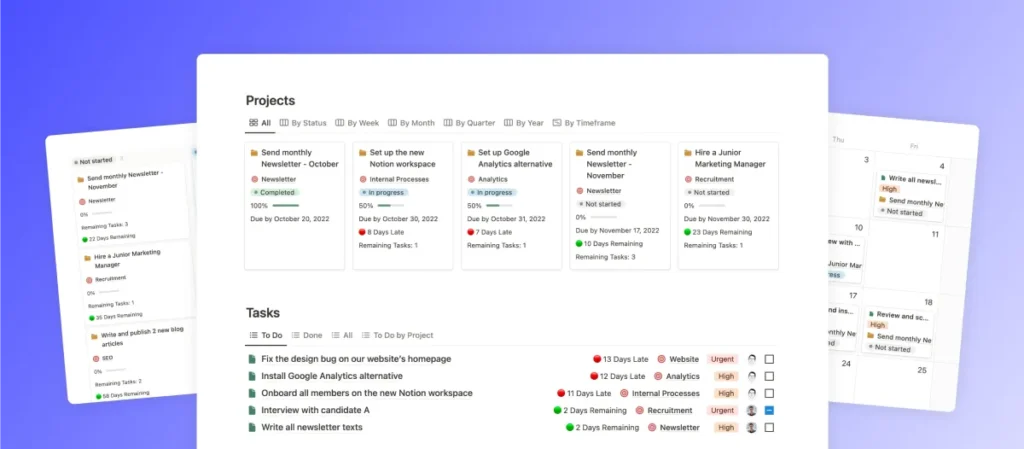
Notion, using April Dunford’s Competitive Alternatives-first approach, is “the all-in-one workspace for teams who currently juggle Google Docs, Trello, and Confluence” — it names the real stack and positions as consolidation, risking the “jack of all trades” perception but winning on simplicity.
Gong, using Dunford’s Obviously Awesome framework, is “the revenue intelligence platform for sales teams who currently rely on CRM notes and gut instinct” — the weak alternatives make its approach feel inevitable.
Webflow, on the Best/Better/Only framework, is “the visual web builder for designers who currently code in Figma but hand off to developers,” staking an “only” claim that Figma and WordPress can’t match, and sacrificing the non-designer market for designer loyalty.
This family is honest about the buyer’s world, which is why it survives the sales call better than most.
Hybrid Frameworks Sacrifice Focus for Coverage
Hybrid frameworks solve for several variables at once and pay for it in discipline.
HubSpot, on Anthony Pierri’s 4-Question Framework, is “the inbound marketing platform for SMBs who need enterprise-grade tools without enterprise complexity” — category, target, alternative, and value in one line, but it must constantly prove it hasn’t become the complex enterprise software it replaced.
Figma, blending Jobs-to-Be-Done with Competitive Alternatives, is “the collaborative design platform for product teams who need more than Sketch but can’t wait for Adobe” — it positions against the actual job, not the product category, and ended up repositioning the entire Adobe–Sketch duopoly.

Miro, combining benefit-based positioning with category creation, is “the visual collaboration platform for remote teams who currently use whiteboards, sticky notes, and 15 different tools,” collapsing many alternatives into one category. It then has to teach the market to value. Hybrids are powerful and hard to hold; the sacrifice is focus.
A framework is not a template you fill in. It is a decision about which variable — category, proof, or alternative — you will spend your credibility on, and which two you will let go. Firms that skip that decision end up optimising for all three, which means they optimise for none, and the buyer files them under “sounds like everyone else.”
Where Firms Get This Wrong
The common failure is not a bad statement. It’s positioning by synonym — a statement where every word is true, and every competitor could sign it.
For organisations seeking trusted advisory services, we deliver innovative solutions with deep industry expertise,” names no category, no alternative, and no trade-off. It reads as substance and contains none.
The diagnostic test is brutal and fast: could a buyer describe your firm to their boss without adding new words?
According to the Wynter 2024 message-testing benchmark, across 1,890 page tests, only 31% of B2B homepage value propositions scored above 4.0 out of 5.0 on clarity in panel testing.
Most positioning fails not because it’s wrong but because it’s unrepeatable. If the buyer has to translate you, you’ve already lost the room.
A Worked Example: Repositioning a Mid-Market Advisory Firm

A mid-market professional services firm — 50 to 100 people, £5–15M revenue — came to me after three years of flat growth. They’d poured budget into thought leadership, hosted a flagship industry conference, and kept an active LinkedIn presence.
They still couldn’t get onto shortlists dominated by the Big Four and larger regionals.
Their positioning statement was the culprit: “For organisations seeking trusted advisory services, we deliver innovative solutions with deep industry expertise.” Positioning by synonym, top-to-bottom.
We applied the Evidence-First proof-based framework and forced three specifics. Not “organisations” but CFOs undergoing turnaround situations.
Not “other firms” but the real alternative — internal restructuring teams or the Big Four’s standard approach. Not “deep expertise” but a structural advantage: a three-person team with 100% prior experience in that specific industry’s turnaround work.
The statement stopped being ownable by every competitor and started being ownable only by them.
The pattern is consistent: firms don’t lack expertise; they lack a statement that survives the 30-second test. Positioning isn’t about sounding impressive. It’s about being repeatable by a buyer who wasn’t in the room when you wrote it.
The Distinct Angle: Twelve Trade-Offs, Not Twelve Templates
Here is where most positioning guides quietly mislead you.
They present frameworks as interchangeable — pick whichever sounds good — and intelligent practitioners believe this for good reason: the frameworks look alike on the page, all resolving into a “for [target] who [need]” shape. The surface similarity is real.
The strategic content underneath is not. Each framework spends your differentiation budget on a different axis, and for professional services, the axis that pays is rarely the one that pays for software.
Salesforce and Slack win by creating and owning a category because software markets reward the firm that names the new thing.
Deloitte wins by proof — 175 years of precedent — because in advisory work, the buyer is purchasing reduced risk, and a category claim from an unknown firm reduces nothing.
This is the sector reframe the SaaS-heavy guides miss entirely: when you sell trust, the Evidence-First family usually outweighs the Category-First family, even though Category-First produces the more quotable line.
This is not a fashionable position; it’s a load-bearing one.
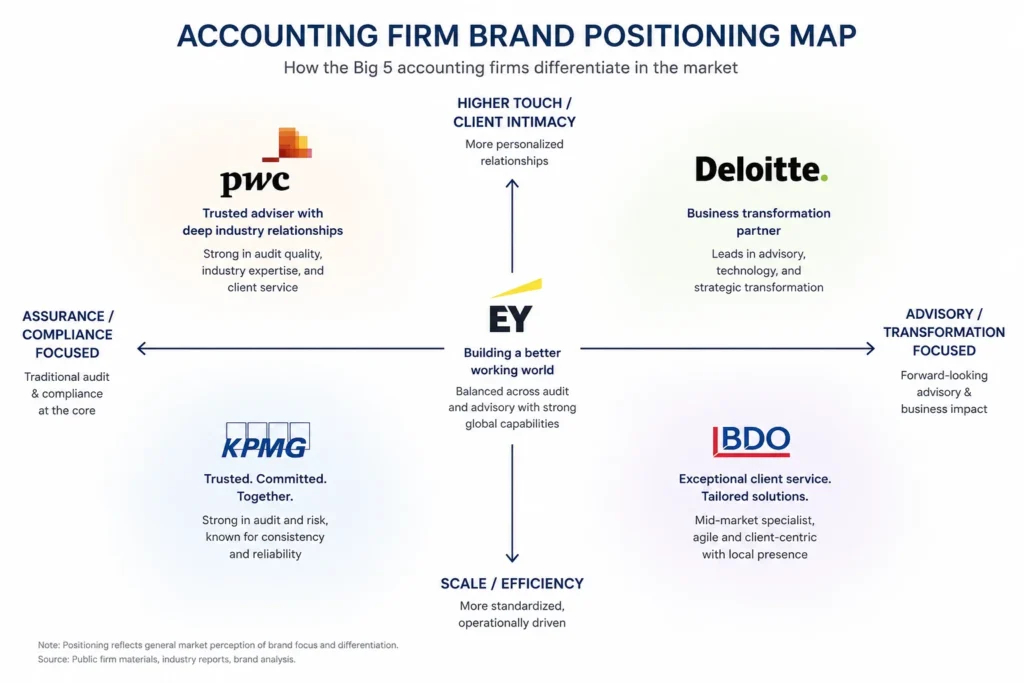
And the market is moving toward it. Professional services firms through 2025 have shifted from selling services to selling outcomes — legal, accounting, and consulting practices repositioning around client transformation rather than the generic “trusted advisor” line, launching outcome-based and sustainability-focused packages and client innovation labs.
Forrester’s 2025 B2B prediction sharpens the point: more than half of large B2B transactions of $1M or greater will move through digital self-serve channels, with younger buyers pulling in ten or more external influencers before they ever speak to sales.
When buyers self-educate first, your positioning statement isn’t internal strategy — it’s your first and sometimes only salesperson.
A proof-first statement that a buyer can repeat to their board does that job. A category claim they don’t yet trust does not.
So the honest objection — “isn’t the framework just a formatting choice?” — collapses on contact with the evidence.
And the second objection a sceptical MD raises — “we already have a positioning statement, why revisit it?” — is answered by the 29% figure: having one and having one that survives the sales conversation are different achievements, and the gap between them is where growth leaks out.
If you want the sharper way to sequence this decision before you rewrite anything, our guide to B2B brand positioning frameworks maps which family fits which commercial situation, and if your firm is mid-transition, the mechanics of a brand repositioning sit alongside it.
| The Default Approach | What It Costs | The Better Approach | Why |
| Pick the framework that sounds most impressive | An unrepeatable statement buyers can’t relay | Pick the framework that fits your trade-off | Repeatability drives the 47% CI-content win rate (Klue 2024) |
| Position by synonym (“trusted, innovative, expert”) | Invisible on shortlists; every rival signs it | Name category, alternative, and sacrifice | Only 31% of B2B pages pass clarity testing (Wynter 2024) |
| Use a Category-First framework for an advisory firm | Category claim from an untrusted firm reduces no risk | Weight Evidence-First: proof and precedent | Trust is the product in professional services |
| Write the statement and file it | Only 29% survives sales conversations (Pragmatic 2024) | Audit call recordings against the statement | The sales call is where positioning is tested |
| Copy a SaaS example verbatim | Software optimises for a different axis | Translate the trade-off, not the wording | Frameworks encode sacrifices, not phrasings |
The Verdict
Twelve positioning statement examples, and not one of them is a template. Salesforce sacrificed the SMB market to own the enterprise CRM.
Deloitte sacrificed agility for 175 years of unmatchable proof. Notion sacrificed a clean story to name the messy stack its buyers actually use. Each is a different answer to the only question positioning ever asks: what will you refuse to do to win?
That reframe is the whole argument, and the evidence carries it.
Only 41% of B2B firms have documented positioning at all (Forrester 2023), and only 29% of that survives to the buyer conversation (Pragmatic Institute 2024) — which means the win isn’t the Word document, it’s a statement clear enough that a buyer repeats it to their boss without adding words.
For professional services specifically, that clarity almost always comes from the Evidence-First family, because you sell trust, and proof is the only claim a rival can’t copy overnight. The category-creation lines read better on a slide. They convert worse in a market where the buyer is de-risking a decision.
Don’t rewrite your statement by reaching for the framework that sounds sharpest. Choose the trade-off you can actually defend, then build the statement to survive the sales call.
If you’re not sure which differentiation your firm is currently overspending or leaving on the table, request a free Brand Equity Audit™ — a structured, written diagnostic that identifies exactly where your positioning is losing commercial ground and what to do about it, delivered without a sales call.
FAQs
What is a positioning statement example?
A positioning statement example is a real brand’s internal statement that shows how a specific framework defines its category, its competitive alternatives, and its strategic trade-off. Deloitte’s “audit firm backed by 175 years of precedent” is one — it demonstrates proof-based positioning, not a tagline meant for public display.
Why do most positioning statements fail in sales conversations?
Most fail because they’re unrepeatable. The Pragmatic Institute’s 2024 audit of 218 teams found that only 29% of buyer-facing conversations reflect documented messaging. When a statement names no category, alternative, or trade-off, the sales team can’t relay it, so it never reaches the buyer.
How do I choose the right positioning framework for my firm?
Choose by trade-off, not by which sounds best. Category-First frameworks sacrifice market breadth for ownership; Evidence-First frameworks sacrifice flexibility for trust. Professional services firms usually weigh Evidence-First, because trust is the product and proof is the one claim competitors can’t copy quickly.
What’s the difference between a positioning statement and a tagline?
A positioning statement is an internal strategy that defines the category, audience, and trade-off; a tagline is a public-facing phrase derived from it. The statement guides every message. The tagline is one downstream expression of it, written for the market rather than the boardroom.
Is it true that having documented positioning is enough?
No documentation is necessary, but insufficient. Forrester’s 2023 survey found that only 41% of B2B firms document positioning, yet Pragmatic Institute found that only 29% survives sales conversations. The win is a statement clear enough that buyers repeat it accurately, not merely one written down.
When should a professional services firm revisit its positioning?
Revisit before a growth phase, acquisition, or repositioning, or when partners describe the firm differently in pitches. Flat growth despite strong marketing is a reliable signal, often caused by positioning by synonym statements that every competitor could sign as true.
What is positioning by synonym?
Positioning by synonym is a statement where every word is technically true, but every competitor could claim it — “trusted, innovative, expert.” It names no category, no alternative, and no sacrifice. It reads as substance while communicating nothing that distinguishes the firm.
How do positioning frameworks differ from each other?
Frameworks optimise different variables. Geoffrey Moore’s template optimises category ownership; April Dunford’s optimises the competitive alternative buyers already use; proof-based models optimise trust. They look similar on the page but encode different strategic sacrifices, which is why they aren’t interchangeable.
Why does framework choice affect revenue?
Framework choice determines whether positioning reaches sales. Klue’s 2024 report found deals using competitive intelligence content close at 47% versus a 21% baseline. A framework naming the real alternative feeds battlecards and objection handlers; an abstract statement feeds none of that material.
What is the 30-second test for positioning?
The 30-second test asks whether a buyer could describe your firm to their boss without adding new words. If they must translate your statement, it fails. Wynter’s 2024 benchmark found only 31% of B2B pages passed clarity testing on this kind of measure.
Should professional services firms copy SaaS positioning examples?
No — copy the trade-off, not the wording. SaaS brands like Slack often win through category creation, which suits software markets. Advisory firms sell trust, so proof-based positioning usually outperforms category claims that an unknown firm can’t yet make credible.
What framework suits an advisory firm competing against the Big Four?
The Evidence-First proof-based framework usually suits it best. Rather than claiming a new category, name a structural advantage a larger rival can’t match — a specialist team with 100% prior experience in the buyer’s specific situation — which reduces perceived risk more than scale claims do.
