B2B Value Proposition: Why Capability Messaging Fails
A £12m consulting firm can lose a mandate it is objectively best placed to win, and never learn why.
The proposal was thorough. The credentials were real. The team was senior.
Somewhere between the pitch and the decision, the deal went quiet – not rejected, just stalled – and the firm assumed it was price. It usually is not the price.
Forrester’s The State of Business Buying, 2024, found that 86% of B2B purchases stall during the buying process and 81% of buyers end up dissatisfied with the provider they chose.
Read those two figures together, and a pattern emerges: most deals do not die at the moment of rejection.
They die of accumulated uncertainty, in a room the provider never enters.
The value proposition is the one asset that either travels into that room and reduces the uncertainty, or sits on a slide explaining how good you are. At the same time, the buying group quietly talks itself out of the decision.
That is the reframe this guide is built on, and it is where how brand strategists help diverges sharply from most copywriting advice.
Complex B2B services do not fail because they are too technical. They fail because the value proposition explains capability when its actual job is to reduce buying risk.
- A working value proposition reduces perceived buyer risk before demonstrating capability.
- Build the proposition in five stages: map the buyer's risk; define one defensible outcome; translate for stakeholders; architect proof; sequence risk first.
- Attach verifiable proof to every claim so sceptical buyers and AI can check without contacting you.
- Translate the outcome into each approver's language; buying groups average 13 internal stakeholders, per Forrester.
- Sequence matters: lead with risk reduction, then capability; clarity is the method, not the strategic goal.
How a B2B Value Proposition That Actually Works Is Built

A working B2B value proposition is built in five stages: map the buyer’s risk, define the specific outcome, translate it for every stakeholder in the buying group, architect the proof, then sequence it so that risk reduction leads and capability follows. Skip the risk-mapping stage, and the other four produce a polished statement that still loses.
- A value proposition reduces perceived risk before it demonstrates capability – buyers de-risk first, admire second.
- It must survive multiple readers with different fears, not persuade one ideal customer.
- Proof is a structural component of the proposition, not a case study bolted on afterwards.
A B2B value proposition succeeds when it reduces the buyer’s perceived risk, not when it explains the provider’s capability more clearly.
This sits within Inkbot Design’s wider brand strategy service, and rolls up into the firm’s broader work on the brand equity system – the value proposition is the sharp end of a strategy, where positioning becomes a sentence a stranger repeats accurately.
What You Need in Place Before You Write a Word
You cannot write a value proposition that reduces buyer risk if you do not yet know what your buyer fears.
That is the honest entry condition most guides skip. They start with the sentence; the sentence is the last thing you build.
Three things must exist first. A documented understanding of who signs off – Forrester’s 2026 buyer research puts the average buying group at 13 internal stakeholders and nine external participants, so “the client” is a committee, not a person.
A specific, defensible outcome you can point to in delivered work, not an aspiration. And access to proof: named results, references, or trial mechanisms you are permitted to cite.
A value proposition assembled without these three becomes a claim the buying group cannot verify, and unverifiable claims raise risk rather than lowering it.
The failure mode here is starting with a workshop full of adjectives. A firm agrees it is “trusted, expert, and partner-led,” writes that on the website, and wonders why nothing changes.
Those words describe the firm to itself. They do nothing for a finance director trying to justify a six-figure commitment to a board.
Stage One: Map the Buyer’s Risk, Not Your Features

The first stage is to write down everything a buyer stands to lose by choosing you – the money, the wasted quarter, the reputational exposure of having championed the wrong provider internally.
You know the stage is done when you have a list of fears specific enough to feel uncomfortable, not a list of benefits.
Most firms invert this. They inventory what they offer and translate each feature into a benefit, which is where Bain & Company’s B2B Elements of Value framework, useful as it is, tends to get misapplied – teams treat it as a menu of value to claim rather than a set of risks to neutralise.
The buyer is not choosing the provider with the most valuable elements. The buyer is choosing the provider least likely to make them look wrong for choosing them.
The specific failure mode at this stage is confusing your risk with theirs. Your risk is losing the deal. Their risk is the deal going badly after they have signed, staked their credibility on it, and told the board it was handled.
Design the value proposition around their risk, and the deal stops feeling dangerous to say yes to.
“A buyer does not reward the provider who proves the most capability. A buyer rewards the provider who makes the decision safest to defend internally. Every complex B2B purchase is, at the point of sign-off, a career-risk calculation being made by someone whose name is now attached to the outcome. Speak to that, and price stops being the focus of the conversation.”
Stage Two: Define One Outcome You Can Defend
The second stage is to state the single outcome your service produces, in terms the buyer would use to their own board – not the mechanism you use to produce it.
You know it is right when a client could repeat it in a meeting you are not in, and it would still persuade.
We run a structured brand equity diagnostic” is a mechanism. “You stop losing pitches you should win” is an outcome.
The distinction matters because, per Gartner’s finding that B2B buyers consult an average of seven information sources per purchase decision, your value proposition rarely gets read in your presence.
It has to work secondhand, forwarded, half-remembered, and quoted by an internal champion who is not as fluent in your service as you are.
The failure mode is the compound outcome – three outcomes joined by commas because the firm could not choose. A buying group cannot accurately repeat three things. It repeats one, badly, or none.
Pick the outcome that most reduces the risk you mapped in stage one, and let the rest live in the body of the proposal.
Stage Three: Translate It for Every Seat at the Table
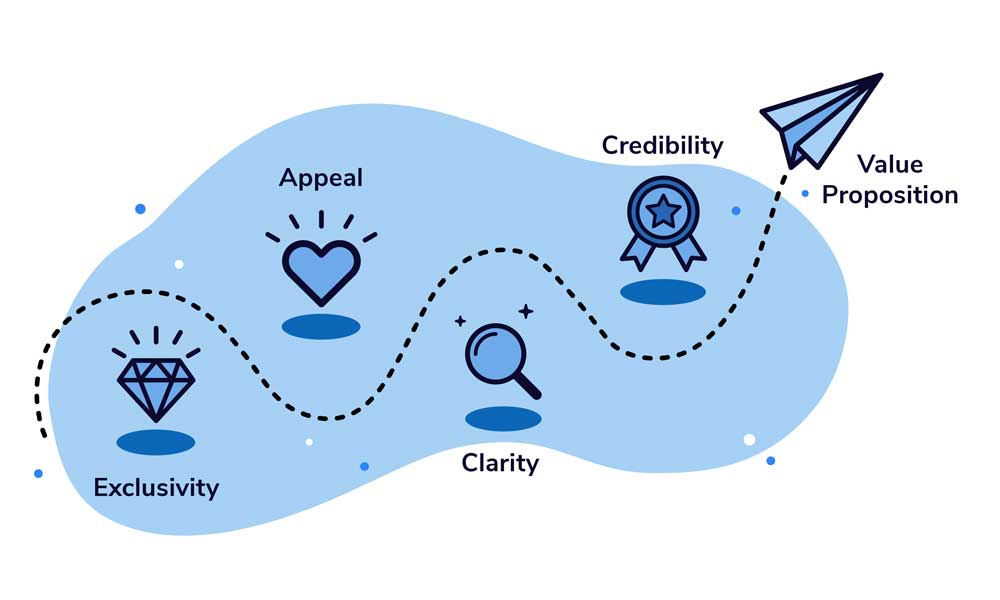
The third stage is to rewrite the same outcome in the language of each person who must approve it, because a value proposition that persuades the managing partner can read as vague hand-waving to the finance director sitting beside them.
You know this stage is complete when you can say what your proposition means to at least four distinct roles.
This is the stage almost every guide ignores, and it is the one that Forrester’s data makes non-negotiable: a buying group of 13 internal stakeholders is not an audience, it is a translation problem.
The champion needs a reason to spend political capital. The finance function needs the commercial logic. The technical evaluator needs to know you will not create work for them. The signatory needs to know this is defensible if it goes to the board.
“Stakeholder alignment is not achieved by broadening the message until it offends no one. It is achieved by writing the same outcome in four different registers so each decision-maker reads the version that answers their specific fear. A value proposition that tries to speak to everyone at once speaks to a committee that does not exist – and every real member of the buying group hears a message aimed slightly past them.”
The failure mode is the lowest-common-denominator statement – the message flattened until it is safe for all readers and compelling to none.
In 17 years of brand work, the pattern I see most often is a strong firm with a value proposition sanded down to the point of saying nothing, because every stakeholder review removed the edge that made it specific.
Stage Four: Architect the Proof Before You Need It
The fourth stage is to attach a specific proof mechanism to each claim in the value proposition, so that no assertion travels through the buying process undefended.
You know it is done when every claim has a corresponding way for a sceptical stranger to check it without contacting you.
Proof is now structural, not decorative. Forrester’s 2026 research reports that more than 60% of buyers acquire some form of trial before committing, and that 94% of business buyers use AI during the buying process, which means your claims are being cross-checked against sources you do not control, at a stage before any conversation happens.
A value proposition that asserts “proven results” with nothing a buyer can independently verify does not read as confident. It reads as risk.
The failure mode is the unfalsifiable claim: “trusted by leading firms,” “results that speak for themselves,” “a proven track record.” These raise buyer risk precisely because they cannot be checked, and a claim that cannot be checked is, to a cautious buying group, indistinguishable from one that is not true.
Replace each with something specific enough to be wrong – a named result, a defined guarantee, a trial the buyer can run.
This is also where a strong brand narrative earns its place: it is the connective structure that makes disparate proof points read as one coherent, credible account rather than a scatter of testimonials.
Stage Five: The Judgement Layer – Where Sequence Decides Everything
The fifth stage is judgment, not procedure: deciding what the buyer must feel safe about first, before they are willing to be impressed at all.
No checklist produces this. It is the result of a specific room that 17 years of watching deals stall does, and that an AI-generated competitor article structurally cannot.
Here is where the sequence becomes the whole game.
Two firms can hold identical proof, identical outcomes, identical stakeholder maps – and one wins because it led with risk-reduction and let capability follow, while the other opened with capability and never got the buyer safe enough to care.
Gartner’s March 2026 survey found that 67% of B2B buyers now prefer a rep-free buying experience, yet 69% still turn to sales reps to validate AI-generated insights.
Read together, that is a buyer who wants to self-educate and de-risk privately, then use human contact only to confirm. Your value proposition has to do the de-risking work on its own before anyone from your firm is in the room.
The judgment call most firms get wrong: they treat proof as the finale, deployed after the capability case is made. Reverse it.
The buyer cannot hear your capability until they feel safe, and they do not feel safe until the risk is addressed. Lead with the thing that lowers the temperature.
The Step Everyone Does in the Wrong Order
The prevailing advice – translate features into benefits, then write with clarity – is not wrong. Intelligent practitioners hold it because clarity genuinely beats jargon, and a clear benefit genuinely beats an opaque feature.
Nielsen Norman Group has spent decades demonstrating that plain, scannable language outperforms dense prose. That evidence is real. The advice earns its place.
It is also incomplete in a way that quietly ruins results. Clarity is a property of a good value proposition; it is not the job.
Treating clarity as the job produces beautifully written statements that explain capability with perfect lucidity, and still lose the deal, because a clearly explained capability that the buyer cannot de-risk is just a well-lit risk.
The sequence error is putting the writing stage first. The writing is stage five of five.
The four stages before it – risk, outcome, stakeholder translation, proof – are what the writing is supposed to carry, and no amount of clarity rescues a value proposition that skipped them.
| The Default Approach | What It Costs | The Better Approach | Why |
| Lead with capability and credentials | Buyer stays uncertain; deal stalls | Lead with the buyer’s risk, addressed | Safety precedes admiration in the buying decision |
| Translate features into benefits | Benefits still read as claims | Attach a verifiable proof to each benefit | 60%+ of buyers trial before committing (Forrester 2026) |
| Write one message for “the client” | The committee reads past it | Write the outcome in four stakeholder registers | Buying group averages 13 internal people (Forrester 2026) |
| Treat clarity as the goal | Clear but unpersuasive | Treat risk-reduction as the goal, clarity as the method | A clear risk is still a risk |
| Save proof for the case-study page | Claims travel undefended | Build proof into the proposition itself | 94% of buyers verify with AI pre-contact (Forrester 2026) |
| Polish the sentence first | Skips the four stages that matter | Sequence risk → outcome → stakeholders → proof → writing | Writing carries the strategy; it is not the strategy |
Where This Stands in 2026

The ground has moved, and it has moved in favour of risk-led value propositions.
Forrester’s 2026 buyer research characterises business buying as shaped by AI everywhere, scrutiny as the default posture, and trust as the paramount currency.
Buyers now self-educate before any human contact, and 94% use AI during the process – which means the claims in your value proposition are being interrogated by both a sceptical committee and the tools it uses to check you.
The buying group has also grown heavier. Forrester puts it at 13 internal stakeholders and 9 external participants, and notes that the group can roughly double when generative AI features are involved in the purchase.
Each added stakeholder is another risk lens your value proposition must pass through intact. A capability-led message degrades with every additional reader, because capability is subjective and each reader discounts it differently.
A risk-reduction message compounds because a lower risk is something every stakeholder wants, regardless of their function.
Gartner’s 2026 finding sharpens the point: 67% of buyers prefer to buy without a rep, while 69% still bring a rep in to validate what AI told them.
The value proposition now does the early, private, high-stakes work of making the firm feel safe to shortlist – before any relationship exists to lean on.
In 2026, the value proposition is not the opening line of a sales conversation. It is the reason the conversation happens at all.
Two Objections Worth Answering Honestly
“This sounds like we should hide our expertise.”
No – it sounds like you should sequence it. Expertise is what makes the risk-reduction credible; a firm with no demonstrable capability cannot reduce anyone’s risk. The argument is not to suppress capability but to stop leading with it. Address the buyer’s risk first, and your capability lands as reassurance rather than noise. Deployed in the wrong order, expertise reads as ego. In the right order, it reads “safety”.
“Our buyers are rational – this risk-psychology framing overstates it.”
They are rational, which is exactly why risk dominates. A rational buyer facing an irreversible six-figure commitment, judged by a board, in front of 12 colleagues, is correctly weighing downside risk above upside potential. That is not a cognitive bias to be worked around. It is sound judgment for your value proposition to respect theirs by taking their risk as seriously as they do.
The Verdict
Complex B2B services do not lose because they are too technical, too niche, or too expensive.
They lose because their value proposition spends its words explaining capability to a buyer who is silently asking one question: what happens to me if this goes wrong?
Answer that question first, and everything else you want to say finally has somewhere safe to land.
The reframe holds all the way down. Clarity is not the job; it is the finish. The job is translation – across the buyer’s risk, across every stakeholder who must approve, across proof a sceptical stranger can verify without you in the room.
Forrester’s evidence that 86% of deals stall and 81% of buyers end up dissatisfied is not a story about bad products.
It is a story about propositions that are explained rather than de-risked, in a market where, as of 2026, buyers scrutinise everything and trust almost nothing on assertion alone.
The single action to take today: take your current value proposition and, beside every claim, write the specific buyer fear it addresses and the proof a stranger could use to verify it.
Where the fear column is blank, you are explaining capability. Where the proof column is blank, you are raising risk. That gap is the work.
If you want that gap mapped rigorously against your commercial position, Inkbot Design offers a free written Brand Equity Audit™ – a structured diagnostic that identifies exactly where your brand is losing commercial ground, and what to do about it. No sales call required.
FAQs
What is a B2B value proposition?
A B2B value proposition is the statement that tells a business buyer why choosing your service is the safest, most defensible decision they can make. It works best when it reduces the buyer’s perceived risk before demonstrating the provider’s capabilities, because complex purchases are decided more by risk than by admiration.
Why do B2B value propositions fail even when the service is good?
They fail because they explain capability rather than reducing the risk of buying. Forrester found 86% of B2B purchases stall during the buying process – usually from accumulated uncertainty inside the buying group, not from an inferior offer. A proposition that never addresses the buyer’s downside risk leaves that uncertainty intact.
How is a B2B value proposition different from a tagline?
A tagline is a memorable phrase; a value proposition is a reasoned argument for why the purchase is safe and worthwhile. The tagline lives on the homepage. The value proposition has to survive a finance director, a technical evaluator, and a board, which a tagline is not built to do.
What proof do B2B buyers actually want before committing?
Verifiable proof they can check without contacting you: named results, defined guarantees, references, or trials. Forrester’s 2026 research reports more than 60% of buyers acquire some form of trial before committing, and 94% use AI to verify claims – so unfalsifiable assertions like “proven results” now raise risk rather than lowering it.
How do I write a value proposition for a whole buying committee?
Write the same outcome in several registers, one per role. Forrester puts the average buying group at 13 internal stakeholders, so a single flattened message reaches a committee that does not exist. The champion, the finance function, the technical evaluator, and the signatory each need the version that answers their specific fear.
Should a B2B value proposition focus on features or outcomes?
Outcomes – but the deeper answer is risk. Features describe your mechanism; outcomes describe the buyer’s result; risk reduction explains why saying yes is safe. Lead with what makes the decision defensible, state the outcome plainly, and let features appear only as proof that the outcome is achievable.
Is it true that clarity is the most important quality in a value proposition?
No – clarity is necessary but not sufficient. A clearly written value proposition that explains a capability the buyer cannot de-risk is just a well-lit risk. Clarity is the method by which risk-reduction, outcome, and proof are delivered; it is not the job of those elements to do.
When should we rewrite our value proposition?
Rewrite it before a growth phase, acquisition, or repositioning – any moment when the stakes of being misunderstood rise. If your current proposition lists what you do rather than what the buyer stops fearing, it is already costing you deals you should win, and a rebrand is the natural point to fix it.
How does AI change B2B value propositions in 2026?
AI makes proof non-negotiable. Forrester reports that 94% of business buyers use AI during the buying process, cross-checking your claims against sources you do not control before any human contact. Your value proposition must now de-risk the purchase privately and verifiably, because it is being interrogated long before a conversation begins.
Why does the order of a value proposition matter?
Because a buyer cannot absorb your capability until they feel safe, lead with risk reduction and capability; land as reassurance. Lead with capability, and the buyer never gets safe enough to care. Two firms with identical proof can win or lose purely on which one placed first.
How long should a B2B value proposition be?
Long enough to reduce the buyer’s core risk, state one defensible outcome, and attach proof – often a short paragraph rather than a single line. The test is not word count, but whether an internal champion could repeat it accurately in a meeting you are not in.
Can a value proposition really affect pricing?
Yes – a proposition that reduces perceived risk lets a buyer justify a premium, because the mechanism of a price objection is usually unmanaged risk, not genuine cost sensitivity. When the decision feels safe to defend internally, price stops being the axis on which the buyer negotiates.
