7 Cognitive Bias Mitigation Strategies in UX Design
The standard advice to “reduce cognitive bias by doing more user research” is itself a product of confirmation bias – and in 2026, following it without scrutiny is producing higher-confidence wrong design decisions, not better ones.
Professional services firms preparing for a rebrand are particularly exposed. They invest in UX research, trust the outputs, and build brand experiences on foundations that were structurally biased from the outset.
The financial cost is real. Firms that launch rebrands built on assumption-driven design don’t discover the failure through poor aesthetics – they discover it through stalled growth, failed partner-level pitches, and websites that generate traffic but close nothing.
Getting cognitive bias mitigation right isn’t a UX nicety. For a firm repositioning ahead of an acquisition or growth phase, it’s the difference between a brand that earns authority at first contact and one that looks credible but doesn’t convert.
Understanding how to enhance brand trust starts with understanding how bias corrupts the decisions that build it.
- Audit research questions to disprove hypotheses; design studies to find disconfirming evidence, not to validate prior assumptions.
- Triangulate across independent sources, including client interviews, analytics and competitor analysis, to prevent single-source confirmation bias.
- Rotate concept presentation order across stakeholder groups and remove competitor anchors to prevent anchoring bias shaping decisions.
- Present significant findings in multiple frames, e.g. success-rate and gap-analysis, to expose framing effects documented by Nielsen Norman Group (NN/g).
- Separate hypothesis ownership from session facilitation; use independent researchers or blind analysis to reduce observer-expectancy and social desirability bias.
What Are Cognitive Bias Mitigation Strategies?
Cognitive bias mitigation strategies are structured research and decision-making methods that prevent pre-existing assumptions – held by researchers, designers, or stakeholders – from distorting design outcomes and brand experience decisions.
Key components:
- Structured question design that eliminates framing effects before data collection begins
- Triangulation across multiple data sources to prevent any single assumption from dominating conclusions
- Systematic alternative explanation testing to challenge first-impression design judgments
Cognitive bias mitigation strategies in UX are structured methods – triangulation, framing audits, and question order variation – that prevent false design confidence from corrupting outcomes.
1. Confirmation Bias Mitigation: Research to Discover, Not to Validate
Confirmation bias is the tendency to seek, interpret, and remember information in ways that confirm existing beliefs. In UX and brand design, this means researchers unconsciously design studies to prove what they already suspect is true.
The mitigation is not more research – it is research designed to find disconfirming evidence. Nielsen Norman Group (NN/g), the UX research and training consultancy, recommends that practitioners ask non-leading questions, use open-ended prompts, and explicitly seek out findings that challenge the working hypothesis rather than support it.
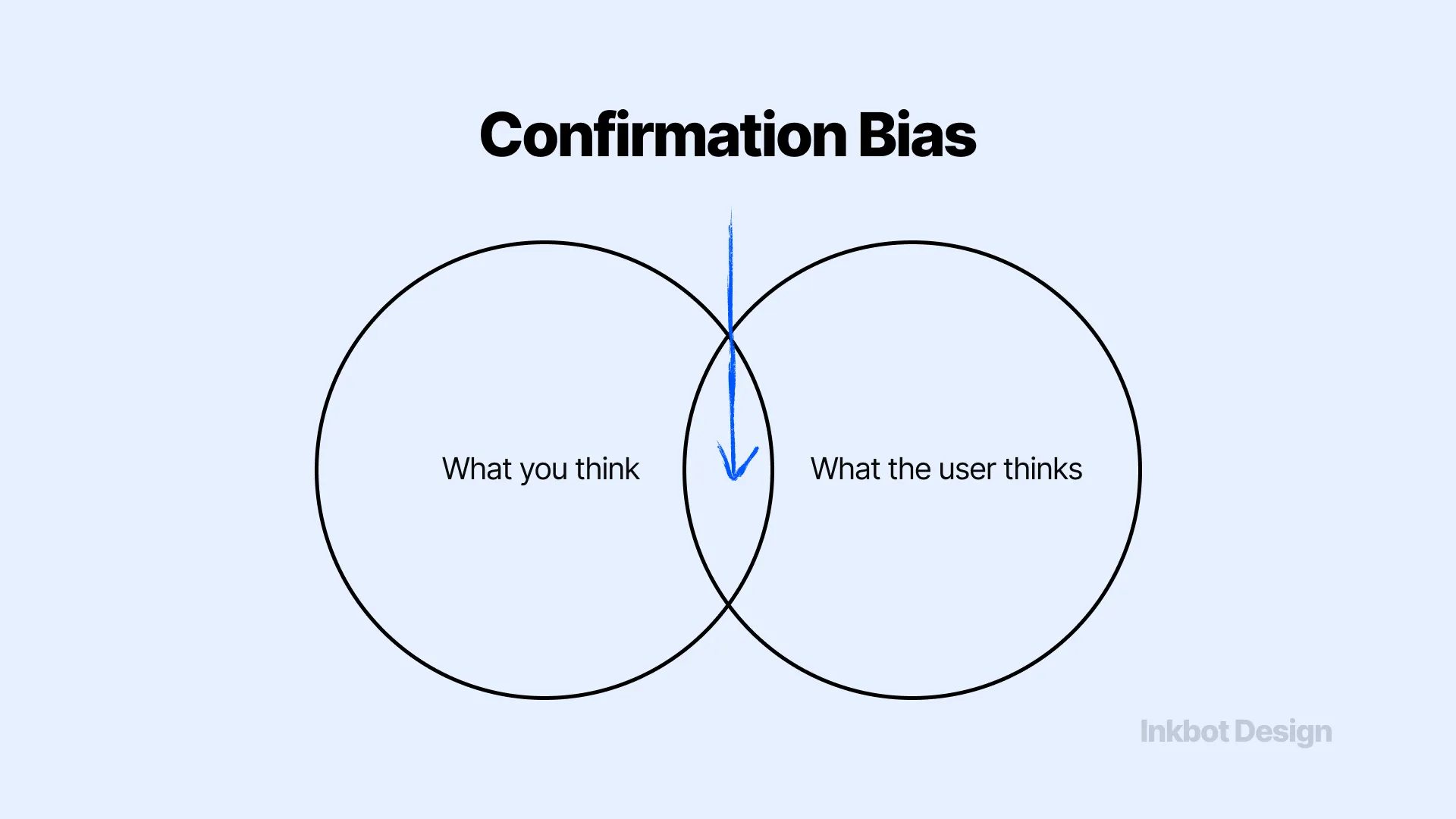
In practice, confirmation bias in professional services brand projects appears most often at the stakeholder brief stage. Partners who have decided the firm needs “a more modern look” will frame every user research question toward validating that instinct.
The research comes back supporting modernisation. The rebrand happens.
The conversion rate doesn’t change – because the firm’s actual problem was positioning clarity, not visual style, and no one designed a question to surface that.
Triangulation is the practical antidote. Using multiple independent data sources – client interviews, Google Search Console data, competitor analysis, and exit surveys – means no single source of assumption can dominate the conclusion.
When three independent data sources point to the same finding, confirmation bias becomes structurally harder to sustain.
Confirmation bias in UX research isn’t a personal failing – it’s an architectural one. When research is designed to validate a hypothesis rather than test it, each session produces evidence for a conclusion that has already been decided. The fix is not more participants. It’s a question audit before the first session runs. Design your study to be proven wrong, and you’ll produce findings worth acting on.
2. Anchoring Bias Mitigation: Vary the Order, Change the Conclusion
Anchoring bias causes UX practitioners and stakeholders to rely too heavily on the first piece of information they encounter – a prototype, an initial data point, a competitor’s design – as the reference frame for every subsequent judgment.
In brand design reviews, anchoring operates through the order in which concepts are presented. The first option sets the cognitive anchor.
Everything that follows is evaluated relative to it, not on its independent merits. This means the sequence of a design presentation is often more influential than the quality of the options within it.
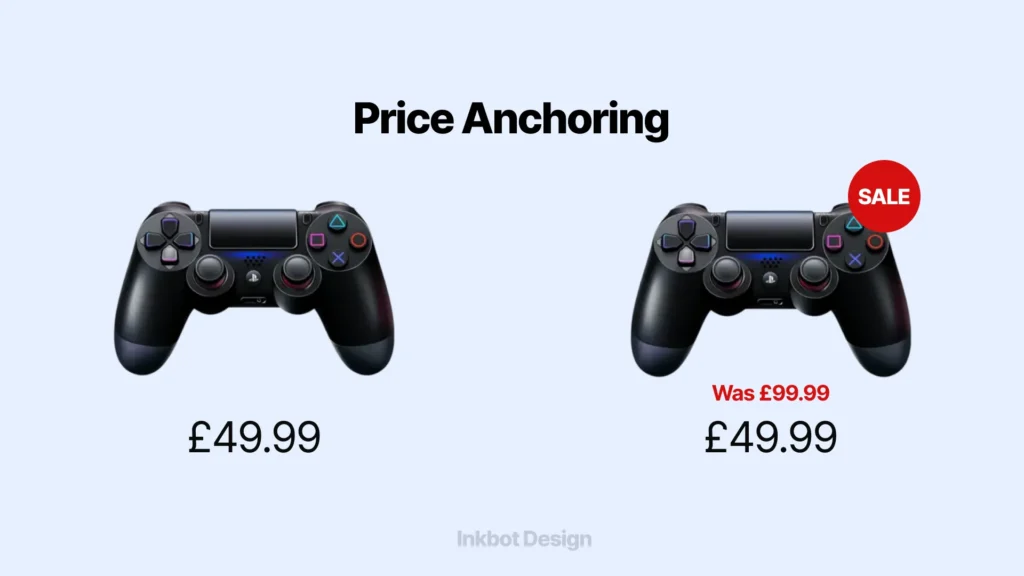
Nielsen Norman Group (NN/g) recommends that UX researchers mitigate anchoring bias by considering alternative explanations before committing to an interpretation, and by deliberately varying the order in which stimuli, questions, or design options are presented across research sessions or stakeholder reviews.
For professional services firms, anchoring bias is most damaging in competitive positioning work. When the first thing shown in a brand strategy session is a competitor’s identity, every subsequent discussion frames the firm’s own options as “better than” or “different from” that anchor – rather than as a standalone expression of the firm’s actual market position.
Anchoring bias makes the first option shown the most powerful option in the room – regardless of its quality. In brand and UX decision-making, the sequence of presentation is a design decision in its own right. Rotate concept order across stakeholder groups. Remove the competitor reference before the first positioning session. The anchor you set in the first five minutes will shape every judgment that follows.
3. Framing Effect Mitigation: Test the Question, Not Just the Answer
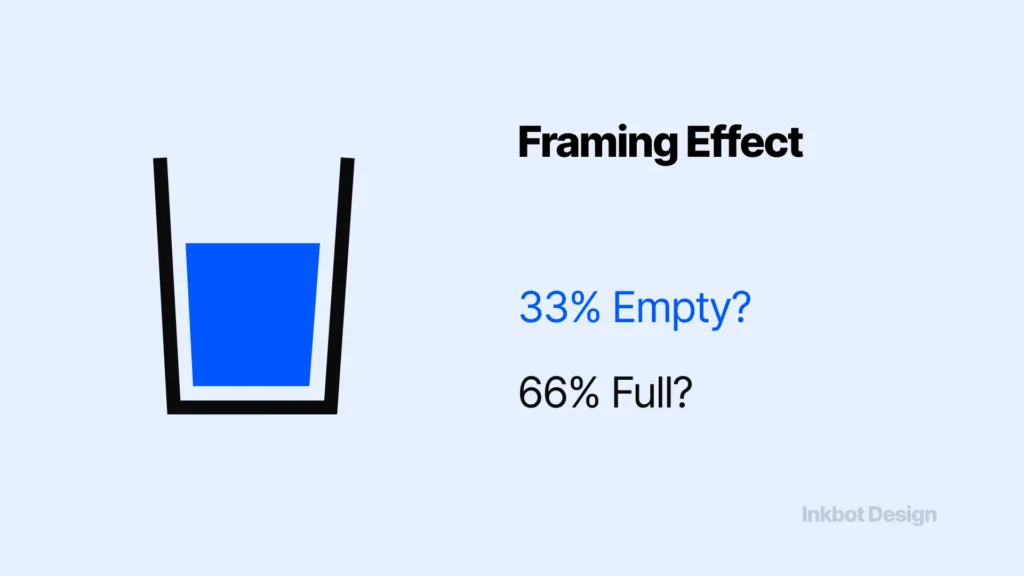
The framing effect is the documented tendency for the same information, presented differently, to produce materially different judgments and decisions.
Nielsen Norman Group (NN/g) reported that UX practitioners shown an identical result framed as a failure rate were 31% more likely to conclude a design needed a full redesign than practitioners shown the same result framed as a success rate.
The design hadn’t changed. The data hadn’t changed. Only the framing had – and it shifted professional judgment by nearly a third.
This is not a small rounding error in UX practice. For a professional services firm commissioning a brand or website project, a 31% shift in professional judgment based purely on how a result is described represents a material decision risk. Rebrands get approved – or killed – on framing.
Nielsen Norman Group’s recommended mitigation is threefold: resist snap judgments on first presentation of results, gather additional context before acting on any framing, and explicitly test the same question from multiple frames before concluding.
In brand strategy practice, framing effect mitigation means presenting research findings to stakeholders in at least two formulations – success-rate framing and gap-analysis framing – and noting where the two presentations produce different reactions.
The gap between those reactions is the framing effect. It should be named, documented, and accounted for before any strategic decision is made.
The framing effect is the most costly cognitive bias in professional UX work because it operates invisibly within trusted research outputs. A 31% shift in design judgment – documented by Nielsen Norman Group (NN/g) – based purely on presentation framing means that how you report findings is as consequential as what the findings say. Report every significant result in at least two frames. Where those frames produce different stakeholder responses, the framing effect is active and must be corrected before a decision is recorded.
4. Availability Heuristic Mitigation: Systematise What You Use as Evidence
The availability heuristic causes UX practitioners to overweight recent, memorable, or emotionally salient examples when making design and brand decisions – at the expense of the full data picture.
The most common version in brand and UX work: a design team has one vocal client who complained about a specific feature.
That complaint becomes the de facto evidence for a redesign decision, while three years of analytics data showing no measurable engagement problem with that feature goes unexamined. The memorable experience dominates. The systematic data is invisible.
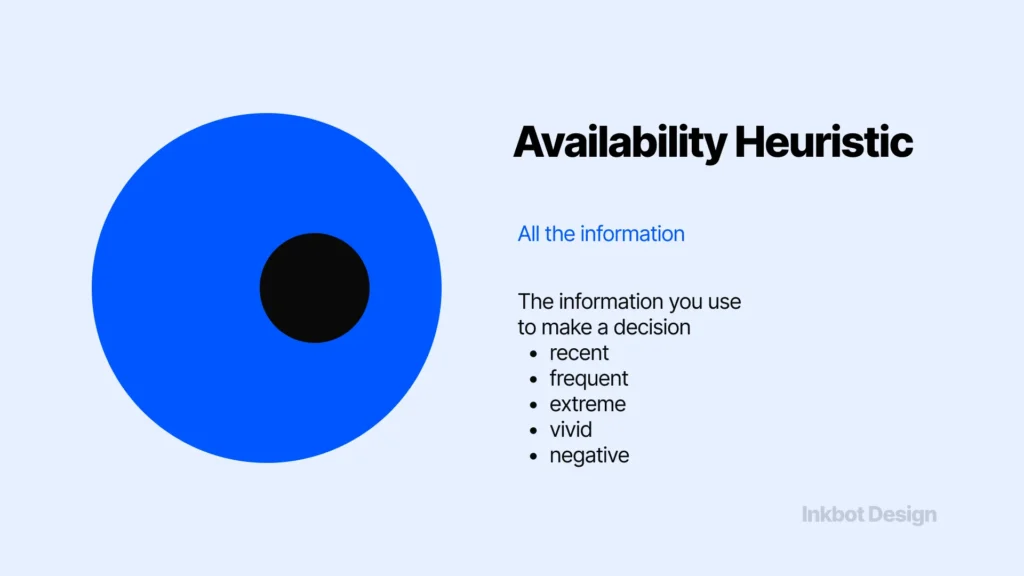
A systematic data collection and analysis process is the documented mitigation for availability bias. Rather than allowing the most recent complaint, case study, or conference presentation to set the agenda, a structured evidence review process requires that all available data sources be consulted before any design conclusion is drawn.
For professional services firms, this is particularly acute in website redesign decisions.
“Our competitors all have this feature” is an availability heuristic: the competitors noticed are available in memory because they were encountered recently, not because they are representative of the market.
A structured competitor analysis process, with defined criteria applied consistently across a named set of comparators, replaces heuristic reasoning with systematic evidence.
Availability bias doesn’t make you irrational – it makes you rational about the wrong data. The examples and cases that come most easily to mind are those with the greatest emotional charge, not those with the greatest statistical weight. Systematic data collection before any design decision isn’t bureaucratic overhead; it’s the only mechanism that puts the full evidential record in front of decision-makers rather than just the most memorable slice.
5. Social Desirability Bias Mitigation: Design Research That Doesn’t Reward Agreement
Social desirability bias causes research participants to give answers they believe the researcher wants to hear rather than answers that reflect their genuine experience or behaviour.
In UX research, this appears most often in moderated usability testing and stakeholder interviews. When a participant can see the designer’s reaction to their feedback, the incentive to soften criticism is powerful.
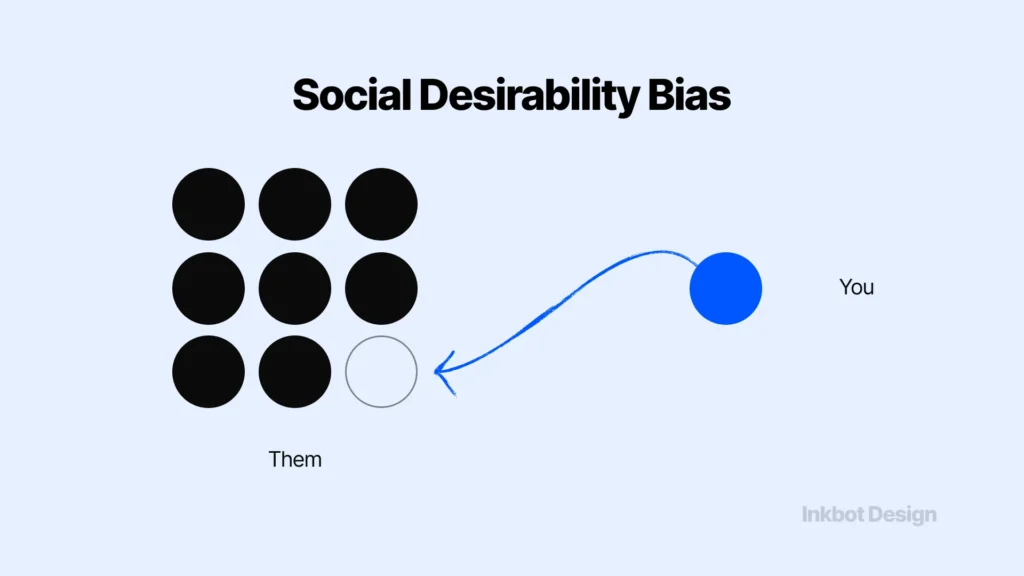
Leading questions amplify this effect. “Did you find this navigation easy to use?” is a social desirability trap. The word “easy” signals what the correct answer is supposed to be.
Nielsen Norman Group (NN/g) guidance consistently recommends open-ended, non-leading prompts as the primary mitigation.
“Walk me through how you’d approach this task” produces authentic behavioural data. “Was that straightforward?” produces socially adjusted responses.
For professional services firms commissioning brand research, social desirability bias is especially acute in partner and leadership interviews.
Senior partners who have championed a brand direction rarely give frank feedback in settings where their position is visible to colleagues. One-to-one anonymous research formats, or written-response methods, yield substantially more honest strategic input than facilitated group workshops.
Social desirability bias is not about dishonesty – it’s about the natural human tendency to be agreeable in observed settings. UX research design that does not account for this produces data that is politically comfortable and strategically useless. Every leading question in your interview script is producing an answer that tells you what participants think you want, not what they actually experience.
6. Recency Bias Mitigation: Weight the Trend, Not the Latest Data Point
Recency bias causes UX practitioners and brand stakeholders to overweight the most recent evidence – a last month’s analytics spike, a recently read competitor case study, a just-completed focus group – at the expense of longer-term trend data.
In brand strategy, recency bias produces reactive decisions. A firm sees a competitor launch a new visual identity and immediately questions its own.
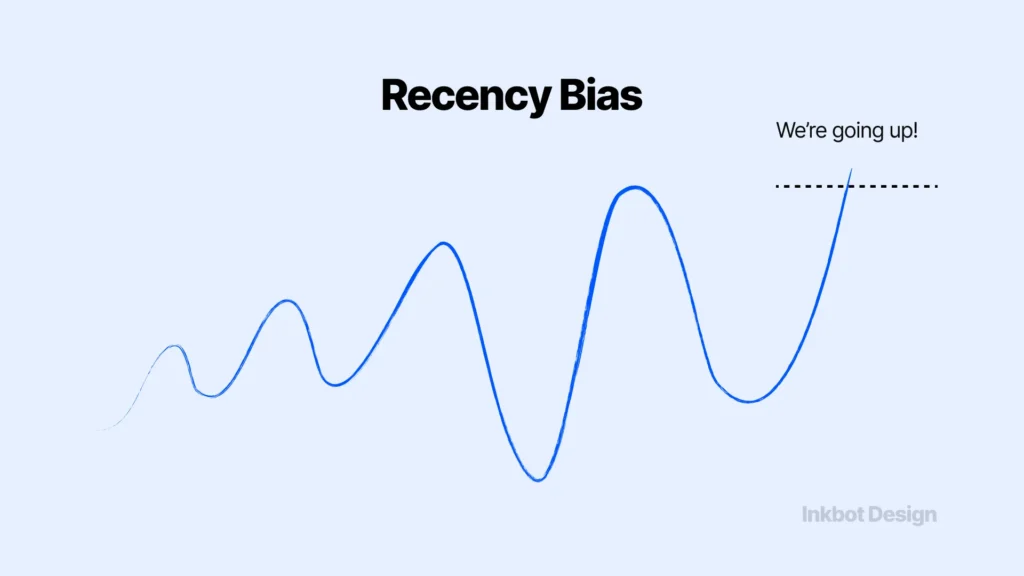
A website analytics report shows a single-month traffic drop and triggers a full UX review. Neither the competitor’s launch nor the single-month drop may be meaningful signals – but they are recent, so they feel urgent.
The mitigation is time-window discipline. Before any design or brand decision is made, the relevant data must be examined across a minimum defined time horizon – twelve months for web analytics, three years for competitive positioning – so that single recent events are placed in the context of a demonstrable trend.
A single month’s data point is noise. Twelve months of directional movement is a signal.
Recency bias is what makes UX and brand strategy reactive rather than strategic. The data point you reviewed last week feels more real than the trend you analysed last quarter – even when the trend is more reliable. Establish minimum time windows for every class of evidence before a decision is permitted. Reactive design is almost always recency bias in disguise.
7. Observer-Expectancy Effect Mitigation: Separate the Researcher from the Hypothesis
The observer-expectancy effect (also known as the Rosenthal effect) causes researchers to unconsciously influence participants’ behaviour through subtle cues – tone of voice, body language, question sequencing – that communicate what outcome the researcher expects to see.
In UX research, this is most damaging in moderated testing, where the researcher is also the designer of the feature being evaluated.
That researcher has an emotional investment in a specific outcome. Participants detect this investment – often without consciously registering it – and adjust their responses accordingly.
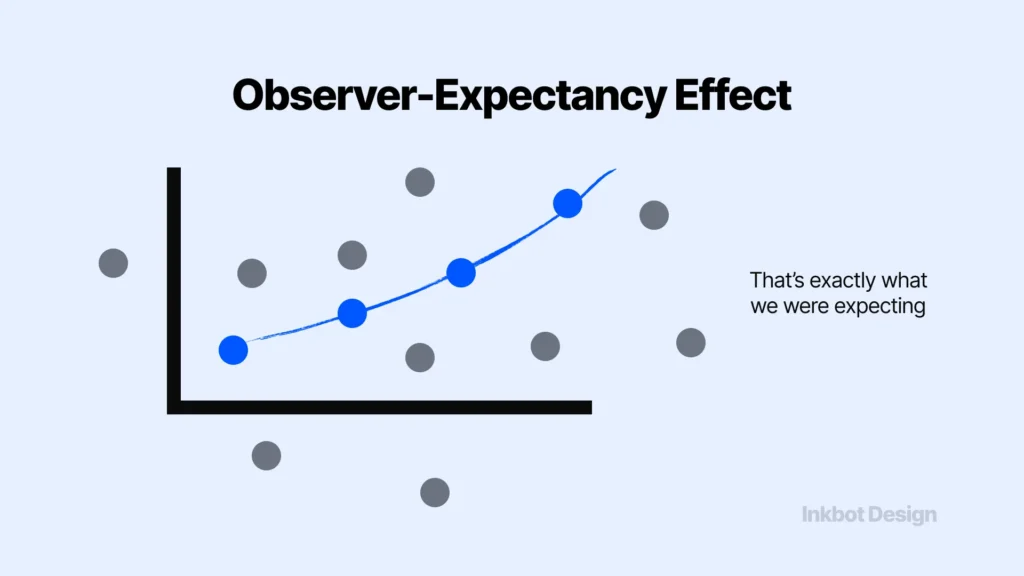
The structural mitigation is to separate the researcher from ownership of the hypothesis. Where possible, the person who developed the design brief should not conduct the user research sessions.
When full separation is not practical, multiple researchers should independently analyse the same raw session data before a synthesis discussion takes place – preventing any single interpretation from setting the frame.
Diverse teams reduce observer-expectancy bias by preventing a single interpretation framework from dominating the analysis.
Multiple sources consistently document that involving fresh eyes – particularly people without prior exposure to the design hypothesis – improves analysis quality and surfaces findings that homogeneous teams systematically miss.
The observer-expectancy effect is the most structurally embedded bias in UX research because it operates through the researcher’s presence rather than their questions. Separating hypothesis ownership from session facilitation is the only reliable mitigation. When that separation is impossible, independent analysis of raw session data – before any discussion between researchers – is the minimum control required.
The Myth That Is Making Your UX Research More Biased, Not Less
High Research Volume Reduces Cognitive Bias
This was once reasonable guidance. In an era when most organisations conducted no structured user research at all, any disciplined data collection was an improvement on pure assumption. The advice to “do more research” was directionally correct when the baseline was zero.
In 2026, it is actively harmful when followed without scrutiny.
Research volume does not correct for research design bias.
Confirmation bias in question framing, anchoring bias in prototype presentation order, and observer-expectancy effects in moderated testing mean that a high-volume, poorly structured research programme yields higher-confidence, incorrect conclusions than a low-volume, well-structured one.
Nielsen Norman Group (NN/g) documented that framing effects alone shifted design judgments by 31%. Running twenty sessions with that framing in place doesn’t reduce the bias – it compounds it, producing a larger and more confident dataset pointing in the wrong direction.
The expensive version of this failure is a professional services firm that invests £40,000–£80,000 in a full brand and website rebuild, supported by an extensive user research programme. It achieves no measurable improvement in conversion or client acquisition. The research was voluminous.
It was also structured by the same partners who had already decided what the firm needed. The sessions confirmed their instincts. The rebrand reflected those instincts. The market had a different view.
Before increasing research volume, audit every question in your research script for framing effects. Identify who owns the hypothesis and who is running the sessions. Test your opening stimuli for anchoring effects. One well-structured, bias-audited study outperforms twenty sessions built on leading prompts.
The State of Cognitive Bias Mitigation in UX in 2026
Cognitive bias in UX has entered a new phase of commercial risk. It is no longer primarily a problem of individual researcher error – it is a problem of systematic bias being encoded into AI-assisted tools at scale, then applied with the confidence of algorithmic objectivity.

AI-Assisted UX Analysis Is the Industry’s Most Anticipated (and Most Dangerous) 2026 Development
According to the Lyssna 2026 UX Trends Report, 88% of UX researchers identified AI-assisted analysis and synthesis as the most anticipated development impacting UX research in 2026. The appeal is obvious: faster synthesis, larger data sets, reduced manual coding burden.
The risk is structural. AI tools trained on existing UX research datasets inherit the confirmation biases, framing effects, and observer-expectancy patterns present in those datasets.
When a biased human researcher produces biased conclusions, the error is localised. When an AI tool trained on biased research produces biased synthesis recommendations, the error scales across every project the tool touches – and arrives with the apparent authority of algorithmic objectivity.
The World Usability Congress 2026 UX Trends Report stated directly that organisations failing to address inclusive leadership “scale biased, incomplete, and fragile” experiences, and that AI tools do not correct for the biases present in their training data.
Speed is not the same as accuracy.
Companies using AI-based tools in design workflows report 30–40% faster delivery times – but acceleration without bias mitigation means errors arrive faster, not less frequently.
The AI Hiring Tool Evidence: Bias Mitigation Produces Measurable Commercial Outcomes
The most striking documented case of bias mitigation producing measurable results in 2026 comes from research on an inclusive AI hiring tool.
A hiring tool designed with deliberate DEI principles and bias-mitigation protocols achieved a 70.2% hiring rate for candidates with disabilities. A standard AI hiring tool, without bias mitigation, achieved 36.2% on the same measure. Bias mitigation nearly doubled the outcome.
This is not an HR anecdote. This is documented evidence that structured bias mitigation in AI-assisted decision tools produces materially different outputs – and that the difference is measurable, reportable, and commercially significant.
For professional services firms building AI-assisted UX analysis into their brand and website decision-making, the same principle applies: mitigation protocols yield better outcomes than the default, unaudited approach.
According to data from the World Economic Forum (WEF) published in 2025, approximately 88% of organisations have already incorporated AI for initial candidate evaluations – and mounting evidence shows those tools perpetuate human biases related to race, gender, age, and disability when deployed without mitigation protocols.
The professional services sector is not immune to this pattern.
NN/g’s State of UX 2026: The Trust Crisis Is a Bias Crisis
Nielsen Norman Group (NN/g), publishing its State of UX 2026 report in January 2026, identified AI fatigue and trust design as the defining UX challenges of the year.
The report described 2026 as shaping up to be the year of AI fatigue, with users increasingly fatigued by “lazy AI features and AI slop” deployed before adequate quality and trust standards were in place.
This is directly relevant to the cognitive bias mitigation strategy. The NN/g analysis identified that building trust in AI-augmented experiences requires transparency, user control, consistency, and adequate failure-recovery mechanisms.
All four of those requirements demand conscious bias mitigation in the design process. A design team that has not audited its own framing biases, confirmation biases, and anchoring effects cannot build a transparent, consistent, trust-generating AI experience – because the biases that produced the design will be embedded in the experience itself.
For professional services firms, this creates a competitive differentiator. The firms that build brand and digital experiences with documented bias mitigation protocols will produce more trustworthy client-facing tools than those that scale quickly without them.
In a sector where a single partner relationship can be worth seven figures over a decade, the trust differential is commercially material.
Cognitive Bias Mitigation in UX: Decision Framework
| Decision Point | The Wrong Way | The Right Way | Why It Matters |
| Research question design | Write questions that test your hypothesis | Write questions designed to disprove your hypothesis | Confirmation bias operates at the question level, not the answer level |
| Prototype presentation order | Present concepts in preference order | Rotate presentation sequence across stakeholder groups | The first concept seen becomes the cognitive anchor for all subsequent evaluation |
| Reporting research findings | Present results in the frame most compelling to decision-makers | Present every significant finding in at least two frames | 31% of design judgments shift based on framing alone (NN/g) |
| Selecting evidence for design decisions | Cite the most recent or memorable case study | Review all available data across a defined minimum time window | Availability heuristic and recency bias both overweight salient, recent examples |
| Moderated research facilitation | Have the designer conduct testing of their own work | Separate hypothesis ownership from session facilitation | Observer-expectancy effect corrupts data when the researcher has an investment in the outcome |
| Stakeholder interviews | Conduct group workshops with senior leadership | Use one-to-one, anonymous formats for strategic input | Social desirability bias produces agreement, not insight, in observed group settings |
| AI-assisted synthesis | Apply AI analysis tools without auditing their training assumptions | Document and test AI synthesis outputs against independent human analysis | AI tools inherit the biases of their training data and report them with algorithmic authority |
The Verdict
The uncomfortable truth about cognitive bias in UX is that the industry’s standard mitigation – “do more user research” – doesn’t address the problem.
It addresses the symptom while leaving the cause in place.
More sessions with biased research designs yield larger, more confident biased datasets. The conclusion arrives with better evidence. It is still wrong.
The mitigation strategies in this article are not conceptually difficult.
- Audit your questions for framing.
- Rotate your presentation order.
- Separate your researchers from their hypotheses.
- Use triangulation across independent data sources.
- Apply minimum time windows to evidence before acting on it.
These are structural decisions about how research is designed – not volume decisions about how much of it to commission.
In 2026, the stakes are higher because AI-assisted UX tools accelerate every bias present in the research they were trained on. A biased dataset scaled through an AI synthesis tool produces biased outputs at speed and volume.
The organisations that document their bias mitigation protocols will produce brand and UX decisions that hold up under scrutiny. The ones that don’t will produce confident decisions that fail in the market.
For a professional services firm preparing for growth, an acquisition, or repositioning, the brand experience is where high-value clients first form their strategic judgment.
That judgment happens in seconds, based on signals the design team encoded months or years earlier. If those signals were encoded by a team operating under unexamined cognitive biases, the experience will feel credible but not convert.
If you want to know whether your current brand is built on evidence or assumption, the Brand Equity Audit™ at inkbotdesign.com/services/brand-audits/ is the structured diagnostic that answers that question – identifying exactly where the brand is losing commercial ground and what to do about it.
FAQs
What is the most commercially damaging cognitive bias in UX for professional services firms?
The framing effect causes the greatest commercial damage because it operates invisibly inside trusted research outputs. Nielsen Norman Group (NN/g) documented a 31% shift in design judgments based purely on how identical results were framed. For firms making brand investment decisions of £50,000–£100,000 on UX research, a 31% error rate in professional judgment is material and preventable.
How does triangulation reduce cognitive bias in UX research?
Triangulation in UX research means consulting multiple independent data sources – client interviews, analytics, competitor analysis, and exit surveys – before drawing any design conclusion. When three independent sources produce the same finding, no single researcher’s confirmation bias can dominate the outcome. Triangulation is the only documented mitigation strategy that simultaneously works across multiple bias types.
What is the difference between researcher bias and participant bias in UX studies?
Researcher bias originates in the person designing and conducting the study, through biased question framing, anchoring in prototype presentation, and observer-expectancy effects. Participant bias originates in the person responding – primarily through social desirability effects. Both require separate mitigation strategies; most guidance conflates them, producing protocols that address only one.
Why are AI-assisted UX analysis tools increasing cognitive bias risk in 2026?
AI-assisted UX tools trained on existing research datasets inherit the confirmation biases, framing effects, and observer-expectancy patterns present in those datasets. When a single biased researcher produces biased conclusions, the error is localised. When an AI tool replicates those biases across every project it touches, the error scales – arriving with algorithmic authority that makes it harder to question.
How does anchoring bias affect brand strategy decisions in professional services firms?
Anchoring bias in brand strategy causes every design option to be evaluated relative to the first reference point shown – a competitor’s identity, an initial concept, or a partner’s preferred direction. The anchor sets the cognitive frame for all subsequent judgments, regardless of whether it represents the best available standard. Rotating presentation order across stakeholder groups and removing competitor references before positioning sessions are the primary mitigations.
What does “question order variation” mean in practice for UX research?
Question order variation means deliberately changing the sequence in which research questions or stimuli are presented across different participant groups or research sessions. Because anchoring bias causes the first item encountered to influence subsequent responses disproportionately, systematic variation in question order prevents any single sequence from dominating the dataset.
How can a professional services firm tell if its recent brand research was affected by confirmation bias?
Review who owned the hypothesis and who designed the research questions. If the partner group or leadership team that had already identified a strategic direction also wrote or approved the research questions, confirmation bias in study design is a structural certainty. The mitigation is retrospective: commission an independent analysis of the raw data using questions designed to identify disconfirming evidence.
What is the observer-expectancy effect, and why does it matter in brand and UX projects?
The observer-expectancy effect causes researchers to unconsciously communicate expected outcomes to participants through tone, body language, and question framing, leading participants to adjust their responses accordingly. In brand and UX projects, this is most damaging when the designer of a concept also conducts its own usability testing. Structural separation between hypothesis ownership and research facilitation is documented as the mitigation.
How long should evidence windows be before making a UX or brand design decision?
Web analytics evidence should be reviewed across a minimum of twelve months before any UX decision is made. Competitive positioning evidence should span at least 3 years. Single-month data points and recently encountered competitor examples are by definition subject to recency bias and availability heuristic distortion – they are noise, not signal, without the longer trend context.
What does social desirability bias look like in stakeholder brand interviews?
Social desirability bias in stakeholder brand interviews appears as consistent agreement with the direction championed by the most senior person in the room, positive framing of existing brand elements regardless of their commercial performance, and reluctance to name competitive weaknesses. One-to-one anonymous interviews and written-response formats yield substantially more honest strategic input than facilitated group workshops with mixed seniority levels.
Is it possible to eliminate cognitive bias from UX research?
Cognitive bias cannot be eliminated because it is a structural feature of human information processing, not a correctable error. Mitigation – through question auditing, triangulation, researcher separation, time-window discipline, and systematic evidence review – reduces the influence of bias on design conclusions. The goal is not bias-free research; it is research designed to make bias visible and accountable before it enters a design decision.
What is the first mitigation step before commissioning a brand or UX research programme?
The first step is a research design audit – reviewing every proposed question for framing effects, identifying who owns the hypothesis relative to who will facilitate research sessions, and mapping the planned evidence sources against the triangulation standard. A research programme that fails this audit before it begins will compound rather than reduce the cognitive biases that prompted the research in the first place.
