7 B2B Brand Positioning Frameworks for Professional Services
The most dangerous assumption a professional services managing director can make is believing that positioning is a marketing exercise. It is not.
Positioning is a structural business constraint.
When a £15m accounting firm attempts to be the “trusted advisor for ambitious businesses,” they choose to compete against every other firm in the country.
Only about 23% of B2B companies meet first‑year revenue targets after product or brand launch, largely because their initial positioning refuses to alienate anyone, and therefore persuades no one.
Effective positioning requires a company to state definitively what it will not do. To execute this, leadership teams must deploy formal diagnostic structures rather than relying on creative brainstorming.
This requires applying specific brand positioning principles to narrow market focus.
- Positioning is a structural business constraint; effective strategy requires deciding who you serve and explicitly excluding others.
- Frameworks must dictate exact homepage content and sales claims in the first five minutes of a pitch so strategy becomes visible and operational.
- Positioning must be evidence-based and entity-dense for AI discovery so buyers trust claims and LLMs shortlist you.
What Are B2B Brand Positioning Frameworks?
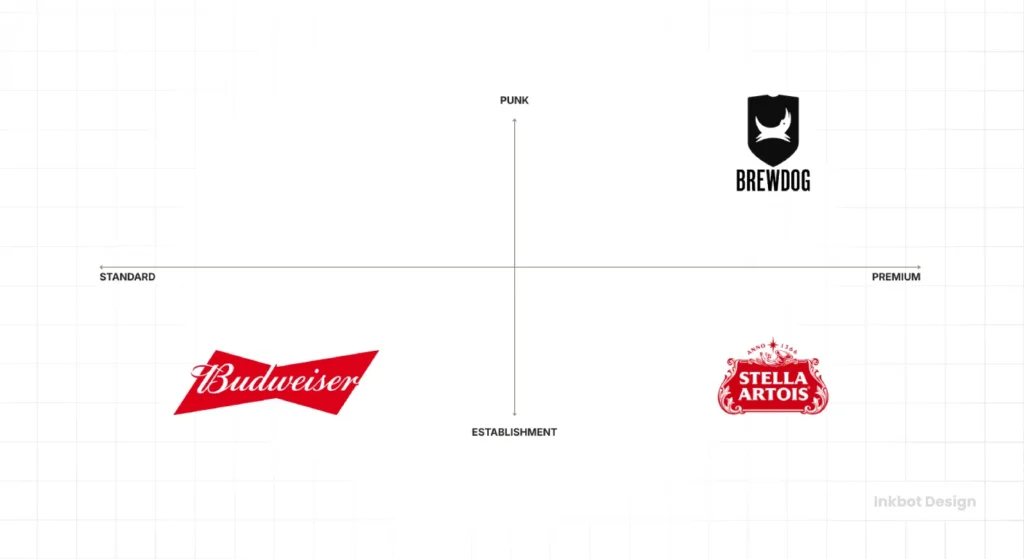
B2B brand positioning frameworks are structured diagnostic tools that compel professional services firms to define their target segment, identify their exact competitors, and demonstrate their specific differentiation.
- They define the precise boundaries of who the firm serves.
- They establish a binary comparison against a named alternative.
- They anchor executive strategy directly to execution channels, primarily the company homepage.
B2B brand positioning frameworks translate abstract business objectives into machine-readable and human-readable market constraints.
Why Defensible Positioning Matters for UK Professional Services
A vague market position destroys margin.
When a buyer cannot immediately determine why a specific 80-person engineering consultancy is materially different from a 400-person global competitor, the buyer defaults to evaluating price.
Industry benchmarks compiled from Gartner, Forrester, and McKinsey indicate that many B2B buyers treat brand as central to supplier value.
Brands that produce clear, evidence‑based positioning see stronger buying preference.
For an MD preparing for acquisition, a tight position directly increases enterprise value. Buyers do not acquire generic capacity; they acquire owned market share.
Consider a regional law firm pitching for a commercial real estate contract. If their positioning claims “full-service excellence,” they face a dozen identical competitors.
If their framework forces them to claim “environmental compliance for brownfield logistics developments,” the competitive set shrinks to three, and their fee premium is justified by specialised risk reduction.
The Anatomy: 7 B2B Brand Positioning Frameworks That Work
Professional services firms must anchor their strategy in frameworks that bridge the gap between technical truth and buyer understanding.
1. The Anthony Pierri 4-Question Model
This framework strips away corporate jargon and demands absolute clarity. Anthony Pierri’s model asks four sequential questions: What is your product? Who is it for? What does it replace? Why is it better?
You must define the offering concretely. Buyers care about what you actually deliver, not your figurative “solutions.”
Naming what the service replaces forces clear differentiation, creating a binary decision point for the procurement director.
2. The Open Strategy Partners (OSP) Value Map
The OSP Value Map connects the internal reality to the buyer’s external pressure.
It inventories technical truth (what the service actually is), links it to specific challenges (the friction the buyer faces), and maps the benefits (the commercial outcome).
This framework stops technical experts from communicating exclusively in jargon. It generates value cases structured strictly as “Benefit, Challenge, Solution,” ensuring every claim is anchored in reality rather than marketing fluff.
3. The 7-Box Canvas Execution Model
Strategy is useless if it is not visible where buyers actually look. The 7-Box Canvas takes the core positioning statement and maps it directly onto the structural elements of a website.
The top boxes contain the core positioning statement, and everything below supports it. By colour-coding homepage sections to match the canvas, firms guarantee visual and strategic consistency across all channels. If the positioning cannot survive on the homepage, it will not survive in the market.
4. The Category Constraint Framework
Instead of inventing a new category that would require millions in educational marketing to explain, this framework forces firms to claim a specific subsection of an existing, funded category.
If you are an IT managed services provider, you do not invent “Holistic Digital Transformation Services.”
You position yourself as “IT Managed Services for FCA-Regulated Financial Planners.” You borrow the parent category’s established budget while monopolising the specific niche.
5. The Evidence-Based Proof Framework
Trust is the single strongest driver of B2B choice in 2026. Buyers demand proof of reliability, compliance, and ethical alignment.
This framework structures positioning around verifiable data points rather than subjective claims.
Every claim of “faster close times” or “reduced risk” must be paired immediately with a named case study, a specific data point from a known client, or third-party validation from a recognised industry analyst. An unsupported abstraction is a liability.
6. The AI-Discovery Alignment Model
AI‑driven discovery via chat agents is reshaping how B2B brands are evaluated. Brands must be machine‑readable as well as human-readable.
This framework structures brand narratives into tight, entity-dense formats. It requires consistent terminology, explicit definitions of service boundaries, and structured data.
If a Large Language Model cannot easily extract and categorise your firm’s specific expertise, you will not appear in AI-generated vendor shortlists.
7. The Consensus-Building Narrative
Buying committees have grown, and sales cycles have lengthened. A framework must provide proof points tailored to multiple stakeholder types.
The messaging that convinces a Chief Financial Officer (cost reduction, compliance) differs entirely from the messaging required for a Chief Technology Officer (integration capability, uptime). This framework maps the core positioning to the specific objections of each individual on the buying committee.
Where B2B Positioning Fails: The Expansion Trap

The most common error in strategic rebranding is treating positioning as an exercise in expanding the total addressable market. Leadership teams often fear leaving money on the table, so they instruct their agencies to soften the language.
They replace “We audit pharmaceutical supply chains” with “We optimise global operational efficiency.”
In doing so, they break the very mechanism that makes positioning work.
B2B brands that make buying easier through clarity and friction‑free experiences can accelerate close times by up to 31%. Clarity requires exclusion.
When you refuse to exclude anyone, you guarantee a high-friction buying experience because the prospect must work out for themselves if you actually solve their specific problem.
“Most B2B positioning fails because it never leaves the strategic document. If a positioning framework does not dictate exactly what appears on the homepage and what the sales team says in the first five minutes of a pitch, it is entirely useless. Alignment is an outcome of visible constraints, not hidden strategy.”
A Worked Application: The Mid-Tier Consultancy
Consider a 120-person HR consultancy in Birmingham undergoing a brand repositioning ahead of an aggressive growth phase.
Currently, they describe themselves as providing “comprehensive human capital solutions for modern enterprises.” They are losing pitches to specialised boutiques on one side and massive global firms on the other.
Applying the 4-Question Model, they are forced to answer:
- What is it? Restructuring and redundancy legal compliance consulting.
- Who is it for? UK manufacturing firms with 500+ employees.
- What does it replace? Ad-hoc employment lawyers and generic HR software.
- Why is it better? We guarantee zero tribunal claims for structural reorganisations.
By applying this framework, they have massively reduced their total addressable market. But they have also reduced their competition to near zero. When a large manufacturer needs to restructure, this specific firm becomes the only logical choice.
Reducing Ambition on Purpose
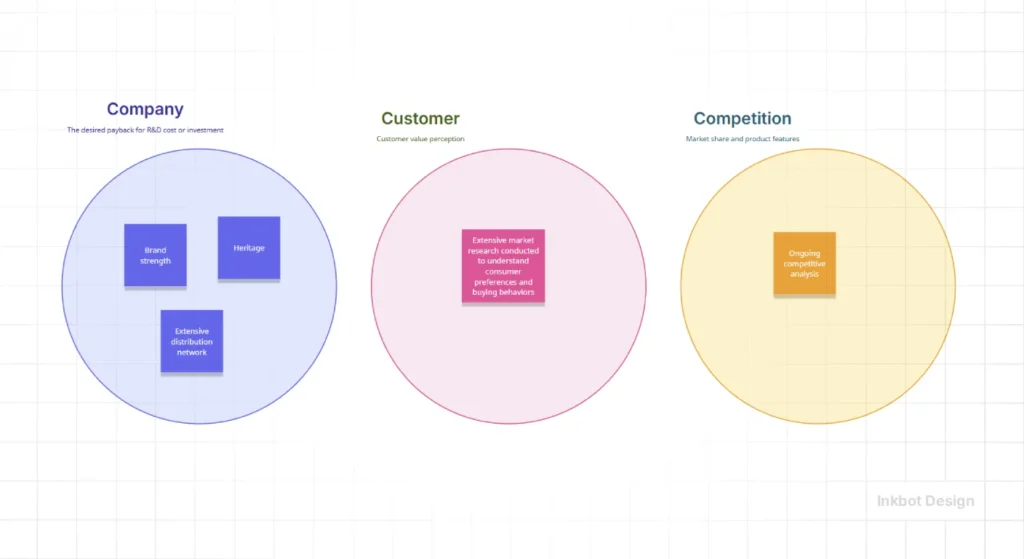
The prevailing view in B2B marketing is that a brand must stand out while appealing to the broadest possible segment of its target audience.
Many intelligent practitioners advocate for creating flexible brand messaging that can adapt to different industries or company sizes.
This is structurally incorrect for professional services.
The best B2B brand positioning frameworks are those that deliberately reduce ambition. Positioning is a strategic constraint. A framework is valuable only if it helps a company decide who it is for, what it will not do, what it can prove, and why a competitor cannot easily copy it.
If your executive team sits around a table and everyone easily agrees on the new positioning statement, the framework has failed.
Effective positioning must feel slightly uncomfortable because it requires turning away revenue that falls outside the defined segment.
If a £10m agency decides to serve only financial services, it must be willing to decline a £200k contract from a healthcare provider. If they take the healthcare contract, the positioning is dead.
This focus is essential because Forrester predicts ungoverned generative AI in commercial apps will cost B2B companies more than $10 billion, highlighting the critical need for tightly governed brand voice and strict, evidence‑based claims.
You cannot govern a brand voice that tries to speak to everyone.
The Verdict
Positioning is the act of deciding what game you are playing and who you are playing it against.
B2B brand positioning frameworks are not creative exercises; they are the architectural blueprints that dictate the commercial boundaries of a professional services firm.
We have seen that generic differentiation leads to price wars, while frameworks that force specific trade-offs generate defensible market share.
The goal is not to sound unique.
The goal is to define a segment so clearly that a buyer reading your homepage immediately understands why you are the only logical choice for their specific problem, and why your competitor is an unacceptable risk.
Stop auditing your competitors’ marketing copy to find an angle. Audit your own technical truth, isolate the exact commercial pressure your best clients face, and build your firm’s entire public presence around that single intersection.
FAQs
Why do most B2B brand positioning frameworks fail in execution?
Most B2B brand positioning frameworks fail because they are treated as internal strategy documents rather than strict operational guidelines. If the framework does not explicitly dictate the exact wording on the company homepage and the exact claims made in sales pitches, the positioning strategy will never reach the buyer.
How does positioning differ from a value proposition?
Positioning defines the exact space a firm occupies in the market relative to named competitors and specific target segments. A value proposition is the specific commercial outcome a client achieves by hiring that firm. Positioning is the foundation; the value proposition is the resulting claim.
What is the most effective way to test a new positioning statement?
The most effective way to test a new positioning statement is to place it immediately on the homepage. If it clearly answers what the service is, who it serves, what it replaces, and why it is better, it works. If it requires a paragraph of explanatory text to make sense, it has failed.
Is it true that niche positioning limits business growth?
No — niche positioning accelerates business growth by reducing the time it takes to close a sale. Forcing a firm to serve a specific market segment eliminates generic competitors. A firm can scale faster by dominating a tight niche and commanding premium fees than by fighting for generic contracts.
When should a professional services firm change its positioning?
A professional services firm should change its positioning when its current market position no longer justifies its fees, when it repeatedly loses pitches to smaller specialist firms, or when it prepares for a major structural change, such as an acquisition or a shift into a new sector.
How do AI search tools impact B2B brand positioning?
AI search tools require positioning to be entity-dense and explicitly defined. If a firm uses vague marketing jargon instead of concrete definitions of its services and target audience, Large Language Models cannot accurately categorise the firm, resulting in its exclusion from AI-generated vendor shortlists.
What role does evidence play in a positioning framework?
Evidence transforms a positioning framework from a marketing claim into a defensible business asset. Every differentiator claimed within a framework must be immediately supported by verifiable data, named client case studies, or third-party analyst validation to satisfy the trust requirements of B2B buying committees.
How long should it take to implement a new positioning framework?
It should take no longer than four to six weeks to define and agree upon a new positioning framework. The implementation phase—updating the website, training the sales team, and aligning public communications—should follow immediately, driven strictly by the constraints defined in the framework itself.
Can multiple positioning frameworks be used simultaneously?
No — using multiple positioning frameworks simultaneously creates conflicting directives and dilutes the core message. A firm must select one governing framework, such as the Anthony Pierri 4-Question Model, and apply it ruthlessly across the entire organisation to maintain strategic and operational alignment.
Why is the company homepage critical to positioning?
The company homepage is critical because it acts as the single source of truth for the brand. If the strategic constraints established by the positioning framework are not immediately visible in the homepage’s hero section, the strategy does not practically exist in the market.
