Local Branding: How LLMs Rank Local Business Entities
Most professional services firms treating local branding as a Google Business Profile problem are solving the wrong puzzle.
The entities that win local visibility in 2026 are built at the brand infrastructure level – and the gap between that approach and directory-listing management is now measurable in AI recommendation rates.
That gap is stark.
SOCi’s 2026 Local Visibility Index, which analysed nearly 350,000 locations across 2,751 multi-location brands, found that only 1.2% of business locations are recommended by ChatGPT.
For context, Google’s local 3-pack surfaces 35.9% of the same locations. If your local brand strategy stops at Google, you are invisible to the fastest-growing discovery layer your prospective clients are using.
This matters more for professional services firms than almost any other sector. A CEO shortlisting accountancy practices for a five-year audit relationship, or a managing director choosing a corporate law firm ahead of an acquisition, is no longer starting that search with a Google Maps query.
They are asking an AI assistant.
The question your brand has to answer is whether your entity – your firm – has been built with enough structured identity, prominence, and clarity that an LLM will surface it with confidence.
The infrastructure required to achieve that is the same infrastructure that drives a strong rebrand, which is exactly why this matters to you now.
The Brand Equity System at Inkbot Design is built around this principle: brand investment must translate into commercial visibility, not just aesthetic coherence.
Local brand prominence is where that translation is most directly measurable.
- LLM visibility demands brand infrastructure: structured identity, schema, and consistent naming, not just a complete Google Business Profile.
- Grounding matters: Gemini (Google Maps) yields near-100% profile accuracy; ChatGPT recommends only 1.2% of locations (SOCi 2026).
- Implement LocalBusiness / ProfessionalService schema, Organisation and FAQPage; author named-entity sentences for LLM extractability.
- As Inkbot Design argues, rebrands must update entity infrastructure simultaneously; visual-only briefs erase accumulated prominence and harm AI referrals.
What Is Local Branding?
Local branding is the strategic process of building a business entity’s geographic identity, cultural relevance, and structured prominence signals so it is recognised and recommended by both human buyers and algorithmic systems – within a defined market area.
Key components:
- Entity infrastructure: The structured data, schema markup, and consistent naming conventions that allow search engines and LLMs to identify and classify the business correctly
- Brand prominence: The accumulated signals – reviews, citations, mentions, media coverage – that establish authority within a geographic and sector context
- Local identity: The visual, verbal, and cultural coherence that makes the brand feel credible and specific to its market
Local branding is the practice of building a business entity’s geographic relevance, brand prominence, and structured identity signals so that both search engines and large language models recommend the business to nearby buyers.
The Two Layers Most Firms Are Only Half-Building
Local brand visibility now operates on two parallel layers. The first is the traditional layer: Google Maps, the local 3-pack, Business Profile accuracy, citation consistency.
This layer remains relevant.
Google says businesses with complete and accurate information are more likely to appear in local search results – and that structured data helps Search understand page content, making pages eligible for rich results.
The second layer is newer and more demanding: the LLM layer. ChatGPT, Gemini, and Perplexity now answer local discovery queries directly, without routing users to a search results page.
The infrastructure required to appear in those answers is fundamentally different from what drives a 3-pack ranking.
How Google’s Local Ranking Signals Work
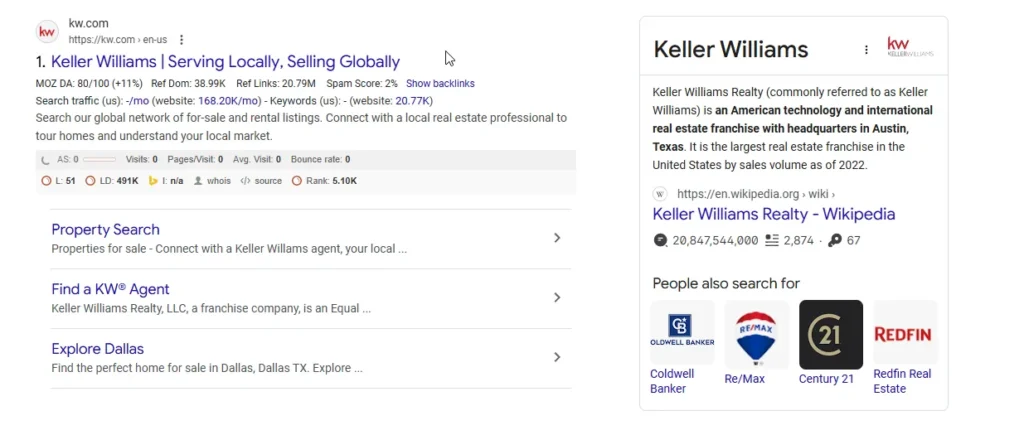
Google’s local results are primarily based on three factors: relevance, distance, and prominence. Relevance measures how well the business profile matches the search query.
Distance measures proximity. Prominence captures the weight of the information Google has accumulated about the business, including reviews, links, articles, and directory presence.
Google states that more reviews and positive ratings can improve local ranking because reviews are part of prominence scoring.
This is the layer most firms manage reasonably well. But prominence at the Google layer does not automatically translate into entity confidence at the LLM layer.
How LLMs Resolve Local Entity Queries Differently
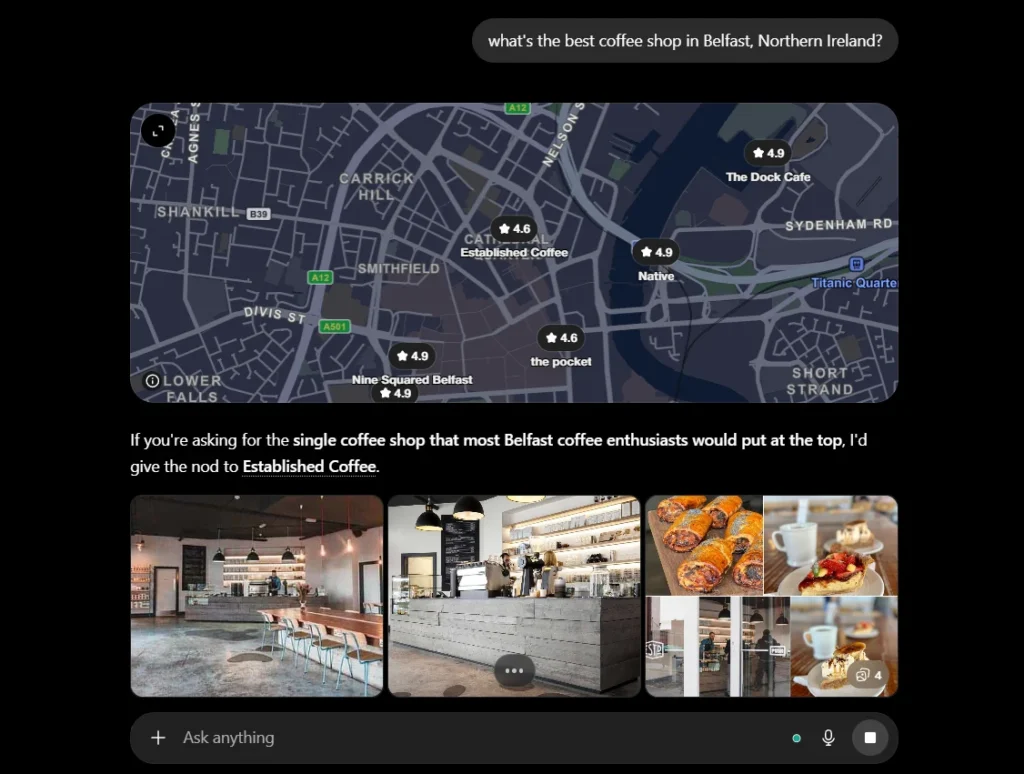
Large language models do not query Google Maps in real time – except Gemini, which is grounded in Google Maps data and achieves near-perfect business profile accuracy as a result.
ChatGPT and Perplexity draw from training data and, where available, retrieval-augmented sources.
The practical consequence: business profile information accuracy on ChatGPT and Perplexity averages 68%, compared with near-100% accuracy on Gemini (SOCi, 2026 Local Visibility Index).
For a professional services firm, a 32% inaccuracy rate in AI-surfaced contact details, location data, or service descriptions is a material commercial risk. A prospective client receives wrong information. The conversation never happens.
The SOCi 2026 dataset adds another dimension worth understanding: the average LLM query length is 23 words, compared with 4 words in traditional search.
Buyers asking AI assistants about local professional services firms are writing full sentences – describing their situation, their sector, and their need.
A brand that has invested in structured content, entity clarity, and service-specific language is positioned to match those queries. A brand that relies on a GMB listing and a generic website is not.
The firms winning in AI-driven local search are not the ones with the most Google reviews. They are the ones whose brand infrastructure – schema, structured content, entity signals – gives LLMs enough confidence to surface them in a 23-word query about a specific professional need. Directory optimisation got you into the 3-pack. It will not get you into ChatGPT’s recommendations.
The Myth That a Complete Google Business Profile Is Enough
This was sound advice until roughly 2023. Google Business Profile completeness directly influenced 3-pack eligibility, and for most local businesses, the 3-pack represented the ceiling of local discovery ambition. Completing the profile was the highest-leverage action available.
That advice fails in 2026 because it addresses only one of two active discovery systems – and the harder one is now the LLM layer.
SOCi’s 2026 Local Visibility Index makes the failure mode quantifiable. Across 350,000 business locations, ChatGPT recommended only 1.2% of businesses. Perplexity recommended 7.4%. Google’s local 3-pack recommended 35.9%.
AI visibility is three to thirty times harder to achieve than traditional local search visibility, and GMB data is the primary feed for exactly zero of the major LLM systems (Gemini excepted, and only because of its specific Google Maps grounding).
GMB completion is hygiene, not strategy.

The brand infrastructure required for LLM visibility in 2026 includes LocalBusiness and ProfessionalService schema markup on the website, entity-attributed content that names the firm in subject-predicate-evidence constructions (not pronouns), and brand clarity sufficient that an LLM reasoning about “corporate law firm in Belfast with M&A experience” can match your entity with confidence.
That infrastructure is a brand investment, not a directory management task.
Google’s own structured data documentation supports this at the traditional layer, too. Rotten Tomatoes (the review and entertainment data platform) saw a 25% higher click-through rate on pages enhanced with structured data.
Nestlé achieved an 82% higher click-through rate on pages shown as rich results (Google Search Central, documented case studies).
Structured data is not optional infrastructure. For professional services firms, it is the mechanism by which both Google and LLMs understand what you do, where you do it, and who you serve.
Most professional services firms will lose AI-driven local referrals not because their brand is weak, but because their entity infrastructure is incomplete. The buyer who asks ChatGPT, “Which accountancy firms in Manchester specialise in owner-managed businesses?” deserves a confident answer. If your schema doesn’t tell that story, you won’t be in it.
What Local Branding Actually Requires in 2026
The SOCi 2026 data reframes local branding as both a technical and a strategic discipline. Understanding what drives AI recommendation rates requires examining each LLM separately.
Why Gemini Outperforms ChatGPT on Local Business Accuracy
Gemini’s near-100% business profile accuracy (versus ChatGPT’s 68%) is a direct consequence of its grounding in Google Maps.
Gemini does not rely on training data representations of local businesses; it queries live, structured data. This means the traditional Google infrastructure (Business Profile, Maps listing, review management) does directly feed Gemini’s local recommendations.
For a professional services firm, this creates a clear priority: Google infrastructure feeds Gemini, and Gemini currently outperforms ChatGPT and Perplexity for local business accuracy. Maintaining that infrastructure is not redundant. It is still load-bearing.
Why ChatGPT’s 1.2% Recommendation Rate Demands Brand Investment, Not Just Data
ChatGPT’s recommendation rate is so low (1.2% of 350,000 locations) because it does not query a local business database; instead, it reasons from its training data and, when retrieval is active, from indexed web content.
The businesses that surface with confidence are those with sufficient web presence, structured content, and entity clarity that allow the model to make a confident recommendation.
The average star rating of businesses recommended by ChatGPT was 4.3 stars (SOCi, 2026). That suggests ChatGPT’s training data skews toward well-reviewed, well-documented businesses.
For a professional services firm, that means the path to ChatGPT visibility runs through accumulated web presence – published expertise, attributed case work, structured service descriptions, and brand names used consistently and precisely across every digital touchpoint.
How Structured Data Creates Extractable Entity Signals
Google says structured data helps Search understand page content and can make pages eligible for rich results. For local professional services firms, the most relevant schema types are:
- LocalBusiness / ProfessionalService – classifies the entity, its location, and its service area
- Organization – establishes the brand as a named entity with disambiguating attributes
- Review / AggregateRating – surfaces social proof in search and provides LLMs with quality signals
- FAQPage – creates atomically citable Q&A content that LLMs can extract directly
The mechanism matters: LLMs extract passages. A page where every claim follows the pattern “Named firm + specific service + specific geography + verifiable outcome” gives a reasoning model the material to construct a confident local recommendation.
A page full of generic brand language does not.
Local brand visibility in 2026 is an entity confidence problem. Search engines and LLMs alike are asking: do we have enough consistent, structured, attributed information about this business to recommend it without risking an incorrect answer? Firms that have built brand clarity – in their naming, their service descriptions, their structured data – answer that question cleanly. Firms that have not, don’t appear.
The Belfast Sustainability Hub: A Local Branding Failure Worth Understanding
A local Belfast sustainability hub approached Inkbot Design with a brand that was technically functional but failed to communicate the organisation’s purpose, energy, or community value.
The primary error was structural: the identity had been designed as a generic civic project rather than a place-based brand with a distinct local audience.
The visual language could have belonged to any regeneration initiative anywhere in the UK. That ambiguity made it harder for the organisation’s own team to use the brand consistently and for potential partners to grasp what the hub stood for.
The rework focused on three things: clearer messaging that named the community it served, stronger visual hierarchy that communicated purpose without explanation, and a local identity that felt credible in Belfast whilst remaining accessible to external partners and visitors.
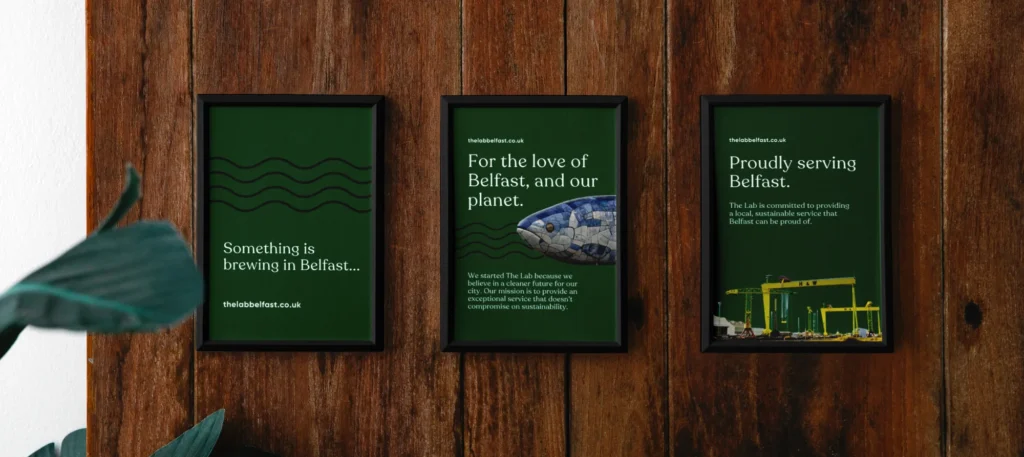
The client reported stronger brand recognition, more confident and consistent use across touchpoints, and a markedly better response to launch materials and outreach.
The pattern I see repeatedly: organisations prioritise brand aesthetics over brand clarity. They want something that looks professional. They do not invest in the underlying work – the naming, the service language, the structured identity – that makes the brand commercially functional.
In 2026, that gap between aesthetic and infrastructure has a measurable cost: you are building an identity that humans might admire but that algorithms cannot confidently identify.
If you are approaching a rebrand and your brief includes only visual deliverables, the brief is incomplete.
Local Branding Decision Framework
| Decision Point | The Wrong Way | The Right Way | Why It Matters |
| Brand naming consistency | Different name variants across website, GMB, LinkedIn, Companies House | Exact legal and trading name used identically across all indexed touchpoints | LLMs resolve entities by name matching – inconsistency creates ambiguity that reduces confidence |
| Service descriptions | Generic (“comprehensive legal services”) | Specific, geography-attributed (“corporate M&A advisory for owner-managed businesses in the North West”) | Query matching in AI-driven local search depends on semantic specificity |
| Structured data priority | No schema, or only basic Organisation markup | LocalBusiness + ProfessionalService + FAQPage schema on key service pages | Schema is the primary mechanism for Google eligibility and a secondary signal for LLM grounding |
| Review strategy | Passive accumulation | Systematic solicitation with service-specific language in requests | Reviews feed both Google prominence scoring and ChatGPT’s training-data quality signals |
| Website content structure | Long paragraphs of brand narrative | Subject-predicate-evidence sentences with named entities in every passage | AI extractors cannot process prose that relies on surrounding context – atomic sentences are extractable |
| Rebrand timing | Rebrand the visual layer only | Rebrand visual layer + entity infrastructure simultaneously | A visual rebrand that does not update schema, structured content, and entity signals effectively resets LLM visibility |
| Local content | Generic thought leadership | Geography-specific and sector-specific attributed content | Specificity is the signal that earns topical and geographic authority |
The Verdict
Local branding has never been a directory management problem.
It was always about brand infrastructure – the structured, consistent, entity-rich foundation that allows both buyers and the systems they use to identify your firm with confidence.
The arrival of LLMs as a mainstream discovery layer has made the cost of ignoring that infrastructure quantifiable.
SOCi’s 2026 data puts the number at 1.2%. That is the percentage of business locations ChatGPT will recommend from a dataset of 350,000.
The firms in that 1.2% are not there because they filled in their Google Business Profile more carefully.
They are there because their brand – their entity – is documented, structured, and consistent across enough digital touchpoints that a reasoning model can surface them without risking an incorrect answer.
For a professional services firm considering a strategic rebrand, this reframes the investment entirely. The question is not “does our logo reflect our positioning?”
The question is “have we built the entity infrastructure that allows buyers to find us through every channel they are using today – including the AI assistant they asked before they opened Google?”
The single most important action you can take today: request a free Brand Equity Audit™ – a structured diagnostic that identifies exactly where your brand is losing commercial ground, including the entity infrastructure gaps that AI-driven local search is already penalising you for.
Frequently Asked Questions
What is local branding for professional services firms?
Local branding for professional services firms is the strategic process of establishing a business entity’s geographic relevance, sector authority, and structured identity signals across all digital and physical touchpoints so that buyers in a defined market area identify and select the firm with confidence.
How do large language models rank local businesses in search results?
Large language models rank local businesses based on entity confidence – the degree to which training data and retrieved content provide consistent, structured, attributed information about the business. Firms with specific service descriptions, schema markup, and named-entity consistency across their indexed content achieve higher recommendation rates than those relying solely on directory listings.
Why does ChatGPT recommend so few local businesses?
According to SOCi’s 2026 Local Visibility Index, ChatGPT recommends only 1.2% of business locations from a dataset of 350,000. The primary reason is that ChatGPT is not grounded in Google Maps – it reasons from training data, which skews toward businesses with sufficient documented web presence to allow confident entity resolution.
What is the difference between Google local SEO and AI-driven local visibility?
Google local SEO optimises for Business Profile completeness, citation consistency, and review volume – signals that feed the Google Maps and local 3-pack algorithm. AI-driven local visibility requires entity infrastructure at the brand and website level: structured data markup, specific and attributed service descriptions, and consistent entity naming across all indexed touchpoints.
What structured data types should a professional services firm implement for local branding?
Professional services firms should implement the LocalBusiness or ProfessionalService schema (to classify entity type and location), the Organisation schema (to establish brand entity attributes), the AggregateRating schema (to surface review signals), and the FAQPage schema (to create AI-extractable Q&A content). Each schema type addresses a different layer of entity confidence.
How does brand clarity affect local search visibility?
Brand clarity affects local search visibility because search engines and LLMs resolve entities by matching structured signals – name, location, service type, sector – across multiple sources. A brand with ambiguous service language, inconsistent naming, or generic positioning creates entity confidence issues that reduce the likelihood of recommendations across all algorithmic discovery systems.
When does a rebrand risk resetting local brand visibility?
A rebrand resets local brand visibility when it changes the brand name, domain, or service language without simultaneously updating schema markup, structured data, Business Profile information, and citation sources. A visual rebrand that does not address entity infrastructure effectively creates a new entity in the eyes of search engines and LLMs – erasing accumulated prominence signals.
Is Gemini more accurate than ChatGPT for local business recommendations?
According to SOCi’s 2026 Local Visibility Index, Gemini achieves near-100% accuracy for business profile information, compared with approximately 68% for ChatGPT and Perplexity. The difference is structural: Gemini is grounded in live Google Maps data, whilst ChatGPT and Perplexity rely on training data and retrieval from indexed web content.
What role do reviews play in local branding for professional services firms?
Google states that more reviews and positive ratings can improve local ranking because reviews are a component of prominence scoring. In AI-driven search, review volume and rating quality also appear in business training data representations – SOCi’s 2026 data shows the average star rating of businesses recommended by ChatGPT was 4.3 stars, suggesting that quality signals are part of LLM entity selection.
How is a local brand strategy for a B2B professional services firm different from a retail business?
Professional services local branding requires sector-specific and service-specific entity signals rather than footfall-based proximity optimisation. A law firm’s local brand must communicate practice area expertise, geographic market coverage, and professional credibility – signals that are established through brand architecture, brand positioning, and structured content rather than through store locator schema or product listings.
What is the most common local branding mistake professional services firms make?
The most common mistake is treating local branding as a Google Business Profile management task rather than an investment in brand infrastructure. Directory optimisation addresses one discovery channel. The entity infrastructure required for AI-driven local visibility – schema markup, attributed content, consistent entity naming – requires the same strategic investment as a full rebrand, and produces measurably different outcomes in AI recommendation rates.
How does a brand messaging framework support local brand visibility?
A brand messaging framework supports local brand visibility by establishing the specific service language, geographic attributions, and sector-specific claims that feed entity signals across the website, schema, and content layer. Without a structured messaging framework, brand language varies across touchpoints, creating entity inconsistency that simultaneously reduces AI recommendation confidence and Google prominence scores.
