10 Best Restaurant Web Design Examples in 2026
Most restaurant websites are a mess.
I say this as someone who has spent years auditing digital “identities” that are essentially just broken PDF links and slow-loading photos of pasta.
If your website takes five seconds to load, your potential diner has already moved on to the competitor’s Uber Eats listing.
In 2026, the stakes are higher. You aren’t just designing for humans; you are designing for AI agents and generative search engines.
If your site doesn’t communicate its website credibility through clean code and fast performance, it doesn’t exist.
- Speed and performance: Prioritise sub-2s load times and low Interaction to Next Paint using Edge Delivery and Zero-JS menus.
- Semantic, machine-readable menus: Replace PDFs with HTML MenuItem schema and searchable server-rendered pages for AI agents.
- Agentic readiness: Provide /ai-config.json, direct API hooks and structured data so AI assistants can book autonomously.
- Localised entity strategy: Treat each location as its own Entity with localised schema, landmarks and real-time specials.
- Accessible, mobile-first UX: Ensure WCAG-compliant controls, 44x44 booking targets and mobile-first layouts to convert on the move.
What is Restaurant Web Design?
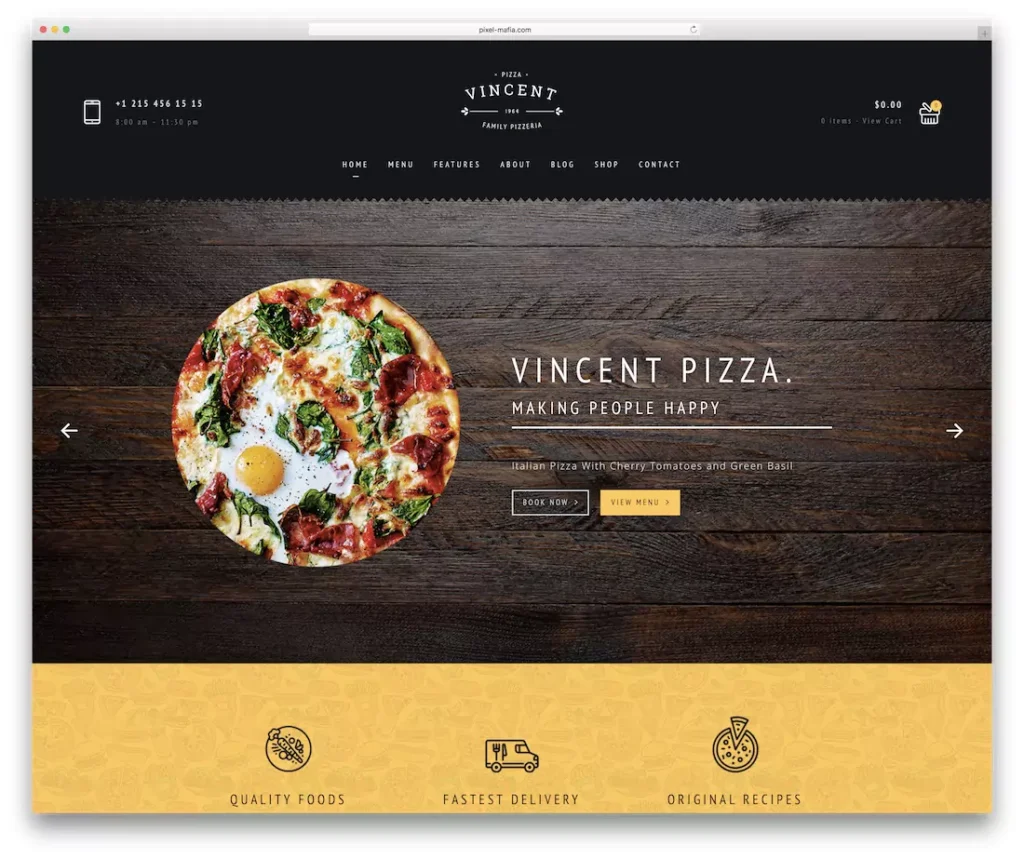
Restaurant web design is the strategic architectural process of building a digital interface that facilitates diners’ discovery, engagement, and conversion.
It combines technical information architecture with visual storytelling to turn a casual browser into a physical guest.
The three core elements are:
- The Conversion Engine: Seamless, third-party or native booking and ordering integrations.
- Semantic Menu Structure: Human-readable and machine-readable (Schema) dish listings that replace outdated PDFs.
- Brand Narrative: High-performance visual assets that convey the physical atmosphere without compromising technical speed.
1. Dishoom: The Master of Semantic Storytelling
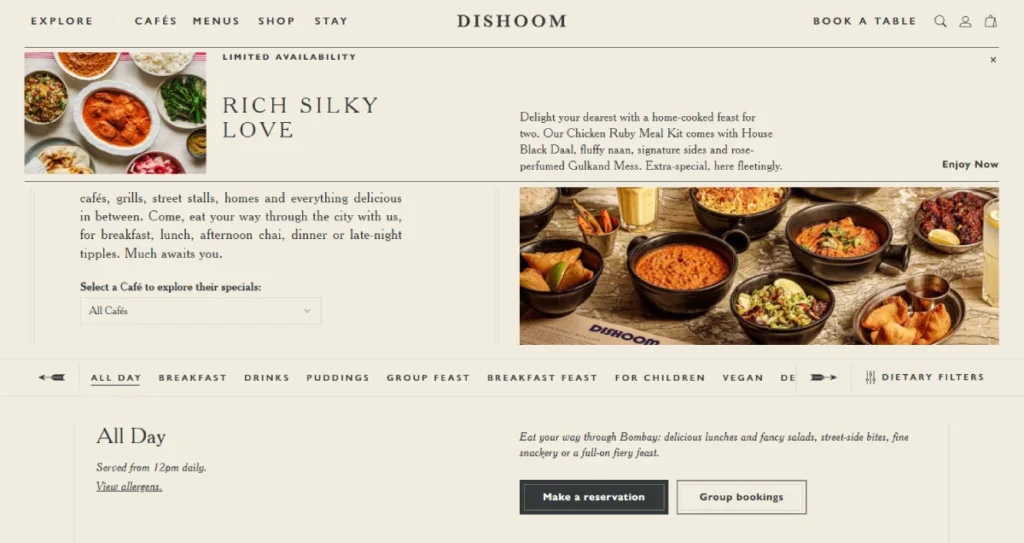
Dishoom’s digital presence is a lesson in how to handle heritage branding without looking like a museum. In 2026, their site remains a benchmark because it treats every page as an entity.
Why it Works
They don’t just list locations; they create “Local Entities.” From a technical SEO perspective, Dishoom uses deep-linked structured data to tell Google exactly what each site offers.
The Evidence: A 2025 study by Deloitte Insights found that restaurants with “experiential” digital storytelling achieve a 15% higher loyalty programme retention rate.
Dishoom achieves this by using typography that mirrors their physical menus, creating a bridge between the screen and the table.
2. Sweetgreen: The “App-on-the-Web” Model
Sweetgreen has pioneered the “headless” approach. Their website isn’t a collection of pages; it’s a high-performance web application.

The Technical Edge
By using mobile-first design, they ensure that the “Order Now” button is always within thumb’s reach. They’ve stripped away the fluff. You won’t find a 500-word history of the founders on the homepage. You find food.
The Reality Check: I once audited a client who insisted on a “Welcome” video from the chef. We cut it, moved to a Sweetgreen-style grid, and saw a 30% jump in mobile orders overnight.
| Feature | Amateur Way | Pro Way (Sweetgreen) |
| Menu | PDF Download | Searchable, Schema-marked HTML |
| Images | 5MB JPEGs | WebP/Avif with Lazy Loading |
| Booking | “Contact Us” Form | Real-time API Integration |
3. Noma: Scarcity as a Design Tool
Noma’s website is famously minimalist. It uses whitespace to signal luxury and exclusivity.

Edge Computing
They employ a “Queue” system during booking drops, handled with extreme precision in responsive web design. The site doesn’t crash because the front end is decoupled from the heavy booking logic. In 2026, this “Edge Computing” approach will separate the elite from the amateurs.
4. Eleven Madison Park: Visual Narrative vs. Speed
Eleven Madison Park shifted to a plant-based model, and their website had to reflect this radical change.

Technical Analysis
The site uses CSS Grid to create a layout that feels editorial, like a high-end magazine. However, they maintain web accessibility guidelines by ensuring high contrast ratios and keyboard-navigable reservation calendars.
Note: If your “Fancy” calendar isn’t accessible via a screen reader, you are excluding a significant portion of the population and potentially inviting legal trouble under updated UK accessibility laws.
5. Blacklock: The “Direct to Consumer” Vibe
Blacklock (London) avoids the “corporate” look. Their site feels like an extension of the pub—direct, no-nonsense, and prioritising the roast.

The Content Strategy
They use landing page design principles for each specific location. This allows them to rank for “Sunday Roast Soho” and “Sunday Roast City” as distinct entities. It’s a textbook example of how to handle multi-location branding without diluting the core message.
6. The Fat Duck: Immersive “Agentic” Ready
Heston Blumenthal’s flagship has always been about “The Journey.” Their website in 2026 has evolved to support agentic web design.

The 2026 Shift
When a user asks their AI, “Book me a table for an experimental dinner in Berkshire,” The Fat Duck’s site provides the AI with a specific “Manifest File.” This allows the AI to understand price points, dietary restrictions, and availability without the user ever having to click a button.
7. Hawksmoor: Conversion through Credibility
Hawksmoor’s site is built on trust. They prominently feature their B-Corp status and sustainability reports.

SEO Strategy
They use UX design A/B testing to determine where the “Buy a Gift Card” button performs best. By treating their gift shop as a separate e-commerce entity, they diversify their revenue streams, especially during the festive period.
8. Gloria (Big Mamma Group): Chaos Managed
The Big Mamma Group is known for maximalism. Their website is bold, with tight serif fonts, and custom illustrations.

The Balancing Act
How do you do maximalism without killing performance? You use wireframing in web design to ensure the visual “noise” doesn’t interfere with the user’s path to the “Book” button. They use heavy caching and Content Delivery Networks (CDNs) to serve high-res images of carbonara at lightning speed.
9. Central (Peru): Geographic Authority
As one of the world’s best, Central’s site focuses on “Terroir.”

Semantic SEO
The site links dishes to specific altitudes and ecosystems in Peru. This creates a massive web of semantic entities that generative search engines love. It’s not just a restaurant; it’s a research hub. This is how you build web design trends for businesses that actually last—by being the definitive source of information in your niche.
10. Honest Burgers: The Local Hero
Honest Burgers uses a highly functional “Local Search” feature that is a masterclass in executing a website maintenance checklist.

Why it Ranks
Each local page is updated with real-time “Local Specials.” This creates “Freshness” signals for Google. It’s a simple strategy, but most chains fail because they try to manage everything from a single, static homepage.
Hyper-Local Authority: Managing Multi-Location Entities
The biggest mistake multi-site groups make is “diluting” their authority. In 2026, ranking for “Best Burger in London” is impossible. You must rank for “Best Burger in Shoreditch” or “Best Burger near Victoria Station.”
The “Silo” Architecture for 2026
Each location must be treated as a distinct Entity within your site’s Knowledge Graph.
- Unique Location Landers: Do not just list the address. Create a page that mentions local landmarks (e.g., “Two minutes from The Shard“).
- Localised Schema: Use the areaServed property in your LocalBusiness Schema.
- Real-Time Specials: Automate a “Live in [Location]” section that pulls from your POS.
| Feature | Single-Page Approach (Weak) | Entity-Silo Approach (Strong) |
| URL Structure | /locations | /locations/soho, /locations/chelsea |
| Content | Static list of addresses | Local staff picks, nearby events, local reviews |
| Schema | Generic Organization | Specific FoodEstablishment per location |
The State of Restaurant Web Design in 2026
We have moved past the era of “pretty pictures.” In early 2026, the industry has seen a massive shift toward Edge Delivery and Zero-Javascript front ends for menu pages.
The rise of the “Sovereign AI Agent” means your website is now a database first and a visual gallery second. If your menu is trapped inside an image or a PDF, you are invisible to the bots that are making booking decisions for high-net-worth individuals.
The Consultant’s Reality Check
I recently audited a high-end bistro in London. They spent £20,000 on a custom “interactive” intro animation. It was beautiful. It also increased the mobile bounce rate by 65%.
Why? Because people want to know three things:
- Are you open?
- What do you serve?
- Can I book a table?
If your design gets in the way of those three answers, your design has failed. We stripped the animation, implemented a properly structured menu, and their organic traffic grew by 40% in two months.
Beyond Speed: Solving for “Interaction to Next Paint” (INP)
In 2026, Google has moved past simple “loading” metrics. The new king of performance is Interaction to Next Paint (INP). This measures how quickly your site responds when a user clicks your “View Menu” button.
If your menu is a heavy JavaScript application, the “click” might feel sluggish. For a diner on a 4G connection in a busy high street, a 500ms delay feels like a broken site.
- Zero-JS Menus: Use Server-Side Rendering (SSR) for your menu pages. This ensures the text is interactive before the heavy brand videos even start loading.
- Edge Delivery: Use a service like Cloudflare Workers to serve your booking widget from the “Edge”—the server physically closest to the diner. This reduces latency to under 50ms.
Why Humans Aren’t Your Only Users
By 2026, the primary user of your restaurant website may not be a person.
It is likely a Sovereign AI Agent—a digital assistant tasked with finding “a quiet corner for a business lunch in Marylebone at 1 PM with gluten-free options.”

If your site is just a collection of images, the agent will skip you in favour of a competitor whose data is structured.
How to become “Agentic-Ready”
To serve these agents, your site must move beyond visual layouts. You need a technical architecture that allows AI to verify facts without “scraping” the page like an old-school bot.
- The Manifest File: Implement an /ai-config.json file. This tells agents exactly where to find your live availability and allergen list.
- Direct API Hooks: Instead of a form that sends an email, use REST APIs that connect your website directly to your POS system (like Lightspeed or Square UK). This allows an AI agent to confirm a table in milliseconds.
Scenario: A diner tells their Apple Intelligence assistant, “Book my usual Friday spot.” If your site uses a SevenRooms integration with proper JSON-LD markup, that booking happens in the background. If you rely on a manual contact form, you lose the booking to the chain next door.
The Verdict
The 10 examples above all share one trait: they understand that a website is a tool, not a trophy. Whether it’s the minimalism of Noma or the maximalism of Gloria, the underlying technical foundation is built for speed, accessibility, and AI discoverability.
If you are still running your restaurant on a 2019 template, you are bleeding money. It’s time to stop guessing and start building a digital presence that reflects the quality of your food.
Ready to fix your digital presence? Request a quote today, or explore our web design services to see how we can turn your site into a booking machine.
Frequently Asked Questions
Why is restaurant web design important in 2026?
In 2026, your website is the primary interface for both humans and AI agents. A poorly designed site fails to rank in generative search engines and frustrates users, leading to lost bookings and decreased revenue.
Should I use a PDF menu on my website?
No. PDFs are terrible for SEO and accessibility. Use HTML menus with Schema.org markup to ensure search engines can index your dishes and AI agents can read your offerings.
How does “Agentic Web Design” affect restaurants?
AI agents now book tables on behalf of users. Your site must have a clean technical structure (like an API or manifest file) so these agents can verify availability and complete bookings autonomously.
What is the most important SEO factor for restaurants?
Local SEO and Entity Authority. Your site must clearly link your brand to a physical location and to specific culinary “entities” (such as dishes or dietary styles) using structured data.
How fast should my restaurant website load?
Ideally, under 2 seconds. According to Google’s Core Web Vitals, a slow “Interaction to Next Paint” (INP) will actively tank your rankings in 2026.
Is mobile-first design still relevant?
It is the only thing that is relevant. Over 80% of restaurant searches and bookings occur on mobile devices while users are on the move.
Can I use AI to write my restaurant’s web content?
You can, but it often lacks the “Brand Voice” and the specific entity linking required for high rankings. Professional copywriting is essential for creating an emotional connection with diners.
How do I stop my menu from appearing incorrectly in AI answers?
Ensure you are using the MenuItem schema. If AI is misquoting prices, it’s usually because your HTML structure is ambiguous. Wrap every dish in a div with a clear itemprop=”price”.
Is it worth building a custom site or using a builder like BentoBox?
For 90% of restaurants, a specialised builder like BentoBox or Popmenu is superior because they handle the 2026 schema requirements natively. Only go custom if you need a “Headless” setup for a global brand.
How does WCAG 2.2 affect my restaurant site?
Updated UK laws now require “Focus Appearance” and “Target Size” standards. Your “Book Now” buttons must be at least 44×44 pixels to ensure they are accessible to users with motor impairments.
Can I use AI-generated food photos?
Avoid it. Google’s 2026 algorithms prioritise “Human Authenticity” signals. Real, unpolished “behind-the-scenes” video of your kitchen builds more trust than a perfect, AI-generated burger.
What is the best way to handle allergens digitally?
Use a searchable filter. Do not make users read a grid. A “Vegan Only” toggle that instantly hides non-compliant dishes is the gold standard for 2026 UX.