Your SaaS Brand Identity Isn’t a Logo Problem — It’s an Uncertainty Problem
A SaaS brand identity is not a visual toolkit bolted onto software. It is the system that reduces buyer uncertainty everywhere the product is judged — the trial, the pricing page, the demo, the renewal call. Get that system right and the logo takes care of itself. Here is how.
 By Stuart Crawford
 Reviewed by Tabitha Ayers
Updated 9 min read
On this page9 min left
Most SaaS rebrands start in the wrong place.
A new wordmark, a refreshed palette, a tone-of-voice document — and six months later the sales cycle is exactly as long, the trial still leaks users at the same wall, and the renewal call still opens with “remind me what you actually do.”
The visual layer changed. The thing buyers were struggling with did not.
That thing is uncertainty. In B2B SaaS, the buyer cannot hold the product in their hands, cannot judge it by its packaging, and increasingly cannot even reach a salesperson before forming a view.
Forrester's State of Business Buying 2026 finds that the typical buying decision now involves 13 internal stakeholders and 9 external influencers — 13 people who each need to feel the risk is survivable before anyone signs.
A logo does nothing to reduce that risk. A brand system does, or it fails to, at every point where those thirteen people meet your company.
If you are treating identity as a design deliverable rather than a commercial instrument, our branding services exist to close exactly that gap.
What a SaaS Brand Identity Actually Is
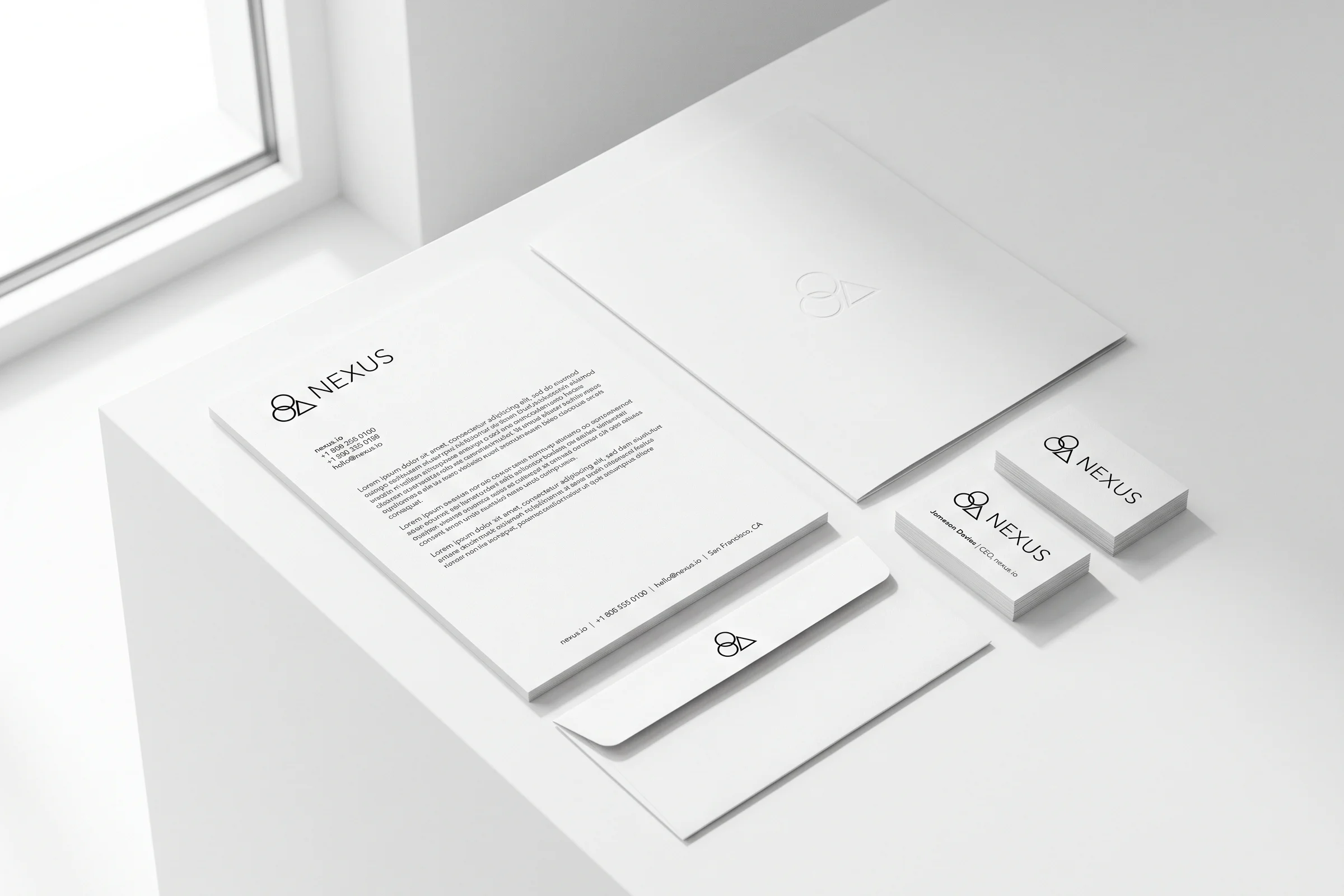
A SaaS brand identity is the coordinated system of signals — verbal, visual, structural, and experiential — that reduces buyer uncertainty across the product experience, sales motion, and customer lifecycle. It is not the logo, though it includes one. It is what makes a hesitant buyer feel the decision is safe.
- It operates wherever the buyer forms a judgement: on the pricing page, during the trial, in the demo, during the security review, and at renewal.
- It succeeds when every one of those touchpoints tells the same story about who the product is for and what it reliably does.
- It fails silently — not with an ugly logo, but with a coherent-looking company that confuses the buyer the moment they go past the homepage.
A SaaS brand identity is the coordinated system of signals that reduces buyer uncertainty across the product experience, sales motion, and customer lifecycle.
Why Consistency Isn't the Goal — Uncertainty Reduction Is
Every ranking article on this topic lands on the same advice: be consistent. Same colours, same voice, same message across marketing, sales, and product.
Intelligent people believe this for a good reason — inconsistency genuinely does erode trust, and a company whose sales deck contradicts its product is visibly unreliable.
But consistency is a means, and the field keeps mistaking it for the end. You can be perfectly consistent about a promise the buyer can't verify, doesn't care about, or can't feel when they actually use the thing. Consistency of a hollow message just delivers the same hollowness reliably to every stakeholder.
The goal is uncertainty reduction. Consistency matters only because inconsistency introduces uncertainty — the buyer notices two different stories and now has to work out which is true, which is friction, which is risk.
Reframe it that way, and your priorities change. You stop asking “Is this on-brand?” and start asking, “Does this touchpoint make the buyer more certain the product will work in their context?” Those are not the same question, and the second one shortens sales cycles.
“A brand that is consistent but unconvincing has solved the wrong problem with impressive discipline. The buyer does not reward you for saying the same thing everywhere. They reward you for removing the doubt that stops thirteen people from signing.”
Consider the two things a buyer's research findings force together. Gartner's 2025 survey found 67% of B2B buyers prefer a rep-free experience — they want to research and evaluate without being sold to.
The same research environment shows that 69% of B2B buyers still rely on sales representatives to validate AI-generated information because AI answers can be incomplete or incorrect. Those look contradictory. They are not.
The buyer wants to reach a confident conclusion on their own, then have it confirmed. A brand system serves by making the self-service story clear enough that sales can validate a decision rather than reconstruct it from scratch.
Where Your SaaS Brand Is Actually Tested Now
The brand is no longer judged mainly in campaigns and sales decks. It is judged during the trial.
Forrester reports that more than 60% of business buyers use a trial to assess a solution, and among buyers making purchases of $10 million or more, 78% use a trial before committing. The promise is now tested before it is believed.
This changes what counts as a brand touchpoint. The sandbox, the sample workspace, the guided demo, the onboarding sequence, the empty states, the time-to-first-value — these are brand moments, not just product or customer-success concerns.
If your positioning promises simplicity and the trial opens onto a blank screen with fourteen configuration options and no obvious first step, the brand has just contradicted itself at the exact moment the buyer was testing whether to believe it.
No amount of homepage polish repairs that. The buyer already felt the gap.
Discovery has moved too. Forrester's 2026 research finds that generative AI is reshaping how business buyers discover, evaluate, and purchase.
That means the core product narrative can no longer live only on a well-designed homepage — it has to stay legible when an AI assistant summarises you from your documentation, a review platform, a comparison page, and an analyst note, none of which you fully control.
A brand that holds together only on its own website disappears the moment it's discovered elsewhere. Reducing uncertainty now means being coherent across surfaces you do not own.
And you are being assessed inside a crowd. Zylo's 2026 SaaS Management Index reports that organisations in its benchmark average 305 SaaS applications and $55.7 million in annual SaaS spend.
The buyer is not asking “is this good?” in isolation — they are asking “does this earn room in an estate that already has 305 tools, overlapping capabilities, and a security team that has to review one more thing?”
Uncertainty here concerns fit, overlap, and switching costs, and your brand system either answers those questions early or leaves the buyer to assume the worst.
The Product-Architecture Problem AI Just Created
Embedded AI has made product naming a brand-defining decision, not an afterthought.
Gartner predicts 40% of enterprise applications will include task-specific AI agents by the end of 2026, up from less than 5% in 2025.
Every one of those agents, assistants, automations, and intelligence layers forces a naming and hierarchy choice — and made carelessly, those choices turn a coherent platform into a confusing inventory of branded capabilities.
Deloitte expects SaaS in 2026 to become more intelligent, adaptive, and autonomous, and forecasts that investment in agentic AI could reach roughly three-quarters of companies.
Read as a branding problem, that is a forecast of nomenclature chaos. When every vendor ships an “AI Assistant,” a “Copilot,” a “Smart” this and an “Intelligent” that, the labels stop helping buyers understand the offer and start multiplying it.
Product-brand architecture — deciding what a product is, what a feature is, what is merely a capability, and what those things are called — is now the part of SaaS brand identity most likely to be neglected and most expensive to get wrong.
This is closely related to how you handle technology company logos and identity systems when a single platform has to hold many sub-brands together.
The discipline is simple to state and hard to hold: name things at the level the buyer needs to reason about them, and no finer. A buyer needs to know your platform has intelligent automation.
They do not need seven separately branded agents, each with its own name, icon, and marketing page. Every name you add is a small tax on buyer certainty.
Building the System: What Changes in Practice
Building this as an uncertainty-reduction system reorders the work in one specific way: the logo gets made last, not first.
Start with the promise and who it's for — and be ruthless about “plainly.” If your one-liner needs a second sentence to explain the first, a buyer three stakeholders deep will not repeat it correctly to the other twelve.
Then map every point at which a buyer forms a judgement and check whether each one tells the same story. This is where the AI-naming problem gets concrete.
Picture a workflow tool that ships “Aria” (the assistant), “AutoFlow” (the automation engine), and “InsightIQ” (the analytics layer) — three names, three icons, three mini-brands the buyer now has to hold in their head to understand one product.
Collapse them into “the automation your workspace already runs” and the buyer reasons about one thing, not three. That decision — made at the architecture layer, not the logo layer — moves more uncertainty than any colour palette.
Knowing which inconsistency the buyer will actually notice — and which one is invisible to everyone but the design team — is not a checklist item. A pricing page that contradicts the sales narrative costs you deals. A slightly off-brand icon in the footer costs you nothing.
Spending equally on both is how good teams waste rebrand budgets. The same principle governs adjacent decisions, from designing for digital accessibility so the promise reaches every buyer, to whether a brand mascot or character system earns its place or just adds noise.
The Default Approach | What It Costs | The Better Approach | Why |
|---|---|---|---|
Start with the logo and visual system | Months spent before the real problem is touched | Start with the promise and the touchpoint map | The visual layer expresses strategy; it can't substitute for it |
Optimise the homepage | Brand collapses the moment discovery happens elsewhere | Make the narrative legible across owned and unowned surfaces | AI-mediated discovery pulls from docs, reviews, and analysts |
Treat the trial as a product concern | Positioning promise breaks at first use | Design the trial as the primary brand proof | 78% of $10m+ buyers test before believing |
Name every AI feature distinctly | Buyer drowns in nomenclature | Name at the level the buyer reasons about | Every extra name taxes buyer certainty |
Chase consistency as the goal | Reliable delivery of a hollow message | Chase uncertainty reduction; consistency follows | Buyers reward removed doubt, not repetition |
The Verdict
Treat your SaaS brand identity as a logo problem, and you will produce a company that looks coherent and still loses deals it should win — because the buyer's uncertainty was never the logo.
It was the trial that contradicted the pitch, the pricing page that raised a question sales had to unwind, the seven AI agents nobody could keep straight.
Treat it instead as an operating system for reducing uncertainty across the product experience, sales motion, and lifecycle, and the visual work becomes the easy part — the expression of a structure that already holds under a buyer's doubt.
Do one thing today: pick the single touchpoint where a buyer decides whether to trust you — most often the trial or the pricing page — and check, honestly, whether it tells the same story your homepage does. If it doesn't, you have found your real brand problem.
To see exactly where your brand is losing commercial ground across every one of those touchpoints, request a free Brand Equity Audit™ — a structured diagnostic that maps the gaps and tells you what to fix first.
Frequently asked questions
What is a SaaS brand identity?
A SaaS brand identity is the coordinated system of verbal, visual, and experiential signals that reduces buyer uncertainty across the product, sales process, and customer lifecycle. It includes the logo but is defined by whether every touchpoint — trial, pricing, demo, renewal — tells the same story about who the product serves.
Why isn't brand consistency enough for a SaaS company?
Consistency only removes the uncertainty caused by contradiction; it cannot manufacture belief in a promise the buyer can't verify. A company can be perfectly consistent in its messaging, but buyers don't feel it during the trial. The goal is uncertainty reduction — consistency is a by-product, not the objective.
Where do SaaS buyers actually judge a brand?
Increasingly during the trial. Forrester reports more than 60% of business buyers use a trial to evaluate a solution, rising to 78% among buyers spending $10 million or more. The onboarding, empty states, and time-to-value are brand touchpoints, not just product concerns.
How should a SaaS company name its AI features and agents?
Name things at the level the buyer needs to reason about them, and no finer. With Gartner predicting 40% of enterprise applications will include AI agents by the end of 2026, undisciplined naming turns a platform into a confusing inventory. Every additional branded name is a small tax on buyer certainty.
When should a SaaS company rebrand versus refresh?
Refresh when the visual system is dated, but the promise and market still hold. Rebrand when the underlying uncertainty problem has changed — a pivot, a new buyer, a merger, or a portfolio that has outgrown its architecture. The trigger is a changed promise, not a tired logo.
Does this apply to professional services firms, not just SaaS?
Yes — the mechanism is identical. A professional services firm's brand is tested during the proposal, pitch, onboarding, and first invoice, just as a SaaS brand is tested during the trial. The touchpoints after the website decide the deal in both.