The Obscurity Tax: The Real Cost of Poor Positioning
Poor positioning rarely costs a professional services firm its visibility. It costs margin. Every buyer, referrer and AI system that cannot quickly explain why your firm is the right choice forces you to pay for clarity later, through discounts, longer sales cycles, extra proposals and partners personally reassuring buying committees.


On this page9 min left
- Poor Positioning Is a Tax Your Firm Pays on Every Deal
- Why “We Just Need More Visibility” Sounds Right
- Where the Obscurity Tax Gets Paid
- Thirteen People Have to Repeat Your Position
- “Won't a Narrower Position Cost Us Work?”
- How to Put a Number on Your Own Obscurity Tax
- Clarity Is Cheaper Than Compensation
- Frequently asked questions
Poor positioning is a tax. Every professional services firm that cannot be explained quickly pays it, and almost none of them ever see the invoice.
The tax hides in other budget lines.
- A discount conceded to keep a renewal.
- A proposal rewritten from scratch for the third pitch this quarter, because nobody could find the paragraph that explains why this firm and not that one.
- A partner's Thursday afternoon is spent on a “chemistry call” with a client who has already met two of your colleagues.
None of it gets coded as a positioning cost. All of it is one.
The timing is the expensive part. Forrester Research, the technology and market research firm, found in its 2024 State of Business Buying study that 92% of B2B buyers begin a purchase with at least one provider already in mind. It also found that 41% begin with a single preferred provider.
A firm that isn't on that mental list when the brief is written spends the rest of the process paying to get onto it.
That is the commercial case for an expertise positioning strategy.
It is also why the cost of vagueness belongs at the centre of any decision about brand positioning for professional services firms.
Poor Positioning Is a Tax Your Firm Pays on Every Deal
The cost of poor positioning is the premium a firm pays when its market position is too vague to be remembered, referred to, searched for, trusted or chosen unaided. It is paid in margin, time and attention, because the firm must buy back clarity it never built into the brand.
- Buyers settle early. 81% of B2B buyers choose a preferred vendor before engaging a sales team.
- Buyers decide in groups. Forrester Research's 2024 State of Business Buying study puts the average B2B buying decision at 13 people.
- Vagueness reads as risk. Firms offset perceived risk with lower fees, longer sales cycles and senior reassurance.
The cost of poor positioning is the extra margin, time and persuasion a firm spends because buyers cannot explain why it is the right choice.
Why “We Just Need More Visibility” Sounds Right

The visibility argument isn't stupid, and the people making it usually have evidence to back it up.
Professor John Dawes of the Ehrenberg-Bass Institute for Marketing Science, writing for LinkedIn's B2B Institute in 2021, argued that around 95% of potential B2B buyers are out of the market at any given moment. The exact share varies by category; the principle doesn't.
The sensible conclusion is that a firm must stay present in buyers' minds long before they need anything. That means more thought leadership, more events and more budget.
All correct. Also incomplete.
Staying present only works when there is something specific to remember. Memory attaches to distinctive associations, such as:
- The firm that sorts out cross-border VAT for e-commerce brands
- The practice that handles partner exits for dental groups
“A full-service firm with a personal approach” gives memory nothing to hold. The 95% will forget it, just as they forget the other 12 firms saying the same thing.
Spending more on visibility without a sharper position doesn't reduce the obscurity tax. It scales it. Every pound of reach buys a larger audience for a message that still can't be repeated.
Where the Obscurity Tax Gets Paid
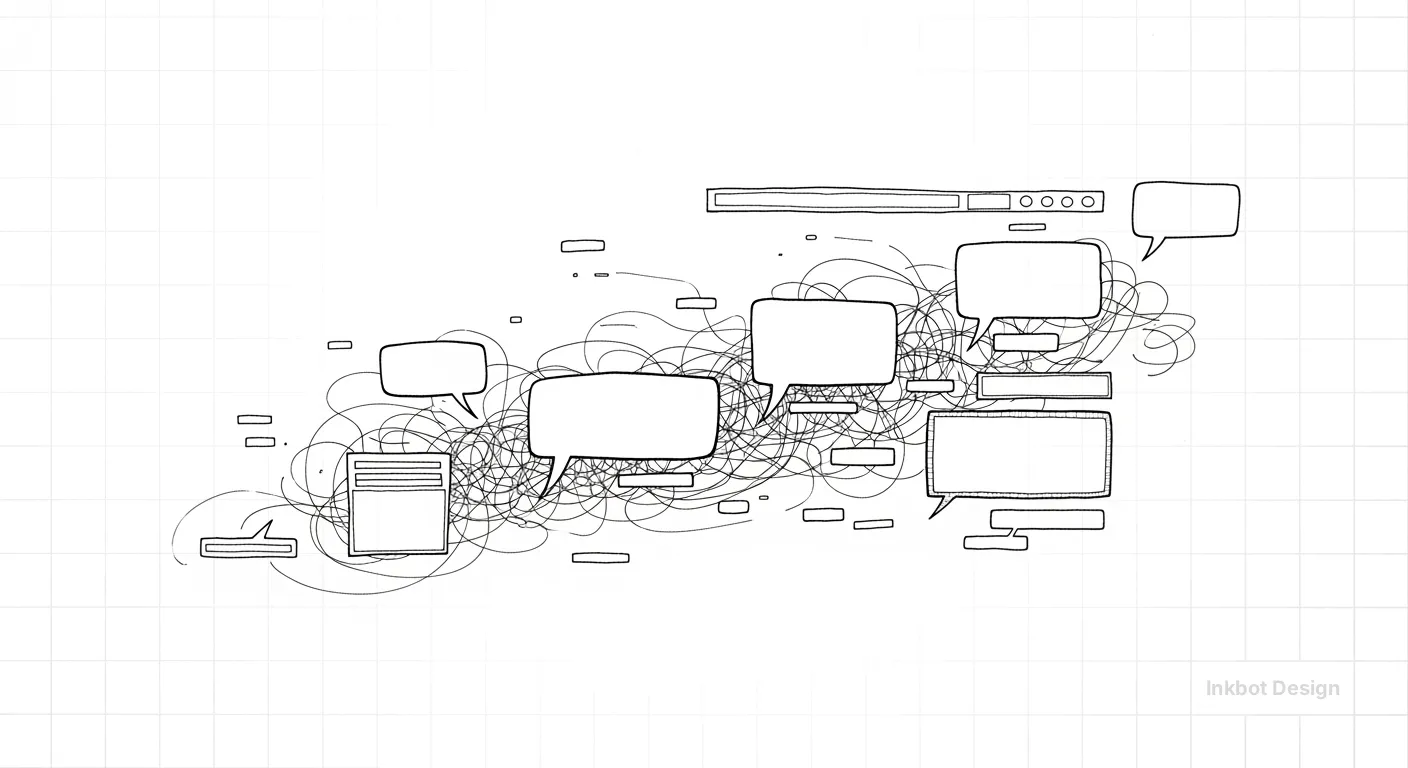
In 17 years of brand work, the pattern I see most often is a firm that knows exactly what it is good at and has never written it down in a form anyone else could repeat.
Where the tax lands | How it shows up | What a clear position replaces it with |
|---|---|---|
Fees | Discounts conceded; rates matched to the cheapest bidder | A reason the buying group can defend paying more |
Sales cycle | “Can we meet the team again?” Extra rounds, stalled decisions | Classification in the first conversation |
Proposals | Long documents rewritten from scratch for each pitch | Shorter proposals built on a repeatable case |
Marketing spend | More content and paid media repeating the same generic claim | Fewer assets, each saying one specific thing |
Partner time | Senior partners are required to close every significant deal | A position juniors and referrers can deliver |
Referrals | Referrers send “general” work, or forget to refer | A specific trigger: “You need X, call them” |
Why Poorly Positioned Firms End Up Discounting
Poorly positioned firms discount because price becomes the only difference a buying group can defend.
Picture a finance director, an operations lead, and a procurement manager comparing three accountancy firms.
If none of them can state a meaningful difference, the cheapest proposal is the easiest one to justify in the meeting. Nobody gets blamed for saving money.
A clear position hands the buying group a second argument. “They've audited a dozen FCA-regulated firms our size” survives an internal meeting. “They seemed really good” doesn't.
The same mechanism explains why a premium pricing strategy starts with position, not the rate card.
Why the Managing Partner Becomes the Positioning
In a poorly positioned firm, the managing partner's personal credibility does the job the brand should be doing.
The cycle runs like this:
- Prospects visit the website and find nothing distinctive.
- They ask to meet someone senior instead.
- Those meetings convert.
- The firm concludes that “our people are our brand” and keeps sending partners to close.
The bill arrives at scale. Partner hours spent reassuring are partner hours not spent billing. A pipeline that depends on three individuals is one that an acquirer will question during due diligence.
For a 50–200 person firm preparing for a sale or a growth phase, key-person dependency in new business is a valuation question as much as a marketing one.
“A firm that can only be explained by its managing partner has a dependency on where its brand should be. Every meeting a senior partner attends to reassure a buyer is one that the positioning should have made unnecessary, and every one of those hours is billed to the firm itself at the most expensive rate in the building.”
Thirteen People Have to Repeat Your Position

86%
Stalling means delayed rather than lost, which is exactly what makes it expensive.
A stalled purchase is the obscurity tax being collected in real time: weeks of follow-ups and revised scopes because somebody in the group couldn't explain to somebody else why this firm and not the others.
Your champion carries your position into rooms you will never enter, and each retelling loses detail. A positioning strategy isn't complete when the leadership team agrees with it.
It is complete when a buyer can repeat it to colleagues in finance, operations, procurement and the executive team without it decaying into “they seem good” or “they do roughly what the others do”.
That retelling increasingly happens through software. Buyers ask AI systems to define a category, compare providers and explain the trade-offs.
Those systems can only describe a firm in the terms published about it. A website promising “trusted advisers delivering tailored solutions” gives ChatGPT nothing to say that it couldn't say about the competitor.
Writing a B2B positioning statement is a useful test of repeatability. If the leadership team can't put it in a sentence, the buying group won't manage it in a meeting.
“Positioning is finished when a procurement manager who has never met you can explain to a finance director why you are the safer choice. Until then, it is the leadership team's opinion. Buyers decide in groups, and groups need a reason they can defend without you in the room. A position nobody can repeat is a cost, however good the firm behind it.”
“Won't a Narrower Position Cost Us Work?”
Two objections come up in almost every positioning conversation with a managing partner. Both deserve straight answers.
The first is that sharpening the position will shut out work.
A firm serving a broad client base worries that being known for one thing means losing the rest. A position describes what the firm is chosen for, not every job it will accept. The generalist work a vague firm keeps “open” is usually won:
- at the lowest fee
- against the most competitors
- after the longest pitch
In other words, it carries the heaviest tax. Narrowing your service offering is as much a pricing decision as a marketing one.
Niche marketing works for the same reason: specificity is cheaper to sell.
The second is “our clients buy on relationships.”
They do, and relationships are an asset. A relationship gets the firm into the meeting. It doesn't reach the other twelve people in the buying group, most of whom have never met your partner. They are judging the firm on what they can read, search and ask an AI system about. A relationship-led firm with a vague position is relying on one stakeholder to sell to twelve.
How to Put a Number on Your Own Obscurity Tax
Measure the tax before the rebrand so that the rebrand can be judged against it. Six figures from the last 12 months will do:
- Win rate on competitive pitches versus referred work. A wide gap means referrals are carrying the position the brand can't.
- Average realised fee against rate card on new engagements.
- Days from first conversation to signed engagement letter.
- Share of new business where a named senior partner had to attend the final meeting.
- How five recent referrers describe the firm, in their own words. If the answers differ, so does the position.
- What ChatGPT, Perplexity and Google AI Mode say when asked to compare your firm with two named competitors.
None of these needs new software. All of them are numbers that an acquirer will eventually ask for anyway.
Clarity Is Cheaper Than Compensation
A good firm with a vague position is economically indistinguishable from an average one, and it pays the difference every week.
It pays in fees conceded, decisions stalled, proposals padded, and partners pulled off billable work to explain what the brand should have said.
More visibility won't fix that; reach just distributes the vagueness faster. The fix is a position that thirteen people can repeat without you in the room, and one that an AI system can describe accurately when someone asks.
Start by finding out where your tax is landing. Inkbot Design's free Brand Equity Audit™ is a structured diagnostic that shows exactly where your brand is losing commercial ground, and what to fix first.
Request yours before the rebrand brief is written.
Frequently asked questions
What is the obscurity tax?
The obscurity tax is the cumulative cost a firm absorbs when its market position is too vague to be remembered, referred to, or chosen without extra effort. It appears as discounting, longer sales cycles, heavier proposals, extra marketing spend, and senior partners spending time reassuring buyers that the brand should have convinced them.
How do you measure the cost of poor positioning?
Measure it through operational figures:
competitive win rate versus referred win rate
realised fees against the rate card
days from first conversation to signature
The share of deals needing a senior partner to close
Add how referrers and AI tools describe the firm. Together, these provide a baseline for judging any rebrand.
Is poor positioning the same as low brand awareness?
No. Low awareness means too few buyers know the firm exists. Poor positioning means buyers who do know it cannot say why it is the right choice. A well-known firm with a vague position still pays the obscurity tax, and more awareness simply spreads the vagueness further.
Can a rebrand fix poor positioning?
No, not on its own. A new identity applied to a vague position produces a better-looking vague firm. Positioning has to be decided first: who the firm is chosen by, for what, and why it is the safer choice. The visual and verbal rebrand then consistently express that decision.
Why does poor positioning lead to discounting?
Poor positioning leads to discounting because price becomes the only difference a buying group can defend internally. When finance, operations and procurement cannot name a meaningful distinction between shortlisted firms, the cheapest proposal is the easiest to justify. A clear position gives the group a non-price reason to pay more.
Does poor positioning affect how AI tools describe a firm?
Yes. AI systems describe firms using what has been published about them. A firm whose website and coverage use generic language gives tools like ChatGPT and Perplexity nothing distinctive to repeat. When buyers ask them to compare providers, that firm is described as interchangeable or not at all.