Digital Accessibility: Why Accessible Infrastructure is a Primary Brand Pillar
Digital accessibility is no longer an optional compliance task for UK professional services firms. For mid-market businesses preparing for a strategic rebrand, accessible digital design is a commercial shield that protects corporate valuation, ensures compliance with the European Accessibility Act, and opens doors to enterprise-level B2B procurement contracts.
 By Stuart Crawford
 Reviewed by Tabitha Ayers
Updated 11 min read
On this page11 min left
- What Is Digital Accessibility?
- The Regulatory Reality of Digital Accessibility
- Why Digital Accessibility Directly Impacts Corporate Valuation
- Exposing the True Financial Friction of Digital Exclusion
- The Fallacy of the Automated Accessibility Overlay
- State of Digital Accessibility in 2026
- The Strategic Framework for Digital Design
- The Strategic Brand Imperative
- The Verdict
- Frequently asked questions
Digital accessibility is not a moral checklist or a secondary user-experience concern; it is a hard fiscal filter that directly dictates corporate valuation and enterprise procurement viability for mid-market firms.
Ignoring these engineering standards during a corporate rebrand is a deliberate act of financial depreciation that actively disqualifies a firm from institutional contracts.
For a managing director or chief executive officer overseeing a business employing 50 to 200 people, the organisation's digital footprint is often its most valuable intellectual property asset.
When that footprint fails basic compliance audits, the entire enterprise faces unhedged legal, financial, and reputational liabilities that dilute market positioning.
To protect market equity ahead of a growth phase, an acquisition, or a market repositioning, leadership teams must integrate technical compliance into their broader corporate strategy.
Deploying The Brand Equity System™ during the foundational stages of a rebrand ensures that your consumer-facing interfaces resist legal challenges and maximise commercial reach.
True brand differentiation requires structural integrity, and structural integrity demands a digital presence that functions flawlessly for every corporate buyer, regardless of physical or cognitive capability.
What Is Digital Accessibility?
Digital accessibility is the intentional practice of designing web assets to remove barriers to use for people with permanent or temporary disabilities.

- Perceivable User Interfaces: Information and user interface components must be presentable to users in ways they can perceive, ensuring content is not invisible to all of their senses.
- Operable System Navigation: Interface components and navigation elements must be fully operable by keyboard, voice control, or alternative input devices without requiring fine-motor precision.
- Understandable Information Systems: Content and operations must be predictable, clear, and free from confusing technical layouts that inhibit user comprehension.
Digital accessibility is the intentional practice of designing web assets to remove barriers to use for people with permanent or temporary disabilities.
The Regulatory Reality of Digital Accessibility
Regulatory updates have transformed digital accessibility from a vague corporate social responsibility initiative into a strict statutory obligation for UK professional services firms.
Businesses expanding into global markets or operating within European supply chains face immediate operational blockades if their public-facing interfaces fail to meet international engineering standards.
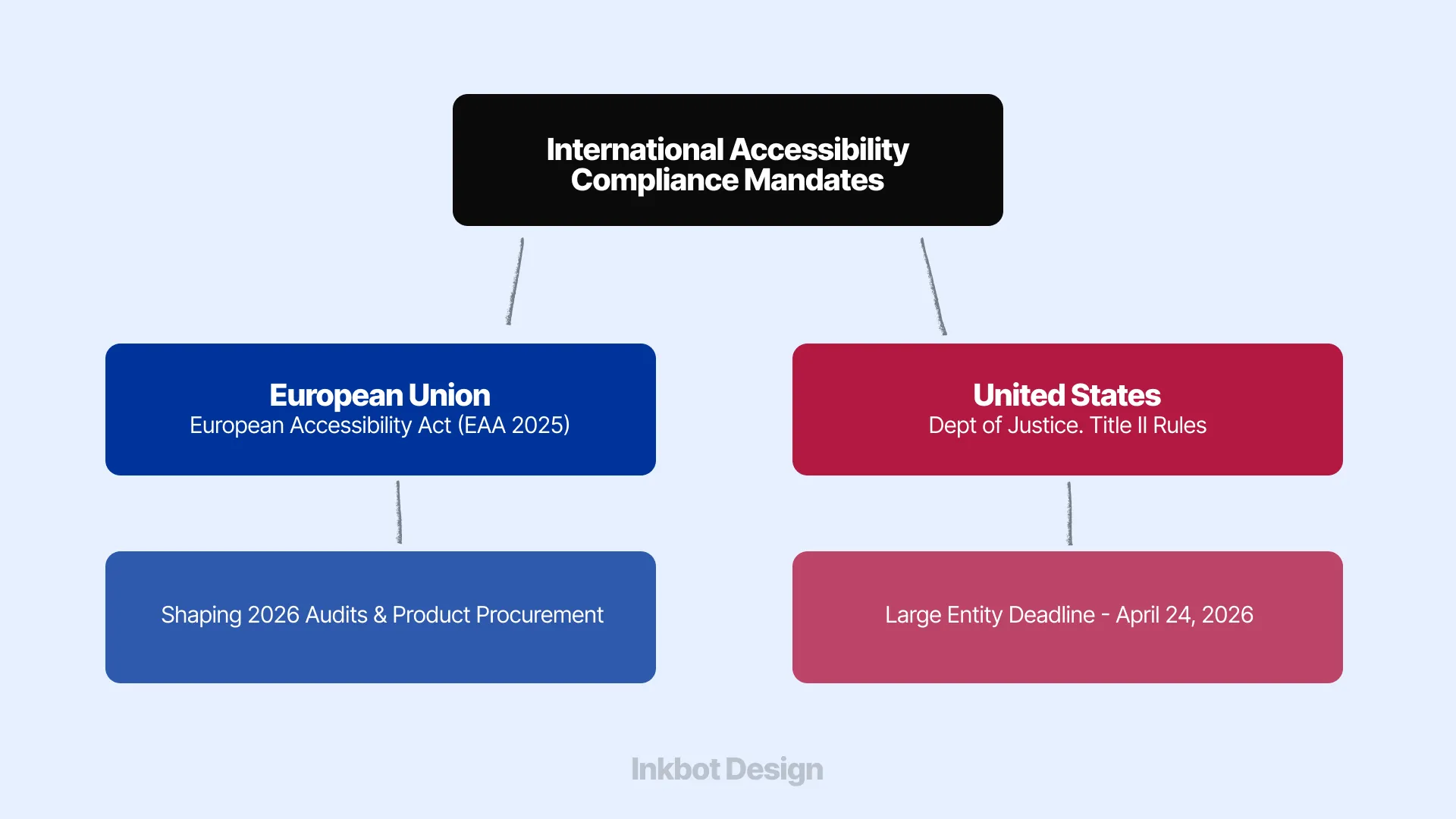
The European Accessibility Act Governs Cross-Border Trade
The European Accessibility Act (EAA), which became an enforceable market force across the European Union, is actively shaping 2026 corporate procurement, product design, and digital remediation strategies.
UK businesses that provide digital services, software, or e-commerce solutions to European citizens must comply with these design standards or face cross-border trade restrictions.
United States Department of Justice Sets Strict Enforcement Deadlines
The United States Department of Justice finalised its Title II rule under the Americans with Disabilities Act, establishing explicit deadlines for web content compliance.
Larger public-facing entities faced a mandatory compliance deadline on April 24, 2026, to meet Web Content Accessibility Guidelines (WCAG) 2.1 Level AA standards, while smaller entities must achieve compliance by April 26, 2027.
This regulatory shift impacts UK professional services firms that service the American public sector or manage transatlantic corporate partnerships.
Web Content Accessibility Guidelines 2.2 Replaces Legacy Procurement Baselines
The World Wide Web Consortium (W3C), the global web standards body, published WCAG 2.2 as a formal Recommendation.
In 2026, commercial enterprises and government procurement agencies treat this updated framework as the preferred baseline for new software contracts, interface audits, and vendor selection processes.
“Corporate compliance is no longer defined by geographic borders or vague local laws. The alignment of the European Accessibility Act and the updated Web Content Accessibility Guidelines 2.2 means that mid-market firms must treat accessible engineering as an absolute prerequisite for international B2B commerce.”
Why Digital Accessibility Directly Impacts Corporate Valuation
When an institutional buyer or private equity firm evaluates a mid-market business for acquisition or partnership, the digital ecosystem undergoes deep technical due diligence.
Non-compliant digital assets represent hidden financial liabilities that can depress overall corporate valuation during structural transactions.
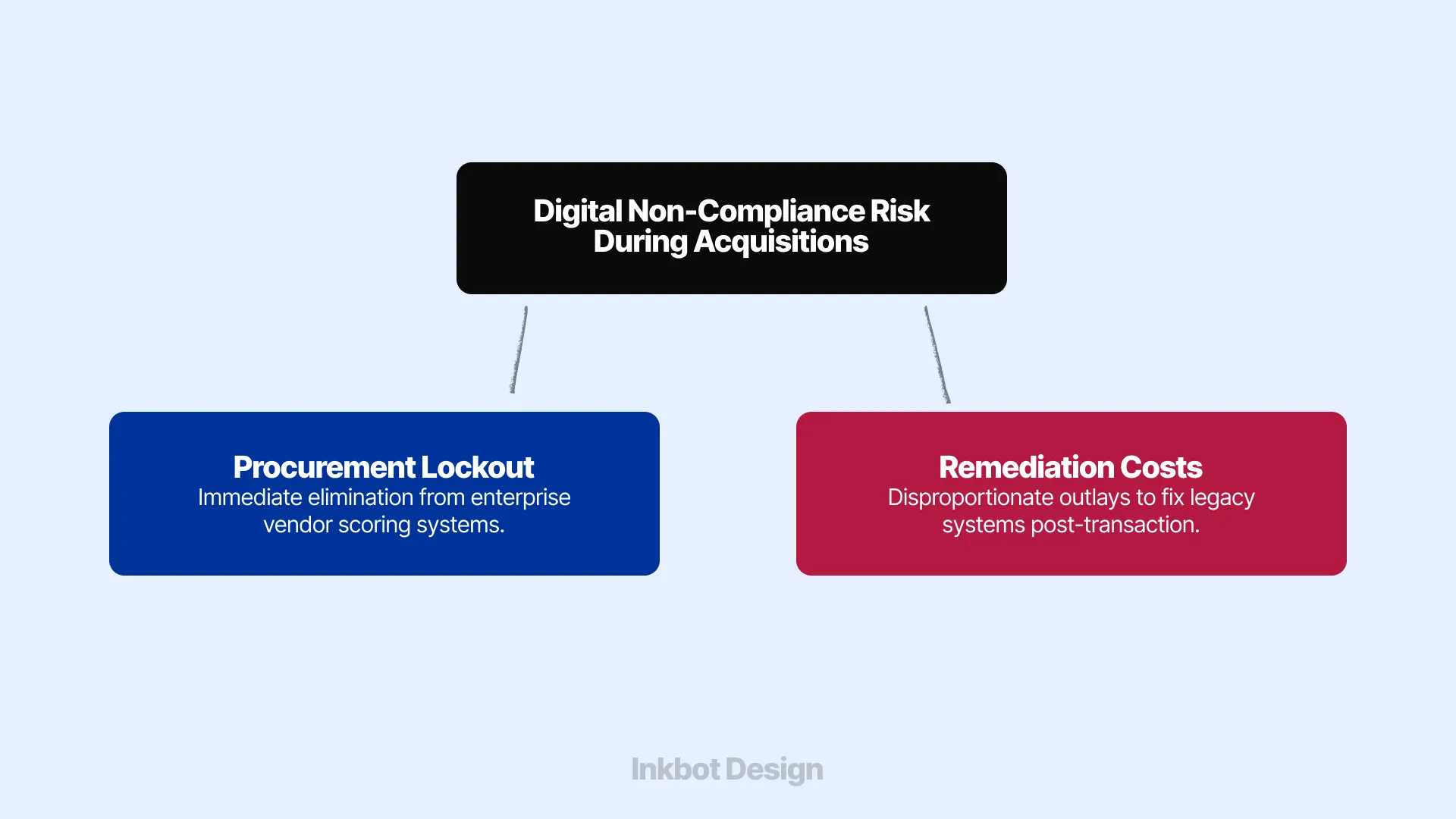
Digital Exclusion Triggers Enterprise Procurement Lockout
Corporate procurement departments utilise standardised software verification matrices that automatically penalise vendors with inaccessible digital platforms.
A professional services firm seeking to secure enterprise-level contracts will find itself excluded from requests for proposals if its digital interfaces fail basic automated and manual validation testing.
Legacy Technical Debt Depresses Overall Corporate Valuation
Retrofitting accessibility into an uncoordinated, poorly coded web application requires substantial financial and engineering outlays after an acquisition is completed.
Savvy institutional buyers calculate these future remediation costs during pre-merger discovery and deduct those projections directly from the business's final purchase price.
Digital Property Depreciates Without Structural Engineering Standards
Digital assets that lack semantic HTML structure, proper keyboard focus management, and compliant colour contrast patterns lose long-term asset value.
According to data published by the HTTP Archive Web Almanack, the global median Lighthouse Accessibility score reached over 85%, indicating that firms trailing this benchmark have substandard technology stacks that impair overall corporate valuation.
“A beautiful brand identity built upon a broken, inaccessible digital architecture is an enterprise liability. Institutional buyers do not pay premium multiples for digital infrastructure that requires immediate, expensive remediation to survive basic regulatory scrutiny.”
Exposing the True Financial Friction of Digital Exclusion
Firms that neglect accessible design principles deliberately disconnect their marketing messages from an enormous segment of the global purchasing public.
This digital exclusion produces measurable friction across client acquisition pipelines, conversion rates, and search engine visibility.
Metric | The Cost of Digital Exclusion |
|---|---|
Global Target Audience Impact | The World Health Organisation (WHO) estimates that 1.3 billion people live with a significant disability, which constitutes roughly 16% of the global population. |
Homepage Accessibility Failure Rates | The WebAIM Million 2026 Report discovered that 95.9% of analysed homepages contained detectable WCAG 2 compliance failures. |
Total Error Volatility Across Digital Assets | The WebAIM Million 2026 Report identified 56,114,377 distinct accessibility errors across one million homepages, averaging 56.1 errors per page. |
Ignoring Global Audience Demographics Reduces Market Capture
The World Health Organisation (WHO), the global public health agency, notes that 1.3 billion people experience significant disability worldwide.
When a professional services firm deploys an inaccessible website, it blocks access to a substantial portion of the global economy, limiting market share expansion.
Pervasive Homepage Errors Undermine Consumer Trust in Data
The WebAIM Million 2026 Report evaluated 1,000,000 homepages and identified 56,114,377 distinct accessibility errors, demonstrating the widespread persistence of poor development practices.
This massive failure rate means that firms investing in clean, accessible development can establish an immediate competitive advantage over legacy market competitors.
High Error Density Accelerates User Bounce Rates
An average of 56.1 distinct errors per webpage causes severe navigational disruption for individuals using assistive technologies.
These technical barriers increase bounce rates, destroy paid advertising returns, and send negative user-experience signals directly to organic search indexing systems.
“Digital exclusion is a self-inflicted commercial penalty that reduces market reach and degrades advertising efficiency. When your public-facing platform contains dozens of hidden structural errors, you are actively driving prospective enterprise clients straight into the arms of compliant competitors.”
The Fallacy of the Automated Accessibility Overlay
Third-party automated accessibility plugins and JavaScript overlays were originally adopted because they promised a one-click, low-cost fix for compliance gaps without modifying underlying source code.
These quick-fix widgets are marketed to time-poor executives as an effortless shield against regulatory fines and consumer litigation.
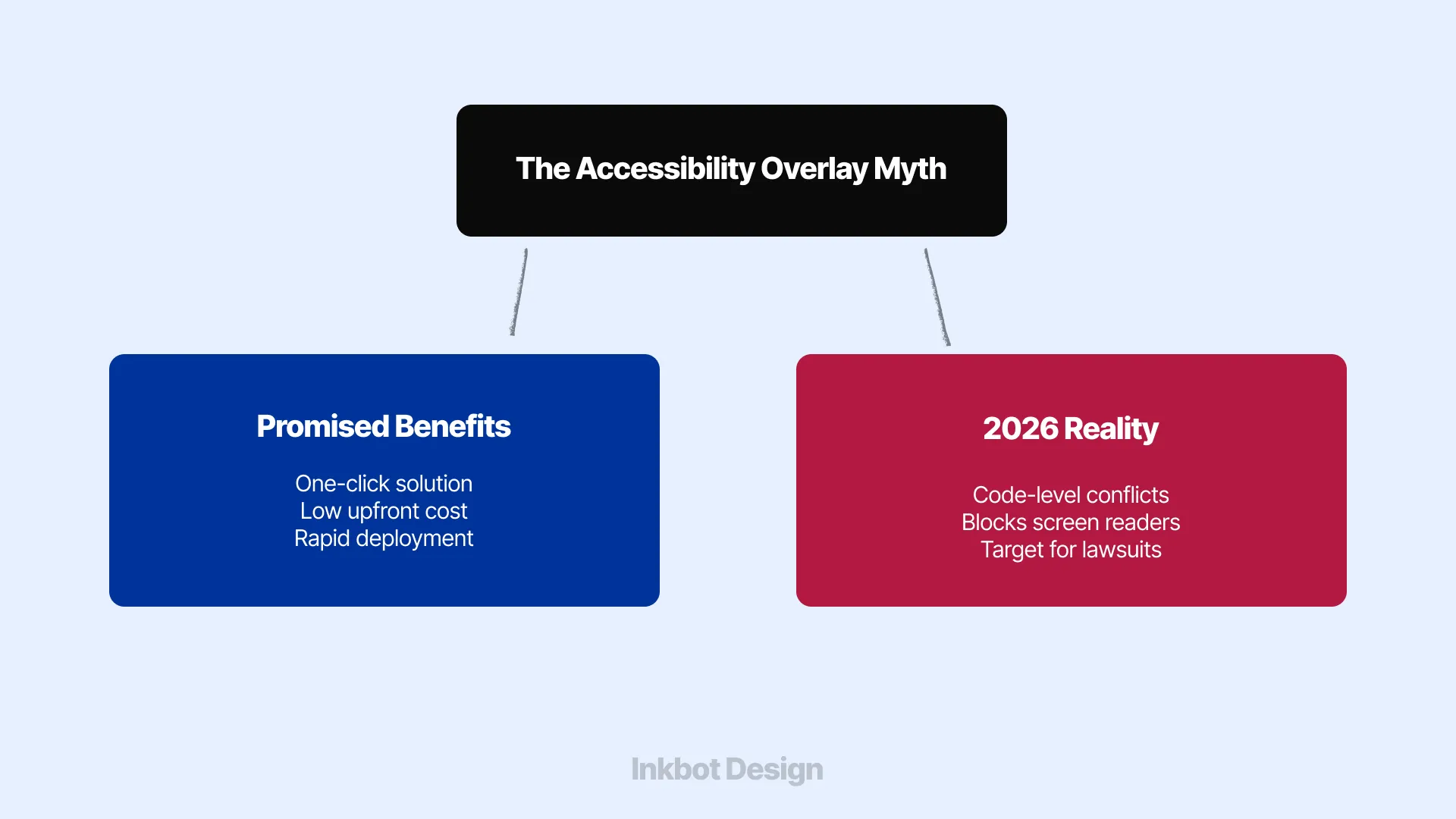
Overlays Introduce Secondary Structural Failure Modes
Software widgets that modify live web layouts via external scripts frequently clash with customised assistive technologies, including specialised screen-reading programmes.
Rather than resolving core accessibility barriers, these tools introduce additional layers of code-level conflicts that frustrate end users and increase functional errors.
Automation Fails to Shield Enterprises from Compliance Litigation
UsableNet, the digital accessibility monitoring and compliance group, tracks annual litigation statistics that prove automated overlays fail to protect brands from legal claims.
Law firms specialising in digital non-compliance explicitly target corporate platforms that feature these superficial widgets, because their presence signals that the underlying source code is fundamentally broken.
True Remediations Mandate Complete Source Code Reconstruction
Replace all temporary software overlays with native, semantically correct HTML code built directly into your primary web architecture during the initial asset design phase.
True compliance requires clear heading structures, native keyboard navigation paths, and verified colour contrast metrics embedded directly into the core theme stylesheets.
“Relying on a superficial JavaScript overlay to solve digital accessibility is an operational error that increases your exposure to class-action litigation. True legal protection and brand equity can only be achieved by writing compliant code directly into your native digital architecture.”
State of Digital Accessibility in 2026
The commercial landscape in 2026 treats digital accessibility as a shifting, tech-driven environment that rewards proactive development and penalises reactive retrofitting.
Modern corporations are abandoning late-stage remediation strategies in favour of agile, component-driven design frameworks that preserve structural equity from day one.
AI-Assisted Auditing Systems Drive Early Triage Processes
Development teams in 2026 leverage artificial intelligence and automated scanning systems to reduce baseline audit times and quickly categorise code defects.
These machine learning platforms help developers identify basic contrast errors and missing label attributes early, allowing human engineers to focus on nuanced functional testing and assistive-technology verification.
Accessible Development Principles Move Earlier in the Build Process
The dominant theme in 2026 technology commentary is building compliance directly into initial component libraries rather than patching broken websites at launch.
This shift aligns closely with modern headless development frameworks and component-driven design systems, ensuring that accessible logic underpins every digital asset.
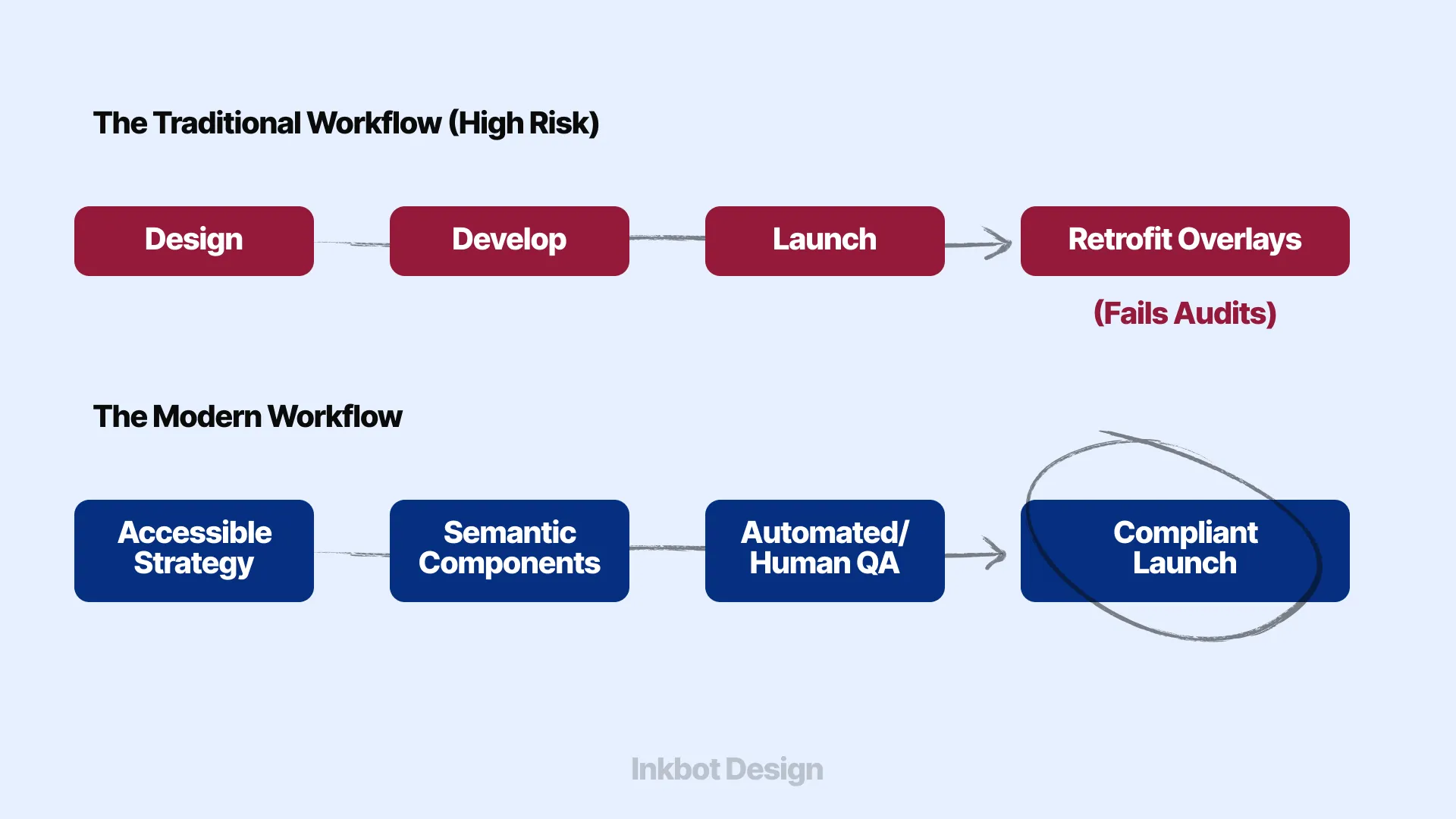
Digital Compliance Expands Rapidly Beyond Basic Web Pages
Current industry guidance has expanded the operational definitions of digital property well beyond standard corporate websites.
Compliance mandates now encompass mobile applications, downloadable corporate documents, embedded video interfaces, interactive customer portals, and multimodal voice experiences.
Automated Testing Engines Require Continuous Manual Verification
Industry leaders emphasise that automated testing platforms cannot, on their own, confirm comprehensive real-world accessibility.
While automation can isolate obvious technical defects, manual testing by human engineers remains essential for validating complex workflows, multi-step checkout sequences, and dynamic user interfaces.
In 17 years of brand work, the mistake I see most often is corporate leadership treating accessibility as a post-launch styling task handled exclusively by junior web developers.
This operational disconnect causes beautiful, expensive corporate rebrands to completely fail initial vendor onboarding assessments and legal compliance reviews within months of public deployment.
Stuart Crawford has led brand identity projects for professional services firms across 21 countries for over 17 years.
When digital infrastructure is separated from the core brand design process, the resulting assets become fragmented liabilities that actively undermine the firm's commercial growth.
The Strategic Framework for Digital Design
The implementation of accessible design standards separates high-performance digital infrastructure from legacy platforms that accumulate massive technical debt.
Mid-market professional services firms must establish clear engineering guidelines to preserve asset value across all digital touchpoints.
Decision Point | The Wrong Way | The Right Way | Why It Matters |
|---|---|---|---|
Text Contrast Levels | Choosing low-contrast text strings based on unverified aesthetic choices. | Enforce a contrast ratio of at least 4.5:1 for standard text elements. | Protects overall visual legibility for individuals with low vision. |
Navigation Systems | Building complex dropdown menus that require precise mouse tracking. | Building full keyboard-accessible focus states into every navigation menu. | Ensures users without traditional pointing devices can browse your structural assets. |
Form Fields | Using placeholder labels inside text inputs that vanish upon interaction. | Attaching permanent, clear HTML label attributes to every entry form. | Prevents screen reader dislocation during critical multi-step corporate lead submissions. |
Image Assets | Leaving image attributes blank or filling them with keyword-stuffed strings. | Writing descriptive alternative text that articulates the visual asset function. | Permits search crawlers and screen readers to accurately index graphical content. |
Media Elements | Uploading video recordings without text transcripts or timed subtitle data. | Embedding synchronised closed captions and text alternatives for media. | Meets international legal standards while capturing users in sound-sensitive settings. |
Layout Semantics | Using generic code divisions to separate paragraphs and main content blocks. | Using explicit semantic HTML elements such as main, header, nav, and article. | Allows parsing software to immediately map and surface your core content. |
Interactive Elements | Relying on ambiguous button descriptions like “click here” or “learn more”. | Writing clear, descriptive button actions such as “Request Brand Audit. | Disambiguates system behaviour for both human users and automated web scrapers. |
The Strategic Brand Imperative
Integrating digital accessibility into a corporate rebrand is a significant commercial decision that directly influences enterprise value, market expansion, and legal protection.
Mid-market professional services firms that embrace compliant, semantically accurate engineering protect their brand equity and ensure their platforms remain robust against future regulatory shifts.
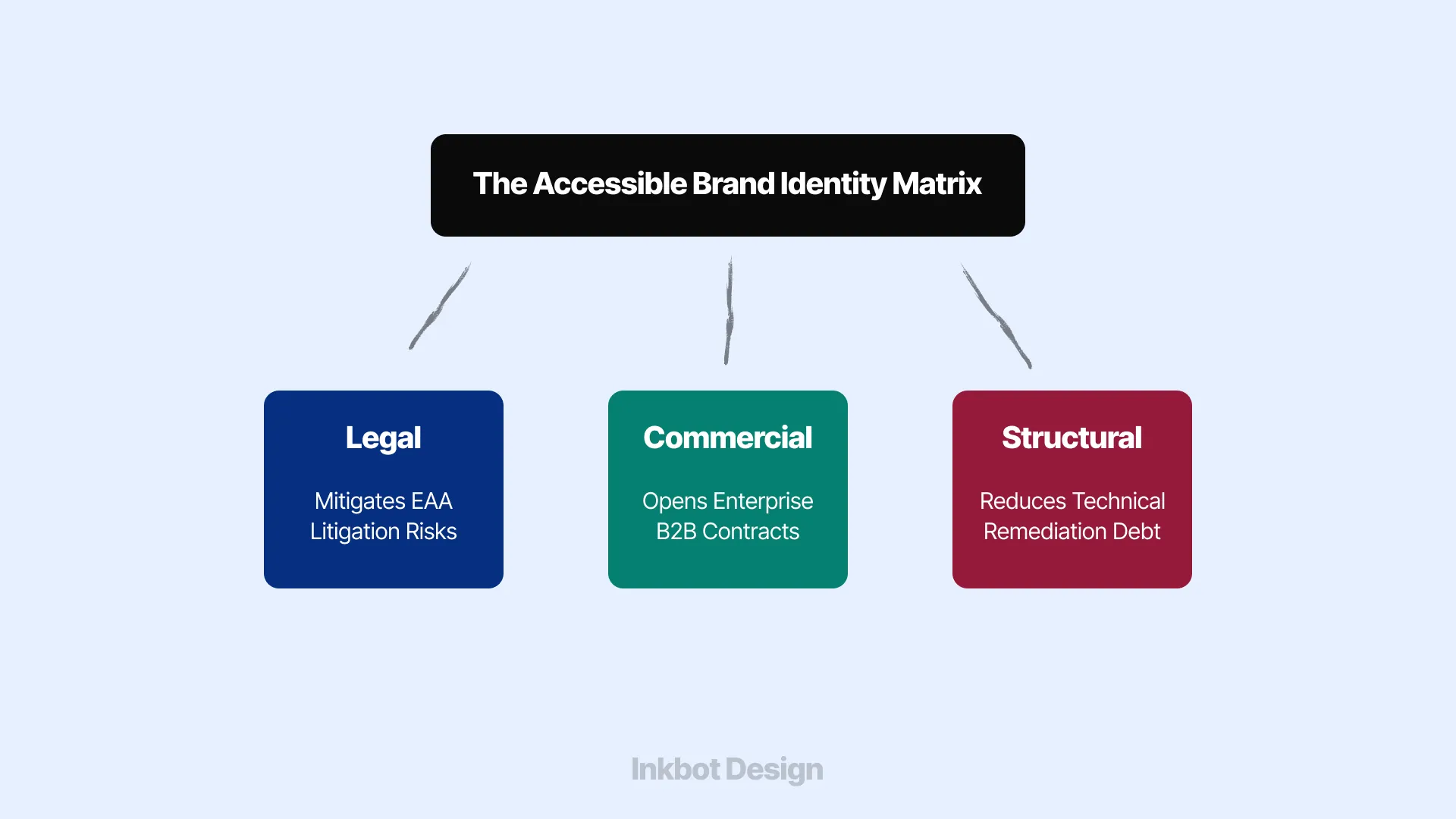
By prioritising native code integrity over superficial, automated JavaScript overlays, leadership teams can build reliable digital assets that perform beautifully during private equity audits and corporate procurement reviews.
True brand authority requires structural quality, and your digital footprint should reflect that operational excellence.
The Verdict
Digital accessibility is a foundational requirement for modern B2B procurement and corporate risk management.
Professional services firms that view WCAG 2.2 guidelines as an elective decoration are systematically destroying their digital asset value and excluding their businesses from institutional contracts.
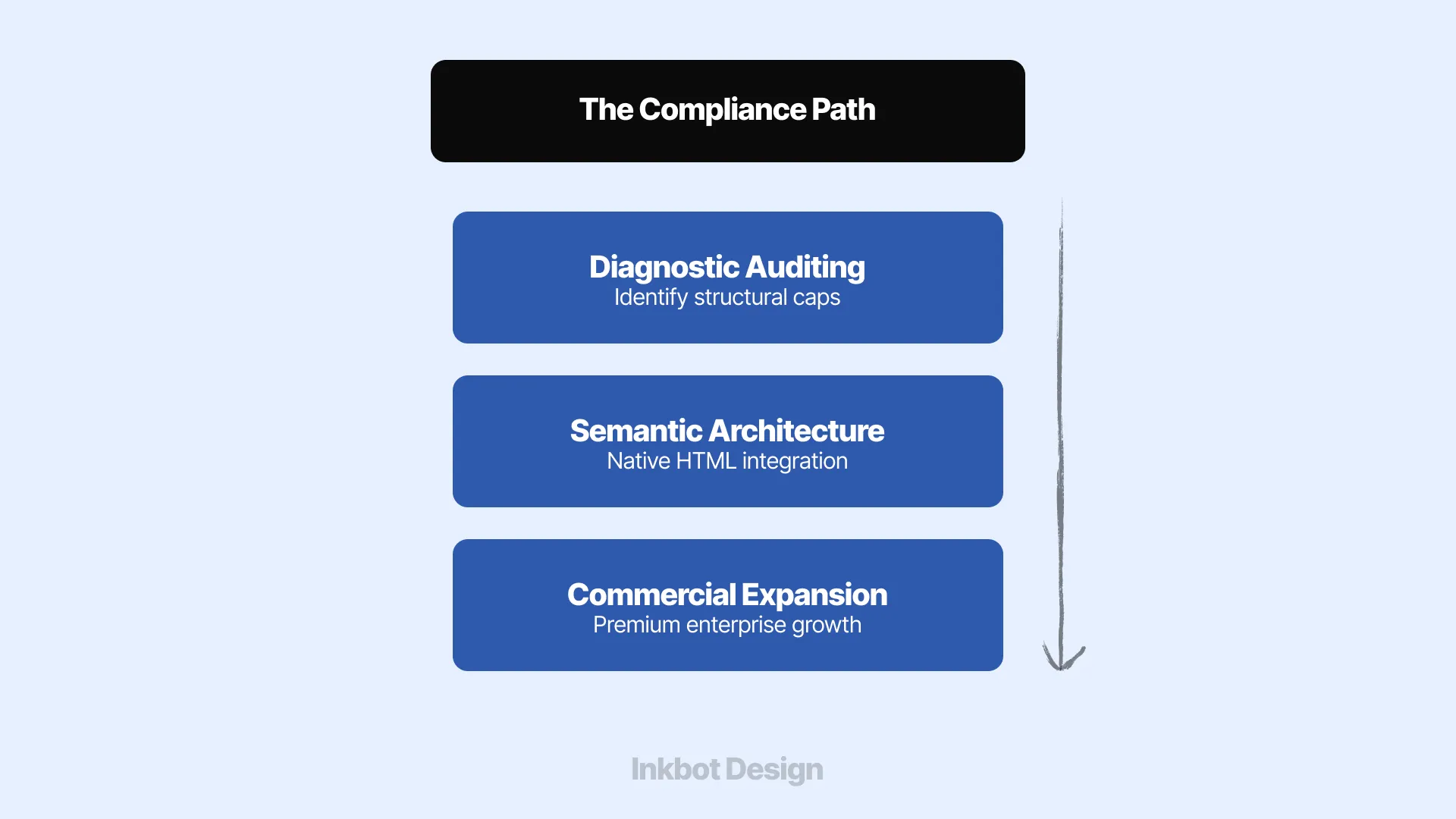
The data from the WebAIM Million 2026 Report indicates that, while global standards are rising, 95.9% of web properties continue to exhibit basic code failures.
This widespread technical gap provides an ideal opportunity for mid-market firms to outpace competitors by launching verified, compliant digital platforms.
Do not risk your market repositioning by building a beautiful brand on a broken, inaccessible foundation.
Protect your corporate valuation and secure your market expansion by evaluating the structural health of your assets today.
Request a free Brand Equity Audit™ at The Brand Equity System™ to identify exactly where your brand is losing commercial ground and what to do about it.
Frequently asked questions
What is the primary difference between digital accessibility and standard user experience design?
Digital accessibility focuses explicitly on engineering digital properties to eliminate functional barriers for individuals with permanent, temporary, or situational disabilities. Standard user experience design optimises general usability patterns for mainstream audiences, often overlooking specialised assistive technology integration.
How does the European Accessibility Act impact UK businesses that do not have physical offices inside the European Union?
The European Accessibility Act applies directly to all digital services, software products, and e-commerce platforms utilised by consumers within the European Union. UK businesses serving European clients must comply with these design standards or face cross-border trade restrictions and fines.
Why do automated accessibility overlays fail to protect professional services firms from compliance lawsuits?
Automated accessibility overlays function as superficial JavaScript layers that fail to fix underlying source code defects. Digital compliance law firms actively target websites that feature these widgets because their presence indicates that the core digital infrastructure remains unremediated.
What are the specific updates introduced in the WCAG 2.2 guidelines compared to older standards?
The WCAG 2.2 framework introduces nine additional success criteria to improve user interactions on mobile devices, assist individuals with cognitive disabilities, and optimise keyboard navigation. These updates focus on input modalities, predictable layouts, and focus appearance.
Can automated testing tools detect every accessibility error on a corporate website?
Automated testing tools catch roughly 30% to 40% of programmatic accessibility errors, including obvious contrast failures and missing image alt attributes. Complex workflows, clarity in contextual navigation, and screen reader intelligibility require manual verification by skilled human engineers.
What is the commercial impact of digital accessibility failures on corporate procurement processes?
Enterprise procurement departments deploy strict vendor vetting matrices that automatically penalise or disqualify non-compliant suppliers. Professional services firms with inaccessible digital platforms are frequently excluded from lucrative requests for proposals during vendor screening.
How does accessible web development influence a firm's organic search engine visibility?
Accessible web development relies on clean semantic HTML, descriptive heading architectures, and detailed text alternatives for graphical assets. These foundational engineering practices make it significantly easier for search engine crawlers to parse, index, and rank your content.
When should digital accessibility be integrated during a corporate rebranding initiative?
Digital accessibility must be integrated at the beginning of the brand strategy phase, directly informing component libraries, colour palettes, and typography selections. Attempting to retroactively patch structural code after a website launch introduces excessive technical debt and ballooning engineering costs.
Is it true that digital accessibility compliance requires an unappealing visual aesthetic?
Digital accessibility compliance does not limit visual creativity or modern interface aesthetics. Compliance simply requires structured code, flexible contrast parameters, and clear navigation paths that support creative design while ensuring universal accessibility.
What are the legal risks under the US Department of Justice Title II rules for international firms?
The US Department of Justice Title II rules mandate strict compliance with WCAG 2.1 Level AA for public-sector web content and mobile applications. International firms partnering with American public agencies or educational institutions must meet these criteria to maintain active contracts.
How do clear form labels reduce user abandonment rates during corporate lead capture?
Clear, permanent HTML labels ensure that screen readers can accurately interpret form fields even when users are actively inputting data. Broken or missing form descriptors confuse assistive technologies, leading to data input errors and high cart abandonment rates.
Why should mid-market CEOs view digital accessibility as a core asset valuation metric?
Digital assets that violate global accessibility mandates represent immediate regulatory and operational liabilities during corporate due diligence. Institutional buyers evaluate these compliance gaps as hidden technical debt and reduce their purchase offers accordingly to cover future remediation costs.