SaaS Brand Strategy: The Investment Committee Behind Your Growth Budget
SaaS brand strategy decides where growth capital creates durable advantage. It sets positioning, architecture, messaging and governance before paid acquisition, product expansion or enterprise sales spend. Treat brand as the investment committee for the rest of the SaaS budget.
 By Stuart Crawford
 Reviewed by Tabitha Ayers
11 min read

On this page11 min left
- Why is SaaS brand strategy a capital-allocation discipline?
- What five commercial decisions does a SaaS brand strategy settle?
- Which positioning decisions must a Series A–C SaaS company settle first?
- How should a scaling SaaS company structure its brand architecture?
- How does SaaS brand strategy pay for itself commercially?
- In what order should a SaaS company sequence brand investment?
- The verdict: fund the brand decisions that compound
- Questions people ask
A Series B SaaS company can raise capital, hire a senior sales team, and still lose six-figure enterprise deals because its external brand explains yesterday’s point-solution startup.
Inkbot Design calls this gap between a company’s true operational capability and its market perception the Obscurity Tax™.
Why is SaaS brand strategy a capital-allocation discipline?

SaaS brand strategy acts as the investment committee for your growth budget because it determines which markets receive sales capacity, which customer segments are declined, which product bets reinforce category authority, and which marketing spend compounds across quarters.
Most SaaS advice treats brand merely as a top-of-funnel marketing lever: clearer positioning lowers customer acquisition cost (CAC), sharper messaging supports price integrity, and consistency aids retention. Those effects are real, but they are too narrow.
Modern enterprise software buying happens largely outside your sales team’s control. Research from Gartner indicates that a majority of B2B buyers prefer a rep-free buying experience and increasingly rely on generative AI tools to research, compare, and shortlist vendors before speaking to sales.
When buyers and AI answer engines evaluate your company independently, your brand architecture must carry the commercial argument on its own.
At the same time, McKinsey’s Global B2B Pulse Survey (2024) found that B2B buyers interact across an average of ten distinct channels during a single purchasing journey.
When a SaaS company’s category claim changes between its homepage, outbound sales deck, product UI, G2 profile, investor updates, and LinkedIn presence, both human buying committees and AI retrieval systems are forced to reconstruct the story themselves.
Inconsistent entity signals cause AI tools to misclassify what your software does—and cause human champions to stall in internal budget reviews.
Brand strategy does not ask, “How do we look more credible?” It asks, “Which customers, categories, and investments deserve our constrained capital?”
For a Series A–C SaaS business, the practical question is not whether to invest in brand, but which brand decisions will make the next £1M of growth capital work harder.
What five commercial decisions does a SaaS brand strategy settle?

A complete SaaS brand strategy settles five core commercial decisions: target customer selection, category framing, provable differentiation, portfolio architecture, and cross-channel consistency rules.
It is not a logo refresh, an isolated tone-of-voice document, or a pre-launch exercise that ends when a new website goes live.
Specifically, an effective SaaS brand strategy locks down:
- Who the company serves: the customer segments where its advantage is strongest and the segments it will stop chasing.
- What category it competes in: the frame buyers use to compare it with alternatives.
- Why it wins: the provable difference that matters to the buying group.
- How the portfolio fits together: the relationship between company, platform, products and proprietary IP.
- What must stay consistent: the positioning, language, evidence and experience that make the company recognisable across ten buying channels.
The distinction matters because a company can have an attractive visual identity and still have no brand strategy.
A polished website with vague category language, three competing product narratives and an enterprise pitch that contradicts the product roadmap is not a brand system. It is a collection of assets.
Inkbot Design’s branding and design services treat identity as the visible expression of these commercial decisions, rather than the starting point.
Which positioning decisions must a Series A–C SaaS company settle first?
Before spending on campaigns or visual rebrands, a scaling SaaS company must settle four foundational choices: which customer cohort drives the highest net retention, which urgent problem unlocks an enterprise budget line, what risk-reduction proof the buying committee requires, and which low-margin segments the company will explicitly exclude.
For a venture-backed SaaS company moving upmarket—often transitioning from Product-Led Growth (PLG) to enterprise Sales-Led Growth (SLG)—brand strategy begins by choosing between horizontal breadth and specialist authority.
A broad, generalist position may flatter a pitch deck’s Total Addressable Market (TAM), but it makes enterprise buying harder.
A procurement lead or CIO evaluating a platform for a regulated industry, a mission-critical workflow, or a board-level risk decision needs to see why your company is the safest specialist choice, not merely that your software has features.
Settle four questions before briefing creative or media teams:
- Which customers produce the strongest expansion, reference, and retention behaviour? According to SaaS Capital’s 2025 B2B SaaS Retention Benchmarks, private B2B SaaS companies above $1M ARR report a median gross revenue retention (GRR) of 91% and median net revenue retention (NRR) of 101%. Account expansion is not automatic; customers expand only when your brand narrative makes the broader value of your platform clear.
- Which commercial problem justifies a dedicated budget line at the target account? Vague promises of “operational efficiency” rarely survive a CFO review. Specific commercial outcomes—such as “reducing time-to-underwriting decision in regulated commercial lending”—defend a budget line.
- What proof does the enterprise buying group require? InfoSec certifications (SOC 2, ISO 27001), implementation certainty, integration depth, sector-specific case studies, and executive sponsorship carry different weights depending on deal size and industry.
- What will the company deliberately not claim? A strategic position becomes commercially useful only when it excludes inferior opportunities and battles over non-core features.
This is where many Series A and Series B SaaS companies get the sequence wrong. They pour capital into paid acquisition while their category, proof, and portfolio story remain muddled.
Inkbot Design refers to the resulting friction as the Marketing Drain and the Convincing Grind: marketing pays a premium for unconvinced traffic, and senior account executives spend the entire quarter on discovery calls explaining what the company actually does.
For the tactical execution of these choices, see Inkbot Design’s guide to SaaS positioning and messaging, which covers how to translate a strategic position into repeatable buyer language.
How should a scaling SaaS company structure its brand architecture?
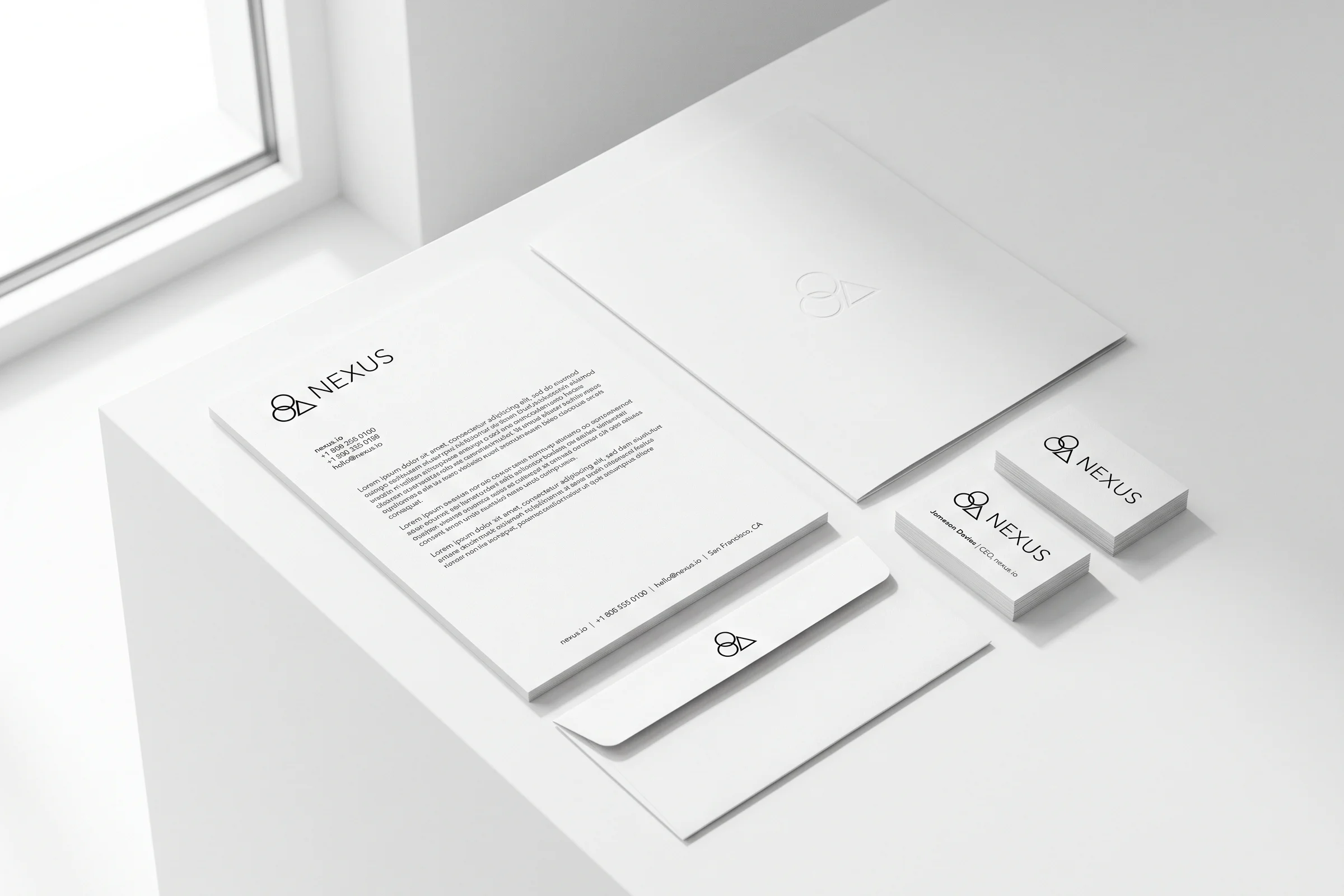
SaaS brand architecture defines the structural hierarchy and naming rules across your corporate masterbrand, core software platform, individual product modules, proprietary methodologies, and acquired companies.
For most Series A–C SaaS businesses, a unified branded house (Masterbrand) outperforms a fragmented collection of sub-brands because it concentrates marketing equity and simplifies cross-selling across the enterprise.
SaaS companies rarely stall upmarket because their logo mark is weak; they stall because they accumulate disconnected names.
A single-product startup becomes a multi-module platform, a feature workflow is given a clever internal codename, and a bolt-on acquisition retains its legacy identity.
While each naming decision feels logical internally, together they force enterprise buyers to decode an org chart before they can sign a contract.
Apply this five-part decision matrix before creating or retaining a separate brand name:
Commercial & Product Condition | Recommended Architecture | Strategic Rationale |
|---|---|---|
The offer serves the same enterprise buyer and reinforces the core platform proposition | Masterbrand | Concentrates brand equity, simplifies procurement, and supports net revenue retention (NRR) expansion. |
The offer targets a fundamentally different buyer, category, or risk profile with durable independent scale. | Endorsed Sub-brand or Standalone Sub-brand | Prevents category confusion when a single master narrative cannot credibly stretch across both audiences. |
The offer is a functional feature, workflow, add-on module, or AI capability. | Descriptive Product Name inside the Masterbrand | Avoids splitting marketing budgets across features that cannot be bought or defended as standalone businesses. |
An acquired product holds strong market equity in a niche segment but conflicts with the master story. | Transitional Endorsed Sub-brand (“[Acquired Name] by [Masterbrand]”) | Retains customer trust and search equity during migration while establishing a defined sunset timeline (typically 12–24 months). |
The name exists primarily to recognise an internal engineering squad, release version, or minor feature | No Brand Name (Plain Descriptive Label) | Eliminates cognitive friction for buyers and prevents internal jargon from leaking into sales collateral. |
Every sub-brand must earn its existence through a distinct audience, durable market relevance, and dedicated budget. Otherwise, distinctiveness belongs inside the masterbrand system.
Architectural clarity directly impacts enterprise deal velocity. Gartner’s B2B buying research shows that buying groups reaching internal consensus are 2.5 times more likely to report a high-quality deal outcome.
A coherent masterbrand architecture gives your internal champion a single, defensible story to take to Finance, InfoSec, and Procurement: what the company is, what the platform does, and why every module belongs together.
How does SaaS brand strategy pay for itself commercially?
SaaS brand strategy generates commercial return across four levers—enterprise win rates, pricing power, net revenue retention (NRR), and senior talent/investor confidence—by reducing perceived implementation risk and making the platform easier to shortlist before a sales conversation begins.
- Enterprise sales velocity: A sharp category position reduces the cognitive work a buying group must perform. When your target customer, category frame, and security/ROI proof are explicit, your internal champion can defend the shortlist to a CFO, InfoSec lead, or procurement committee without waiting for a custom sales deck.
- Pricing power and escaping the Fee Justification Trap: Brand strategy does not confer pricing power by assertion alone. It avoids what Inkbot Design calls the Fee Justification Trap by making a specific commercial value visible, narrowing the set of competitors for comparison (“Category of One”), and providing verifiable evidence that reduces perceived switching risk.
- Retention and multi-product expansion: With median private B2B SaaS net revenue retention sitting at just 101% (per the SaaS Capital benchmark cited above), expansion revenue cannot rely on aggressive renewal upsells alone. A unified platform narrative helps existing customers see how adjacent modules solve their next workflow problem, turning expansion into a logical progression.
- Executive talent and Series B/C valuation: A scaling software business competing for principal engineers, enterprise account executives, and growth-equity partners is selling a future market position. Investors and senior candidates evaluate whether leadership has a coherent thesis for owning its category.
Furthermore, research by Professor John Dawes at the Ehrenberg-Bass Institute, in partnership with the LinkedIn B2B Institute, estimates that roughly 95% of B2B buyers are out of market at any given time (the “95–5 rule”).
While that figure serves as a macro heuristic rather than a fixed law for every SaaS vertical, its capital-allocation lesson is direct: brand investment cannot be judged solely by this quarter’s last-click pipeline.
It exists to build mental availability and entity authority, so your platform becomes the default shortlist choice when buyers enter the 5% active-buying window.
For a detailed breakdown of how to model these commercial outcomes for your board, read Inkbot Design’s guide to the ROI of brand strategy.
In what order should a SaaS company sequence brand investment?
A SaaS company should sequence brand investment across six deliberate stages: (1) strategic positioning, (2) brand architecture, (3) messaging hierarchy, (4) visual and verbal identity systems, (5) go-to-market operationalisation, and (6) ongoing governance.
Treating brand as a sequenced programme prevents the common mistake of funding a visual rebrand before leadership agrees on the category and target enterprise buyer.
- Settle the strategic position: Define your priority ICP, category frame (“Category of One”), commercial proof, and explicit segment exclusions. Complete this before commissioning a visual rebrand, paid media campaign, or sales-enablement overhaul.
- Fix the brand architecture: Decide what the corporate entity, core platform, and product modules are called, and establish strict rules for how acquisitions fit the masterbrand.
- Build the verbal message system: Architect one master commercial narrative, then adapt its proof points for enterprise buyers, technical evaluators, investors, and prospective hires.
- Express it through visual and verbal identity: Engineer the logo architecture, typography, colour system, and design specification that make your strategic position immediately recognisable.
- Operationalise across high-stakes touchpoints: Deploy the new architecture into boardroom pitch decks, RFP/tender templates, website flows, product UI naming, investor updates, and executive LinkedIn profiles.
- Govern as you scale: Establish decision rules for future feature launches, bolt-on acquisitions, and international market entries.
The most expensive failure mode in SaaS marketing is starting at Step 4. A new visual identity cannot repair an undecided strategic position; it only makes an unclear company look more confident while burning growth capital.
How do you govern a SaaS brand as the company scales?
Effective SaaS brand governance protects commercial clarity during rapid product expansion and M&A through five operational controls: entity naming rules, a central messaging source of truth, pre-launch fit reviews, verifiable evidence standards, and quarterly cross-functional audits.
Brand governance is not a bureaucratic “brand police” function; it is commercial hygiene that prevents product and sales teams from inventing competing narratives as headcount grows. A practical governance model includes:
- Entity and naming rules: Clear criteria dictating which product names may be created, what each entity represents, and who holds sign-off authority.
- Message operations (Single Source of Truth): A canonical repository for category definitions, approved customer proof, structured data/schema descriptions, and prohibited claims.
- Pre-launch commercial review: A mandatory gate requiring every new module, acquisition, or campaign to state which ICP problem it solves and how it reinforces the masterbrand.
- Evidence standards: A rule that all ROI figures, security posture claims, and performance benchmarks require named, attributable verification before publication.
- Quarterly alignment and AI-entity review: A scheduled audit checking that sales decks, product marketing, hiring pages, investor letters, and AI answer engines (ChatGPT, Claude, Perplexity, Gemini) still describe the same company.
Every named asset should contribute to external market memory. If a name only clarifies your internal engineering org chart, it is commercial noise.
How do you measure whether a SaaS brand strategy is working?
You evaluate a SaaS brand strategy by tracking commercial decision velocity and upmarket deal efficiency—specifically target-segment win rates, sales-cycle compression, champion message recall, multi-module expansion (NRR), and AI/search entity accuracy—rather than isolated vanity impressions.
Useful commercial and diagnostic indicators include:
- Enterprise win-rate movement: Win-rate trends specifically within your priority upmarket ICP segment and competitive shortlist deals.
- Sales-cycle length and objection profile: Reduction in time-to-close and fewer late-stage objections around company credibility, category fit, or platform cohesion.
- Champion narrative accuracy: The proportion of active opportunities where the internal buyer champion can accurately articulate your category position and value proposition to their CFO without a sales rep present.
- Net revenue retention (NRR) and multi-module adoption: Expansion revenue driven by existing customers adopting adjacent platform capabilities.
- Cross-channel and AI-search consistency: Alignment across sales decks, product UI, and investor narratives, alongside accurate entity categorisation when prospective buyers query generative AI search tools.
- Share of branded search and direct traffic: Growth in high-intent organic brand queries, interpreted alongside active demand-generation spend.
Do not treat any single metric as isolated proof of causation. Brand strategy operates alongside product quality, pricing model, sales execution, and macroeconomic conditions.
The ultimate test is whether leadership can make faster, higher-conviction capital allocation decisions once the company’s market position is settled.
The verdict: fund the brand decisions that compound
SaaS brand strategy is not a cosmetic marketing expense; it is the commercial operating system that determines where growth capital creates durable enterprise advantage.
If your software platform has outgrown its early startup identity, the practical first step is not an immediate visual rebrand.
It is a forensic review of the customer segment, category claim, proof architecture, and portfolio structure that will compound your next 12 months of sales, product, and demand-generation spend.
Eliminate Your SaaS Obscurity Tax™
If your leadership team cannot state your category position, proof architecture, and portfolio rules on a single page, start with a diagnostic.
Inkbot Design’s Brand Equity Audit™ is a free, 2-to-3-page written diagnostic of your firm’s brand presentation, market positioning, and digital visibility.
- What it covers: Identity Gap analysis, Visual Trust review, Messaging & Positioning logic check, Website/Entity review, Competitor benchmarking, and AI-Search Visibility checks across ChatGPT, Claude, Perplexity, and Gemini.
- How it works: You answer five diagnostic questions asynchronously by email. Stuart Crawford personally leads the assessment.
- Turnaround & commitment: Typically delivered within two working days (48-hour target). No sales calls required and no obligation.
Ready for a complete strategic transformation? Explore the fixed-fee Brand Equity Blueprint™ (£7,500 one-time fixed fee for one brand, typically delivered in 4–6 weeks) or ongoing fractional direction via the Brand Equity Partnership™ (£3,000/month equivalent, three-month minimum commitment).
Questions people ask
What is SaaS brand strategy?
SaaS brand strategy is the commercial decision framework that defines who a software company serves, what market category it competes in, why it wins against alternatives, and how its product portfolio fits together. It governs positioning, verbal messaging, visual identity, sales enablement, and growth-capital priorities.
Is brand strategy worth it for a Series B SaaS company?
Yes, particularly when a Series A–C SaaS business is moving upmarket to enterprise accounts, transitioning from Product-Led Growth (PLG) to Sales-Led Growth, entering a new category, or integrating acquisitions. Investment should focus first on positioning, brand architecture, and enterprise proof before visual redesign or paid campaign spend.
What is the difference between SaaS brand strategy and brand identity?
SaaS brand strategy settles the commercial choices: target audience, category frame, competitive differentiation, portfolio hierarchy, and evidence standards. Brand identity expresses those choices visually and verbally through logo systems, colour palettes, typography, design guidelines, and communication tone.
When should a SaaS company create a sub-brand?
Create a sub-brand only when an offer targets a fundamentally different buyer, requires a separate category position, and carries durable standalone commercial scale. For features, workflows, and add-on modules that serve the same buyer, use descriptive product names within the corporate masterbrand.
How does brand strategy affect enterprise SaaS sales?
A coherent brand strategy equips your internal buyer champion with a clear, repeatable business case for Finance, InfoSec, Procurement, and executive stakeholders. Research by Gartner indicates that B2B buying groups reaching internal consensus are 2.5 times more likely to report a high-quality deal outcome.
Should brand strategy come before paid acquisition?
Yes. Paid acquisition amplifies a clear market position, but it cannot fix a muddled one. Scaling paid media before settling your ICP, category claim, and proof architecture creates a Marketing Drain where sales reps spend their quota explaining what the software actually does.
How long does SaaS brand strategy take, and what does it cost?
A focused single-brand strategy and identity programme—such as Inkbot Design’s fixed-scope Brand Equity Blueprint™ (£7,500 one-time fixed fee)—typically takes 4 to 6 weeks from onboarding to the development of master brand guidelines and pitch-deck architecture. Multi-brand portfolio restructures and ongoing rollout across product UI, sales enablement, and executive communications typically continue over quarterly cycles (such as the Brand Equity Partnership™ at £3,000 per month equivalent on a three-month cycle).