Branding Agency vs Freelancer vs AI: Choose by the Cost of Getting It Wrong
A 120-person accountancy practice doesn’t buy a logo. It buys the mark on every proposal, tender, office sign and partner email signature, chosen by a room of people who each have a view.
When a managing partner searches for “branding agency vs freelancer,” the question differs from that of a founder with a £200 launch budget.
Same words. Different decision.
The cost of a wrong answer scales with that footprint.
One small-business owner on Reddit’s r/branding forum described paying about $28 for a Fiverr logo in 2022, replacing it two and a half years later, then having to update the website, business cards and social media while worrying about confusing existing customers.
Multiply that update list by 120 people and three offices.
Most comparisons rank the three options on price, speed and “expertise”. That ranks the wrong thing.
The useful question is what a wrong brand would cost your firm, and whether anyone inside it could spot one before it went to print.
I’m Stuart Crawford, Creative Director of Inkbot Design; I’ve spent 17 years building identities for professional services firms across 21 countries.
This guide sits within our wider resource on logo design and branding, alongside what a full professional logo design service covers, and it includes the cases where an agency is the wrong buy.
- Decide provider by the cost of getting the brand wrong, not just price, speed or expertise.
- Use AI for provisional identities that are cheap and easy to replace; it speeds exploration but lacks strategic judgement.
- Hire a freelancer when positioning is settled, one person can sign off and in-house marketing can run the rollout.
- Choose an agency when positioning is unresolved, many stakeholders must agree, or the brand must hold across offices and services.
- Buy judgement first, then buy execution; assess footprint, reversibility, decision-makers and in-house ability to spot weak options.
Which Should Your Firm Choose: Branding Agency vs Freelancer or AI?
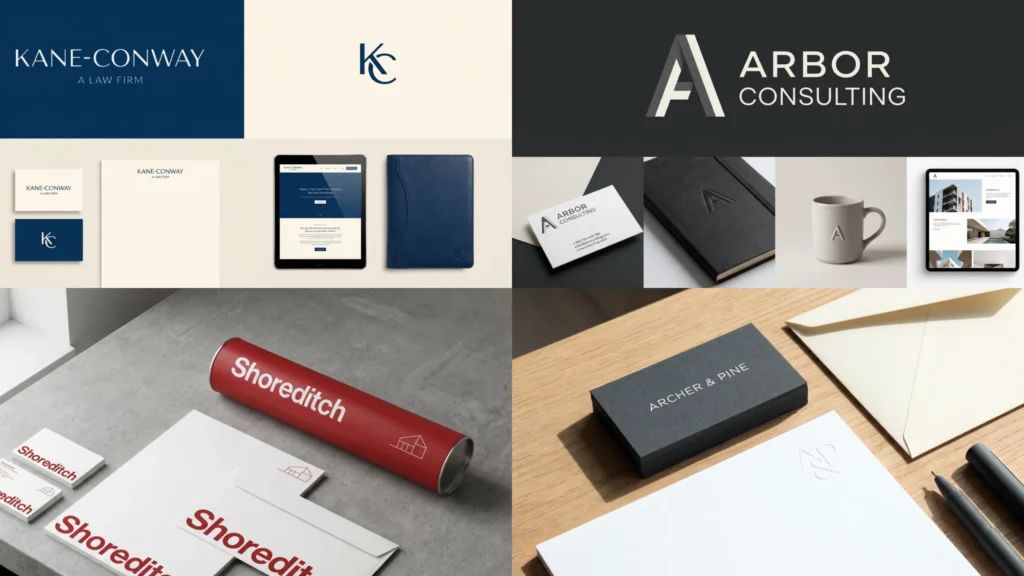
Choose an AI generator when the identity is provisional, and a mistake would be cheap to reverse. Choose a freelancer once your positioning is settled, and have someone in the firm direct and judge the work.
Choose an agency when positioning is unresolved, several partners must agree, or the brand has to hold together across services, offices and a full rollout.
- AI tools from Adobe and Canva now produce logos, palettes and brand kits, so making the artwork is no longer the scarce part of a rebrand.
- The scarce part is judgement: deciding what the brand should say, and recognising a weak option before it ships.
- A provider’s fee only makes sense when measured against what a wrong brand would cost to replace, re-approve and roll out again.
The right choice between a branding agency, a freelancer and an AI generator depends on how much a wrong brand would cost the business.
“Isn’t AI Good Enough Now?”
For some jobs, yes. The blanket claim that AI only produces generic clip-art is getting harder to defend.
In June 2026, Adobe announced that Firefly AI Assistant, part of Adobe’s generative AI suite, could generate a logo, brand identity and colour palette from a description of the user’s style and brand name.
In March 2026, Adobe expanded public beta access to Firefly custom models, which users can train on their own images to reproduce a chosen style.
In February 2026, Canva, the online design platform, announced that users could generate designs inside ChatGPT and Claude using the colours, fonts and logos stored in their Canva Brand Kit.
Read those announcements closely.
Adobe generates an identity from a description you provide; Canva starts with an existing Brand Kit. Neither shows the part a professional services firm struggles with: deciding what the firm stands for.
A custom model reproduces a chosen style. Choosing it is still a human call.
The market is pricing that difference. Upwork’s 2026 Future Workforce Index found that generative AI and creative production work on Upwork’s marketplace recorded 90% year-on-year growth in contract starts, while per-contract earnings declined by 13%.
The figure covers Upwork’s whole marketplace, not branding specifically, but the direction is plain: producing creative output is getting cheaper.

When an AI-Generated Logo Is Genuinely Enough
An AI-generated logo is enough when a business is testing an idea, the identity is openly provisional, and replacing it would touch a handful of assets.
A founder on Reddit’s r/generativeAI forum asked in April 2026 whether an AI logo generator would suit someone looking to keep launch costs below $200. For that founder, the honest answer is yes.
A 50–200-person firm is in a different position. Its identity is not provisional, and ownership is unsettled ground: independent designer Bojan Gulevski notes that the copyright status of AI-generated logos is unresolved, which can complicate trade mark registration.
For an established firm, AI earns its place in the process by exploring routes quickly and producing materials within an approved system, rather than deciding the brand.
“Why Pay an Agency When a Good Freelancer Costs a Fraction?”

Sometimes you shouldn’t.
The case for a freelancer is strong: direct access to the person doing the work, and no agency overhead in the fee.
Bojan Gulevski makes a fair point against agencies, too: smaller clients sometimes get a junior team billed at senior rates. If your firm has one decision-maker, an agreed position and a marketing lead who can run the rollout, a strong freelancer may be the better buy.
One r/branding user asked in December 2025 what actually changes after moving from freelancers to an agency. The drawing doesn’t change much. The work around it does:
- Discovery across many stakeholders. Interviewing eight partners, a handful of clients and the business development team and reconciling what they say is facilitation, not design.
- Decision management. When the audit partners want reassurance, and the advisory partners want ambition, someone has to hold the brief and stop the debate restarting at every partner meeting.
- A system, not a mark. The identity has to work across proposal templates, tenders, signage, digital and recruitment, with rules that other people can follow after handover.
- Accountability for the whole scope. One party owns the outcome if the rollout slips.
A single freelancer can do some of this. Doing all of it alone, alongside the design, is where capacity runs out. Talent rarely does.
Take a hypothetical 140-person firm formed by merging two practices: two legacy names, partners on both sides with firm views.
Its design brief can’t be written until positioning is settled, and settling it is most of the job. That firm doesn’t need more execution. It needs judgement and someone accountable for agreement.
Upwork’s data hints at where value now sits. In the same 2026 report, AI-augmented professional services on Upwork grew 72% year on year while earnings rose by 22%, the reverse of the creative-production trend.
Upwork also found that 41% of skilled freelancers used AI agents to execute tasks autonomously, compared with 34% of full-time employees. The line between “freelancer” and “AI” is blurring, so the question for any provider is who directs the tools and who judges the result.
“We’ve Paid Professionals Before, and It Was Disappointing”
In the same r/generativeAI thread, a commenter with more than 16 years in business said paid designers had always left them disappointed, with costly work that looked amateurish. A fee guarantees nothing. Neither does “human-made”.
Judge any freelancer or agency on four things before signing:
- Relevant work. Similar complexity matters more than similar aesthetics. A beautiful café identity says little about how to run a partnership rebrand.
- The proposed process. Ask them to explain each stage and the risk it mitigates, then compare their answers with a structured logo design process.
- Written scope. Concepts, revisions, files, guidelines and rollout support. Our breakdown of what logo design costs and what the fee should include shows what is commonly included and excluded.
- Rationale. Ask why a past client’s logo looks the way it does. If the answer is about taste rather than that client’s problem, expect the same on your project. The criteria for what makes a good logo give you a fair yardstick.
The trap is hiring on portfolio style when the real problem is positioning. A gorgeous identity built on an unresolved position gets redesigned the moment the partners finally agree on what the firm is.
“Surely the Cheapest Option That Looks Fine Is the Sensible One?”
It is, when a wrong brand is cheap. That’s the whole decision. Price the risk with four questions:
- How big is the footprint? List all places where the identity will appear: website, proposal and tender templates, signage, email signatures, recruitment materials, and client portals. That list, not the design fee, is the replacement bill. The Fiverr buyer above also said the interim years taught them which colours and styles they preferred, so a provisional identity isn’t always wasted money. Our guide on when to redesign your logo covers the trade-off tips.
- How reversible is it? A start-up can quietly swap its logo next year. A firm whose mark sits on engagement letters, panel submissions and the office front cannot.
- How many people must agree? One decision-maker can brief a freelancer or an AI tool. Twelve partners need a process.
- Can anyone in-house tell a strong option from a weak one? If not, you are buying judgement, whatever the invoice calls it.
| Scenario | Recommended choice | Why |
| Piloting a new service line under a temporary sub-brand | AI generator or freelancer | Provisional, small footprint, easy to reverse |
| Refreshing a mark that the partners already agree on, with in-house marketing to run the rollout | Senior freelancer | An execution problem with clear direction |
| Producing campaign assets within an approved identity | AI tools inside your brand kit, or a freelancer | Applying a brand, not deciding one |
| Two practices merging under one name | Agency | Positioning unresolved, many stakeholders |
| Repositioning ahead of a sale or investment round | Agency | High cost of a wrong answer on a fixed timeline |
| Partners describe the firm differently in the same pitch | Agency, strategy first | The problem isn’t visual |
| Several offices with inconsistent materials | Agency, or a senior freelancer plus an in-house project lead | A system and rollout problem |
“The costly mistake is paying for execution when the problem needs judgement. A logo can be drawn in an afternoon by a person or a machine. Deciding what twelve partners will stand behind for the next decade, and catching a weak route before it reaches every proposal and office sign, is an expensive skill. Buy that first, then buy the drawing as cheaply as quality allows.”
Buy Judgement First, Then Buy the Drawing
The agency vs freelancer vs AI comparison looks like a price question. It actually asks how much a wrong brand would cost your firm, and whether anyone inside could catch the mistake in time.
If the identity is provisional and reversible, an AI or a freelancer is the sensible buy, and an agency would be overspending.
If positioning is unsettled, partners disagree, or the brand has to carry a merger, a sale or a multi-office rollout, judgement is the scarce resource.
Answer the four questions above in writing before you brief anyone. If the answers point to AI or a freelancer, use one.
If they point to a positioning problem, Inkbot Design’s free Brand Equity Audit™ is a structured diagnostic that shows where your current brand is losing commercial ground and what to fix first.
Frequently Asked Questions
Is an AI-generated logo enough when testing a business idea?
Sometimes an AI-generated logo is a reasonable choice for testing a business idea when the identity is clearly provisional and appears on only a few assets. Treat it as a placeholder, check nobody in your market already uses something similar, and plan to replace it once the business proves itself.
Should I invest in professional branding before I have customers?
No, not usually in a full strategic engagement. Before customers, an identity needs to look credible and be easy to replace. The calculation changes once buyers judge your trustworthiness before they can verify it, as clients of a law or accountancy firm do, or once the brand spreads across many assets.
Can a freelancer handle a full rebrand for a 100-person firm?
Yes — a freelancer can handle a full rebrand for a 100-person firm when positioning is already agreed, one person has authority to sign off, and the firm has in-house capacity to run the rollout. Without those three conditions, the stakeholder and coordination work usually exceeds what one person can manage alongside the design.
Can we use an agency for strategy and AI tools for production?
Yes — a hybrid can work. An agency or senior freelancer establishes the positioning and visual system. Then AI tools, such as a Canva Brand Kit connected to ChatGPT or Claude, help staff produce materials within it. The risk is drift, so the guidelines need clear rules and a designated person to approve output.
