Brand Identity vs Brand Image: The Gap That Shapes Growth
Brand identity vs brand image is not a design debate. It is a strategic comparison between what an organisation intends to mean and what stakeholders conclude from the evidence they receive.
 By Stuart Crawford
 Reviewed by Tabitha Ayers
10 min read

On this page10 min left
The central difference between brand identity vs brand image is simple: brand identity is the meaning an organisation deliberately creates and presents, while brand image is the meaning people actually take away from their interactions with it.
That distinction becomes commercially significant when a firm believes it is seen as an expert, premium, responsive, or innovative firm, yet prospects describe it as interchangeable, expensive, unclear, or difficult to work with.
The problem is rarely just a logo. It is usually a gap between the promise embedded in the brand and the evidence audiences encounter.
For decision makers, the useful question is not whether a brand has an identity. Every organisation does. The question is whether its intended identity is being confirmed by customer experience, employee behaviour, market communications, and reputation.
A brand is not only what an organisation publishes. It is also the conclusion people reach after they compare its claims with its conduct.
What Brand Identity and Brand Image Actually Mean
Brand identity is the intended system of meaning
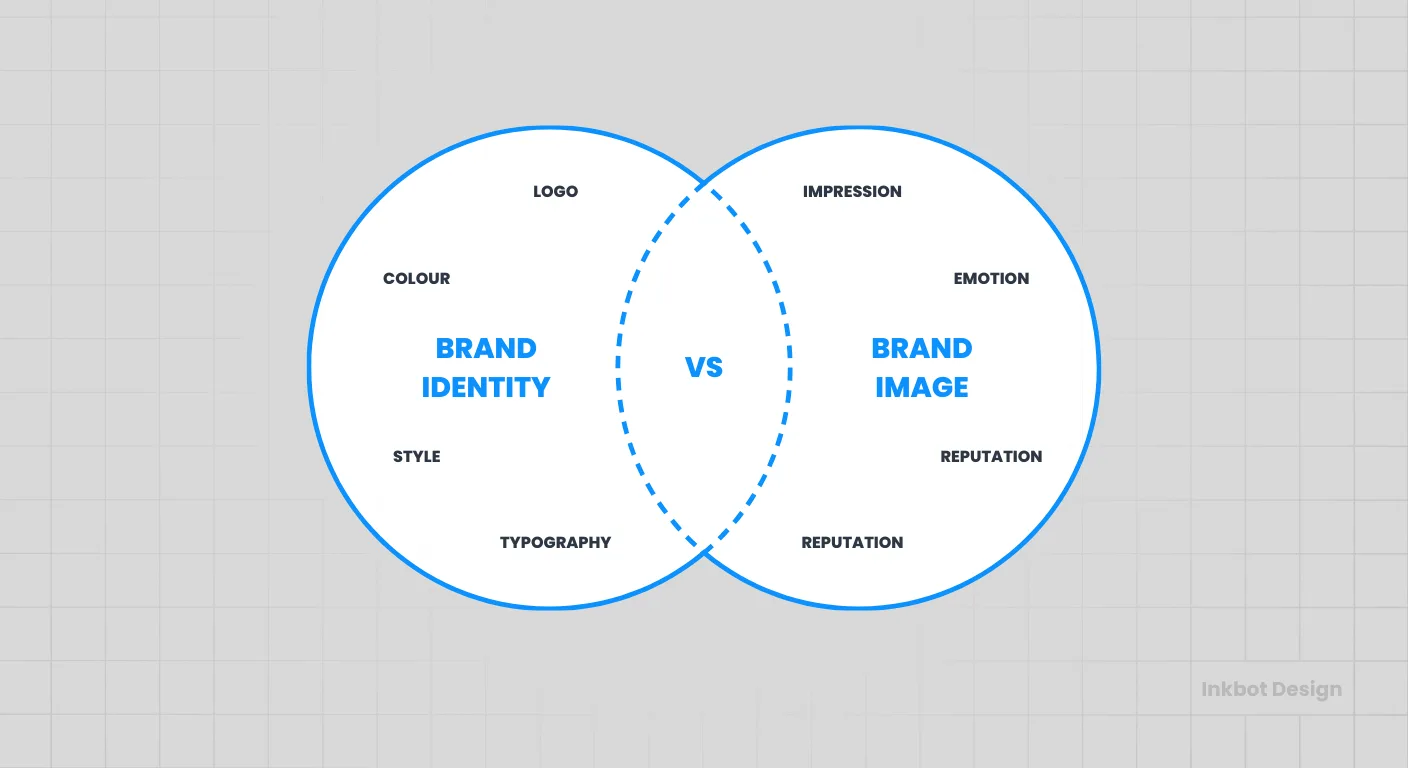
Brand identity is the deliberate system an organisation uses to express who it is, what it stands for, and why a buyer should choose it. It includes more than visual identity. A logo, typeface, colour palette, photography style, and website design are visible expressions, but they are only part of the system.
A complete identity also includes positioning, value proposition, naming, voice, messaging, service principles, and the promises made at each customer touchpoint. It gives employees and external partners a shared answer to practical questions: What should this organisation sound like? What should clients expect? What do we refuse to compromise on?
Canva’s explanation of the distinction notes that brand identity is defined by the brand, while brand image is formed through market interpretation. That is the essential control boundary. Leadership can decide what the organisation intends to signal. It cannot simply declare what people will believe.
For a professional services firm, identity may include an intended position such as “commercially sharp advisors for complex growth decisions.” That phrase alone does not create market authority. It must be supported by expertise, client conversations, proposals, service delivery, partner visibility, and outcomes that make the position credible.
Brand image is the audience’s accumulated conclusion
Brand image is the set of associations people hold in memory. It includes what they think a business is like, how they expect it to behave, whether they trust it, and which alternatives they compare it against.
These associations are often incomplete. A prospective client may know a firm only from a referral, a proposal, a website, and several online reviews. An employee may form an image based on leadership behaviour, internal communications, and the reality of promotion practices. A supplier may project an entirely different image through commercial negotiations and payment processes.
The result is that a single company can have multiple brand images simultaneously.
Dimension | Brand identity | Brand image |
|---|---|---|
Primary source | Internal strategic decisions | Audience interpretation and experience |
Time orientation | Intended future position | Perceptions shaped by past and current evidence |
Main components | Positioning, messaging, visual and verbal identity | Associations, expectations, feelings, judgments |
Degree of control | Directly managed | Influenced, but not directly controlled |
Key question | “What do we want to stand for?” | “What do people believe about us?” |
A Doria case study on identity and image describes identity as strategic and future-oriented, while image generally reflects accumulated perceptions from prior experiences. This is why a new identity can be launched quickly while market perception changes slowly.
Brand image is not the same as brand reputation
The terms overlap, but they are not identical.
Brand image concerns the associations currently attached to a brand. A firm may be viewed as traditional, premium, approachable, specialist, or innovative. These associations can shift when audiences encounter new communications, products, people, or experiences.
Brand reputation is broader and more durable. It reflects accumulated judgments about credibility, reliability, conduct, and performance. Reputation is often tested most visibly when an organisation faces criticism, service failures, leadership controversy, or difficult market conditions.
A firm can have a polished image but a fragile reputation. For example, a consultancy may look highly sophisticated online yet develop a poor reputation if clients repeatedly report unclear scope, missed deadlines, or unexpected fees. Strong visual identity cannot erase contradictory evidence.
Why the Identity–Image Gap Matters

A coherent identity can still produce a negative image
Consistency matters, but it is not a substitute for delivery. A company can use a disciplined design system, clear messaging, and tightly controlled campaigns, yet still be perceived negatively if its operations contradict its promise.
Consider a financial advisory firm that presents itself as transparent and client-focused. Its proposal language is plain, its website explains fees clearly, and its brand voice is reassuring. But if clients later encounter unclear billing, slow responses, or generic advice, the operational experience will outweigh the polished identity.
This is the mechanism under the surface: people do not assess a brand through communications alone. They compare communications with evidence. When the two agree, the intended identity becomes more believable. When they conflict, people tend to trust the evidence.
HubSpot’s overview of branding influences identifies advertising, customer service, reviews, product quality, and social presence as factors that can shape brand image. For leadership teams, this means brand perception is not solely a marketing metric. It is a cross-functional outcome.
Different audiences may hold different images
It is tempting to ask, “What is our brand image?” as if there were one answer. In practice, image varies by stakeholder group, market, seniority, service line, and stage of the buyer journey.
A useful starting point is to separate audiences before drawing conclusions:
- Existing clients can judge delivery quality, value, responsiveness, and relationship strength.
- Prospects may only judge visibility, clarity, credibility, and perceived differentiation.
- Employees experience leadership behaviour, culture, and the distance between internal promises and operational reality.
- Referral partners often judge reliability, expertise, commercial fit, and reputational risk.
- The general public may hold only broad or media-shaped associations.
This distinction prevents a common strategic mistake: treating disagreement as inconsistency when it may be a legitimate difference in experience.
A long-standing client may reasonably perceive a firm as highly personal because of direct access to senior advisors.
A prospect who sees only broad campaigns may perceive the same firm as corporate and distant. Both perceptions can be true within their respective contexts.
The priority is to identify whether the difference reflects intended segmentation or an unmanaged gap. If a premium service is intentionally designed for complex mandates, it may be appropriate for it not to be perceived as low-cost or mass-market.
If a firm wants to be known for responsiveness but only selected clients receive timely communication, that is not segmentation. It is a delivery problem.
Positioning turns the gap into a commercial issue
A strong identity without a defensible market position often becomes decorative. Organisations may look different without being meaningfully preferred.
Effective brand positioning establishes the intended place a firm should occupy relative to alternatives. It clarifies the category, audience, competitive frame, distinctive value, and reasons to believe the promise. Brand image reveals whether that intended position has actually landed.
For example, a legal firm may intend to own “practical counsel for ambitious mid-market businesses.” If clients instead describe it as “competent but similar to every other regional firm,” the problem is not simply a matter of awareness. The intended distinction is not being recognised or remembered.
That gap can reduce fee confidence, weaken referrals, and increase reliance on price-based comparisons. Buyers who do not understand why a firm is different have little reason to pay more for it.
How to Measure the Identity–Image Gap
Measure attributes, not one vague overall score
Overall brand favorability can be useful, but it hides important contradictions. A firm may score well for expertise and poorly for clarity. It may be respected by clients but unknown among prospective hires. It may be seen as premium by one sector and overpriced by another.
A stronger method is attribute-level tracking. Begin with the few associations that define the intended identity, then measure whether priority audiences connect those associations to the brand.
Intended association | Evidence to collect | What a gap may indicate |
|---|---|---|
Trusted | Client interviews, reviews, referral feedback | Weak proof, inconsistent advice, reputational concerns |
Premium | Win and loss interviews, pricing objections, proposal feedback | Unclear value, weak differentiation, price sensitivity |
Responsive | Response time data, service surveys, complaints | Operational delay, unclear ownership, staffing pressure |
Innovative | Market interviews, content engagement, competitor comparison | Generic claims, limited proof, outdated service experience |
Specialist | Search behaviour, referral sources, buyer interviews | Broad messaging, unclear service architecture, weak expertise signals |
We should not assume there is a universal acceptable score or a standard numerical threshold for the identity–image gap. Available evidence does not establish one. Context matters. A narrowly focused firm may accept low awareness outside its target sector, while a consumer brand may require broad recognition.
The practical test is comparative: Is the gap narrowing among the audiences that matter most, and are the associations linked to commercial outcomes such as consideration, referral quality, conversion, retention, or pricing confidence?
Use an evidence hierarchy
Not all feedback carries equal diagnostic value. A single social media comment may reveal an issue, but it should not dictate strategy. A structured pattern across interviews, service data, reviews, and sales conversations deserves more weight.
Use evidence in this order:
- Observed behaviour: referral patterns, repeat business, conversion rates, response times, complaints, churn, and pricing objections.
- Direct stated perception: interviews, surveys, win and loss conversations, and post-project feedback.
- Public expression: reviews, media coverage, social discussion, and third-party recommendations.
- Internal interpretation: leadership assumptions, employee feedback, and workshop observations.
Internal views are valuable, but they should be treated as hypotheses until external evidence confirms them. Senior teams often know what they intend to communicate. They may be less able to see how that communication is decoded outside the organisation.
Diagnose the source before redesigning anything
When image and identity diverge, a rebrand may be useful. It is not automatically the right first move.
Start by separating four possible failure points:
- Recognition failure: target audiences do not notice, remember, or understand the brand’s intended distinction.
- Messaging failure: audiences see the communications but interpret the promise differently than intended.
- Experience failure: the promise is understood, but service, product, or people do not consistently deliver it.
- Reputation failure: accumulated evidence has reduced confidence, making new claims less believable.
A visual redesign can help recognition and may clarify messaging. It will not solve an experience failure. If clients complain about poor handovers, an updated website cannot repair the image problem.
The recovery action must change the underlying experience: defined ownership, clearer communication standards, better onboarding, or revised service processes.
This is where disciplined brand management matters. The work is not limited to approving creative assets. It involves managing the signals, systems, and behaviours that either reinforce or weaken the intended market position.
How to Align Identity, Experience, and Perception

Build a promise that operations can prove
A brand promise should be specific enough to guide decisions and realistic enough to be delivered consistently. “We put clients first” is difficult to test because almost every competitor can claim to do so. “Senior commercial advice within agreed response times for time-sensitive transactions” is more concrete. It gives clients something they can experience and employees something they can operationalise.
Before publishing a promise, test it against three questions:
- Can the organisation demonstrate this consistently today?
- Can buyers see proof before they purchase?
- Does the promise create a useful distinction from credible alternatives?
If the answer is no, refine the promise or fix the operating model before amplifying it. Overpromising may create initial attention, but it also widens the identity–image gap when delivery falls short.
Translate strategy into touchpoint rules
Identity becomes real when people can apply it during everyday decisions. This requires more than a visual manual. It needs clear principles for language, sales materials, customer onboarding, proposals, hiring, service recovery, and leadership communications.
Well-designed brand guidelines can create consistency across visual and verbal expression, but they should be connected to actual business moments. A guideline that specifies logo spacing but says nothing about proposal tone, client updates, or complaint responses is incomplete.
A practical touchpoint review can use the following structure:
Touchpoint | Intended signal | Questions to test |
|---|---|---|
Website | Clear expertise and relevance | Can a buyer identify the firm’s speciality and value within minutes? |
Proposal | Commercial confidence | Does the language explain value, scope, and fees without ambiguity? |
Sales conversation | Credibility and understanding | Are claims supported by relevant evidence rather than broad assertions? |
Service delivery | Reliability and responsiveness | Are roles, timelines, updates, and escalation routes clear? |
Review response | Accountability | Does the organisation respond in a way that matches its stated values? |
Expect image to lag behind identity changes
A rebrand can immediately change identity assets. New messaging, a new visual identity, and revised campaign materials can go live on a specific date. Audience image does not work that way.
Perception changes when people encounter repeated, credible evidence over time. A prospective client who has not interacted with the firm since the old identity may still hold the old view. A dissatisfied former customer may require meaningful service improvements before updating their judgment. Some audiences may never see the change at all.
There is no reliable universal timeframe for image to catch up after a rebrand. The speed depends on audience reach, interaction frequency, the scale of the change, prior reputation, and whether the experience validates the new promise.
Consider two scenarios. A business-to-business advisory firm updates its identity but has a small, stable pool of target clients. Image may change gradually because buyers encounter the firm infrequently. A consumer service brand with high transaction volume may receive faster feedback, but a poor service experience can also spread faster through reviews and social channels.
Fair warning: launching an identity before the organisation is ready to support it can make the gap more visible. The market may notice a stronger promise before it experiences stronger performance.
Conclusion
Brand identity vs brand image is not a design debate. It is a strategic comparison between what an organisation intends to mean and what stakeholders conclude from the evidence they receive.
The strongest brands do not try to force perception through polished communications alone. They define a clear position, translate it into observable behaviours, measure associations by audience and attribute, and address the operational causes of mismatch. That is how identity becomes a credible image over time.
For decision-makers, the next step is straightforward: identify the few associations the business must own, test whether priority audiences actually associate them with the brand, and act on the gap with the right intervention rather than the most visible one.
Questions people ask
What is the difference between brand identity and brand image?
Brand identity is the deliberate expression of what an organisation wants to stand for. Brand image is the perception audiences actually form. Identity is created internally; image is formed externally through communications, experiences, reviews, products, people, and reputation.
Is brand identity what a company controls?
A company can directly manage its identity, including messaging, visual identity, positioning, and standards for brand use. It cannot fully control brand image because audiences interpret signals through their own expectations and experiences. The practical objective is to influence through consistent, credible evidence.
Which comes first: brand identity or brand image?
Identity usually comes first as a strategic decision. An organisation defines its intended position and promise, then expresses them through branding. Image develops afterwards through audience exposure and experience. In established businesses, however, the existing image should inform identity work, as past perceptions cannot be ignored.
Can a strong visual identity compensate for poor customer experience?
No. A strong visual identity can improve recognition, clarity, and perceived professionalism, but it cannot sustainably compensate for poor delivery. When service evidence conflicts with brand claims, customers typically give more weight to their direct experience than to the design system.
How can customer reviews reveal a brand image problem?
Reviews are most useful when analysed for repeated themes rather than isolated comments. Look for patterns in the words customers use: responsive, expensive, unclear, helpful, slow, expert, or impersonal. Compare those words with the associations the organisation intends to own. Repetition across multiple reviews may show where experience is reinforcing or undermining identity.
How do employees affect external brand image?
Employees shape external image through their behaviour, communication, expertise, and consistency. They are particularly influential in professional services, where clients often experience the brand through people rather than products alone. If internal culture contradicts the external promise, that contradiction can appear in service quality, recruitment feedback, and client relationships.
What should a business fix first when identity and image do not match?
Fix the source of the mismatch first. If people do not understand the offer, clarify positioning and messaging. If they understand it but do not experience it, improve service delivery. If trust has been damaged, focus on accountable behaviour and evidence before increasing promotional activity. Redesign should follow diagnosis, not replace it.