Brand Entity Consistency: Build a Trusted Web Presence
Brand entity consistency means presenting a coherent set of factual identity signals across owned, earned, and third-party channels. The goal is not to make every page read identically. The goal is to ensure that every credible representation points to the same organisation and accurately explains its relationship to associated people, locations, services, and brands.
 By Stuart Crawford
 Reviewed by Tabitha Ayers
10 min read

On this page10 min left
Brand entity consistency is the practice of ensuring your organisation is represented as the same real-world business wherever customers, platforms, directories, and automated systems encounter it.
It covers more than a logo or a matching colour palette. It includes your public name, trading name, legal identity, address, phone number, website, service categories, leadership relationships, locations, and official profiles.
For decision makers, the commercial issue is straightforward: contradictory business information creates doubt.
A prospective client may see one name on your website, another in a directory, an old office on a map, and a different description on LinkedIn.
Even if each record has an innocent explanation, the combined effect can weaken customer perception and make a premium position harder to defend.
I would treat entity consistency as a governance responsibility, not a one-time SEO task.
It is how you ensure that the facts surrounding your brand support the market authority your visual identity and messaging are designed to create.
What Brand Entity Consistency Actually Means
Brand entity consistency means presenting a coherent set of factual identity signals across owned, earned, and third-party channels.
The goal is not to make every page read identically. The goal is to ensure that every credible representation points to the same organisation and accurately explains its relationship to associated people, locations, services, and brands.
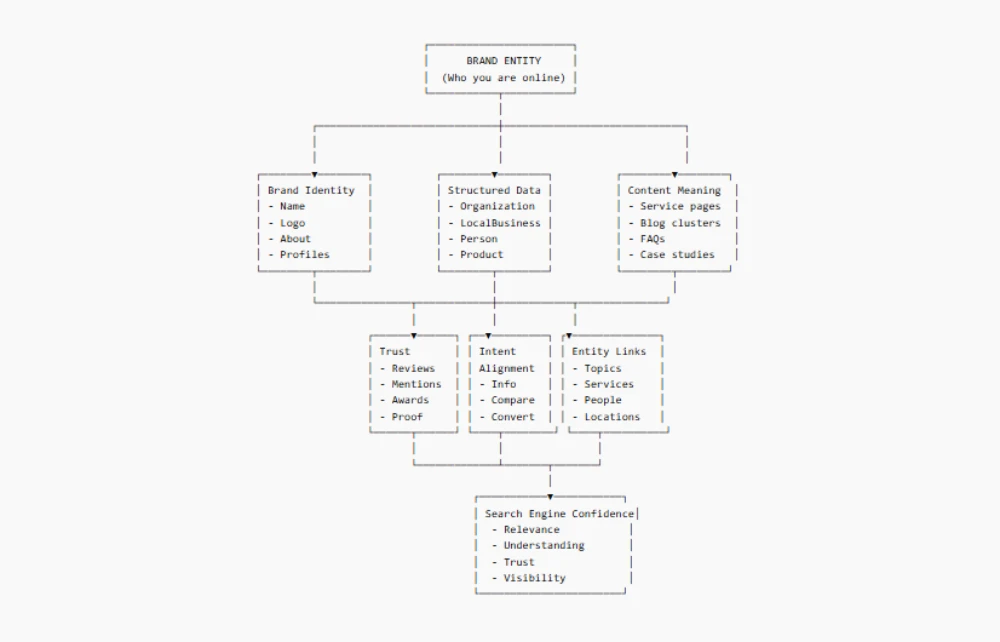
A brand entity is the identifiable commercial subject behind generative engine optimisation. For a professional services firm, it may be the customer-facing firm name, supported by a registered legal company, regulated professionals, regional offices, practice areas, and a parent group.
Those elements should connect cleanly rather than compete with one another.
Brand consistency versus entity consistency
Brand consistency usually concerns the recognisable expression of a brand: visual identity, tone of voice, brand messaging, and customer experience. Entity consistency is narrower in one respect and broader in another.
It is narrower because it focuses on verifiable facts. It is broader because those facts must travel beyond the channels your organisation directly controls.
Area | Primary question | Example of failure |
|---|---|---|
Visual identity | Does the brand look recognisable? | An outdated logo remains on a partner profile |
Brand messaging | Does the organisation communicate a coherent value proposition? | One office claims specialist advisory work while another claims general consultancy |
Entity consistency | Can a person or system identify the same organisation across sources? | The website, map listing, and company profile show conflicting names or locations |
A refreshed website will not resolve an old Google Business Profile. Equally, correcting a phone number will not repair an unclear market position.
Both disciplines matter because visual and verbal coherence makes a firm recognisable, while factual coherence makes it credible and easier to distinguish from similarly named organisations.
Why inconsistency damages trust
Inconsistency rarely produces a single dramatic failure. More often than not, it creates friction at decision points.
A buyer checking credentials may hesitate when the office address on a regulatory register does not match the address on the website. A referral partner may use an outdated trading name. A prospective hire may wonder whether two profiles describe the same organisation.
The underlying mechanism is ambiguity. Systems that organise information must reconcile claims from several sources, while people make quick judgments about whether information appears current and controlled. Neither process benefits from conflicting facts.
There is no reliable UK-wide threshold indicating that a specific number of inaccurate listings results in a measurable ranking loss. Nor is there a validated universal score for entity consistency. That uncertainty matters.
I would avoid promises that correcting ten directory listings will generate a defined uplift. The more defensible case is risk reduction: fewer contradictions give customers and platforms fewer reasons to misidentify the business.
A consistent entity record does not guarantee visibility. It creates a dependable foundation on which visibility, reputation, and brand equity can be built.
Facts should match; copy can adapt
A common mistake is demanding identical wording across every channel. That can produce awkward social profiles, inaccessible copy, and descriptions that ignore what a specific audience needs.
Separate factual consistency from persuasive consistency:
- Factual consistency includes the approved public name, primary domain, phone number, legal or trading name relationship, address, service areas, and business category.
- Persuasive consistency includes the length, emphasis, tone, and examples used in a description.
- Visual consistency includes approved logos, colours, imagery, and naming conventions.
For example, a law firm may use a concise profile description for a business directory, a detailed sector-focused introduction on its website, and a recruitment-focused narrative on LinkedIn. Those descriptions need not be identical. They should still agree on what the firm is, whom it serves, and what it is called.
Define the Identity That Must Remain Consistent
Before correcting public profiles, establish the entity model internally. This is where many firms discover that the apparent inconsistency is actually an unresolved business decision.
Separate legal, trading, location, and product identities
A registered legal name is not always the name customers know. A parent company can own a subsidiary with a separate public brand.
A national firm can operate regional offices. A consultancy may also offer a named product or program. Treating all of these as interchangeable creates misleading records.
Use an entity record that explicitly maps each relationship.
Identity type | What it represents | Where it commonly appears | Control requirement |
|---|---|---|---|
Legal entity | Registered company or partnership | Contracts, invoices, Companies House records | Preserve legal accuracy |
Trading name | Customer-facing business name | Website, proposals, profiles, marketing | Use consistently where customers encounter the firm |
Parent organization | Owning or controlling entity | Group sites, corporate disclosures | Explain ownership without replacing the trading brand unnecessarily |
Location | A specific office or service point | Maps, local listings, contact pages | Maintain accurate local address and phone details |
Product brand | A named service, platform, or offer | Product pages, campaigns, partner materials | Clarify whether it is separate or part of the main business |
Consider a consulting firm legally registered as “Woodrow Advisory Holdings Ltd,” trading as “Woodrow Advisory,” with offices in London and Manchester.
Its Google profiles, social accounts, and customer communications should normally foreground Woodrow Advisory.
The legal entity belongs in places where formal disclosure is required. Replacing the public brand with the registered name everywhere may confuse customers; hiding the legal relationship everywhere may confuse suppliers and regulators.
The objective is not forced uniformity. It is a documented, intelligible relationship between identities.
Choose a canonical public name
Your canonical public name is the name most customers should see and use when referring to your organisation. It should be grounded in real-world usage: signage, client communications, official website headers, proposal documents, and other stable customer-facing materials.
Google’s business representation guidelines outline rules for business names, chains, departments, practitioners, and multiple brands at a single location.
The central policy principle is practical rather than cosmetic: names should reflect how the business is represented in the real world, not include unnecessary promotional text.
That matters for location naming. A chain should generally use a consistent name unless its real-world representation genuinely differs by location.
Similarly, two distinct brands operating at the same address should not automatically be merged into a single profile. A shared reception desk does not make separate businesses into a single entity.
Define nonnegotiable fields
Not every field deserves equal attention. I recommend establishing a controlled fact set with an owner and review date for each item.
- Identity fields: public name, legal name, trading name, logo, primary website, and official email domain.
- Location fields: registered office, customer-facing offices, service areas, local phone numbers, and opening hours where applicable.
- Classification fields: core services, industry categories, regulated status, geographic coverage, and audience.
- Relationship fields: parent company, subsidiaries, office locations, key practitioners, and product brands.
- Reference fields: verified social accounts, review profiles, professional directories, and business listings.
This is where internal brand alignment becomes operational. Marketing, business development, operations, HR, IT, and local office leaders should not maintain competing versions of the same fundamental facts.
Create an Evidence-Based Governance System
The difficult part is not finding discrepancies. It is deciding which record should win when credible sources conflict.
Build a practical evidence hierarchy
There is no universally validated source hierarchy that applies to every UK business. Companies House, a regulated professional register, an official website, a map profile, and a social account each serve different purposes.
A sensible hierarchy therefore depends on the fact being checked.
Fact in dispute | Strong starting evidence | Escalation question |
|---|---|---|
Legal company name | Formal company and legal records | Is the customer-facing trading name different? |
Regulated status or practitioner details | Relevant professional register | Is the individual still associated with the firm? |
Public brand name and service positioning | Current official website and client communications | Does real-world signage and usage support it? |
Location and customer contact details | Official contact page and verified local profile | Is this a registered office, operational office, or service area? |
Historic name or acquisition | Official announcements and archived business records | Is continuity clear enough to explain rather than erase? |
A source confidence score can make decisions repeatable. This is a proposed governance method, not an established ranking factor.
Score each source on three dimensions: authority, recency, and directness to the fact in question.
A recent official office page may be stronger evidence for opening hours than a corporate registry. A registry may be stronger evidence for the legal entity name.
Maintain a contradiction register
A spreadsheet can work at first. Larger firms may use a digital asset management, governance, or CRM system. The tool matters less than the discipline of recording what was found, who owns the correction, and whether it was verified afterwards.
Field | Example entry |
|---|---|
Contradiction | Legacy directory lists former trading name |
Affected entity | Woodrow Advisory, Manchester office |
Source confidence | Medium: third-party directory, last updated unknown |
Approved fact | Current trading name and official domain |
Owner | Marketing operations |
Resolution | Request amendment, preserve former name only in historical context |
Verification date | Confirm after platform update and record evidence |
Prioritise contradictions by customer impact, not by how easy they are to edit. A wrong legal name on a low-traffic directory may be less urgent than an inaccurate phone number on a prominent map listing.
Conversely, a legacy name may need to remain visible during a rebrand if removing it immediately would sever recognition and confuse existing clients.
Give change control the same status as financial control
Entity consistency breaks most often during change: a rebrand, merger, acquisition, office move, leadership departure, franchise opening, or service closure. The brand changes quickly; third-party records do not.
For material changes, use a controlled sequence:
- Approve the canonical facts, relationships, public naming rules, and effective date.
- Update owned channels first, including the website, contact pages, structured data, email signatures, and downloadable documents.
- Update high-visibility external profiles, including Google Business Profile, regulated registers where relevant, social accounts, and key professional directories.
- Preserve historical continuity with redirects, transition messaging, and clearly labelled former names where appropriate.
- Reaudit after updates propagate, then close unresolved items only when evidence confirms the result.
A rebrand is not a reason to erase history indiscriminately. If clients still search for a former name, a transition page can explain the relationship. If a discontinued product is genuinely separate from the ongoing business, avoid presenting it as though it remains current.
Implement and Test Consistency Across the Web
Once your entity record exists, implementation becomes more precise. The aim is to connect accurate representations, not to publish the same data indiscriminately across all available directories.
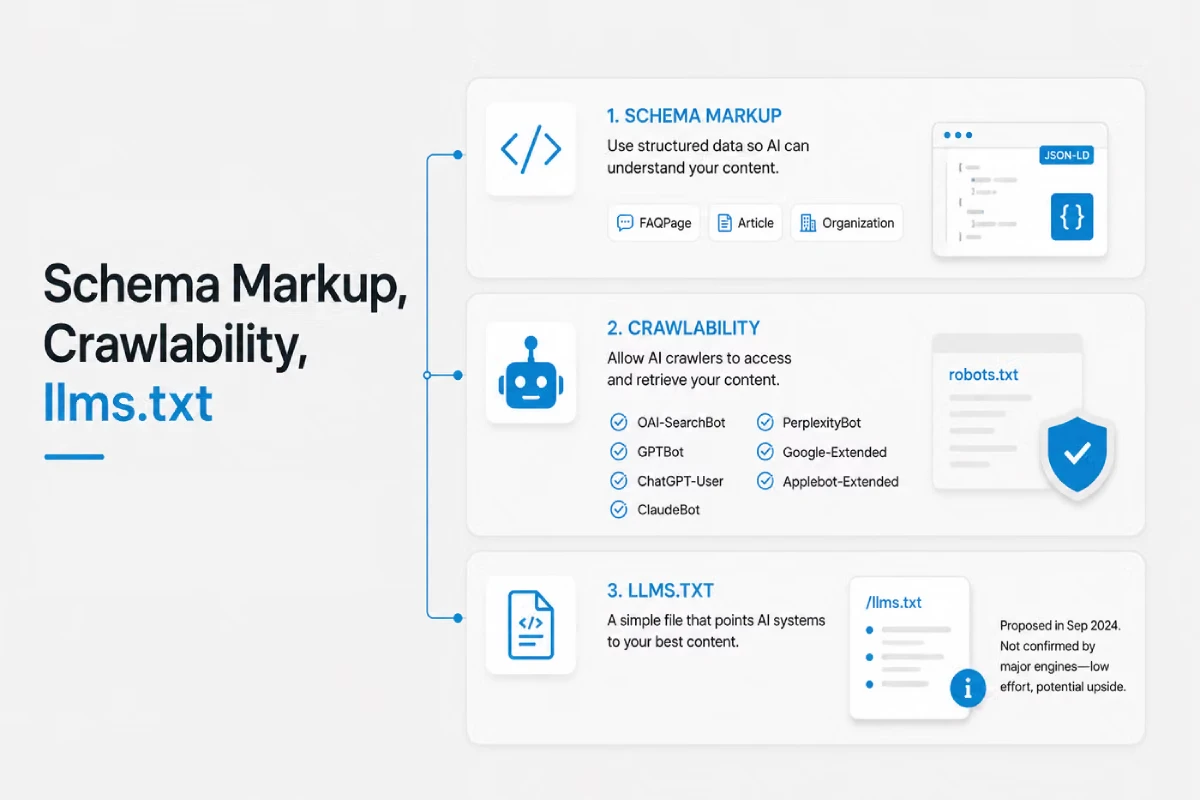
Use structured data as clarification, not a shortcut
Organization structured data can describe an organization’s name, URL, logo, contact points, and relationships. The sameAs property can identify official profiles that refer to the same entity. These are useful signals because they state your claims in machine-readable form.
They are not a mechanism for forcing a search feature, overriding contradictory public evidence, or declaring unrelated profiles equivalent.
Only reference profiles you control or can verify as official. A dormant social account with an outdated name is not made trustworthy simply because it appears in structured data.
Rivetline AI identifies public name, legal or trading name, category, website, contact details, services, and regions served as useful entity information.
Its overview of essential entity details is a useful reminder that identity is a connected record rather than a single schema field.
Your brand style guide should support this work by defining approved names, logo versions, disclaimers, capitalisation, and references to offices or service lines. It should not substitute for the entity record itself. Style guidance governs expression; entity governance governs factual identity.
Audit by ambiguity, not just field matching
A simple audit asks whether every listing has the same name, address, and phone number. A better audit asks whether a stranger could confuse your organisation with another one.
Test realistic ambiguity cases:
- Search the brand name alongside each major city, practice area, and key executive name.
- Check whether a parent company and subsidiary are described as one business when they are legally or commercially distinct.
- Review whether multiple brands at one address are represented separately where they operate separately.
- Test former names, common abbreviations, and frequent misspellings.
- Confirm whether the contact details distinguish a registered office from a client service location.
For example, a firm may have one London address for statutory mail and another office where client meetings are held. Publishing the statutory address as the main customer location may be legally accurate but commercially misleading.
The solution is not to choose one truth over another; it is to label each address according to its purpose.
Be selective with third-party profiles
Third-party sources can reinforce a coherent public record when they are relevant, maintained, and independently credible. But mass submission is not a strategy.
As Crescendo Agency’s explanation of third-party verification notes, external information can help others evaluate a brand; this does not mean every directory listing automatically creates an SEO benefit.
Prioritise profiles that have a real decision-making function:
- Google Business Profile for eligible locations.
- Professional and regulated directories relevant to your sector.
- Major social and professional networks that clients genuinely use.
- Review platforms where the firm is actively represented.
- Industry associations, partner pages, and event listings with editorial standards.
Avoid creating profiles you will not maintain. An abandoned listing becomes future contradiction inventory.
Measure operational health over time
Use a recurring quarterly review for stable organisations and a tighter schedule during major business changes. Measure process health, not speculative ranking outcomes.
Metric | What it reveals | Useful decision |
|---|---|---|
Open contradictions | Current factual conflict exposure | Allocate ownership and escalation |
High impact unresolved items | Risk at customer decision points | Prioritise correction work |
Verified priority profiles | Coverage of critical external sources | Identify missing or stale representations |
Average resolution time | Governance responsiveness | Improve approvals and access controls |
Repeated error type | Root cause of inconsistency | Update templates, training, or systems |
The most valuable trend is often repetition. If office addresses repeatedly drift out of date, the failure is unlikely to be a directory problem. It is probably a change-control problem within the organisation.
Conclusion
Brand entity consistency is the discipline of making your organisation legible, verifiable, and recognisable across the web.
It protects brand equity because clients should not need to resolve basic questions about who you are, where you operate, or whether a profile is current.
Start with a controlled entity record, distinguish legal and customer-facing identities, resolve contradictions using evidence, and build change control into every material brand transition.
The result is not perfect uniformity. It is a public record that tells one accurate, defensible story about your business.
Questions people ask
What details must match across websites and profiles?
Public brand name, primary domain, core contact details, location purpose, service categories, and corporate relationships should be accurate and consistent. Descriptions can vary by channel as long as they do not contradict those facts.
Should the legal company name and trading name be identical everywhere?
No. Use the legal name where formal disclosure requires it, and the trading name where customers recognise the business. The important requirement is a clear, documented connection between the two.
Does NAP consistency matter if there is no physical shop?
Yes, although the relevant facts differ. Service businesses should keep their public name, phone number, domain, service areas, and customer contact details up to date. Do not present a virtual or registered address as a walk-in location if it is not one.
How should parent companies and subsidiaries be handled?
Represent them as related but distinct entities when they are genuinely separate organisations or customer-facing brands. Explain ownership clearly on official channels rather than casually merging names.
Should every profile use exactly the same brand description?
No. Maintain a canonical description as a factual reference, then adapt the length and emphasis for the audience and platform. Consistency of meaning matters more than repeated wording.
What should a franchise do about location names?
Use the real-world business name consistently, while accounting for legitimate local variation. Google’s naming rules are particularly relevant here: a location should not add promotional phrases merely to capture more searches.
Can structured data correct inaccurate third-party listings?
Not by itself. Structured data clarifies what your website says, but it cannot compel external platforms to update their records or make systems disregard other credible evidence.