llms.txt for Professional Services Firms: What It Does and Doesn’t Do
llms.txt emerged in 2024 as a proposal to provide AI agents with concise website information and links to more detailed material. The current proposal is described in the llms.txt v2 documentation as a way to provide agents with concise, linked website information, potentially at the site root or at a path that covers pages beneath it.



On this page9 min left
For professional services firms, llms.txt is best understood as a concise, machine-readable guide to the most useful public information on a website.
It can help AI agents locate selected pages, understand the relationship between them, and access cleaner supporting material than a full HTML page may provide.
It is not a shortcut to being cited by ChatGPT, Claude, Gemini, or any other AI product. It does not control crawler access, protect confidential content, improve search rankings on its own, or guarantee new client enquiries.
That distinction matters in generative engine optimisation (GEO). A law firm, accountancy practice, or advisory business may invest substantial time producing authoritative sector content, service explanations, insight articles, and client resources.
If that material is scattered across inconsistent pages, unclear labels, or outdated URLs, an llms.txt file will not repair the underlying information architecture.
It can only point agents to information that is already accurate, accessible, and well-governed.
Think of llms.txt as a signed directory in the reception area, not a locked door, legal contract, or sales representative.
What llms.txt Is and Its Current Status
A proposal, not a ratified web standard
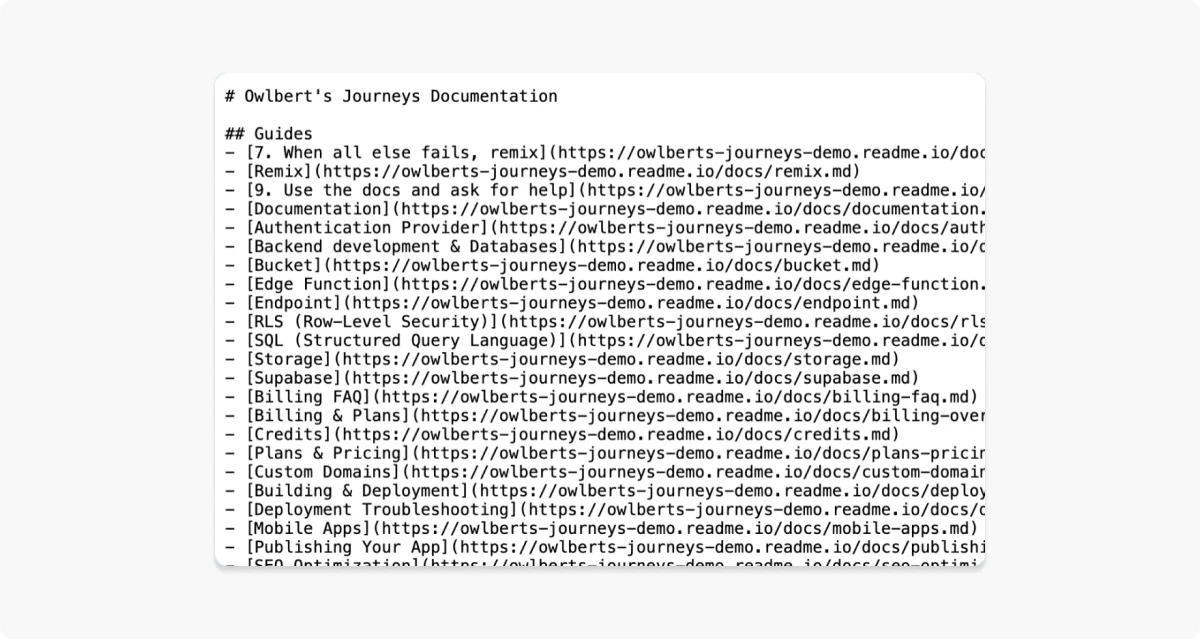
llms.txt emerged in 2024 as a proposal to provide AI agents with concise website information and links to more detailed material. The current proposal is described in the llms.txt v2 documentation as a way to provide agents with concise, linked website information, potentially at the site root or at a path that covers pages beneath it.
The distinction between a proposal and a formal web standard is not academic. A formal standard typically has broad implementation support, established governance, and predictable behaviour across systems. llms.txt does not currently provide that certainty.
Different AI products, crawlers, retrieval systems, and website platforms may ignore it, interpret it differently, or never request it at all.
For decision-makers, the practical position is simple: publish llms.txt only when its maintenance cost is low, and its content governance is strong. Treat it as a useful experiment in structured publishing, not a guaranteed distribution channel.
The core structure is intentionally simple
An llms.txt file is typically written in Markdown and includes a clear site or project name, brief explanatory context, operational guidance, and links to selected resources. The linked pages may be Markdown versions of detailed documentation, service pages, policy pages, or authoritative articles.
For a professional services firm, the file should not become a compressed version of the whole website. Its value is editorial selection. It should answer three questions quickly:
- What does this firm do?
- Which audiences, sectors, or service categories matter most?
- Which public pages are the most reliable sources for detailed information?
A firm specialising in tax advisory for technology businesses, for example, might link to its tax services overview, technology sector page, leadership biographies, client onboarding information, and carefully maintained insights hub.
It should not link indiscriminately to every archive page, press mention, tag page, or outdated campaign landing page.
Proposal changes create a maintenance obligation
A file can remain technically available while becoming structurally stale. The proposal itself has evolved. The published llms.txt change history indicates that the proposal has changed and that earlier assumptions about context expansion tooling are no longer part of the current proposal.
This is a useful warning against copying templates without reviewing them. Older examples may use labels or conventions that no longer have the same meaning. In particular, do not assume that a section labelled “Optional” has a special machine-interpreted role simply because an old tutorial says it does.
I recommend recording the proposal version or review date in your internal publishing documentation, even if you do not expose that note publicly. That creates accountability when a platform update, redesign, or content migration changes the site structure.
How to Build an llms.txt File That Reflects Your Firm
Start with canonical information, not a generator
A generator can quickly create a valid file. It cannot determine whether the linked material is strategically correct, legally current, or consistent with the firm’s market position.
Before generating anything, identify the pages that represent your canonical public position. A canonical URL is the preferred address for a specific document. If your llms.txt file points to a retired service page while your navigation points elsewhere, agents receive conflicting signals. So do human readers.
Use a small editorial group that includes marketing, subject matter owners, and whoever controls publishing. For regulated firms, legal or compliance review may be appropriate for pages covering professional advice, claims, complaints procedures, or regulated services.
A practical selection framework is below.
Content type | Include when | Exclude when |
|---|---|---|
Core service pages | The page states a current, specific service offering | It is a temporary campaign or duplicates a stronger page |
Sector pages | The firm has meaningful evidence and active capability in that sector | The sector is only mentioned in passing |
Expertise and insight | The content is dated, reviewed, and attributable to a relevant team | It contains obsolete commentary or unreviewed opinion |
Contact and onboarding pages | They explain a real client journey or eligibility process | They expose unnecessary operational detail |
Leadership biographies | Credentials and responsibilities are current and public | The pages contain personal data not needed for client decisions |
Write for clarity, not keyword density
The opening description should state the firm’s category, audience, primary services, and geographic or sector focus where relevant. It should use terminology that a prospective client, procurement team, or AI agent can understand without relying on internal shorthand.
For example, “We help organisations with complex commercial disputes” is clearer than “We deliver holistic legal excellence.” The first statement identifies a problem category. The second offers little usable detail.
Language consistency is equally important. If your website calls a service “corporate finance advisory” in one place, “transaction support” in another, and “deal services” elsewhere, the llms.txt file should not paper over the confusion. Resolve the naming system first. Useful brand-naming frameworks can help firms establish a service category, an offering name, and a market-facing descriptor before those terms are repeated across public materials.
Use a concise model rather than a content dump
A lean file is easier to verify and less likely to become stale. A typical professional services version may include:
- A firm name and one-sentence description
- A short explanation of the primary audience and service scope
- Links to key services, sectors, people, insights, and contact information
- A brief instruction to prefer linked canonical pages for current detail
- A review date or internal publication workflow outside the public file
The file should not include unpublished pricing, client names without permission, confidential methods, internal playbooks, or material intended only for authenticated users. Publishing a public text file makes information easier to locate. It does not make it safer.
Align the file with brand governance
A firm’s llms.txt content is part of its public positioning system. The terms used to describe services, sectors, proof points, and client fit should align with the language used across the website, proposals, directories, and thought leadership.
This is where brand voice archetypes can be useful. A firm positioning itself as precise and authoritative should avoid vague, inflated wording in its AI-facing summary. A more collaborative advisory brand may still need direct language, but its chosen examples and service descriptions can reflect that relationship model.
The objective is not personality for its own sake. It is consistency. When a firm claims specialist authority on a service page but uses broad generic language in llms.txt, it weakens the information that agents and readers use to classify the business.
What llms.txt Can and Cannot Achieve
What it can do
llms.txt can provide a compact path through a complex website. That is useful when ordinary pages contain extensive navigation, cookie interfaces, scripts, related content modules, or promotional elements that obscure the core text.
It may also improve internal discipline. Selecting a small set of authoritative URLs forces a team to decide which pages genuinely define the firm. For organisations with sprawling websites, that exercise can reveal duplicated services, unsupported sector claims, inconsistent bios, and broken user journeys.
A concise file can also make a documentation estate easier to understand for tools that choose to retrieve it. That is the right level of expectation: it may help systems that choose to use it.
What it cannot do
llms.txt does not grant or revoke access. It is not an authentication mechanism, an authorisation layer, a confidentiality boundary, or a substitute for permissions management. Private content should be protected by proper access controls, regardless of whether it is mentioned in the file.
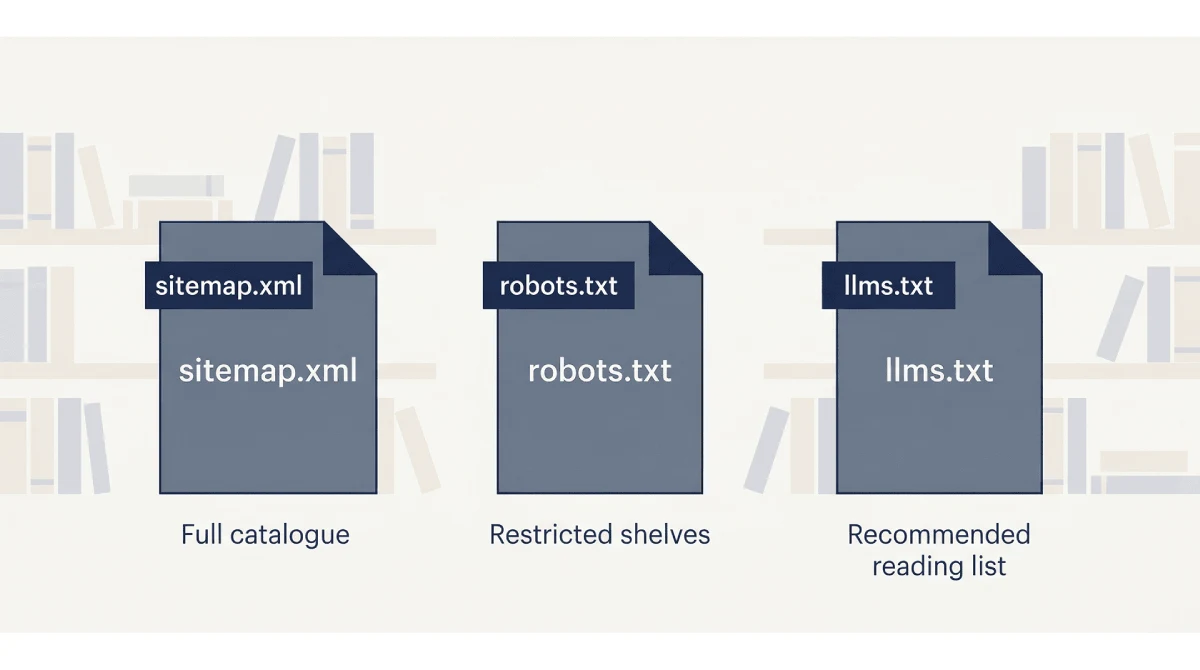
It also does not replace robots.txt. The two files have different jobs.
File or format | Primary purpose | What it does not reliably do |
|---|---|---|
robots.txt | Communicates crawler access preferences | Guarantee crawler compliance or explain your business |
XML sitemap | Lists URLs intended for discovery | Curate the meaning or priority of page content for AI agents |
llms.txt | Offers selected guidance and linked resources for agents | Control access, force indexing, or guarantee citations |
Page-level Markdown | Provides detailed clean content for a specific page | Replaces a concise site-level index |
It is also not proof that a firm will appear more often in AI-generated answers. Publication, request activity, retrieval inclusion, citations, referrals, and conversions are separate events. A file can be published perfectly and still produce no observable commercial effect.
Fair warning: this is especially relevant to firms with limited access to analytics. If you cannot inspect server logs, track referrals, or monitor the linked pages, you may be unable to distinguish genuine use from a successful deployment with no measurable outcome.
Related formats need separate decisions
Some teams encounter llms-full.txt or llms-ctx.txt and assume they are compulsory additions. They are not automatically interchangeable with the core approach.
The llms-ctx.txt description presents it as a related context-oriented representation within the llms.txt proposal ecosystem. That does not mean every site needs it. Full content files can be expensive to maintain, particularly for firms whose insight libraries change weekly or whose regulated content requires frequent review.
Choose a related format only when you can answer these questions:
- Is there a specific consumer or platform workflow that can use it?
- Can the content be generated from a single approved source of truth?
- Can broken links, stale content, and duplicate material be detected automatically?
- Does the benefit justify the additional public surface area?
For most professional services firms, a concise llms.txt file linked to robust canonical pages is the safer first step.
How to Measure, Govern, and Maintain It
Measure a chain of evidence, not a single vanity metric
The most common mistake is treating publication as success. It only confirms that the file exists.
Instead, create a measurement chain that separates technical events from commercial outcomes.
Stage | Evidence to collect | What the evidence proves |
|---|---|---|
Publication | HTTP status, content review, deployed URL | The file is publicly available |
Request activity | Server logs showing requests to /llms.txt | A client requested the file |
Retrieval inclusion | Platform documentation or verifiable system behaviour | The content may have entered a retrieval process |
Citation or mention | Repeatable monitoring of public AI outputs | The firm was named or linked in an answer |
Referral activity | Analytics traffic from identifiable sources | A user reached your site |
Commercial impact | Qualified enquiries, consultations, or pipeline attribution | The activity contributed to a business outcome |
Do not collapse these stages. A bot request does not prove retrieval. Retrieval does not prove citation. A citation does not prove that the firm received a qualified enquiry.
Consider a consultancy that publishes llms.txt and sees 50 requests over a month. That indicates technical interest, but it does not establish that the file shaped any answer.
If no linked pages receive attributable traffic and no enquiries reference AI tools, the appropriate conclusion is limited: the file was requested, not proven commercially effective.
Establish ownership before deployment
Maintenance fails when no one owns it. An llms.txt file should have a named business owner, a technical owner, and a defined review trigger.
A sensible governance model includes:
• A marketing or communications owner for messaging accuracy
• A technical owner for availability, redirects, validation, and deployment
• Subject matter owners for regulated, technical, or time-sensitive statements
• A quarterly review for stable sites, with immediate review after major changes
Immediate review triggers include a rebrand, a service rename, a website migration, a merger, a leadership change, a sector repositioning, or the withdrawal of a major offer. These are the moments when a stale summary can cause more damage than no file at all.
Your brand guidelines should define approved service names, claims language, voice, and visual identity. While llms.txt is text-only, it should still follow the same editorial rules that govern positioning elsewhere.
Validate before and after publishing
The workflow does not need to be complex, but it should be repeatable.
- Draft the file from approved source pages, not memory.
- Check every linked URL returns the intended page and does not redirect unnecessarily.
- Confirm that titles, summaries, and service terminology match canonical website copy.
- Review public information for privacy, confidentiality, and regulatory suitability.
- Deploy the file at the intended path and verify its HTTP response.
- Monitor server logs and broken link reports.
- Recheck after CMS migrations, URL changes, and content restructures.
If a contradiction is discovered, correct the canonical page first when appropriate, then update llms.txt. Do not create a separate truth solely for AI agents. That approach produces governance debt quickly.
Conclusion and Sources
A practical decision, not a speculative promise
llms.txt is worth considering when your firm already has strong public information, clear ownership, and a realistic way to maintain a curated set of canonical links. It can sharpen the structure of your content and provide a cleaner route to your most authoritative pages.
I would avoid treating it as an AI visibility tactic in isolation. The stronger investment remains the same: precise positioning, credible expertise, current content, controlled claims, and a website that makes it easy for prospective clients to understand why your firm is the right choice.
Questions people ask
Is llms.txt an official web standard?
No. It is better described as a community proposal than a ratified web standard. That means support is voluntary and behaviour varies between systems. Publish it for clarity and experimentation, not because compliance is mandatory.
Where should llms.txt be placed?
Most organisations place it at /llms.txt in the website root. The proposal also allows path-based placement for content beneath a particular path. Use a single, clear approach and avoid publishing multiple conflicting versions unless there is a documented technical reason.
Does llms.txt control whether AI crawlers can access a website?
No. llms.txt provides information and links. It does not replace access control, authentication, authorisation, robots.txt, rate limiting, or content security measures. Keep private material private through proper technical controls.
Will publishing llms.txt improve visibility in AI answers?
There is no reliable evidence that publication alone improves citations, referrals, rankings, or conversions. It may help systems that choose to use it understand selected public resources, but the commercial impact should be treated as an empirical question and measured accordingly.
Should a firm publish llms-full.txt as well?
Only if there is a clear use case and a sustainable content pipeline. A full content file can create duplication, stale material, and governance risk. For many firms, a concise llms.txt file linked to well-maintained canonical pages is more manageable.
How often should llms.txt be updated?
Review it at least quarterly for stable websites and whenever core positioning changes. Update immediately after service renames, site migrations, major content removals, changes to regulated statements, or revised contact processes.
Is llms.txt worthwhile for a small UK business website?
Possibly, but only when it can be maintained with minimal effort. There is no established UK legal or regulatory requirement to publish it. A small firm may first gain more value by improving core service pages, contact journeys, accessibility, and content accuracy. If those foundations are sound, llms.txt can be a low-cost addition.