Google AI Overviews: Being Cited Is Not Being Chosen
Google AI Overviews can put professional expertise in front of a buyer without requiring them to visit your website. Professional services firms should therefore assess more than citations. Content must explain judgement, service suitability and evidence, giving prospective clients a reason to investigate further and a basis for choosing advisers.



On this page6 min left
A professional services firm should optimise for the buyer’s decision, not merely for inclusion in Google’s answer.
A citation can put your expertise on the screen without explaining why a prospective client should choose your advisers.
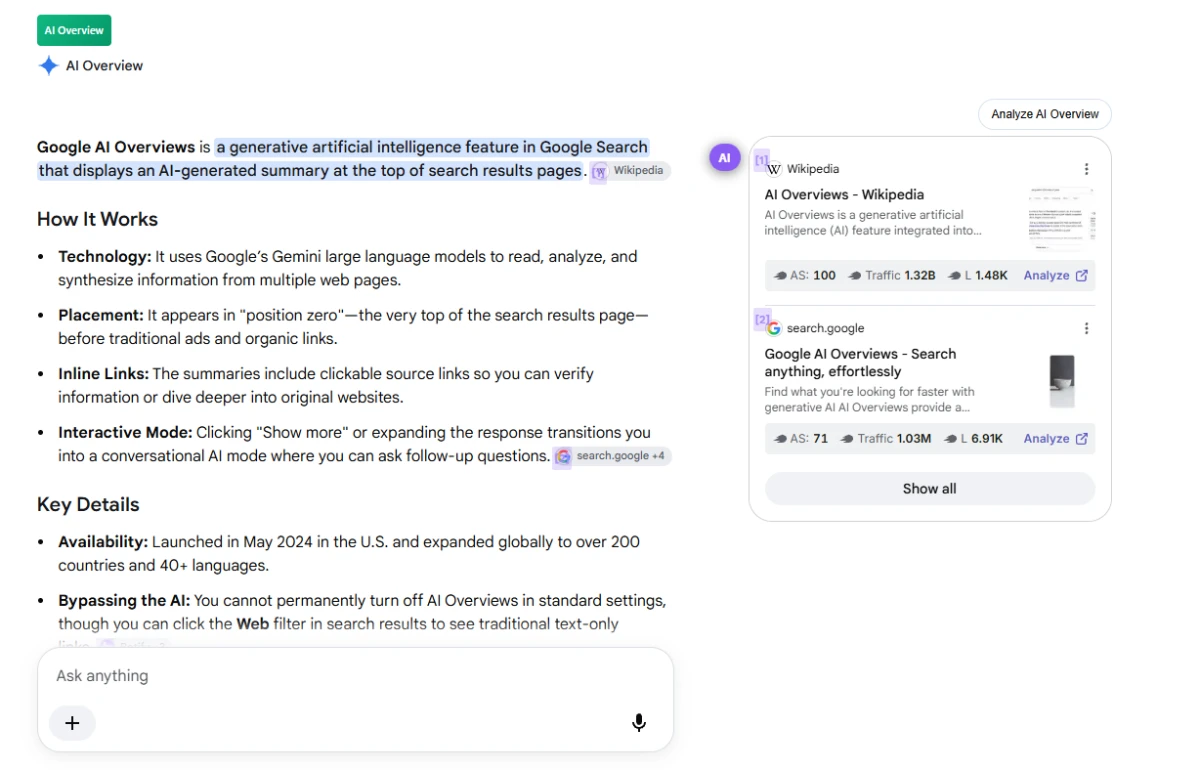
Google AI Overviews are AI-generated summaries displayed for selected Google searches, with links to supporting sources.
Pew Research Center, a US research organisation, found that users clicked a link within a summary on just 1% of visits to search pages containing one in its March 2025 browsing study. Being present and earning a visit are different events.
For a managing director preparing a rebrand, that distinction matters.
Answer-based discovery belongs within generative engine optimisation and the wider work of digital marketing services.
But a visibility project still needs a clear commercial purpose.
Start there.
What Google AI Overviews should achieve for your firm
Google AI Overviews should be treated as a potential route into consideration, rather than proof of buyer confidence. Professional services content should answer the initial question and help a prospective client assess the provider behind the answer.
- A source citation records visibility, not an enquiry.
- A website visit records engagement, not suitability for the service.
- Content should explain the circumstances in which your advice applies.
Google AI Overviews are AI-generated summaries in Google Search that answer selected queries and include links to supporting web pages.
A source citation is not a client decision
The argument for pursuing citations is reasonable.
If prospective clients read answers within search results, a firm has a reason to investigate whether relevant expertise appears there.
The audience is substantial.
A survey conducted by Pew Research Center found that 60% of US adults said they read AI-generated summaries at the top of search results. The survey included 5,119 adults.
That measures reported reading of search summaries generally, not Google-only use or professional-services purchasing.
Ignoring the interface would therefore be a poor default. Treating presence within the interface as commercial success would be another.
Pew Research Center’s separate browsing analysis covered 900 US adults and 68,879 unique Google searches during March 2025.
Traditional-result links received clicks on 8% of visits with an AI summary, compared with 15% without one.
This was an observational comparison: the research does not establish that summaries caused the difference.
The 1% summary-link finding also needs its denominator intact.
The figure describes visits to search pages containing a summary that resulted in a summary-link click. The figure does not describe the percentage of individual citations clicked, and says nothing directly about enquiries.
“We need visibility before anyone can choose us.”
Fair objection. The response is to retain visibility as one objective, while refusing to let a citation count stand in for the entire commercial argument.
Keep citation counts in the visibility report. Keep qualified enquiries in the commercial report. A rise in the first does not establish a rise in the second.
Make professional judgement visible.
My recommendation is to assess content against the questions a prospective client would need answered before making contact.
For a consultancy, a definition of operational restructuring may answer the search. The definition does not necessarily indicate whether the consultancy is suitable for a business facing a particular operational problem.
That is where judgement belongs.
A restructuring adviser can explain what restructuring means. A more useful service page explains which warning signs justify an initial conversation, what information the adviser needs, and which situations require another specialist.
The distinction is practical. A buyer can compare those statements with the buyer’s own circumstances. A page containing only a definition offers less help with that comparison.
Use the following framework as an editorial test, not as a claimed Google ranking formula.
Editorial test | What the page should contain | What the reader can assess |
|---|---|---|
Diagnosis | The questions asked before recommending work | Whether the adviser investigates before prescribing |
Trade-off | A genuine disadvantage of the proposed route | Whether the explanation acknowledges competing priorities |
Boundary | Conditions under which the service is unsuitable | Whether the engagement fits the problem |
Evidence | A documented example, with context and limits | What supports the provider’s claims |
Next decision | The information needed before proceeding | What a useful first conversation requires |
Consider a hypothetical 100-person operations consultancy. The example illustrates the framework; the example is not an Inkbot Design client or evidence of results.
A generic service page might promise to “improve operational efficiency”.
A revised page could explain that the consultancy begins by examining where work waits between teams, whether delays come from capacity or approval rules, and whether management has reliable information about those delays.
The revised page could then state a boundary: if the underlying problem is an unresolved leadership decision, a process-mapping exercise may document the blockage without removing the cause.
That is a more useful explanation of the proposed work. The buyer can see what the consultancy would investigate and what could change the recommendation.
The trade-off deserves equal attention. A detailed page may require partner review, permission to discuss client work and careful handling of confidential information.
Where a named case cannot be published, explain the method without implying an undisclosed success story.
Do not turn a composite example into a case study. Label the example.
The same discipline applies to a rebrand following an acquisition. If the website, partner biographies and business profiles describe different service scopes, first decide which description is accurate.
A review of brand entity consistency can help organise that work. Clear wording should reflect an agreed business identity, rather than conceal disagreement between partners.
“Our clients come through referrals.”
Then test the page against a referred prospect’s questions. Could a prospective client confirm the service offered, identify the relevant adviser and understand the next step? A referral does not remove the need for an intelligible website.
If prospects already arrive well informed and enquiries are suitable, a wholesale content programme may be unnecessary. Review the pages most often used during consideration before commissioning another library of introductory articles.
Decide what to change before buying more content

Use one important service page as a diagnostic.
Choose a service connected to the growth phase, acquisition or repositioning under discussion. Ask a partner, a business-development lead and someone outside the specialist team to review the same page independently.
The proposed exercise is deliberately small. The aim is to discover what needs attention before expanding the work.
Ask each reviewer to answer:
- Which client problem does the page address?
- What information would change the recommendation?
- When would the service be unsuitable?
- What evidence supports the provider’s claims?
- What should a prospective client bring to an initial conversation?
Record where answers diverge.
If partners disagree about the intended client or service boundaries, treat that as a positioning question. Publishing additional answers before resolving the disagreement risks distributing several versions of the same business.
If reviewers agree on the positioning but cannot find supporting detail, improve the page. Add the diagnostic questions, permitted evidence and limits that already exist in the delivery team’s knowledge.
If the content is useful but not searchable, ask a technical specialist to investigate accessibility and indexing. Rebranding would be a disproportionate response to a technical publishing problem.
These are different jobs. Budget accordingly.
An AI visibility audit can establish a record of the answers and sources observed for selected questions. Define the questions, dates and observation conditions so another reviewer can understand what was checked. Treat the record as an observation, not a permanent statement about every buyer’s results.
For measurement, keep three categories separate:
Category | Record | Limitation |
|---|---|---|
Visibility | Observed mentions and citations for a defined question set | Does not establish that a buyer saw the answer |
Website engagement | Search visits and subsequent page behaviour where measurable | Does not by itself explain purchase intent |
Commercial interest | Enquiry suitability and prospects’ reported discovery routes | Attribution can be incomplete |
A broader share-of-voice review belongs in the first category. The other categories need their own records.
Ask new prospects how the firm entered consideration, allow more than one answer, and retain “not known” as a valid response. A tidy attribution chart is not worth inventing certainty.
Pew Research Center’s findings explain why the distinction matters: reading a summary, clicking a traditional result and clicking a summary source are separate behaviours.
Review the page against the questions again after revision. If the page explains the work more clearly but search performance remains unchanged, that is a clearer page—not evidence of an AI-search uplift.
Start with the page a prospective client would judge
A citation gives you something to investigate.
The content behind the citation must still explain what the firm does, how the firm reaches a recommendation and where the firm’s advice stops.
You can improve one service page internally. If the difficulty is unresolved positioning across services or acquired businesses, the task is wider than editing copy.
Inkbot Design offers a free Brand Equity Audit™ to examine where the brand may be losing commercial ground and identify priorities. The audit is a diagnostic, not a promise of inclusion in search or enquiries.
Choose one commercially important service page today. Check whether a prospective client can use that page to assess fit.
Questions people ask
Does a Google AI Overview citation mean Google recommends my firm?
No — a source citation should not be treated as a recommendation to hire the cited provider. A citation identifies supporting material within an answer; the citation does not establish suitability, service quality or commercial endorsement. The reader still needs evidence relevant to the choice of an adviser.
Do the Pew findings describe UK professional-services buyers?
No — the cited Pew Research Center studies concern US adults. The browsing study examines general Google searches, while the survey measures reported use of AI search summaries. Neither establishes how UK professional-services buyers shortlist advisers nor how frequently exposure to summaries leads to an enquiry.
Should a professional services firm rebrand for AI-search visibility?
A rebrand should follow a diagnosed positioning or identity problem, rather than a desire for citations alone. If service descriptions are accurate and agreed, page improvements or technical investigation may be more proportionate. If partners disagree about the business being presented, resolve that disagreement before expanding content.
Will the judgement framework guarantee an AI Overview citation?
No — the proposed judgement framework is an editorial checklist, not a validated citation method. Diagnosis, trade-offs, boundaries and evidence help reviewers assess whether content supports a buyer’s decision. The framework should be tested against reader usefulness without claiming guaranteed inclusion, traffic or enquiries.