How to Measure Brand Share of Voice in LLMs and AI Overviews
Brand share of voice in LLMs is not a traffic metric; it is a controlled-buying-surface metric. Stop counting generic AI mentions. Learn how to measure visibility in the high-intent comparison prompts that actually determine professional services shortlists.


On this page8 min left
Brand share of voice in LLMs and AI Overviews is not a traffic metric; it is a controlled-buying-surface metric.
The conversation must shift entirely from “how often do we show up?” to “do we show up in the prompts that actually shape vendor consideration, shortlist formation, and category framing?”
A professional services firm can achieve absolute dominance in low-value informational prompts and remain entirely invisible at the exact moments when a prospect decides whom to hire.
Measuring the former while ignoring the latter is commercial negligence.
Without measuring performance at the decision-making layer, your digital brand equity is fundamentally unquantifiable in modern search environments.
What Is Brand Share of Voice in LLMs?
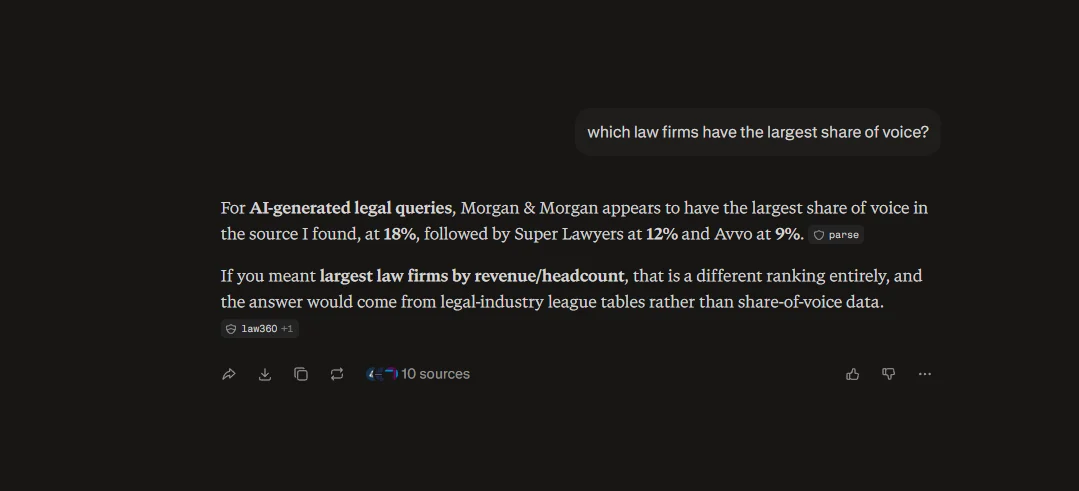
Brand share of voice in LLMs and AI Overviews is the percentage of high-intent, decision-making prompts where a specific brand is recommended compared to its competitors.
- It ignores low-intent informational queries that do not drive commercial shortlisting.
- It measures visibility across distinct surfaces, separating Google AI Overviews from dedicated AI chat interfaces.
- It tracks performance specifically within comparison, alternative, and implementation prompts.
Brand share of voice in LLMs and AI Overviews is the percentage of high-intent, decision-making prompts in which a specific brand is recommended over its competitors.
The Illusion of the Vanity Metric
The prevailing view in digital marketing treats AI's share of voice the same way as traditional media mentions.
Agencies calculate total brand appearances across all generative responses, divide by the total category mentions, and report a percentage.
Intelligent practitioners defend this approach because it provides an immediate, quantifiable baseline. It looks like traditional public relations. It satisfies boards that demand to know whether the firm is “visible in AI.”
This mention-based methodology fails because it treats all visibility as equal.
When a B2B buyer asks an LLM “what is digital transformation,” the resulting AI summary might mention your consultancy. That mention carries almost zero commercial weight.
The buyer is educating themselves, not selecting a vendor. Treating that appearance as a victory creates a dangerous reporting illusion.
The firm believes it is winning the category while entirely missing the prompts that matter.
The Generative Search Divide
The visibility mechanism varies significantly depending on the specific AI surface the buyer uses. Google AI Overviews and dedicated LLM chat interfaces (AI Mode) do not operate on the same logic, pull from the same sources, or trigger on the same intent.
A 2026 Northwestern Spiegel study found AI Overviews appear in 43 per cent of a test set of 160 queries. However, the intent divide is absolute.
The Northwestern Spiegel study reported that AI Overviews trigger on 98 per cent of informational queries, but only 40 per cent of commercial queries and 0 per cent of transactional queries.
“The idea of a unified ‘AI visibility score’ is mathematically flawed. An AI Overview is an informational summarisation tool. An LLM chat interface is an interactive reasoning engine. A brand cannot measure performance across both using a single methodology.”
This divergence is accelerating. Search Engine Land reported BrightEdge data showing brands appeared in 90 per cent of AI Mode responses but only 43 per cent of AI Overview responses.
Crucially, the BrightEdge study found AI Overviews show 30x higher week-to-week volatility and rely on 20+ inline citations, whereas AI Mode leans on a tight cluster of just 5 to 7 source cards.
If your marketing department reports a combined share of voice metric, they are blending highly volatile search summarisation with stable chat reasoning. The resulting number means nothing. You must isolate your share of search by surface, intent, and prompt architecture.
The Mid-Market Vulnerability
If you run a UK professional services business employing 50–200 people, the generative engine presents a specific structural threat to your positioning.
LLMs inherently default to scale and historic prominence when lacking explicit contextual constraints.
An arXiv study from June 2026 analysed over 100,000 prompt responses across more than 100 brands. The arXiv researchers found first-visibility rates of 73 per cent for household-name brands. Established mid-market brands achieved 44 per cent visibility. Niche and small brands secured just 11 per cent.
This happens because LLMs map entities based on connection density. Household names possess decades of digital PR, backlink profiles, and forum discussions.
When a prospect asks ChatGPT for “top UK accountancy firms,” the model retrieves the entities with the highest semantic density. The mid-market firm, regardless of its actual capabilities, is structurally disadvantaged in broad-category prompts.
To overcome this, mid-market firms must stop competing for broad category terms. You cannot outrank PwC in a generic prompt.
Instead, the firm must dominate hyper-specific, highly constrained prompts detailing exact capabilities, specific UK regional expertise, and distinct methodological approaches.
The “Wait and See” Fallacy
The most common objection from managing partners is that AI visibility does not yet translate to signed retainers.
“Our clients hire us based on relationships and referrals,” they argue. “Generative AI is a toy for junior researchers, not a tool used by decision-makers allocating £100,000 budgets.”
This objection misinterprets how modern B2B procurement operates.
The referral still matters, but the validation process has changed. A peer recommends your firm. The prospect does not immediately call you. They validate the referral through search. Increasingly, that validation happens via an LLM.
The attribution data already proves this shift. Fairing reported that 11.8 per cent of its customers had at least one customer mention an LLM in attribution surveys in April 2025, up from less than 1 per cent the prior year. Fairing also found that ChatGPT accounted for 64.6 per cent of LLM-attributed transactions.
“Refusing to measure your share of voice in LLMs because ‘relationships drive revenue’ ignores how those relationships are validated. The AI interface is the new reference check. If your firm is invisible when the prospect asks the model to compare you against a competitor, the relationship rarely survives the validation phase.”
Waiting for AI to become a definitive acquisition channel before measuring it guarantees your firm will be absent when the category is mapped.
Measuring the Buyer Moment
We return to the core reality: brand share of voice in LLMs and AI Overviews is not a traffic metric. To measure it correctly, professional services firms must abandon total mention volume and adopt a buyer-moment methodology.
Semrush recently announced an expanded 2026 AI Visibility Index built on 126 million U.S. AI search prompts. This signals that large-scale, prompt-specific measurement is now a mainstream operational requirement.
You must measure visibility across three specific prompt structures:
- The Comparison Prompt: “How does [Your Firm] compare to [Competitor] for complex corporate restructuring?”
- The Alternative Prompt: “What are the best mid-market alternatives to [Tier 1 Competitor] in the UK?”
- The Methodology Prompt: Which UK branding agencies specialise in typography systems for legal firms?
If your firm appears as the definitive answer in these three prompt structures, your AI share of voice is commercially viable. If you only appear for “what is a typography system,” your AI strategy is generating PR, not pipeline.
Stop measuring the absolute size of your footprint. Measure your dominance of the controlled buying surface.
The Verdict
Brand share of voice in LLMs is the ultimate test of how effectively a firm's digital entity has been constructed. If the brand relies on generic service descriptions and thin thought leadership, the generative engines will ignore it during critical buyer moments.
The prevailing approach of counting total AI mentions produces comforting charts but obscures commercial vulnerability.
The single most important action a professional services firm can take today is to identify the five high-intent comparison prompts their ideal prospects use to build shortlists and test their visibility across the major LLMs.
If your firm does not appear as the recommended choice, the solution is not writing more blog posts. The solution requires dismantling and rebuilding how machine learning models understand your firm's entity.
To determine exactly where your firm is losing commercial ground in both traditional and generative search, request a free Brand Equity Audit™. This structured diagnostic maps your current entity visibility and provides the exact technical architecture required to dominate your category's specific buying moments.
Frequently asked questions
Why is mention-based AI share of voice an ineffective metric?
Mention-based tracking counts every appearance of a brand equally, regardless of context. It blends high-value vendor comparisons with low-value informational summaries, creating a false perception of commercial visibility that does not correlate with pipeline growth or client acquisition.
How do AI Overviews differ from AI Mode in search behaviour?
AI Overviews function as summarisation tools, heavily triggered by informational queries, utilising 20 or more inline citations. AI Mode functions as an interactive reasoning engine, relying on a tighter cluster of 5 to 7 source cards, displaying significantly less week-to-week volatility.
What are the most important AI prompts a B2B firm should track?
A B2B firm should track comparative prompts, alternative searches, and highly specific capability queries. These buyer-moment prompts dictate vendor shortlists. Tracking generic industry definitions provides no commercial value for mid-market professional services firms.
Is generative AI actually used in B2B vendor selection?
Yes — attribution data proves it. A 2025 Fairing report found 11.8 per cent of customers mentioned an LLM in attribution surveys, with ChatGPT accounting for the majority of LLM-attributed transactions. Prospects use LLMs to validate referrals before initiating contact.
Why do mid-market firms struggle with AI visibility?
LLMs map entities based on connection density, structurally favouring household names with decades of digital PR and massive backlink profiles. Mid-market firms often secure only a fraction of the visibility of established giants in broad category prompts.
How can a 100-person consultancy improve its LLM share of voice?
The consultancy must abandon broad category targeting and build semantic density around hyper-specific capabilities. By explicitly defining its methodologies, regional expertise, and unique positioning, the firm provides the LLM with the constraints needed to recommend it over a generic tier-one competitor.
When should a professional services firm audit its AI visibility?
A professional services firm should audit its AI visibility immediately before any strategic rebrand or major growth phase. Understanding how LLMs currently map the firm's entity is a mandatory prerequisite for developing positioning that machine learning models will actually cite.
Does traditional SEO still matter for AI share of voice?
Yes — but the mechanics have shifted. While traditional SEO focuses on keyword volume and backlinks to drive traffic, AI visibility requires dense, structured entity relationships. LLMs must confidently understand exactly what the firm does, who it serves, and how it compares to alternatives.
What is the difference between AI share of voice and share of search?
Share of search measures the volume of active queries that users type into search engines to find a specific brand. AI share of voice measures how often a brand is cited or recommended within the generative responses provided by LLMs and AI Overviews.
Can we rely solely on AI visibility tools to measure our share of voice?
No — generic tracking tools often rely on mention-based methodologies. While tools provide raw data, a firm must manually filter it to isolate the specific comparisons and alternative prompts that actually influence the professional services buying cycle.