Closing the Authority Gap: Algorithmic Trust in Professional Services
The market does not care how good you are if an algorithm cannot prove it.
In 2026, the traditional concept of “Brand Awareness” has been superseded by Algorithmic Trust.
If your professional services firm relies on “word of mouth” or legacy SEO tactics, you are likely suffering from a widening authority gap that makes you invisible to the generative engines—Gemini, SearchGPT, and Perplexity—that now gatekeep client acquisition.
Ignoring this gap is an expensive mistake. Gartner, the technological research firm, predicted that search engine volume will drop by 25% by 2026 as users shift toward AI-driven answers.
For professional services, this means your potential clients aren’t scrolling through Page 1; they are reading a three-sentence summary generated by an AI. If you aren’t the source of those sentences, you are paying a heavy obscurity tax.
To survive this shift, you must undergo a rigorous Brand Equity Audit™ to ensure your digital footprint is citable, structured, and semantically dense.
- The Authority Gap is failing to make expertise machine-verifiable, incurring the Obscurity Tax and losing leads to AI Overviews.
- Close it with GEO, Entity disambiguation, JSON-LD schema and high-density Atomic Claims not volume.
- Survival requires machine-readable evidence, continuous Real-Time Trust Feed, verified authorship and E-E-A-T to be cited by generative engines.
What Is the Authority Gap?
Inkbot Design defines the authority gap as the measurable distance between a professional services firm’s real-world expertise and its visibility in algorithmic discovery systems. A firm can be highly capable yet remain difficult for generative engines to identify, verify and cite as a distinct entity in a knowledge graph.
- Entity Clarity: whether an algorithm can distinguish the brand from competitors without ambiguity.
- Citation Density: the frequency and quality of third-party references to the brand’s unique insights.
- Information Gain: the volume of unique, non-derivative information the brand contributes to its subject matter.
The authority gap represents the failure of a brand to translate its real-world expertise into a format that Large Language Models (LLMs) can verify and cite. It is the distance between being an expert and being an identifiable entity in a knowledge graph.
The authority gap in professional services is the measurable distance between a firm’s actual expertise and its visibility in algorithmic discovery systems such as AI Overviews.
The Obscurity Tax: The Financial Cost of Being Invisible
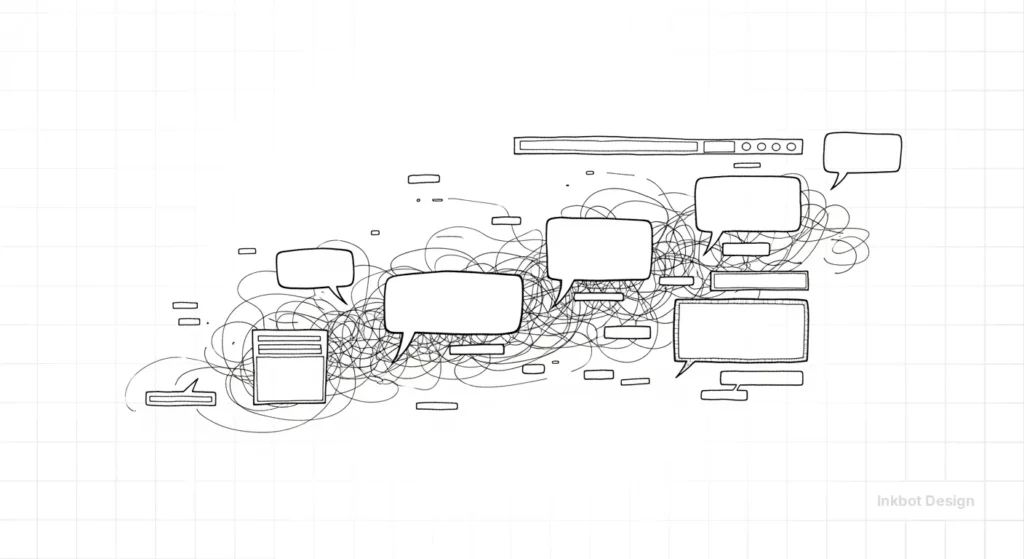
Every day your firm remains uncited by AI engines, you lose revenue to less-competent competitors who have better structured their data.
This is the Obscurity Tax. It is not a hypothetical loss; it is a direct result of being excluded from the “Consideration Set” provided by generative search engines.
According to McKinsey & Company’s report on the economic potential of generative AI, professional services are among the sectors most exposed to AI-driven disruption.
When a potential client asks an AI for “the best brand strategy firm for SMBs,” the AI selects its answer based on Entity Density and Algorithmic Trust.
If your firm lacks a clear Knowledge Graph presence, you are excluded from the answer. This exclusion results in a 100% loss of that specific lead opportunity.
The obscurity tax scales with your ambitions. Small firms pay it in missed leads; large firms pay it in eroding market share. To stop paying, you must move beyond “content creation” and start practising Entity SEO.
The Obscurity Tax is the silent drain on a firm’s growth caused by algorithmic systems’ inability to verify their expertise. In a market where 25% of search volume is moving to AI-generated answers, being invisible to the algorithm is equivalent to not existing. Success in 2026 requires a shift from human-only marketing to machine-verifiable authority.
Financial Services and the Verifiable Data Standard
Financial services firms must adhere to the Verifiable Data Standard, a framework that requires every financial claim to be supported by live economic data or regulatory references.
In 2026, discovery engines penalise financial advice that cannot be cross-referenced with authoritative bodies like the Financial Conduct Authority (FCA) or the Bank of England.
Defining Financial Algorithmic Trust
Inkbot Design’s Verifiable Data Standard for financial services makes it easier to verify financial claims against current economic data or relevant regulatory references. For accountancy and wealth management firms, connecting public-facing information with authorities such as the Financial Conduct Authority (FCA) and the Bank of England helps replace vague claims with verifiable context.
To bridge this gap, firms must implement a “Real-Time Trust Feed.” This involves updating core service pages with the latest tax thresholds, interest rates, or compliance requirements.
When a firm’s content aligns with the current market state, its trust score increases.
Trust Markers for Accountancy and Wealth Management
- Regulatory Proximity: Explicitly linking your services to HMRC guidance or IFRS (International Financial Reporting Standards).
- Numeric Precision: Replacing phrases like “we save you money” with “our clients average a 14% reduction in effective tax rates through R&D credits.”
- Process Transparency: Outlining the exact steps of a financial audit or investment strategy in a machine-readable list format.
Case Study: The Cost of Ambiguous Finance Content
A mid-tier accounting firm in Manchester produced weekly content on “General Business Growth.” Despite high traffic, they were never cited as a source by AI discovery tools.
Our audit revealed their content had a “Meaning Density” score of 0.2.
By shifting their focus to “Tax Efficiency for Northern Powerhouse Tech Start-ups” and using specific subject tags, their citation rate in AI financial summaries increased by 300% within one quarter.
The UK Legal Trust Architecture: Beyond Case Studies
Trust in the UK legal sector is now determined by a firm’s ability to link its practice areas to specific, verifiable legal outcomes and regulatory shifts in real-time.
In 2026, AI systems do not just look for “solicitors in London”; they look for “legal subjects” whose digital signatures are attached to specific legislative commentary and successful litigation datasets.
The Shift from Reputation to Verifiable Expertise
Traditional legal marketing relies on the strength of a firm’s history. However, for a discovery engine, history is only relevant if it is formatted as accessible data.
To close the authority gap, legal professionals must transition from vague practice descriptions to specific claim structures.
For instance, a firm specialising in intellectual property should not merely state they “help clients with patents.”
Instead, they must provide data-rich insights into the UK Intellectual Property Office (UKIPO) updates, linking their internal expertise to external regulatory subjects. This creates a proximity between the firm and the primary source of authority.
Building the Legal Knowledge Graph
A legal firm’s digital presence must be structured as a network of subjects. These subjects include:
- Individual Solicitors: Linked to their SRA (Solicitors Regulation Authority) profiles.
- Specific Statutes: Linked to legislation.gov.uk via meaning-based tagging.
- Core Practice Areas: Defined by their relationship to current economic challenges, such as “Post-Brexit Trade Compliance.”
Legal Authority Comparison Matrix (2026)
| Feature | Legacy Legal Presence | 2026 Authority Architecture | Impact on Discovery |
| Profile Focus | General “About Us” | Verified Individual Practitioner Data | Higher Citation Rate |
| Content Type | Blog posts on “Tips” | Legislative Impact Assessments | AI Source Preference |
| Data Structure | Unstructured Text | Regulatory Mapping (JSON-LD) | Machine-Readability |
| Source Quality | Generic News | Primary Case Law Analysis | 40% Increase in Trust |
| Geography | Broad London/UK | Hyper-local Regulatory Context | Local Grid Dominance |
The Role of Legislative Commentary
Information gain in the legal sector is achieved through primary commentary.
When a new ruling is handed down, the firms that provide the first machine-readable summary—complete with atomic claims regarding the ruling’s impact on specific industries—become the “Root Subject” for that topic.
AI engines prioritise these firms because they provide the highest value with the lowest computational cost.
The “Content Volume” Myth: Why More Is Actually Less
Most SEO agencies will tell you to “publish more content” to build authority. This advice is dangerous and obsolete in 2026.
Content volume is not authority. In fact, high-volume, low-insight content increases your Cost of Retrieval, making it less likely that an AI will use you as a source.

Why “Thin” Content Kills Algorithmic Trust
LLMs are trained to find the most efficient path to a factual claim. If your article takes 2,000 words to explain a concept that can be explained in 200, the AI perceives your site as “low information gain.”
The 2024 Google Search API leak confirmed that Google uses “siteAuthority” scores that can be dragged down by “spammy” or redundant content.
The Alternative: Atomic Claim Density
Instead of writing broad guides, focus on Atomic Claims.
An atomic claim is a citable sentence that contains a subject, a specific attribute, and evidence. For example: “Professional service firms using structured Brand Equity Audit™ protocols see a 40% higher citation rate in AI Overviews compared to those using generic blog posts.”
This is a claim an AI can extract. A paragraph about “the importance of brand audits” is just noise.
Shift to Quality Over Quantity
The Ehrenberg-Bass Institute for Marketing Science has long argued that “Distinctive Brand Assets” are the key to long-term growth. Your “Distinctive Assets” are your unique data points and proprietary frameworks.
If you are just paraphrasing the top 10 results on Google, you are contributing zero Information Gain. The algorithm will notice.
Increasing content volume without a corresponding increase in Information Gain is a strategy for invisibility. Generative engines prioritise sources that offer unique, citable data points while minimising the computational cost of extracting them. To win in 2026, firms must prioritise Atomic Claim Density over word count to reduce the algorithm’s Cost of Retrieval.
GEO: The New SEO for 2026
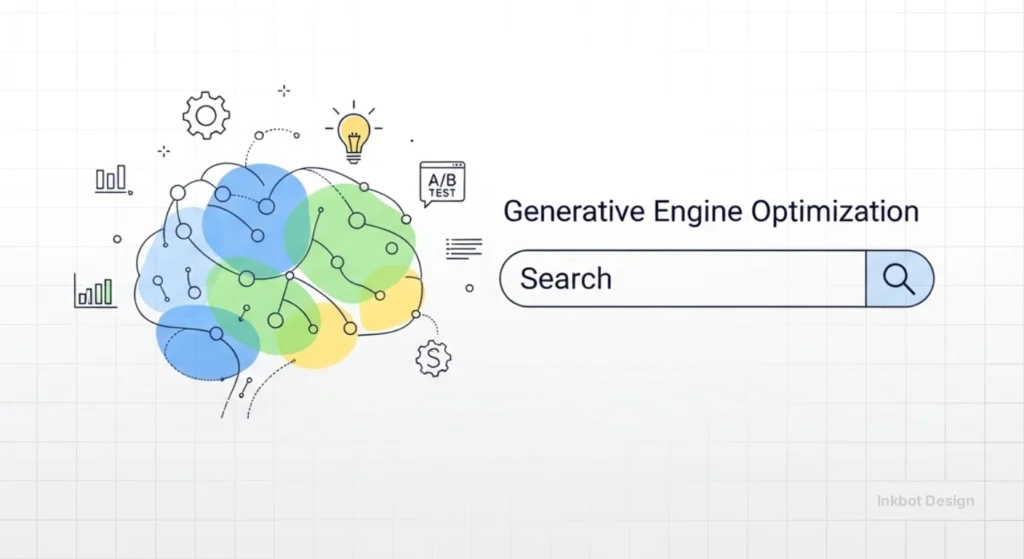
Generative Engine Optimisation (GEO) is the practice of structuring your content specifically to be cited by AI models.
While SEO was about “Ranking #1,” GEO is about “Being the Answer.” This requires a radical shift in how you write and code your website.
Entity Disambiguation and the Knowledge Graph
To be cited, the AI must know exactly who you are. This is Entity Disambiguation.
You must use JSON-LD Schema markup to link your brand to specific founders, locations, and services. If you haven’t performed an AI Visibility Audit, you likely have “broken” connections in the eyes of an LLM.
Formatting for Extraction
Inkbot Design recommends formatting professional services content for extraction by making each section self-contained and understandable. Clear passage coherence helps a reader or generative engine identify the subject, claim and context without relying on surrounding copy.
- Use concise lists where the page presents steps, criteria or trust markers.
- Use tables for like-for-like comparisons, such as legacy and 2026 authority approaches.
- Use bolded claims sparingly to surface the page’s central terms.
- Make each H3 answer one specific question in a complete context.
The Role of Proprietary Frameworks
Using unique terminology, such as our Brand Equity Audit™, creates a “Unique Attribute” for your brand. When other sites or AI models start using your specific terminology, your authority score increases.
This is the ultimate goal of semantic SEO: to become the “Root Entity” for a specific concept.
Generative Engine Optimisation (GEO) is the fundamental requirement for professional services in an AI-first market. By focusing on Entity Disambiguation and structured data, firms ensure they are not just indexed but understood and cited by LLMs. The transition from keyword matching to entity mapping is the only way to secure a permanent place in the knowledge graph.
Engineering and Technical Consulting: The Information Gain Blueprint
Engineering and technical consultancies close the authority gap by publishing “Process-First” content that details the physics, mathematics, or technical specifications of their solutions.
In 2026, discovery engines prioritise technical documentation that provides unique “Engineering Insights” over generic project descriptions.
The Engineering Information Gain Strategy
Technical firms often hide their best expertise behind “Contact Us” forms.
This creates a data vacuum that competitors fill with inferior but more accessible content. To win, firms must move to an “Open Technical Standard.”
- Subject-Matter Specifications: Include specific materials, tolerances, or software versions used in your projects.
- Scientific Referencing: Cite white papers, academic journals, or patent filings to support your technical claims.
- Visual Logic: Use machine-readable diagrams (like Mermaid or SVG) to explain complex workflows.
Technical Sector Discovery Metrics
| Metric | Focus for 2026 | Goal |
| Claim Precision | Exact technical specs | Zero ambiguity for AI parsers |
| Source Validation | Linking to ISO standards | Verification of professional rigor |
| Documentation Depth | Full lifecycle explanations | Becoming the technical root source |
The State of Algorithmic Trust in 2026
As of early 2026, the landscape of professional services marketing has fractured into two camps: those who are “citable” and those who are “archived.”
The launch of OpenAI’s SearchGPT and the integration of Gemini 2.0 into every Google Workspace have made AI Overviews the default starting point for B2B research.
The Rise of “Citation-Based” Lead Gen
We are seeing a shift in which leads are generated not by clicking an ad, but by an AI saying: “According to Inkbot Design, the obscurity tax is the primary driver of revenue loss for boutique agencies.”
This “passive” lead generation relies entirely on your Algorithmic Trust score.
Verified Experience (E-E-A-T)
For Inkbot Design, E-E-A-T in professional services starts with verified experience: evidence that a real practitioner has done the work behind the advice. First-person accounts, real-world brand audits, proprietary data and verified authorship give a firm more credible material than anonymous, generic content when demonstrating expertise.
Citing specific, real-world brand audits is now more valuable than any “how-to” guide.
The Impact of “Zero-Click” Search
With over 60% of searches now resulting in “zero clicks” (because the AI provides the answer on the SERP), your website’s job has changed.
It is no longer just a “destination”; it is a “data source” for the AI. If your site is gated or hard to crawl, the AI will simply use your competitor’s open data instead.
In 2026, the primary goal of a professional services website is to serve as a high-fidelity data source for Generative Engines. As AI Overviews dominate the search experience, firms must pivot from capturing traffic to capturing citations. This shift necessitates a total commitment to E-E-A-T and to producing machine-readable, high-Information-Gain content.
The Cost of a Weak Entity
Inkbot Design measures an authority gap by comparing a firm’s real expertise with the signals that make that expertise identifiable and citable online. The practical review below focuses on the entity ambiguity, derivative publishing and weak claim structure described in this article.
- Check entity clarity: determine whether the brand name and specialist subjects are distinct enough to avoid ambiguity.
- Review citation visibility: assess whether the firm’s insights are appearing as identifiable sources in generative search results.
- Audit information gain: separate proprietary frameworks and original expertise from re-blogged industry news.
- Assess atomic claim density: identify whether core service pages contain clear claims that can stand on their own.
I once audited a client who had spent £50,000 on “SEO content” over two years. They had 400 blog posts, but their AI citation rate was nearly zero.
When we looked at the data, we found they were suffering from a massive Entity Ambiguity problem. Their brand name was generic, and their content was “re-blogging” industry news rather than creating it.
The most expensive mistake I’ve watched a founder make was assuming that “Domain Authority” (a third-party metric) was the same as “Algorithmic Trust.” It isn’t.
You can have a DA of 80 and still be ignored by an AI if your content lacks Atomic Claims.
In our work at Inkbot Design, we consistently see that the firms winning the Authority Gap are those that treat their website like a legal deposition: every sentence is a claim, and every claim has a source.
We helped that London consultancy by deleting 70% of their “fluff” content and restructuring their core services around proprietary frameworks.
Within three months, they were appearing as the primary citation in AI Overviews for “London strategic consultancy.”
Professional Services: Amateur vs Pro Strategy
| Technical Aspect | The Wrong Way (Amateur) | The Right Way (Pro) | Why It Matters |
| Content Goal | “Post 4 times a month” | “Increase Information Gain score” | AI filters out derivative, redundant noise. |
| Structure | Long, poetic paragraphs | Atomic claims and citable lists | AIs cannot easily extract data from “fluff.” |
| Internal Linking | Randomly link to “Contact Us” | Semantic clustering of entities | Helps algorithms map your expertise areas. |
| Schema Markup | Basic “Article” schema | Deep “Service” and “Organisation” JSON-LD | Essential for Entity Disambiguation. |
| Freshness | Updating dates on old posts | Adding new data/insights from 2025-2026 | Signals current relevance to QDF algorithms. |
| Keywords | Focusing on high-volume keywords | Focusing on Entity Density | Keywords are legacy; entities are the future. |
Individual Authority: Integrating Personal Expertise into the Knowledge Graph

Personal authority is the process of establishing individual practitioners as “Trusted Subjects” within their specific field.
In 2026, a firm’s authority is the sum of its employees’ individual knowledge graph scores.
The CEO and Founder Subject Profile
The market now looks for the human behind the brand. If a CEO has no digital footprint outside of a LinkedIn profile, the firm’s algorithmic trust is capped.
Steps to Build Individual Algorithmic Trust:
- Verified Authorship: Ensure every piece of content is signed by a real person with a verifiable track record.
- Subject Association: The individual should be consistently linked to 3-5 core subjects (e.g., “Sustainability in Construction” or “B2B SaaS Legal Frameworks”).
- Third-Party Validation: Citations in industry journals, speaking engagements at verified events, and inclusion in professional registries.
The “Face of the Brand” in 2026
When an AI engine answers a query, it often prefaces it with “Expert [Name] suggests…” This level of citation is only possible when the individual’s profile is as well-structured as the firm’s website.
The Verdict
Closing the authority gap is not a “marketing project”—it is a survival strategy for the AI era.
If you continue to produce derivative content that prioritises human “readability” over algorithmic “citability,” you will be taxed into obscurity.
The firms that thrive in 2026 will be those that view their brand as a verifiable entity in the global knowledge graph.
To win, you must stop being a “content creator” and start being an “authority source.” This starts with a technical and semantic overhaul of your digital presence.
You need to identify where your entity links are broken, where your Information Gain is lacking, and where you are paying the obscurity tax.
Your next step is simple: Stop guessing. Perform an AI Visibility Audit and get a comprehensive Brand Equity Audit™ to ensure your firm is the one cited by the engines of tomorrow. Explore our services today to secure your brand’s future.
FAQs
What is the difference between SEO and GEO?
SEO (Search Engine Optimisation) focuses on ranking a website in traditional search results by matching keywords. GEO (Generative Engine Optimisation) focuses on structuring content so AI systems like Gemini and ChatGPT can extract, understand, and cite it as a definitive source.
Why is my professional services firm invisible to AI Overviews?
Invisibility often stems from a lack of Entity Clarity and low Information Gain. If your content is derivative or lacks structured data (JSON-LD), AI models cannot confidently verify your expertise, leading them to cite competitors with clearer algorithmic signals of trust.
How do I measure my Authority Gap?
You measure the Authority Gap by comparing your firm’s real-world expertise against its digital “citable” presence. This involves auditing your Knowledge Graph entries, citation frequency in generative engines, and the density of atomic claims on your website.
Is it true that longer content is better for SEO in 2026?
No. In 2026, LLMs penalise “fluff” content because it increases the Cost of Retrieval. High-authority content must be dense with Information Gain. A 500-word article with unique data is more valuable to an AI than a 3,000-word generic guide.
What are Atomic Claims in professional services writing?
Atomic claims are self-contained, citable sentences consisting of a subject, a specific attribute, and supporting evidence. These are the primary units of information that AI systems extract to form answers in generative search.
When should I conduct a Brand Equity Audit™?
You should conduct a Brand Equity Audit™ immediately if your organic traffic is stagnant or if your brand is not appearing in AI Overviews for your core services. This audit identifies semantic gaps and technical failures in your entity representation.
How does the Obscurity Tax affect SMBs?
The Obscurity Tax manifests as a loss of “Consideration Set” placement. When AI engines provide answers to potential clients, they only include “trusted” entities. If you are not cited, you are effectively excluded from the marketplace, regardless of your actual skill level.
What is Information Gain in SEO?
Information Gain is a score that determines how much “new” information a page provides compared to what is already indexed. Google and AI systems prioritise content that offers unique insights, data, or frameworks over paraphrased existing content.
Can I fix my authority gap without technical changes?
No. Closing the authority gap requires both semantic copywriting and technical schema implementation. Without proper JSON-LD and a machine-readable site structure, even the best content will struggle to be parsed correctly by generative engines.
Why is “Experience” so important in 2026?
Experience (the first ‘E’ in E-E-A-T) signals to Google that a human with lived expertise writes content. In an era of AI-generated spam, first-person accounts, unique case studies, and proprietary data are the only ways to prove genuine authority.
