Brand Strategy Services: The Brand Equity System™
Your Brand is a Commercial Asset. Stop Subsidising Market Obscurity.
High-calibre professional services practices routinely lose multi-six-figure instructions to inferior competitors who simply articulate authority better. The Brand Equity System™ is a fixed-fee strategic methodology engineered to eliminate your Obscurity Tax, command fee premiums, and secure institutional pricing power.
THE INKBOT ADVANTAGE
Why Expertise Alone Fails in a Low-Trust Market.
Most professional services firms lose high-value contracts not because of poor delivery, but because of weak brand positioning. When your brand signals “generalist vendor” rather than “specialist authority,” you pay an Obscurity Tax on every pitch — competing on price because your brand strategy never made the case for value.
Ambiguity is the silent killer of margins. If your internal expertise has outpaced your external brand identity, the market can’t price what it can’t see. We don’t treat brand strategy as an artistic exercise — it’s a measurable business function: positioning, messaging and brand architecture designed to stop strategic drift and turn your brand into your hardest-working financial asset.
Strategy is the difference between being a choice and being the only option. We build the brand positioning, verbal identity and corporate brand architecture required to align your internal vision with external market authority.








In high-stakes professional services, buyers do not purchase services; they de-risk critical decisions. When your positioning fails to demonstrate domain specialism, your partners are forced to justify fees in competitive procurement bake-offs. We engineer the positioning frameworks, corporate architecture, and narrative systems required to take your practice completely out of competition.
Evaluate My Brand Equity →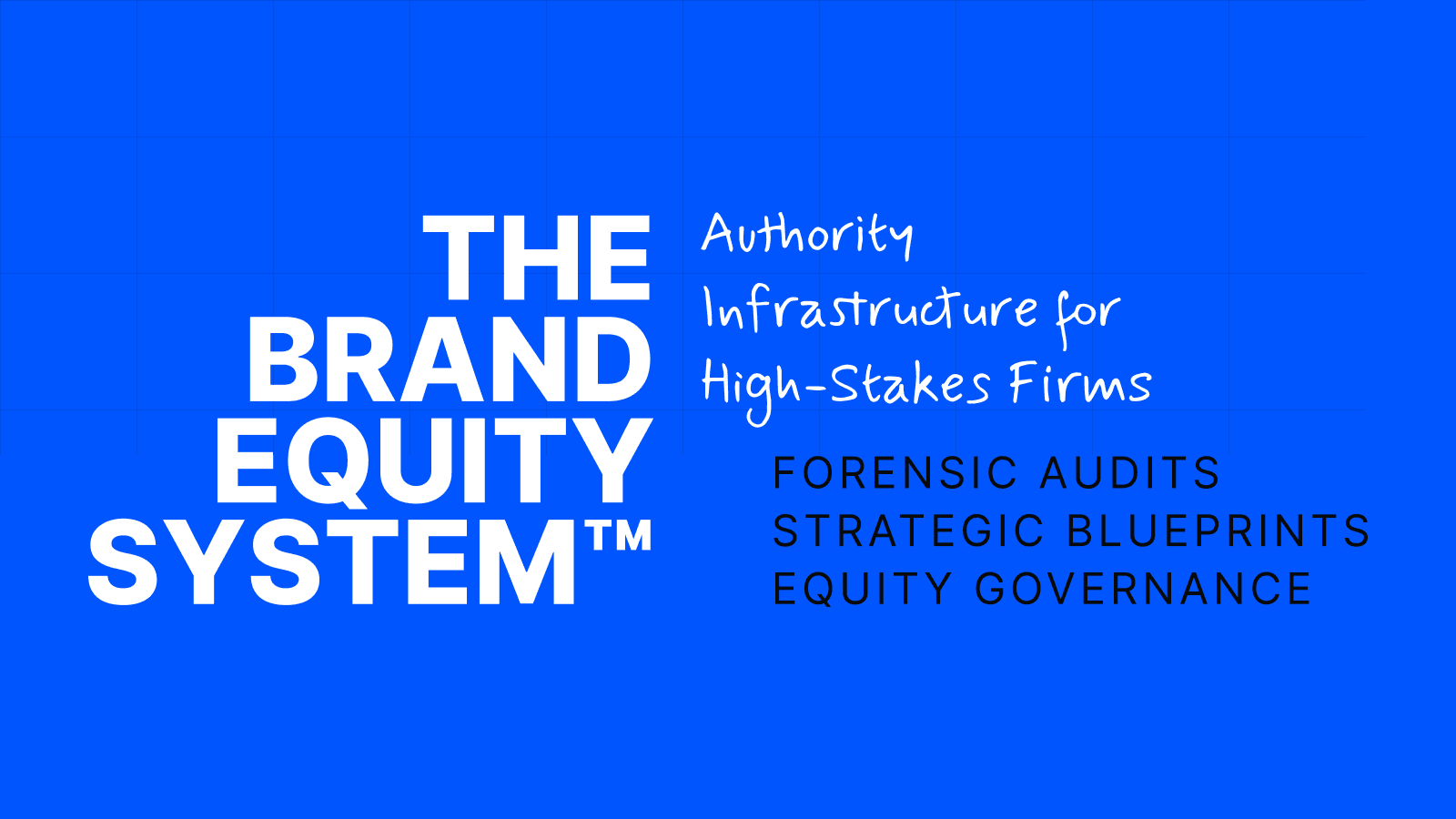
THE BRAND EQUITY SYSTEM™
What Our Brand Strategy Services Include.
We’ve retired the creative guesswork of traditional branding agencies. The Brand Equity System™ is a proprietary brand strategy methodology that moves systematically from forensic diagnosis to high-performance brand architecture — so every creative decision is a calculated investment in your market position, for the clients who vet you and the AI search agents they use to do it.
Precision positioning for premium margins.
Most firms compete on price because their brand positioning signals “generalist.” We conduct a forensic audit of your competitive landscape to find the Meaning Gap your rivals missed, then install a definitive positioning framework — a Category of One strategy that justifies premium fees and moves you from commodity vendor to the only logical choice.
Narrative engineering that justifies your expertise.
If you can’t articulate your value, the market won’t pay for it. We build ownable verbal identities and strategic brand-naming and messaging frameworks that do the heavy lifting for your partners and sales team — translating complex professional expertise into persuasive language that wins the pitches you usually lose.
Building your brand as a sellable asset.
Growth creates complexity that leaks revenue. We architect brand hierarchies that define the exact relationship between your parent firm and its sub-brands, practice areas and services — so your brand equity compounds rather than diluting as you scale, positioning your firm as a high-value asset ready for growth or exit.
Hardening your practice against search decentralisation.
High-value procurement decisions are increasingly vetted by agentic AI search systems before an executive ever visits a website. We structure your brand narrative, entity data, and authority signals so that generative answer engines categorise your practice as the benchmark authority in your vertical—ensuring your firm is retrieved, validated, and recommended when enterprise mandates are searched.
The Brand Equity System™
Detailed Breakdown
The Brand Equity Audit™ (The Diagnostic) — Free
Free: A written brand audit for firms that have outgrown their original identity. No sales calls — we extract the data via a five-question commercial brief and deliver a forensic report within 48 hours.
- Identify Revenue Leaks: We pinpoint exactly where your current branding is repelling high-value clients and funding your competitors’ growth.
- The “So What?” Test: a brutal audit of your firm’s messaging and positioning against the specialist demands of your market.
- Entity & AI Search Review: a technical assessment of how AI search agents currently categorise your firm — and whether they’d recommend you.
The Brand Equity Blueprint™ (The Reconstruction) — Fixed Fee: £7,500
Your complete brand strategy, built once, built right. The Blueprint replaces creative guesswork with a rigorous specification for your firm’s market position.
- Market Intelligence: a deep competitive audit to identify the Meaning Gap your rivals are too generalist to own.
- Positioning Framework: a Category of One brand positioning strategy that makes you the only logical choice for high-stakes clients.
- Visual Direction: a high-performance visual identity system engineered to trigger trust on first contact.
- Narrative Strategy: a verbal identity and brand messaging guide that equips your partners to justify premium fees with total conviction.
The Brand Equity Partnership™ (The Governance) — £3,000/month
Your brand strategy, actively managed. A brand is a living financial asset that requires governance to prevent strategic drift.
- Fractional Brand Director: direct access to our lead strategist for monthly brand management sessions, keeping your positioning aligned with shifting market conditions.
- Active Execution: ongoing creative and narrative support for high-stakes touchpoints — tender documents, investor decks, digital content.
- Compound Equity Management: as your firm scales, your visual and verbal assets grow in value rather than fragmenting.
Prefer to read the full breakdown?
Close the Authority Gap. Commission Your Written Brand Equity Audit™.
We do not run speculative sales calls or pitch meetings. Complete the five-question commercial brief below to initiate a forensic review of your firm’s market positioning, verbal identity, and entity signals. We deliver your three-page Brand Equity Audit™ directly to your inbox within 48 hours.
Partnering with Inkbot Design was the single most important investment in our brand equity. We had the product, but we lacked a definitive strategic focus. They took our complex concepts and distilled them into a high-performance brand strategy that gave us immediate market clarity.
Their process is exceptional—inventive in their creative solutions and deeply analytical in their strategic thinking. They understood our commercial vision even when we couldn’t articulate it ourselves. We now have a brand identity system that commands attention and drives the growth we were aiming for. If you are scaling a business, you need Inkbot on board.

THE BRAND EQUITY SYSTEM™
Our Brand Strategy Process: Six Stages from Diagnosis to Dominance.
We’ve retired subjective design. The Brand Equity System™ moves from forensic diagnosis to high-performance implementation — turning invisible firms into indispensable category leaders.
Brand Equity Audit
A deep-dive diagnostic of your brand and digital presence to identify the Obscurity Tax hurting your margins — the specific dead zones where revenue leaks through the cracks.
The Result: your Brand Equity Audit™ — the diagnostic truth, in writing, within 48 hours.
Brand Positioning
We define your Category of One: a definitive positioning strategy that justifies premium pricing and makes your competition irrelevant to high-value clients.
The Result: a bulletproof brand positioning framework that commands an authority premium.
Verbal Identity
From strategic brand naming to persuasive messaging frameworks, we ensure your expertise is articulated with total authority across every pitch, platform and proposal.
The Result: a unified messaging blueprint that’s clear to clients and AI search agents alike.
Visual Identity
We translate your positioning into a high-performance visual identity system — strategic infrastructure built to trigger trust on first contact, not decoration.
The Result: a high-equity visual system designed for global growth.
Brand Activation
We oversee the digital-first implementation of your new identity — from investor decks to high-conversion web platforms — so your launch translates into immediate market momentum.
The Result: market velocity, backed by measurable gains in lead quality.
Brand Governance
A brand is a financial asset that requires active management. Ongoing strategic oversight keeps your brand architecture working as a revenue driver while your firm scales.
The Result: compounding equity — your brand remains your firm’s most valuable sellable asset.
OUR PHILOSOPHY
Where Strategic Truth Meets Market Equity.
Branding is not an aesthetic luxury. In a market vetted by AI search agents and high-stakes buyers, your brand strategy is either a hardworking financial asset or a commercial liability. Through rigorous brand architecture and disciplined design, we ensure your firm stops competing on price and starts commanding the authority premium it has actually earned.
Where We Stand
By the Numbers
- 17+ Years of brand strategy expertise
from traditional print to the age of agentic AI.
- 4.9/5 Average across 160+ verified reviews.
A reputation built on strategic depth and precision delivery.
- 2,500+ Strategic resources published.
We don’t just practise brand strategy; we lead the conversation with one of the industry’s largest libraries.
- Top 30 UK branding agencies
and the top-ranked branding firm in Belfast.

SPECIALIST ARCHITECTURE
Brand Strategy for High-Stakes Professional Services Firms.
The Compounding Cost of the Obscurity Tax
Exceptional professional practices rarely fail due to technical competence; they fail due to an Authority Gap. While your advisory capabilities operate at an institutional standard, your external brand still signals regional generalist. When market perception lags behind technical execution, every tender becomes an uphill battle against commoditisation.
This is the Invisible Drain. Without strategic brand architecture, your sales team works twice as hard to build trust, and your marketing spend produces diminishing returns. You aren’t just losing deals — you’re paying a tax on every interaction.
We don’t chase trends; we architect authority.
Our brand strategy practice specialises in professional services — law, accountancy, financial advisory and management consultancy — where trust dynamics decide who wins high-value contracts.
From our Belfast studio, we partner with firms across the UK, the US and 21 countries worldwide, bridging the gap between your actual expertise and your market perception — for the clients who vet you, and the AI agents they use to do it.
Frequently Asked Questions (FAQ)
Clarifying the Path to Market Authority.
We believe in radical transparency. Whether you’re curious about our Brand Equity Blueprint™, the commercial ROI of identity, or how we lead global scale-up projects from our Belfast studio, you’ll find the answers to your most pressing questions below.
What is brand strategy?
Brand strategy is the commercial plan behind a brand: who it serves, how it’s positioned relative to competitors, what it says, and how its identity expresses that positioning. It covers brand positioning, verbal identity, messaging and brand architecture — the decisions that determine whether a firm competes on value or on price. Design executes the strategy; it isn’t the strategy.
What’s the difference between brand strategy and brand identity?
Brand strategy is the thinking: positioning, audience, differentiation, messaging. Brand identity is the expression of logo, typography, colour, and voice. A brand identity without a brand strategy is decoration — it can look premium while positioning you as a generalist. The Brand Equity System™ builds the strategy first, then engineers the identity to prove it.
What does a brand strategy agency deliver that a design studio doesn’t?
A design studio delivers assets. A brand strategy agency delivers the positioning framework, verbal identity and brand architecture that tell those assets what to say — then measures the result in margin, sales-cycle length and lead quality. You can buy a beautiful logo that loses pitches. A strategy exists to stop that.
How is the Brand Equity Blueprint™ priced?
The Blueprint is a fixed capital investment of £7,500. We do not track hours, and we do not do bespoke quotes based on what we think you can afford. You are paying for the strategic architecture required to justify premium margins in your sector.
How do you measure the ROI of a brand strategy project?
We track success through Market Equity. This translates into increased margin potential (the ability to charge a premium), shortened sales cycles (due to pre-built trust), and total stakeholder alignment. By the end of our process, your brand is no longer a cost centre; it is a measurable driver of revenue.
Why do we start with a written Audit instead of a call?
Your time is an asset. We lead with a professionally written diagnostic — delivered within 48 hours — to identify your three most critical “Brand Leaks.” This allows you to review the data and our strategic thinking without the pressure of a sales pitch. We only move to the Blueprint phase if the audit reveals a clear path to ROI.
How long does a typical brand strategy engagement take?
A comprehensive engagement usually spans 4 to 6 weeks. We move systematically through our six-stage framework to ensure no stage is rushed. We don’t cut corners because we aren’t just making you look good — we are building the foundation for your next decade of growth.
Can we hire Inkbot Design for Brand Naming as a standalone service?
No. We do not sell à la carte deliverables because standalone assets do not solve commercial problems. A name without a positioning framework and visual architecture is useless. We only deploy the complete Brand Equity Blueprint™.
We already have a logo we like. Can we just do the Strategy and Positioning?
We conduct an Identity Gap Analysis as part of the free Brand Equity Audit™. If your current logo holds genuine market equity and aligns with your new positioning, we will integrate and evolve it within the Blueprint. If it is actively causing friction and signalling “generalist,” we will tell you the truth and recommend that you replace it. We do not compromise the system to save a flawed legacy asset.
How involved will our leadership team need to be in the process?
Strategy is a partnership, not a hand-off. We require high-level input during the Discovery and Alignment phases. Our goal is to minimise friction for your team while ensuring the final strategy has 100% boardroom buy-in and internal conviction.
Do you handle the visual rollout and web design after the strategy is set?
Yes. As an integrated strategic partner, we ensure your strategy isn’t left on a shelf. Through our Commercial Activation pillar, we translate the strategy into high-performance web platforms, investor decks, and digital marketing systems that actually perform.
How does Inkbot Design handle global projects from a Belfast studio?
We are a digital-first brand strategy consultancy. Our roots are in Belfast; our clients are in London, New York, Dallas and 21 countries worldwide. Our process is built for high-stakes, asynchronous collaboration across any time zone — most of our engagements never require a single in-person meeting, and none have suffered for it.
What is a “Brand Equity Audit,” and why is it the first step?
It’s a forensic diagnostic of the Identity Gap — the distance between how you are perceived and what you are actually worth. We identify where your current branding is “taxing” your growth. This data ensures our strategy is based on reality, not assumptions.
How do you ensure our brand is “future-proof” for AI-driven search?
Modern brand strategy must account for Generative Engine Optimisation (GEO). We build your narrative and entity signals so that AI search agents categorise your firm as the definitive authority in your niche. If the AI doesn’t trust you, neither will the market.
Is this suitable for established firms with 20+ years of history?
Yes. In fact, established firms often pay the highest Obscurity Tax. If your brand identity was built for the 2010s, it is likely a commercial liability in the age of AI-driven search. We perform “Strategic Reconstructions” that preserve your heritage while aligning your identity with modern market demands.