Executive Stationery Systems: Designing Tactile Trust for B2B
Closing a £250,000 professional services contract rarely breaks down over technical competency. It breaks down over perceived risk.
When a management board evaluates competing advisory practices, every partner claims equal expertise, displays identical client logos on their slides, and uses the same industry jargon.
At this juncture, procurement decisions pivot toward risk mitigation. B2B buyers seek tangible evidence that an agency possesses operational permanence, structural discipline, and meticulous attention to execution.
Self-administered stationery designs fail because leaders view physical assets as cosmetic admin rather than commercial infrastructure.
They commission business cards as an isolated afterthought, allow individual partners to print local letterheads on office inkjet paper, and distribute digital proposal PDFs that disappear into overcrowded downloads folders.
This operational negligence signals instability. A 100-person firm that presents lightweight stock or mismatched Pantone shades actively signals poor quality control to conservative procurement leads.
Establishing a cohesive brand identity design strategy ensures that every physical touchpoint reinforces market leadership rather than exposing organisational drift.
According to a MarketingSherpa survey, 82% of internet users trust print ads and physical printed materials more than any other channel when making a purchasing decision.
Physical collateral carries disproportionate trust weight because it requires real capital expenditure, physical manufacturing, and logistics.
A digital document costs virtually nothing to distribute; a precision-engineered physical executive deck demonstrates commitment.
- Precision-engineered executive stationery systems convert tactile quality into reduced buyer risk and immediate credibility during high-value B2B procurements.
- Standardise substrates, lock Pantone Matching System spot colours, require vector assets and physical wet proofs; insist on FSC chain-of-custody.
- Structure a modular, role-based kit, batch production for cost-efficiency, and integrate physical collateral with ABM via high-density QR codes.
How Executive Stationery Systems Are Designed for B2B Trust
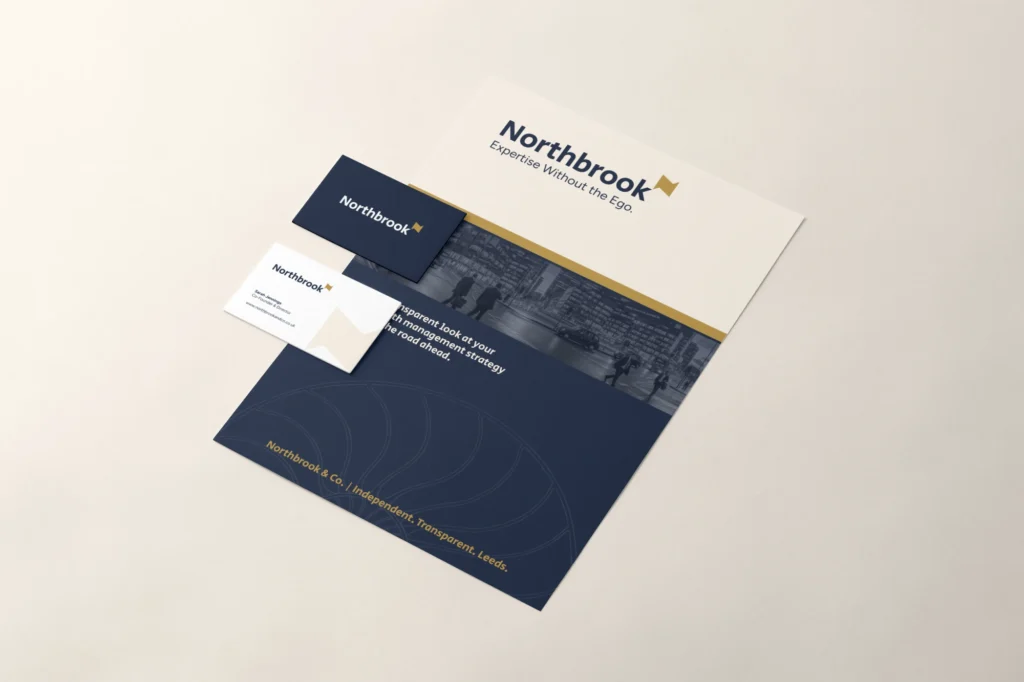
Executive stationery systems are specified physical collateral frameworks—comprising corporate business cards, formal letterheads, executive leave-behinds, presentation folders, and proposal enclosures—engineered to convey institutional stability during high-value B2B procurement cycles.
To build an executive stationery system that reduces vendor risk:
- Standardise core substrates by locking in specific GSM paper weights and cotton-pulp blends across all corporate collateral.
- Control colour reproduction by enforcing strict Pantone Matching System (PMS) spot-colour rules on uncoated papers.
- Deploy modular kit architectures that tailor physical leave-behinds to specific buyer personas and account-based marketing funnels.
Executive stationery systems are structured collections of physical brand collateral—including business cards, letterheads, and proposal covers—engineered to signal institutional maturity and reduce buyer risk in B2B transactions.
Building a complete brand identity requires extending visual rules beyond screen pixels into tangible physical assets.
When managing a complex repositioning effort, align physical print guidelines directly with your broader visual identity parameters to prevent brand fragmentation across channels.
System Foundations Before Printing
Attempting to specify physical collateral without established design fundamentals guarantees wasted printing budgets. Before requesting press proofs or selecting paper stocks, secure four foundational elements:
- Vector Brand Assets: All logomarks, typography markups, and brand icons must exist as native vector files (.EPS or .AI) with fully converted outline fonts. Raster images (.PNG or .JPG) will pixelate when printed on high-resolution offset printing plates.
- Colour Profile Architecture: Primary brand colours must possess calibrated values for spot reproduction (Pantone Matching System), 4-colour offset process (CMYK), and screen display (RGB/HEX). Expecting a single CMYK mix to reproduce identically across digital screens and uncoated paper is a recipe for muted, inaccurate colours.
- Structural Typography Scale: Font hierarchies must specify exact point sizes, leading (vertical line spacing), tracking (horizontal letter spacing), and set widths optimised for print legibility rather than screen resolution.
- FSC Chain-of-Custody Certification: Modern corporate governance requires that all paper sourcing align with Forest Stewardship Council (FSC) standards. Ensure your printing partners hold verified FSC chain-of-custody credentials before signing production orders.
Stage 1: Specifying Substrates & Tactile Weights
Paper selection is an engineering choice, not a decorative preference. The weight, texture, and density of paper stock communicate brand attributes before a reader processes the printed text.
Standard 80 GSM copier paper signals operational frugality. For executive letterheads, specify uncoated wove paper in the range of 120 GSM to 150 GSM, or cotton-blend paper.
Cotton-content paper provides a distinct tactile feel and exceptional folding endurance, preserving document integrity during postal transit.
For executive business cards, 350 GSM is the absolute floor. Scale-up leadership teams should specify 400 GSM to 600 GSM multi-layer duplexed or triplexed boards.
A 500 GSM business card feels substantial; it resists bending, sits authoritatively on a boardroom table, and immediately sets your executive team apart from competitors handing out thin 300 GSM digital prints.
Texture dictates perception. Smooth, ultra-calendered papers convey modern efficiency, making them suited for technology consultancies and corporate finance practices. Lightly textured or tactile surfaces (such as classic laid or subtle eggshell finishes) project heritage and legal rigour.
Match the physical substrate to the positioning established in your firm’s brand consistency guidelines. Ensure that all paper choices adhere strictly to FSC or recycled standards to fulfil corporate environmental obligations.
Stage 2: Colour Calibration & Precision Finishing
Reproducing brand colours accurately on physical paper requires rigorous colour management. Offset print presses lay down wet ink that absorbs into the paper fibres, altering the appearance based on the substrate’s density.
Uncoated papers absorb ink rapidly, causing “dot gain”—an expansion of printed ink dots that darkens images and dulls colour intensity. A blue specified as CMYK 100/70/0/0 will render deep and crisp on a coated sheet but appear flat and muddy on an uncoated 120 GSM letterhead.
To overcome this, specify Pantone Matching System (PMS) spot colours for all primary corporate identity elements. Spot colours utilise pre-mixed, solid inks applied via dedicated printing plates, guaranteeing precise hue consistency regardless of paper absorption.
Selective finishing techniques elevate print pieces into memorable touchpoints. Blind debossing presses a graphic element into thick paper stock without ink, creating clean light and shadow effects. It is ideal for applying corporate logomarks to presentation covers.
When applying metallic foils, avoid cheap, high-gloss chrome or bright yellow gold. Instead, specify matte metallic finishes—such as brushed copper, champagne gold, or warm micro-milled silver. These soft metallic accents convey understated refinement rather than loud ostentation.
Edge painting adds a subtle perimeter colour to thick, multi-layer business cards. Painting the card edges in your primary brand accent hue adds a refined pop of colour when cards sit stacked in a holder, turning a simple card into a polished brand artefact.
Stage 3: Modular Architecture & Role-Based Kit Structuring
An executive stationery system must function as a modular kit of parts rather than a rigid set of identical items. Different corporate roles require distinct combinations of physical assets.
C-Suite / MD
- 600 GSM Triplexed Card
- Leather Presentation Folder
- Wax-Sealed Executive Pack
Partners / BD
- 400 GSM Duplexed Card
- Deck Enclosure Sleeve
- Personalised Note Cards
Account Teams
- 350 GSM Corporate Card
- Digital Business Card Code
- Standardised PDF Template
Structure your physical suite across three operational Tiers:
- Tier 1: C-Suite & Managing Directors: Outfitted with heavyweight 600 GSM triplexed business cards, custom-bound executive presentation folders, personal correspondence cards, and bespoke watermarked stationery for high-stakes investor or acquisition communications.
- Tier 2: Partners & Business Development Leads: Issued 400 GSM duplexed business cards, tailored proposal leave-behind enclosures, standardised compliment slips, and physical note cards for post-meeting follow-ups.
- Tier 3: Practice Consultants & Account Managers: Supplied with 350 GSM corporate business cards, digital business card integration codes, and standardised letterhead templates for operational correspondence.
Integrate physical stationery directly into your Account-Based Marketing (ABM) workflows. Print custom proposal covers equipped with subtle, high-density QR codes printed on the interior flap.
When a prospect reviews a physical deck, scanning the code takes them to a secure, personalised landing page featuring video introductions, team CVs, and dynamic pricing models.
By merging physical print with trackable digital assets, you turn traditional stationery into a measurable, interactive layer of your sales technology stack. This alignment strengthens your overall brand operating systems, ensuring seamless delivery across every client touchpoint.
Stage 4: Procurement, Batching, & Production Quality Control
Custom print manufacturing involves fixed setup costs. Plate creation, press wash-ups, die-cutting tooling, and foil stamp setup fees typically run between £50 and £150 per production run.
For small print volumes, setup fees destroy unit economics. Printing 20 business cards with custom die-cutting can push the unit cost past £5.00 per card. Amortising those same setup costs over a run of 500 cards drops the unit cost to under £0.45 per card.
To optimise printing budgets without compromising quality, batch production should be across the entire organisation.
Establish standardised grid layouts for business cards across all tiers. Print core shell stocks—such as letterhead backgrounds or folder covers—in high-volume offset runs using solid PMS spot colours.
Once shell stocks are printed and stored, overprint personalised individual details (names, job titles, direct contact numbers) in smaller, on-demand digital batches as new team members join.
Before approving full production runs, mandate physical wet proofs or press passes for critical collateral. Digital PDF proofs displayed on uncalibrated computer monitors cannot accurately reveal ink absorption, debossing depth, or foil registration.
Reviewing physical proofs on actual specified stock eliminates expensive reprint errors.
Navigating Production Trade-Offs

Executing an executive stationery system requires balancing ideal aesthetics against physical production realities.
“Tactile quality is a trust amplifier in B2B procurement. Substandard paper choices signal operational fragility, while precision-engineered physical collateral communicates capital stability, operational discipline, and long-term permanence before a single word is read.”
The Grain Direction Trade-Off
Paper fibres align in a uniform direction during manufacturing (“grain direction”). Folding paper against its grain cracks the outer fibres, leaving jagged, white edges along folded seams.
When specifying presentation folders or folded correspondence cards, mandate that the grain direction runs parallel to the fold line. If structural constraints require folding across the grain, instruct your print provider to creasing-score the stock before folding to preserve surface integrity.
The Environmental versus the Heft Trade-Off
Enterprise buyers demand environmental responsibility, yet 100% post-consumer recycled paper has historically produced grey tones and rough surface textures.
Modern premium mills have solved this trade-off. Specify FSC-certified stocks manufactured using 100% wind power or cotton rags upcycled from textile waste.
These substrates deliver crisp brightness, excellent ink holdout, and high tactile weight while strengthening your firm’s sustainability narrative.
The Colour Perception Trade-Off
Colour psychology plays a vital role in shaping client perceptions during pitch reviews. The strategic choice of primary and secondary tones directly affects how conservative buyers perceive a firm’s authority and stability.
Understanding how hue variations alter buyer confidence is crucial when selecting paper and ink combinations. Reviewing principles of colour psychology helps ensure your physical palette evokes trust and professionalism.
Engineering a B2B Stationery Suite for a £15m Consultancy
To see how an executive stationery system functions in practice, consider a real-world implementation executed for a UK management consultancy.
The Context
A 120-person legal and management consultancy based in the UK was repositioning to target FTSE 250 enterprise accounts. Despite strong technical capabilities, the firm struggled in competitive pitches against national competitors.
An audit revealed that individual partners were using self-printed letterheads on standard 80 GSM copier paper, carrying cheap 300 GSM digital business cards, and presenting proposals in flimsy plastic comb-bound folders. The visual disconnect was damaging pitch conversions.
The Specification Strategy
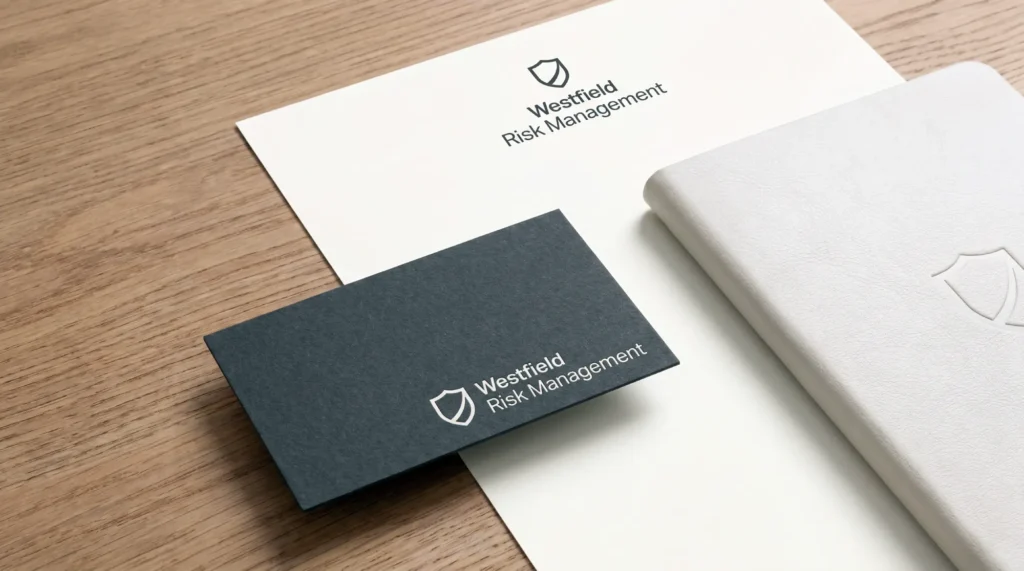
Inkbot Design engineered a unified executive stationery system designed to signal institutional permanence:
- Core Substrate: Standardised all corporate correspondence on 135 GSM natural white uncoated cotton-blend stock. Specified a heavy 540 GSM double-bonded board for executive business cards.
- Colour Precision: Locked primary corporate navy to a single PMS spot colour, eliminating colour shifts across offset letterheads and digital proposal covers.
- Modular Enclosures: Designed a custom die-cut pocket folder using 350 GSM dark navy board featuring a blind-debossed corporate logomark on the front cover and micro-milled champagne foil accents on the interior flap.
- ABM Integration: Embedded custom QR codes on interior proposal flaps, linking physical pitch leave-behinds directly to tailored video overviews from the leading engagement partner.
The Commercial Outcome
The updated physical suite completely changed the firm’s pitch presence. Within nine months of rolling out the new stationery system, the consultancy closed three enterprise accounts with an aggregate contract value of £1.2m.
Procurement feedback specifically highlighted the firm’s polished presentation, noting that their physical proposal materials projected exceptional professionalism and attention to detail compared to competing agencies.
From Cosmetic Print to Buying Confidence

Most marketing guides treat stationery as an aesthetic detail—a soft branding element designed to make a business “look professional.” This perspective overlooks the underlying commercial mechanics of enterprise sales.
Executive stationery systems are not decorative accessories. They are risk-reduction assets engineered to build buyer confidence.
Gartner’s 2025 B2B buyer survey found that 61% of buyers prefer a rep-free buying experience. Modern enterprise decision-makers conduct extensive research, review documentation, and compare proposals independently before ever meeting a sales representative.
When buying, teams evaluate proposals behind closed doors; your physical collateral speaks for your organisation. A lightweight, poorly printed proposal deck signals operational fragility.
A substantial, beautifully engineered executive folder communicates capital strength, organisational discipline, and execution capability.
Forrester’s 2023 Business Trust Survey reports that 77% of purchase influencers consider brand awareness and vendor maturity key factors when determining whether to trust an organisation. Physical collateral serves as tangible proof of that maturity.
Recent industry research indicates that 55% of buyers rely more heavily on sales collateral content to make purchasing decisions than they did a year prior.
Upgrading your print collateral from basic admin to a strategic stationery system directly improves deal velocity across every stage of the funnel. Investing in physical touchpoints directly helps improve brand perception among risk-averse procurement boards.
“A B2B buyer evaluating a £250k proposal is fundamentally seeking to avoid making a career-limiting mistake. Precision-engineered physical collateral provides immediate, non-verbal proof that your business is stable, detailed, and built to endure.”
Handling Executive Objections
Objection 1: “Our sales cycle is completely digital now. Nobody needs paper.” Reality: Digital communication is saturated. The average executive receives over 120 emails daily, leading to digital fatigue. Physical collateral breaks through screen noise. Delivering a heavy, custom-bound proposal pack to a key prospect ensures your firm commands physical space on their desk during crucial decision-making windows.
Objection 2: “Custom stationery is an unnecessary expense when cutting costs.” Reality: A complete executive stationery system for a 100-person firm typically requires an investment of £3,000 to £6,000. Amortised across a three-year lifespan, the annual cost is negligible. Winning a single additional £100k contract as a result of improved pitch perception delivers an immediate, exponential return on investment.
Market Landscape & Sourcing Trends
The commercial printing landscape is experiencing a flight to quality. According to Grand View Research, the global commercial printing market was valued at USD 677.18bn in 2025 and is projected to reach USD 719.69bn in 2026, representing a 6.86% compound annual growth rate.
This growth is driven not by mass-market flyers, but by high-value, highly customised B2B print solutions. As digital advertising costs increase, scale-up businesses are rediscovering the high conversion rates of targeted, tactile physical collateral.
Simultaneously, sustainability has transitioned from an optional benefit to a strict requirement. Industry data indicates that eco-friendly product adoption in stationery has reached 56%, with 65% of stationery manufacturers now using eco-friendly or recycled materials in production.
Modern executive stationery systems must combine heavy tactile quality with verified FSC certification, soy-based inks, and zero-waste production practices.
I’ve led brand identity and print systems projects for professional services firms across 21 countries for over 17 years. The consistent pattern seen across hundreds of client engagements is that firms upgrading to structured physical collateral experience immediate gains in pitch confidence and buyer perception.
The Verdict
Executive stationery systems are an underutilised leverage point in B2B sales.
While your competitors continue to send generic digital PDFs and hand out flimsy business cards, a custom-engineered physical collateral system provides an immediate competitive advantage in high-stakes pitches.
To upgrade your firm’s physical collateral from basic admin to revenue-generating trust infrastructure:
- Audit your current print footprint. Collect every business card, letterhead, proposal folder, and leave-behinds currently used across your offices. Place them on a single table and check for colour shifts, inconsistencies in paper weight, and visual drift.
- Establish strict substrate specifications. Lock in precise GSM weights, paper finishes, and Pantone spot-colour references across all corporate communication channels.
- Engage specialist print partners. Avoid generic online print platforms. Partner with commercial printers equipped with offset presses, precision die-cutting machinery, and expert colour-matching capabilities.
If your physical collateral fails to reflect the true calibre of your practice, your brand is quietly losing ground during critical pitch reviews.
Request a free Brand Equity Audit™ from Inkbot Design today. Our structured diagnostic identifies exactly where your brand identity is losing commercial traction and provides a clear blueprint for engineering market authority across every physical and digital touchpoint.
FAQs
What is an executive stationery system?
An executive stationery system is a coordinated suite of physical brand assets—including business cards, letterheads, proposal enclosures, and leave-behinds—engineered to project institutional stability and reduce buyer risk during high-value B2B sales cycles.
What paper weight should be specified for executive business cards?
For executive business cards, 400-600 GSM multi-layer stock should be specified. Standard 300 GSM cardstock feels thin and flexible, whereas 500 GSM board offers structural rigidity and projects a premium market positioning.
Why are Pantone spot colours necessary for corporate letterheads?
Pantone spot colours ensure absolute colour accuracy across all printed materials. Standard CMYK process printing varies across press runs and paper types, whereas pre-mixed Pantone spot inks maintain precise brand colour consistency on uncoated stocks.
Is physical stationery still relevant for modern B2B scale-ups?
Yes — physical stationery remains highly relevant. Industry data shows that 82% of buyers trust print materials more than digital media, making tactile collateral a powerful tool for standing out during complex, multi-stakeholder procurement reviews.
How can printed executive collateral be connected to digital marketing workflows?
Printed collateral connects to digital workflows through embedded high-density QR codes printed on interior proposal flaps. Prospects who scan the code access personalised landing pages featuring video introductions, team credentials, and dynamic presentation decks.
What is dot gain, and how does it affect uncoated paper stock?
Dot gain is the expanding absorption of wet ink into paper fibres during printing. Uncoated papers absorb ink rapidly, causing printed images and colours to darken or dull unless properly calibrated during press prep.
What paper weight is recommended for formal corporate letterheads?
Formal corporate letterheads should be printed on 120 GSM to 150 GSM uncoated wove or cotton-blend paper. This weight provides a substantial tactile feel, prevents ink bleed-through, and maintains structural integrity during folding and mailing.
How can setup costs be reduced on custom stationery runs?
Setup costs are minimised by batching production across the organisation. Printing shared shell elements in large offset press runs and overprinting individual personalised details in smaller digital batches maximises efficiency while maintaining quality.
What is the difference between blind debossing and hot-foil stamping?
Blind debossing presses a graphic design into thick paper stock without ink or foil, creating a clean recessed impression. Hot-foil stamping uses heat and pressure to apply a thin metallic foil layer to the paper surface.
What environmental certifications should corporate paper stocks carry?
Corporate paper stocks should carry Forest Stewardship Council (FSC) Chain-of-Custody certification. This ensures paper fibres are sourced from responsibly managed forests that meet strict environmental, social, and economic sustainability standards.
How does premium stationery reduce procurement risk in B2B pitches?
Premium stationery signals operational discipline, capital stability, and meticulous attention to detail. In rep-free buying scenarios, physical collateral serves as tangible proof that a firm is well-established, reducing perceived vendor risk for risk-averse procurement boards.
