Brand Due Diligence Before an Acquisition
Brand due diligence provides decision-makers with a disciplined way to test whether goodwill is real, controlled, defensible, and capable of surviving the transaction.



On this page9 min left
Brand due diligence is the structured assessment of whether a target company’s brand is a transferable commercial asset, a manageable liability, or an underfunded post-acquisition requirement.
Before an acquisition, we need to test beyond awareness and visual quality. The central question is whether the brand supports customer demand, pricing power, retention, reputation, and the buyer’s investment thesis.
A polished identity can conceal weak customer preference. Equally, an unremarkable visual system can sit behind a trusted name with substantial commercial value. The acquisition decision should distinguish the two.
What Brand Due Diligence Evaluates

Brand due diligence is a transaction test, not a design review
Brand due diligence examines the commercial value, risks, control, and transferability of a brand in the context of a specific deal. It should sit alongside financial, commercial, legal, tax, and operational diligence rather than appear as a late marketing workstream.
A conventional brand audit can be a useful input because it reviews identity, messaging, consistency, and market presentation. However, brand audit work becomes due diligence only when it answers transaction questions:
- Does the brand contribute to revenue quality, customer retention, or premium pricing?
- Are the trademarks, names, domains, licenses, and creative assets controlled by the target and transferable?
- Does customer trust depend on the founder, a retailer, a platform, or another party outside the business?
- Will the intended acquisition structure preserve or damage the equity that the buyer is paying for?
This distinction changes the work. A design review may recommend a clearer visual identity. A diligence review must identify whether inconsistent identity has already weakened conversion, caused market confusion, or exposed the company to legal risk.
The five questions an investment committee should ask
We can make the assessment more decision-useful by organising it around five questions.
Decision question | What we test | Why it affects the deal |
|---|---|---|
Is demand genuinely brand-led? | Customer choice, repeat purchase, referrals, branded search, channel pull | Separates brand equity from general market demand |
Can the buyer control the asset? | Trademark ownership, licenses, domains, contracts, creator rights | Determines whether the acquired business receives the rights it expects |
Is the promise credible? | Product experience, service delivery, reviews, complaints, claims | Identifies gaps between positioning and reality |
Is goodwill durable? | Founder dependence, channel concentration, partner dependence | Reveals goodwill that may disappear after closing |
Can value survive integration? | Naming, portfolio architecture, governance, migration plans | Estimates post-close cost and customer disruption |
These questions force a practical shift from “Is this a good brand?” to “What exactly are we buying, what could impair it, and what must happen after closing to retain value?”
Where brand diligence fits with other workstreams
There is overlap, but no duplication, between diligence disciplines. Financial diligence can confirm margins and revenue concentration. Commercial diligence can size demand and competitive pressure. IP diligence can establish formal ownership of intellectual property. Brand due diligence considers the implications for customer preferences and future value creation.
For example, a target may report strong revenue and have registered trademarks. Yet customers may buy primarily because of a charismatic founder who intends to leave after a short transition. Financial data confirms past performance; trademark records confirm legal rights; brand diligence tests the transferability of customer trust.
The same is true for a professional services acquisition. A firm may have a recognisable name, but its clients may place their confidence in specific partners rather than the corporate brand. That does not necessarily make the business unattractive.
It does mean the buyer should model retention risk, transition communications, relationship handovers, and investment in the corporate brand.
A Practical Brand Due Diligence Workflow
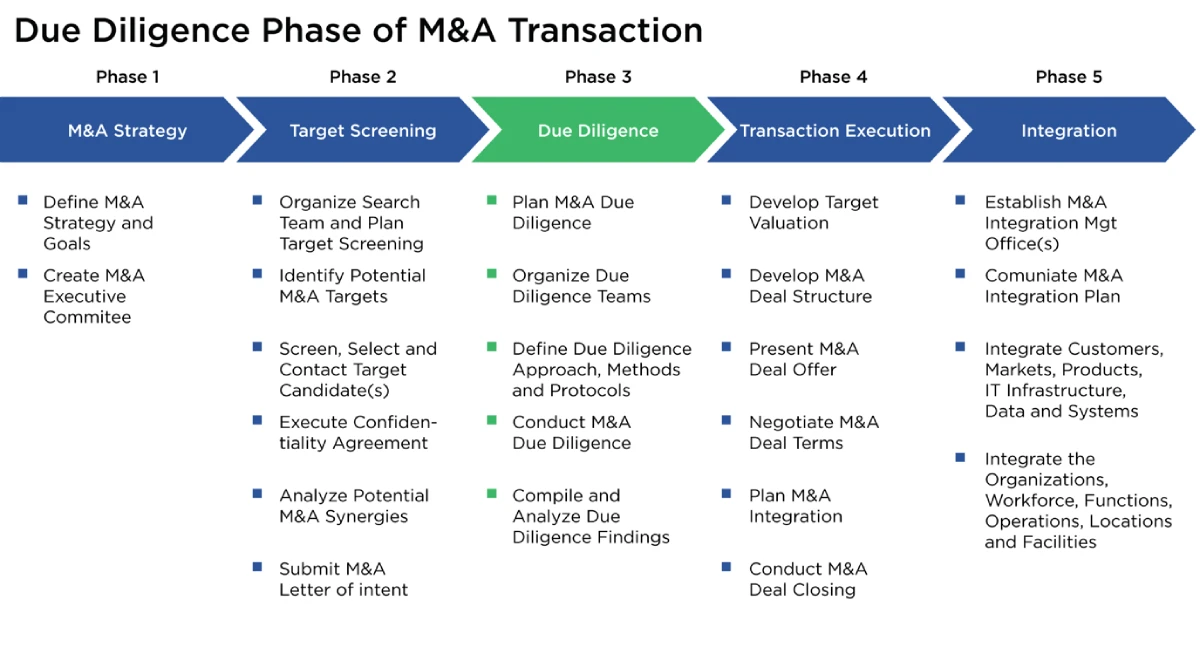
Start with the investment thesis, not the communications archive
The scope of diligence should be proportionate to the value at risk. A buyer acquiring a regional bolt-on business with limited standalone brand recognition needs a different review from a buyer acquiring a consumer brand whose name drives demand across multiple markets.
We should begin by documenting the deal hypothesis in plain language. For example:
- The buyer expects to retain the target name because it commands premium pricing in a specialist segment.
- The buyer intends to merge two service brands into a single master brand within 18 months.
- The buyer sees cross-sell potential but has not yet established whether customers view the target as credible outside its core offer.
- The target’s customer acquisition depends on a marketplace, retailer, or affiliate network that may not continue after change of control.
Each statement becomes a testable claim of diligence. This prevents a common failure mode: gathering a large quantity of brand material without determining what would confirm or weaken the investment case.
Build an evidence-to-claim matrix
An evidence-to-claim matrix is a simple control document that connects every major assertion to evidence, a time period, an owner, and its limitations. It is especially valuable where management presentations contain broad phrases such as “market leader,” “trusted brand,” or “strong loyalty.”
Brand claim | Evidence requested | Reliability check | Potential contradiction | Decision implication |
|---|---|---|---|---|
Customers pay a premium | Win-loss data, price realisation, customer interviews, competitor comparison | Separate price from product scope and service level | Discounting may be widespread | Revisit pricing power assumption |
The name is protected | Trademark schedule, renewal dates, assignments, licenses | Match records to entities and territories | Marks may be owned personally or by an affiliate | Require transfer or condition precedent |
Reputation is strong | Reviews, complaint records, media coverage, client feedback | Check recency and customer segment | Recent service failures may be hidden in average ratings | Set remediation plan or reserve |
Demand is repeatable | Cohort retention, repeat orders, referral data, pipeline source data | Compare periods and channels | Retention may follow contracts, not preference | Reduce projected brand contribution |
The matrix does not create certainty. It makes uncertainty visible. That matters when different workstreams rely on the same untested management claim.
Request the right evidence early
An effective request list should include documents, data, and human evidence. Documents establish ownership and governance. Data reveals commercial patterns. Interviews help explain why those patterns exist.
Request at least the following:
- Brand strategy, positioning materials, messaging frameworks, and historical identity guidelines.
- Trademark schedules, registration certificates, renewal records, assignments, coexistence agreements, and infringement correspondence.
- Domain name records, social account administration records, software subscriptions, and access controls.
- Licenses for names, logos, photography, typefaces, endorsements, content, and brand collaborations.
- Customer research, review analysis, complaints, churn data, referral sources, sales call notes, and win-loss findings.
- Marketing performance by channel, including spend, lead source, conversion, branded and nonbranded demand where available.
- Agreements involving founders, spokespersons, distributors, platforms, retailers, franchisees, or ambassadors.
- Existing crisis plans, reputation management policies, and records of material public complaints or regulatory issues.
The goal is not to create a bigger data room. It is to obtain evidence that can change the price, terms, closing conditions, or the first 100-day plan.
Use interviews to test the story behind the numbers
Quantitative data rarely explains the source of trust. Structured interviews with leadership, sales teams, frontline staff, key customers, and channel partners can reveal whether the brand promise is understood and delivered consistently.
Ask the same core questions across groups. What does the company do better than alternatives? Why do customers choose it? What would cause them to leave? Who or what represents the brand? Which promises are difficult to keep?
A gap between internal and external answers is often more valuable than consensus. If leadership describes a premium advisory brand while buyers describe it as “the cheapest safe option,” price resilience may be weaker than management assumes.
Conversely, if customers use language that signals trust and differentiation but the company has not formalised it, the buyer may have a defensible platform for repositioning.
Legal Ownership, Reputation, and Rented Goodwill

Apply a UK trademark decision framework
For UK transactions, trademark diligence should establish not simply whether a mark exists, but whether the correct legal entity owns it, whether it covers commercially relevant goods or services, and whether the transaction transfers the right.
Finding | Transaction risk | Typical response |
|---|---|---|
Target owns registered marks in relevant classes and territories | Lower ownership risk | Confirm assignment mechanics and update records after completion |
Mark is owned by a founder, parent, or unrelated affiliate | Buyer may not acquire essential rights | Require assignment before completion or price the risk explicitly |
Target operates under a license | Use may end on change of control or have territorial limits | Review consent, duration, termination rights, and transfer provisions |
Key mark is unregistered or registered in narrow classes | Enforcement and expansion may be constrained | Obtain legal advice, assess common law rights, and budget protection work |
Active challenge, infringement claim, or coexistence restriction exists | Legal cost, rebrand risk, or geographic limits | Escalate to specialist counsel and assess deal protections |
A registered trademark is not a complete answer.
The buyer should reconcile the trademark schedule against the names actually used on products, contracts, websites, signage, packaging, and international channels. An unused registered mark has limited commercial value; an extensively used but poorly documented name can carry significant exposure.
This is also where brand protection planning becomes relevant. The buyer needs a post-close approach to renewals, monitoring, enforcement, domain control, and consistent permitted use. Without governance, a portfolio of rights can erode through neglect or uncontrolled local adaptations.
Identify rented goodwill before it disappears
Rented goodwill is apparent brand value that depends on an asset or relationship the target does not control. It may arise from a marketplace ranking, an exclusive retailer, a distributor’s sales team, a celebrity endorsement, a platform audience, a franchise license, or a founder’s personal reputation.
Consider a business that reports strong direct traffic but has built its audience almost entirely through a founder’s public profile. If the founder leaves, the company may retain its trademarks but lose the attention mechanism that produced demand.
The appropriate response is not automatically to abandon the deal. It is to determine whether the company can convert personality-based trust into institutional trust during the transition period.
We should test rented goodwill through contracts, channel economics, customer interviews, and scenario analysis. Ask what happens if the relationship ends, changes ownership, reduces visibility, or demands higher fees.
If a single external party controls a material share of brand exposure, the risk belongs in commercial assumptions and integration planning, not just the marketing section of a presentation.
Set clear escalation thresholds for reputation risk
Not every negative review merits a valuation adjustment. Reputation findings should be classified by severity, recurrence, credibility, and commercial reach.
Severity | Characteristics | Recommended action |
|---|---|---|
Contained | Isolated complaints with documented resolution | Monitor and validate service recovery process |
Patterned | Repeated complaints about a common service, quality, or conduct issue | Investigate root cause and require remediation plan |
Material | Credible allegations involving senior leaders, regulated conduct, safety, discrimination, or systemic deception | Escalate to legal, compliance, and investment committee review |
Existential | Risk could materially impair license to operate, customer trust, or use of the name | Consider indemnities, conditions, major repricing, or withdrawal |
There is no universal numeric threshold that determines when a reputation issue changes a deal. Context matters.
A handful of complaints may be routine for a high-volume retailer. The same number could be serious for an advisory firm selling discretion and trust. The question is whether the issue contradicts the promise customers pay for.
Measuring Brand Value and Integration Readiness

Separate value evidence from activity evidence
Marketing activity is not evidence of brand value. Media spend, impressions, posts, event attendance, and campaign volume show effort. They do not, on their own, show customer preference or commercial return.
We should prioritise signals closer to economic behaviour:
- Repeat purchase, renewal, and retention patterns relative to comparable alternatives.
- Referral rates and the proportion of new customers arriving through direct recommendation.
- Price realisation, discounting patterns, and win rates at different price points.
- Branded demand, direct traffic quality, and customer-initiated contact where reliable data exists.
- Sales cycle length, conversion, and procurement outcomes when the brand is named as a decision factor.
- Customer research that distinguishes awareness from consideration, preference, trust, and willingness to recommend.
A premium price can still be caused by scarcity, contracts, technical performance, or switching costs. Brand may be one factor, not the whole explanation. The diligence team should avoid allocating all favourable economics to brand without testing plausible alternatives.
Triangulate when customer data is incomplete
Incomplete data is common, particularly in founder-led firms, fragmented service businesses, or targets that have not invested in customer analytics. The absence of a survey should not stop the review, but it should reduce confidence in strong brand-value claims.
Use triangulation. Compare customer interviews with sales narratives, complaint themes, pricing behaviour, referral sources, competitor positioning, review content, and retained account data. Each source has weaknesses; the combination can reveal a credible pattern.
For instance, a consulting firm may lack formal brand tracking. If its clients consistently cite specialist reputation in interviews, referrals account for a substantial share of qualified opportunities, and the firm wins despite higher fees, the evidence may support an authority-based positioning hypothesis.
If interviewees instead emphasise individual partners and the pipeline weakens whenever those partners are unavailable, founder or partner dependency becomes the more credible interpretation.
Run an integration readiness test before signing
Integration is the point at which buyers can unintentionally destroy the value they acquired. Renaming too quickly can discard accumulated recognition.
Keeping every legacy name can confuse customers and create duplicated marketing costs. The right answer depends on equity strength, overlap, legal rights, audience expectations, and the buyer’s future architecture.
A pre-merger brand strategy should therefore be developed before final naming decisions are announced. It should establish the decision rights, the customer communication sequence, the transition period, and measures to demonstrate whether equity is being retained.
Test readiness across four areas:
- Architecture: Is the target retained, endorsed, absorbed, or used as a product brand? Define the reason and customer benefit for that structure.
- Governance: Who approves naming, messaging, local adaptations, trademark filings, and public statements after close?
- Customer migration: Which audiences need early reassurance? What must remain stable, such as service teams, contracts, portals, or product names?
- Measurement: Track retention, inquiries, conversion, complaints, and brand-related search behaviour through the transition, using a pre-close baseline where possible.
Avoid announcing a rebrand merely to signal change. Choose it when the buyer can explain how a new identity improves market clarity, trust, or operating efficiency without sacrificing hard-won customer recognition.
Conclusion
Brand due diligence provides decision-makers with a disciplined way to test whether goodwill is real, controlled, defensible, and capable of surviving the transaction.
We should start with the investment thesis, verify each commercial claim against evidence, escalate legal and reputation issues early, and treat integration as part of the purchase decision rather than a post-close afterthought.
The most useful outcome is not a subjective score.
It is a clear view of what the buyer is acquiring, what needs protection, and which risks should alter price, terms, timing, or the first 100 days plan.
Questions people ask
What is brand due diligence?
Brand due diligence is a pre-investment or pre-acquisition assessment of a brand’s commercial value, legal control, reputation, market position, and transferability. It tests whether the name and associated goodwill support the buyer’s revenue and growth assumptions.
How is brand due diligence different from IP due diligence?
IP due diligence focuses on ownership, registration, licensing, disputes, and the enforceability of intellectual property rights. Brand due diligence includes these issues, as well as tests of customer perception, pricing power, brand-to-product alignment, reputation, channel dependency, and integration risk. IP asks whether the buyer owns the mark; brand diligence asks whether owning it will create the expected commercial value.
How do we test whether a brand supports pricing power?
Review realised prices, discount frequency, win-loss reasons, customer interviews, renewal behaviour, and competitor alternatives. We should isolate the effect of brand from product quality, contractual lock-in, regulatory requirements, and supply scarcity. A claimed premium is persuasive only when customers can choose alternatives and still explain why the target is worth more.
What documents should a UK buyer request for trademarks and brand rights?
Request trademark schedules, certificates, renewal records, assignment documents, license agreements, coexistence agreements, dispute correspondence, domain records, and evidence of ownership for key creative assets. Reconcile the legal owner of each right with the selling entity and the assets listed in the transaction documents.
How can we assess a brand when customer data is incomplete?
Use multiple imperfect sources rather than inventing precision. Combine interviews, account retention, referrals, pricing records, reviews, sales notes, complaint themes, channel data, and competitor analysis. State the limitations clearly and use the uncertainty to guide conditional deal terms or post-close research priorities.
How do we know if brand equity depends too heavily on the founder?
Look for founder-centred search demand, social audiences, customer interview language, sales participation, personal guarantees, media reliance, and contracts tied to the founder. Then model a realistic departure scenario. If trust is personal, a retention agreement and managed transition may be necessary, but they do not replace investment in institutional credibility.
What findings should cause a buyer to pause an acquisition?
A pause is justified when essential rights cannot be transferred, material licenses may terminate upon a change of control, serious allegations of reputational harm lack a credible explanation, the demand depends on a relationship that will not continue, or the buyer has no viable plan to preserve critical customer trust. These are not marketing inconveniences. They can change the asset being purchased.