Brand Valuation in Acquisitions: Passing PPA Scrutiny
In corporate acquisitions, brand valuation is an accounting discipline, not a marketing exercise.
Boardrooms routinely overstate brand equity in deal narratives, only for auditors to bury that same value inside residual goodwill on the opening balance sheet.
For acquisitions involving UK independent financial advisory and wealth management firms, establishing a defensible brand valuation requires proving that customer trust and pricing power belong to the institution itself rather than individual advisers.
If your brand cannot be shown to drive separable, forecastable cash flows under formal purchase price allocation scrutiny, its financial worth on the deal sheet is zero.
- Brand must generate separable, forecastable cash flows or its value is absorbed into residual goodwill under IFRS 3 and IAS 38.
- Institutionalise client relationships, trademark proprietary service frameworks, and document processes to convert personal goodwill into recognised brand assets.
- Apply the Relief-from-Royalty Method and maintain registered trademarks to evidence licence rates and prevent brand value reclassification to goodwill.
What Is Brand Valuation in Acquisitions?
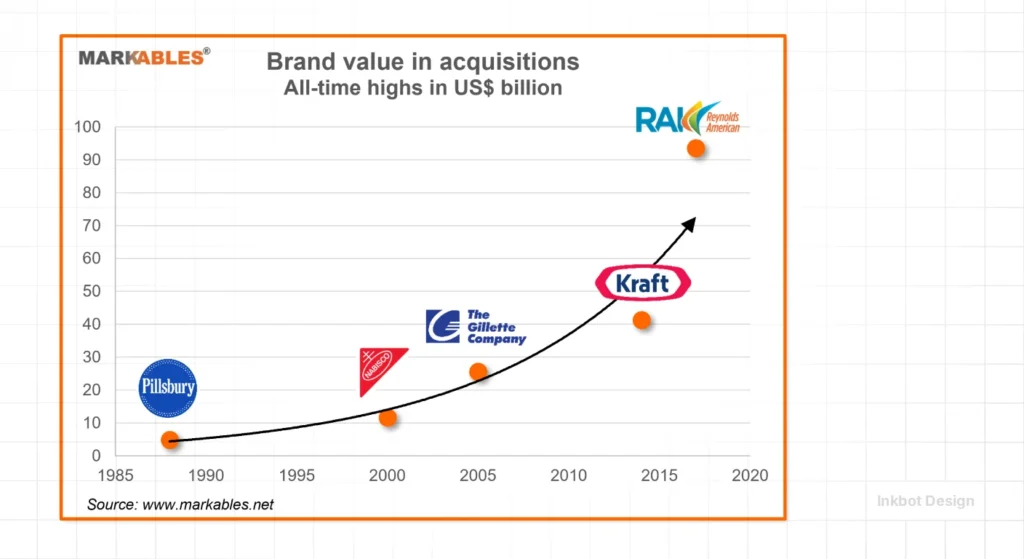
Brand valuation in acquisitions is the financial reporting process of identifying, isolating, and quantifying the monetary worth of a target company’s brand assets during purchase price allocation. It determines whether brand equity is recognised as a distinct intangible asset or absorbed into residual goodwill.
- Separable Cash Flows: The brand must generate measurable revenue independently of other operating assets.
- Audit Scrutiny: Valuation methods must withstand testing by independent financial reporting auditors in accordance with IFRS 3 and IAS 38.
- Balance Sheet Capitalisation: Approved brand valuations are capitalised as non-amortisable or amortisable intangible assets rather than unclassified premium payments.
According to financial reporting standards, brand valuation in acquisitions measures whether brand equity generates separable, forecastable cash flows that meet purchase price allocation audit standards.
To evaluate whether your firm’s brand assets can survive acquisition audit scrutiny or where market trust is currently leaking, request a structured Brand Equity Audit™ to benchmark your positioning before transaction preparation begins.
Why Buyers Assume Brands Hold Value
Acquisitions in the UK wealth management sector are accelerating.
Consolidators and private equity backers actively acquire regional advisory practices, paying premiums above tangible asset values. Corporate development teams justify these deal multiples by citing brand reputation, client retention rates, and market presence.
This boardroom logic is entirely understandable. When a wealth management firm commands a 15% fee premium over local competitors while maintaining a 98% client persistence rate, leadership naturally attributes that performance to brand equity.
They view the brand as an overarching asset that attracts high-net-worth individuals, lowers client acquisition costs, and secures long-term assets under management (AUM).
Under this commercial perspective, paying a premium for an established advisory brand feels logical. Acquirers believe they are purchasing a durable commercial engine that will continue generating revenue long after the founding partners retire.
“A brand is not what you tell the board it is worth during deal negotiations. A brand is what an independent accounting auditor allows you to capitalise on the balance sheet after applying income-based impairment testing.”

The Accounting Reality: How PPA Audit Scrutiny Strips Away Myth
When the deal closes, the transaction moves from the boardroom to the valuation team for Purchase Price Allocation (PPA) in accordance with IFRS 3 or local GAAP. Here, abstract brand sentiment meets accounting reality.
In recent transaction benchmarks, the gap between perceived intangible value and recognised balance sheet assets remains stark:
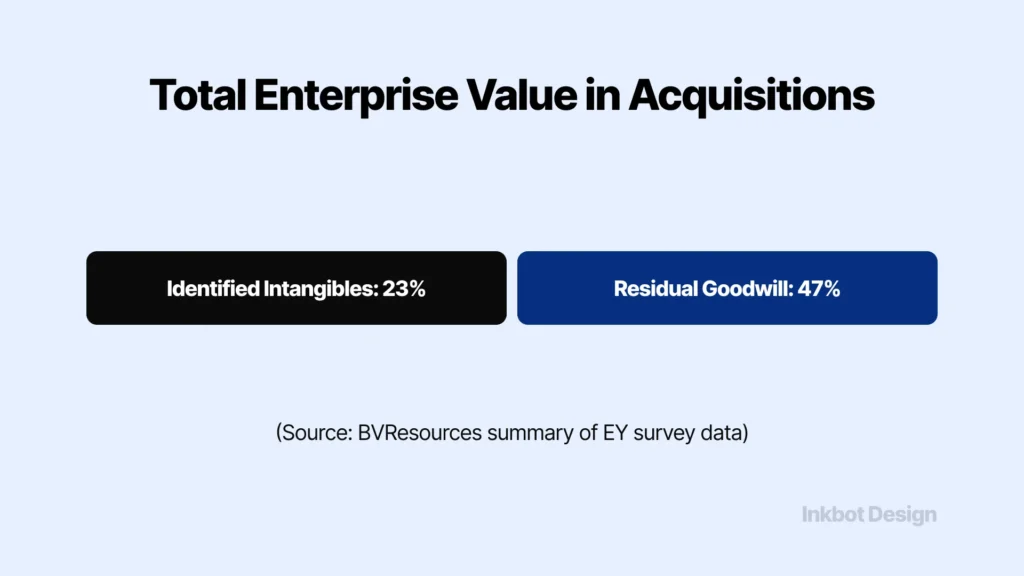
- A BVResources summary of an EY survey found that clearly identified intangible assets accounted for just 23% of enterprise value, on average, across recent corporate transactions.
- The remaining 47% of enterprise value was allocated directly to residual goodwill.
- In consumer-facing sectors, goodwill allocations averaged 65% of enterprise value, while the technology sector recorded 60%.
- An EY study analysing over 780 transactions in India found that 28% of enterprise value went to identifiable intangibles, compared to 35% allocated to goodwill.
These allocations arise because accounting standards require that an intangible asset meet strict legal and economic criteria to be recognised separately from goodwill.
Under IAS 38, an asset is identifiable only if it is separable—capable of being rented, sold, or licensed independently—or arises from contractual rights.
Valuation specialists evaluating a target brand typically rely on the Relief-from-Royalty Method (RRM), a hybrid income-and-market approach.
RRM calculates the royalty fee the acquiring business would have to pay to license the brand name from a third party if it did not own it.
If the acquirer cannot demonstrate that industry peers routinely license similar brand names, or if the brand cannot be separated from the individual advisers generating the revenue, the valuer sets the theoretical royalty rate near zero.
The result? The entire brand premium is reclassified into residual goodwill.
Data from Stout’s Purchase Price Allocation Study underscores how active and rigorous this benchmarking landscape is.
Reviewing 5,346 filings and 183 transactions closed in Q4 2024, Stout noted that deal structures are shifting.
Contingent consideration (earnouts) appeared in 22.4% of Q4 2024 transactions, down from 32.0% in Q4 2023. As buyers move away from heavy earnout structures toward upfront enterprise pricing, proving the baseline balance sheet value of identifiable assets becomes vital.
The Strategic Shift for UK Wealth Management and Financial Advisory Partners
For Partners and Managing Directors at independent financial advisory (IFA) and wealth management practices in the UK, this accounting reality changes how firms must be built before an exit.
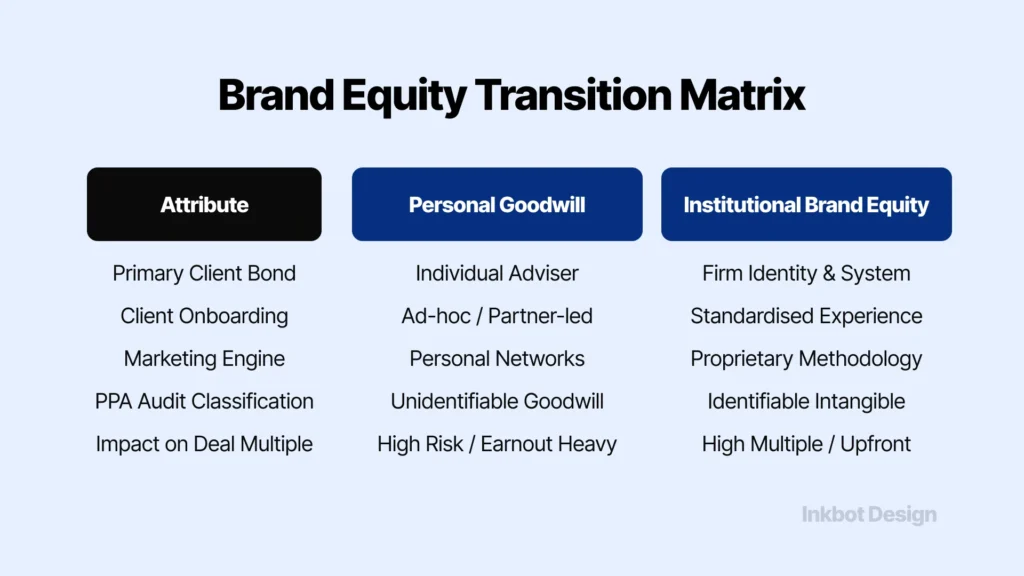
If an advisory business relies entirely on personal relationships cultivated by senior partners, the brand possesses no independent commercial life. When an acquirer’s valuation team investigates the revenue driver, they categorise the client loyalty as personal goodwill.
To protect value during acquisition, the firm must transition personal goodwill into institutional brand equity long before entering the data room.
In nearly two decades of brand architecture work, the pattern that emerges constantly across mid-market professional services is that firms spend lavishly on visual redesigns right before a sale, yet fail to document the institutional client experience that auditors require to prove separable cash flow.
To secure a recognised brand line during PPA, wealth management firms must establish three operational structures before transaction discussions:
- Documented Service Frameworks: Standardise investment management processes under proprietary, trademarked framework names owned by the corporate entity.
- Institutionalised Client Onboarding: Ensure high-net-worth clients interact with a multidisciplinary team and a digital portal, reducing reliance on a single adviser.
- Trademark Protection: Secure formal trademark registrations for all primary brand names, sub-brands, and proprietary service terms across relevant operating jurisdictions.
Isn’t Client Trust Always Personal in Advisory Firms?
Sceptical Managing Partners often argue that in private wealth management, clients buy people, not logos. They contend that attempting to isolate a corporate brand from individual chartered financial planners is an artificial exercise that auditors rightly reject.
This objection contains a partial truth: high-net-worth relationships are inherently personal. However, it mistakes the relationship channel for the underlying trust foundation.
High-net-worth clients do not entrust millions of pounds to an adviser operating from an unbranded office and communicating inconsistently.
They trust the adviser because the individual is backed by an institution that demonstrates stability, clear governance, robust compliance, and an authoritative brand presence.
When an advisory firm creates branded investment models, standardised reporting tools, and a distinct wealth management platform, client trust attaches to the firm’s infrastructure.
When an adviser departs, client retention remains high because the perceived value resides within the firm’s operational ecosystem.
Valuers can isolate those institutionalised cash flows under the Relief-from-Royalty Method, confirming that the brand itself reduces client churn and commands pricing power.
Reconciling the Boardroom Narrative with the Balance Sheet
The ultimate objective of brand valuation in acquisitions is to reconcile the boardroom’s strategic vision with the CFO’s audit-trail defence.
When a brand line item successfully survives PPA audit scrutiny and appears on the opening balance sheet, it provides immediate commercial advantages:
- Reduced Goodwill Impairment Risk: Over-allocating purchase price to goodwill creates annual balance sheet risk under impairment testing rules. Recognised intangible assets offer clearer, structured accounting treatment.
- Enhanced Post-Deal Financing: Debt providers and institutional lenders view identified, trademarked intangible assets as tangible collateral far more readily than unallocated goodwill premiums.
- Defensible Earnout Metrics: Clear asset separation prevents post-merger disputes between buyers and sellers regarding which revenue streams are derived from historical brand equity versus post-acquisition operational integration.
| The Default Approach | What It Costs | The Better Approach | Why |
| Boardroom Brand Narrative | Brand value is claimed during pitches, but gets 100% absorbed into residual goodwill during an audit. | Auditable Cash Flow Isolation | Identifies specific revenue streams tied to trademarked, institutionalised client frameworks. |
| Partner-Centric Marketing | Buyer applies heavy key-person discount and demands long, contingent earnouts. | Institutionalised Identity System | Proves client retention belongs to the firm’s platform, enabling higher upfront cash payouts. |
| Unprotected Asset Names | Relief-from-Royalty rate set to 0% due to lack of enforceable legal separation. | Registered Trademark Portfolio | Provides legal separability required under IAS 38 for formal balance sheet capitalisation. |
The Verdict
In acquisition accounting, brand valuation is not about celebrating market sentiment; it is about proving economic separability.
For UK financial advisory and wealth management firms targeting premium exits or executing buy-and-build strategies, allowing brand value to be written off as residual goodwill is a failure of deal preparation.
When corporate development teams and private equity backers evaluate professional services targets, they must demand more than superficial brand metrics.
They require evidence that the brand generates separable, forecastable cash flows capable of withstanding rigorous purchase-price allocation audit scrutiny.
By institutionalising client relationships, protecting intellectual property, and establishing proprietary service frameworks well before entering M&A negotiations, advisory firms transform informal reputation into an auditable, capitalizable balance-sheet asset.
Next Action for Managing Partners
If your firm is planning an acquisition or preparing for an exit within the next 12 to 36 months, audit your brand assets before the deal team arrives.
Request a free Brand Equity Audit™ from Inkbot Design to identify exactly where your brand is losing commercial ground, isolate personal goodwill risks, and build an auditable brand architecture that maximises enterprise value on the deal sheet.
FAQs
What is brand valuation in acquisitions?
Brand valuation in acquisitions is the financial reporting process of calculating the monetary value of a target company’s brand name, trademarks, and associated intellectual property during purchase price allocation. It determines whether brand equity is recognised as a separable intangible asset or included in residual goodwill.
How do auditors distinguish brand value from goodwill in purchase price allocation?
Auditors use financial reporting standards like IFRS 3 and IAS 38. A brand is recognised as a distinct intangible asset only if it is separable—capable of being sold or licensed independently—or arises from contractual legal rights that generate forecastable cash flows separate from overall operations.
What is the Relief-from-Royalty Method in brand valuation?
The Relief-from-Royalty Method is an income-based valuation technique that calculates a brand’s value by estimating the hypothetical royalty fees a company saves by owning the brand rather than licensing it from a third party.
Why does so much brand value end up classified as goodwill in M&A?
Brand value ends up in goodwill when target firms fail to prove that their revenue exists independently of key individuals, or when they lack registered trademarks and documented proprietary systems that satisfy accounting criteria for separability.
Can a UK wealth management practice capitalise its brand on the balance sheet?
Yes — provided the firm demonstrates that its client retention, pricing power, and onboarding systems belong to the corporate entity rather than individual advisers, backed by registered trademarks and auditable cash flows.
How does deal structure affect brand valuation in wealth management acquisitions?
Heavy earnout structures reflect buyer uncertainty regarding asset transferability. Proving that brand equity generates institutional, separable revenue allows buyers to offer higher upfront consideration and reduce contingent earnout percentages.
Does customer satisfaction alone establish brand value for accounting purposes?
No — while customer satisfaction indicates strong market sentiment, auditors require direct evidence of separable, forecastable cash flows or licensing comparables before recognising an intangible brand asset on the balance sheet.
What is the difference between personal goodwill and institutional brand equity?
Personal goodwill is revenue directly tied to an individual’s personal relationships. Institutional brand equity represents revenue driven by the firm’s reputation, standardised frameworks, and corporate identity, surviving individual staff departures.
When should a professional services firm conduct a brand valuation audit?
A firm should conduct a brand equity and valuation audit 12 to 36 months before initiating an M&A transaction. This allows sufficient time to institutionalise client relationships, protect trademarks, and establish auditable processes.
What role do registered trademarks play in acquiring brand valuation?
Registered trademarks provide the legal contractual basis required under IAS 38 to prove asset separability, enabling valuation teams to apply the Relief-from-Royalty Method effectively.
