What Is Brand Naming? Strategy, Types and Selection Criteria
Brand naming gives a firm a verbal identifier, but choosing well requires more than partner preference. Strategy sets the job; name types create different trade-offs; legal and linguistic checks expose constraints. For established professional firms, the first decision is whether a new name solves the actual problem or creates another.
 By Stuart Crawford
 Reviewed by Tabitha Ayers
10 min read

On this page10 min left
- What is brand naming—and what is it not?
- What should your firm’s name actually do?
- What types of brand names can you choose?
- What makes a brand name suitable for your firm?
- How does the brand naming process work?
- Does your firm need a new name—or a clearer proposition?
- How would a professional services firm apply this?
- Define the job before changing the name
- Questions people ask
Brand naming is the process of creating and evaluating a name for a business, product or service.
For an established professional firm, the question starts with a commercial one: what must the name help clients understand, and what must it stop getting wrong?
Before appointing a brand naming agency, separate three decisions: the strategic job, the naming direction and the criteria for choosing.
Otherwise, a repositioning project can become a lengthy argument about words.
The managing partner’s favourite is not a strategy.
What is brand naming—and what is it not?

Brand naming creates a verbal identifier and assesses whether it aligns with the organisation’s positioning, audience and practical requirements.
It can involve naming a new business, replacing an established name or naming an individual service.
Choosing the word is separate from designing its visual identity or obtaining trade mark protection.
- A brand name identifies a business or offering; supporting messaging explains the proposition.
- Naming strategy establishes the job before candidates are judged.
- Company registration, domain ownership and trade mark protection are separate considerations.
Brand naming is the strategic process of creating and evaluating a name for a business, product or service against defined commercial criteria.
Brand naming versus branding and company registration
Brand naming concerns the verbal identifier.
Branding also covers positioning, messaging, visual identity and the experience associated with the organisation.
Changing “Smith Accountants” to another name does not, by itself, explain why its advice deserves a place on a buyer’s shortlist.
A registered company name identifies a legal entity. A trading name may be the name used to present to customers. A brand name can serve either role, but the terms are not interchangeable.
The Intellectual Property Office confirms that registering with Companies House does not automatically provide trade mark protection.
Treat incorporation and brand protection as different tasks, even when the same words appear in both applications.
What should your firm’s name actually do?

Brand naming strategy should define the name’s role in the firm’s next stage of growth. “We need something modern” is not enough.
An advisory practice moving beyond tax compliance needs a different brief than a consultancy that retains its specialism while entering another region.
Write the intended change in plain language: “Clients must stop assuming we only provide local bookkeeping.” That gives the naming team something to solve.
“Make us sound ambitious” gives everyone permission to disagree.
Define the strategic job before choosing words.
A professional-services brand name needs a clear assignment, not responsibility for the entire sales argument.
For a founder-led consultancy planning its succession, the assignment might be to reduce dependence on a single individual’s identity.
For an established law firm with a recognised name, it might be to preserve continuity while presenting newly combined practices.
Those situations should not produce identical briefs.
Use brand naming strategy to establish the intended audience, competitive context and required change in perception. Then use appropriate naming frameworks to explore directions against that brief.
A name can introduce an association. It cannot demonstrate technical competence. If procurement teams need evidence of sector expertise, provide relevant credentials and case studies rather than expecting a newly coined word to do the work.
Define the job narrowly enough to judge.
What types of brand names can you choose?
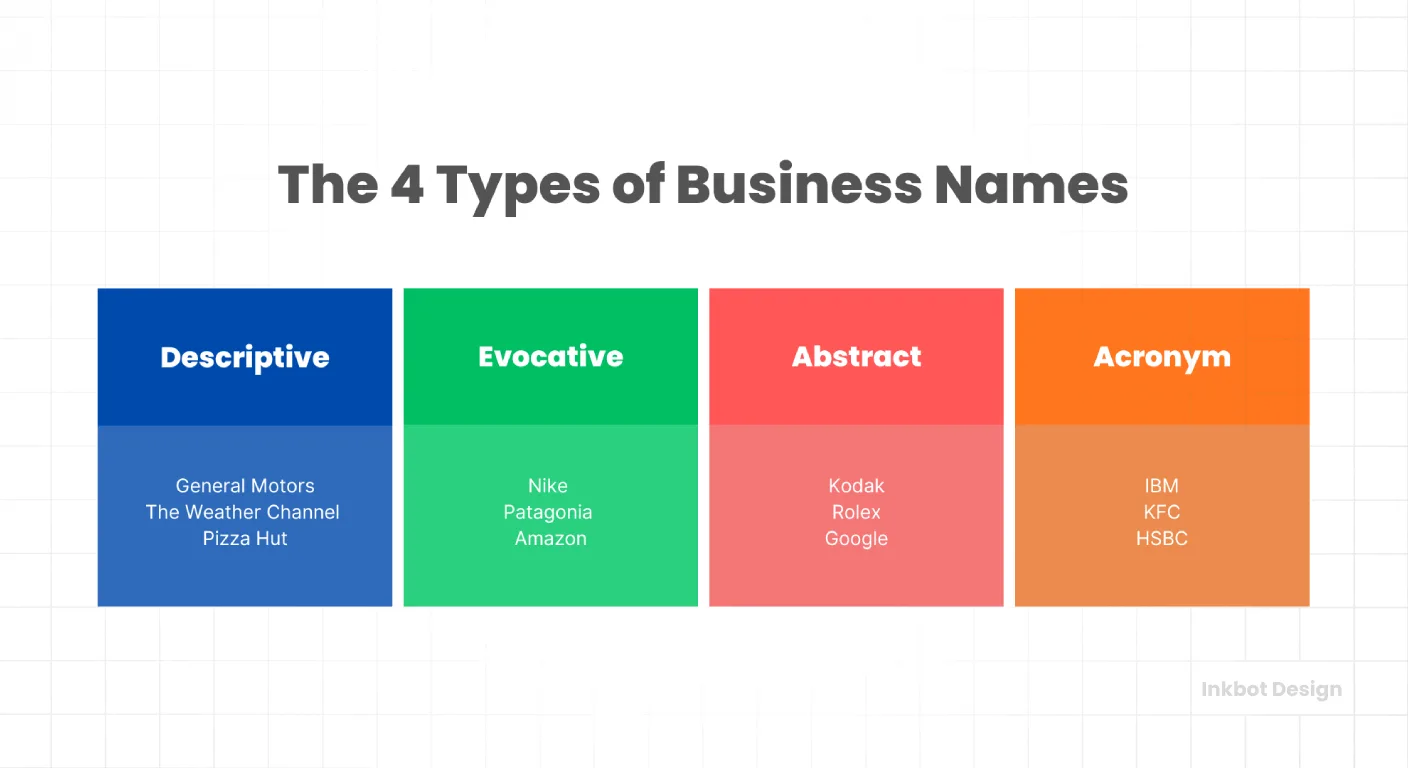
Types of brand names offer different ways to balance immediate meaning with room to build an association. A useful starting point is the descriptive–suggestive–abstract spectrum. Founder and geographic names describe where a name comes from, so they can overlap with that spectrum.
The examples below illustrate naming structures only. They are fictional, have not been screened and are not recommendations for use.
Descriptive names: immediate meaning, possible constraints
A descriptive brand name states something about the service, audience or location. “Regional Payroll Services” tells a buyer more about the offering than an unfamiliar invented word.
That clarity can suit a narrowly focused practice whose specialism is unlikely to change. It becomes less helpful if the firm later adds transaction advice and outsourced finance leadership.
There is also a distinction between being understandable and being registrable.
UK trade mark law includes grounds for refusing registration of marks consisting exclusively of descriptive indications, subject to provisions such as the acquired distinctiveness requirement.
Do not assume a clear service description will qualify for protection as a word mark.
Choose descriptiveness when immediate category recognition serves the brief. Question it when the description would confine the firm to yesterday’s business model.
Suggestive names: an association rather than a service list
A suggestive brand name points towards an idea without literally listing the service. A hypothetical advisory practice might explore language associated with orientation, judgement or progress.
The advantage is conceptual space: the name can support a broader proposition than “Payroll Services”. The constraint is interpretation. A metaphor that means “clear direction” to the partners may mean very little to a prospective finance director.
Test the intended association without explaining it first. Ask what kind of organisation the person expects, then show the descriptor and introduction.
A suggestive direction fits when the association supports the positioning and can be explained naturally. It does not fit merely because the presentation includes an impressive story about the word.

Abstract and invented names: meaning that must be built
An abstract brand name has no immediately obvious connection to the service. An invented name creates a new word or combination rather than relying on an existing category term.
These directions leave room for the firm to establish its own associations, but the introduction must carry more explanatory weight. A proposal cover might need “Corporate finance advisers” beneath the name until the context becomes familiar.
The obvious objection is fair: “Our clients need to know what we do.”
Yes. But the full name-and-descriptor combination can provide that information. Judge the complete introduction, not the unfamiliar word floating alone on a slide.
An invented name is not automatically distinctive in law, easy to pronounce or available. Novelty is a starting condition. It is not clearance.
Founder and geographic names: a different classification
Founder-based brand names draw on a person’s identity. Geographic names draw on a place. Either can be suitable, but examine what the reference implies.
A founder’s surname may support continuity where clients recognise the firm through that person. Removing it without evidence of a problem could discard something useful. Equally, a succession plan may require the business to demonstrate that its expertise extends beyond the founder.
A place name can communicate local commitment. It may also lead to an incorrect assumption about its reach if the firm now serves clients nationally.
For a fuller comparison of descriptive, suggestive and abstract brand names, assess what each direction explains immediately and what the rest of the identity must explain.
What makes a brand name suitable for your firm?
Good brand name criteria turn an open-ended preference debate into an assessable decision. Start with the approved strategic job, then distinguish unacceptable constraints from qualities that can be compared.
For example, “suggests the wrong service” is a different problem from “one partner dislikes the sound”. Both deserve discussion. They should not carry equal authority.
Separate non-negotiable constraints from preferences
Brand name evaluation should identify which issues must be resolved before a candidate can progress. Potential legal conflicts need specialist assessment; personal preferences need a reason connected to the brief.
Use a decision table like this before discussing favourites:
Criterion | Practical test | Decision consequence |
|---|---|---|
Strategic fit | Does the name support the agreed positioning rather than the previous business model? | Reject or revise directions that contradict the brief. |
Category interpretation | What service would an unfamiliar buyer expect before and after seeing the descriptor? | Investigate mistaken expectations; do not assume the explanation fixes them. |
Referral usability | Can someone repeat and spell the name after hearing it in a normal introduction? | Examine recurring friction, not isolated hesitation. |
Competitive separation | Could a buyer confuse the candidate with a relevant competitor? | Investigate similarity in the markets that matter. |
Future suitability | Does the name still fit the firm’s actual expansion or succession plan? | Avoid restrictions tied to a credible planned change. |
Legal and linguistic suitability | What do qualified advisers and relevant language reviewers identify? | Resolve material issues before public commitment. |
Digital practicality | Can the firm use a clear web address, email format and consistent presentation? | Compare workable options; do not let domain availability decide the strategy. |
Do not turn the table into numerical theatre. A candidate scoring well on most rows does not cancel an unresolved legal concern.
Agree the criteria first. Otherwise, people can quietly rewrite the rules to favour the name they already want.
Test the name in referrals, search and future services
A professional-services brand name should be assessed in the situations where buyers encounter it. Put candidates into a spoken introduction, a proposal cover, an email address and a short search task.
Ask someone to find the intended firm when they hear the name.
Record whether they reach an unrelated organisation, need the spelling repeated or misunderstand the service. These are observations to investigate, not proof of a future conversion rate.
Test realistic future uses too. If the approved plan includes a corporate finance practice, place that service beside the candidate. Do not invent distant global ambitions merely to reject every specific name.
The second strong objection is also reasonable: “Our clients choose the partners, not the name.”
Where referrals are personal and the current name causes no demonstrated difficulty, that supports retaining it. Where referred prospects repeatedly find the wrong business or assume the wrong specialism, investigate the source of the friction.
Ask where the introduction breaks.
Distinguish preliminary checks from legal clearance.
Brand naming checks should be staged. Early screening can identify obvious problems before the firm invests in design or consultation. It should not be presented as a legal opinion.
Ask the agency’s proposal to specify who conducts preliminary searches, who commissions professional legal review, which territories and services are covered, and who owns the decision to proceed.
Company registration does not settle trade mark protection, and descriptive wording can raise distinctiveness objections. Those are reasons to obtain advice on actual candidates, not instructions to reject an entire naming category.
Use the legal and linguistic name evaluation criteria to frame the questions. Leave candidate-specific legal conclusions to the appropriate adviser.
How does the brand naming process work?

The brand naming process should move from an agreed brief to a documented decision, with checks proportionate to the firm’s intended use.
A domestic consultancy with a single service line does not require the same assessment scope as a group introducing multiple brands across multiple countries.
The principle is consistent: avoid public commitment before the relevant questions have been answered.
From an agreed brief to a documented decision
A brand naming project can follow this sequence:
- Define the problem, audience, positioning and intended scope.
- Agree naming directions and selection criteria.
- Develop candidates and record the reasoning behind them.
- Conduct preliminary screening and practical tests.
- Commission the required legal and linguistic assessment.
- Approve the decision and plan implementation.
For agency selection, request deliverables against those stages. Clarify whether stakeholder interviews, research, domains, professional legal fees and launch planning are included or separate.
Governance matters too. A partnership can collect views widely without giving every contributor an undefined veto. Identify the decision owner and escalation route before showing the shortlist.
Use the dedicated brand naming process and governance resource for the detailed workflow. This introductory framework should help you assess a proposal, not pretend every naming project has the same schedule.
Does your firm need a new name—or a clearer proposition?
An established firm needs evidence of a naming problem before it commits to renaming.
“The website feels dated” identifies a presentation issue. “Prospects assume we only serve one town because it is in the name” identifies a possible naming constraint.
Check the explanation before approving the remedy.
Retain, refine or rename
Professional services brand-naming decisions can begin with three routes.
Retain the name when it supports recognition, does not misrepresent the business and can accompany the intended positioning. If the homepage fails to explain the firm’s specialism, fix that explanation first.
Refine the presentation when the core name remains suitable, but the descriptor, service naming or visual hierarchy creates confusion. A firm can clarify “Tax and business advisory” without necessarily replacing the identifier clients already know.
Consider renaming when the name itself creates a material constraint: it describes a service the firm no longer provides, conflicts with the combined identity after a merger, or carries an issue requiring specialist resolution.
These are diagnostic routes, not automatic verdicts. A geographic name does not prove that national expansion requires replacement. Find out whether buyers actually interpret it as a limit.
Before renaming an established company, document what must change across proposals, email, signage, directories and client communications. That implementation burden belongs in the decision.
Keep the test honest: if clearer messaging would solve the problem, why buy a new name?
How would a professional services firm apply this?
Professional-services brand naming becomes easier to assess when the strategic brief stays fixed while the naming direction changes. The following illustration shows the method, not a successful client outcome.
Worked illustration: an established advisory firm
This is a hypothetical illustration—not an Inkbot Design client case.
Imagine an established UK accountancy practice whose name refers to its original town and bookkeeping service.
The firm now wants to present its tax and finance-director advisory work more clearly to businesses elsewhere in the UK.
The brief is not “sound bigger”. It is: “Stop implying that the firm only provides local bookkeeping while preserving useful client recognition.”
Compare three routes:
Route | What it could address | What still needs testing |
|---|---|---|
Retain the core name; change the descriptor | Clarifies the broader service offer without replacing the main identifier | Whether the existing wording still causes the narrow interpretation |
Adopt a suggestive name with a clear descriptor | Removes the literal service restriction while introducing a positioning idea | Whether buyers understand the introduction and existing clients recognise continuity |
Adopt an invented name with an explicit descriptor | Creates a different verbal identifier without the old geographic reference | Pronunciation, interpretation, transition requirements and legal suitability |
The first route deserves a fair test.
Show the revised name-and-descriptor combination in a proposal and homepage introduction. Ask suitable participants what work they expect the firm to undertake and where they believe it operates.
If the narrow assumption persists, investigate whether the name is causing it or whether the wording still overemphasises bookkeeping. Changing two things at once makes that diagnosis harder.
Only then compare replacement directions against the same criteria. No candidate receives a free pass because the partners enjoy its origin story.
The illustration shows the relationship: strategy defines the problem, name types provide options, and evaluation criteria expose the trade-offs.
Specialist naming for a professional services firm takes those questions into the partnership’s actual circumstances.
Define the job before changing the name
Brand naming is a management decision with a creative component.
The brief establishes what must change.
The naming direction determines how directly the name communicates.
Evaluation tests whether a candidate can perform that job in practice.
Today, write one sentence: “Our current name prevents or complicates .” Add the evidence beneath it. If the space remains empty, begin with positioning and messaging rather than a rename.
A clear internal brief and appropriate specialist advice may be enough for a limited project.
If the problem spans your name, proposition, identity and visibility, request a free Brand Equity Audit™.
Inkbot Design’s written diagnostic reviews those wider brand issues and prioritises what to address; it is not trade mark clearance.
Questions people ask
Can an established professional firm choose its own brand name?
Yes — an established professional firm can develop its own naming brief and candidates. Internal work is most useful when the strategic problem and decision authority are clear. Independent facilitation may help where partner disagreement blocks progress; relevant professional legal review remains a separate requirement before committing to a candidate.
Should a brand name include the firm’s main service?
No — a brand name does not have to include the firm’s main service. A descriptor can explain the category beside a suggestive or invented name. Including the service is worth considering when immediate clarity matters and the wording will remain accurate in line with the firm’s credible growth plans.
Does buying the domain name protect the brand name?
No — buying a domain name does not, by itself, establish trade mark protection. Domain registration, company registration and trade mark registration serve different purposes. The Intellectual Property Office specifically warns that Companies House registration does not automatically provide trade mark protection; assess the intended name separately with an appropriate adviser.
Can AI tools replace a brand naming agency?
No — AI tools cannot replace every responsibility in a brand naming engagement. They can generate candidate words for people to investigate, but they do not settle the brief, resolve partner disagreements or provide professional legal clearance. Use them as an input when the firm can manage those responsibilities separately.