Website Design Brief Template for Professional Firms
A website design brief should define what your professional firm needs its website to achieve, prove and protect. This practical template covers commercial objectives, positioning, website pages, content ownership, budgets, technical requirements and partner approvals. Use it to prepare a clearer project specification before approaching potential web design agencies.


On this page9 min left
- What Should a Professional Website Design Brief Include?
- What Must Your Website Prove to Prospective Clients?
- What Pages Does a Professional Firm Actually Need?
- Who Writes the Website Content, and Will We Be Able to Update It?
- How Much Should a Professional Firm Website Cost, and Who Owns It?
- How Many People Need to Approve the Website Project?
- What Does Website Success Look Like After Launch?
- A Website Brief Should Protect the Business Behind the Website
- Questions people ask
A website design brief template for a professional services firm should establish what the business needs its website to achieve, what prospective clients need to believe, and who is responsible for approving the project.
Too many briefs begin with colours, layouts and examples of websites the partners happen to like. That is the wrong starting point for a law firm, accountancy practice, consultancy or financial services business preparing for a strategic repositioning.
The website needs to communicate expertise, support commercial objectives and withstand scrutiny from prospective clients. The brief should make those requirements explicit before an agency starts designing.
If you're planning a wider repositioning, your requirements should also align with your professional services website design strategy and the wider website design services your business may require.
What Should a Professional Website Design Brief Include?
A professional website design brief should contain ten essential sections covering the business, commercial objectives, target clients, positioning, website structure, content, technical requirements, budget, ownership and decision-making.
The document should give prospective agencies enough information to understand the project, identify potential complications and prepare comparable proposals.
Use the following framework as your starting point.
Section | Information to include |
|---|---|
1. Company background | Services, history, locations, structure and business model. |
2. Project overview | Why the website is being commissioned and what has prompted the change. |
3. Commercial objectives | The business outcomes the website must support. |
4. Target audience | Priority client groups, their requirements and purchasing concerns. |
5. Positioning | What differentiates the firm and why clients should believe its claims. |
6. Website structure | Required pages, navigation and content hierarchy. |
7. Content requirements | Copywriting, photography, case studies, credentials and testimonials. |
8. Technical requirements | CMS, integrations, accessibility, security, analytics and search requirements. |
9. Budget and timeline | Available investment, milestones and launch expectations. |
10. Governance and ownership | Decision-makers, approvals, intellectual property and ongoing responsibilities. |
A practical starting point: Keep the main brief concise enough for agency teams and partners to review. Attach detailed technical specifications separately where necessary.
Do not mistake a completed document for a completed strategy. If the partners cannot agree on what the business should be known for, the agency cannot resolve that disagreement by choosing a different homepage layout.
What Must Your Website Prove to Prospective Clients?

A professional services website must communicate the firm's expertise and provide credible reasons for prospective clients to trust its advice.
Professional services are difficult to evaluate before purchase. A prospective client cannot test an accountant's tax advice, assess a solicitor's litigation judgement or experience a consultancy's strategic thinking in advance.
The website therefore needs to make expertise visible.
This should be a central part of the brief, not a paragraph added after the design references.
Define what makes the firm credible.
Ask the leadership team to identify the evidence supporting the firm's claims.
For example:
- Legal practices: Practice specialisms, relevant professional credentials, representative matters and appropriately approved client testimonials.
- Accountancy firms: Technical expertise, sector experience, qualifications and the types of organisations served.
- Management consultancies: Relevant project experience, methodology, senior expertise and demonstrable client outcomes.
- Architecture practices: Completed projects, design capabilities, planning experience and the credentials of the project team.
- Financial services firms: Relevant qualifications, regulatory status and approved descriptions of services.
These are suggested evidence categories. Not every firm can publish every type of information.
Client confidentiality, advertising restrictions and professional obligations must be considered before publication.
Specify what visitors should believe
A useful brief should contain three questions:
- What should a prospective client understand about the firm within the first few seconds?
- What evidence would make that proposition credible?
- What should the visitor do next?
Consider a hypothetical 12-partner accountancy practice seeking to move into larger corporate engagements.
The partners may want the website to communicate specialist tax expertise, but a list of services and professional qualifications may not explain why a larger company should appoint the practice.
The brief should specify the evidence required, the industries the practice wants to serve and the enquiry the website should encourage.
That changes the design requirements. The homepage needs to establish the firm's position. Service pages need to explain the relevant expertise. Team profiles need to demonstrate who will deliver the work.
The brief must define the evidence behind the firm's positioning before anyone decides how to present it.
What Pages Does a Professional Firm Actually Need?
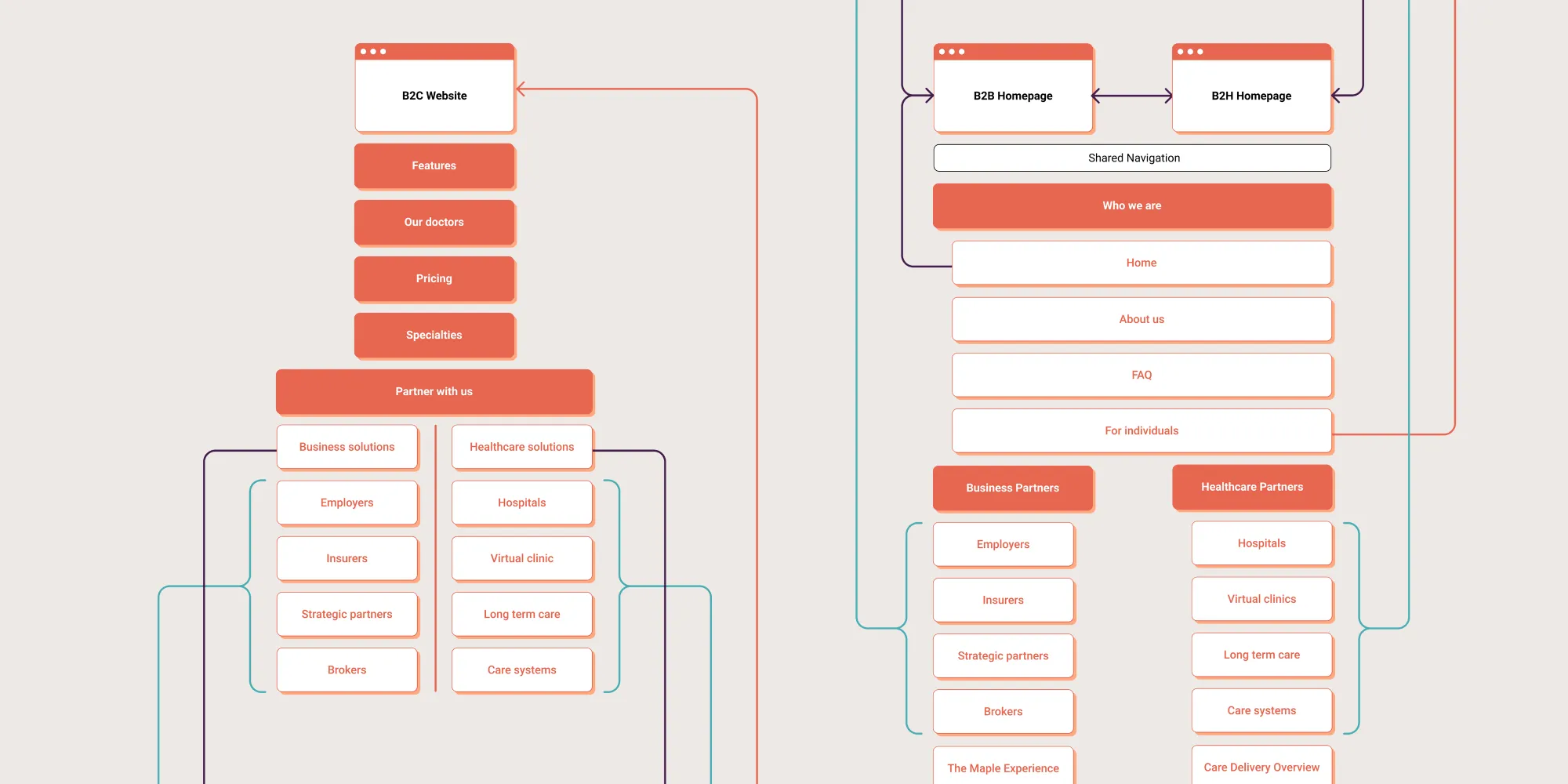
A professional firm's sitemap should reflect the services it offers and the questions prospective clients need answered before making contact.
Start with the revenue priorities. If a consultancy wants more corporate restructuring assignments, the relevant service page needs to explain that specialism, the types of organisations it serves, and the expertise it offers.
A generic services page listing 14 unrelated capabilities will not do that job particularly well.
For each proposed page, record:
- The audience it serves.
- The service or question it addresses.
- The evidence it needs.
- The next action it should encourage.
If two proposed pages serve the same audience and answer the same question, consider combining them. If a specialist service has a distinct buying journey, give it a dedicated page.
That is how a sitemap becomes a commercial decision rather than a list of URLs.
A useful starting structure is:
Website page | Its commercial purpose |
|---|---|
Homepage | Establish the firm's position and direct visitors towards relevant services. |
Service overview | Explain the firm's principal areas of expertise. |
Individual service pages | Address specific client needs, problems and purchasing concerns. |
About the firm | Explain the organisation, its experience and its approach. |
Team biographies | Demonstrate the experience and qualifications of relevant professionals. |
Case studies/results | Provide appropriate evidence of previous work and outcomes. |
Insights/resources | Demonstrate subject knowledge and answer relevant client questions. |
Contact | Make the next step clear and accessible. |
Additional pages may include location pages, industry specialisms, recruitment, investor information or dedicated acquisition-related announcements.
Do not add pages simply because a competitor has them.
A page should exist because it serves a distinct audience need, explains an important service or provides evidence that supports a buying decision.
The brief should also identify the intended navigation structure. A visitor looking for corporate tax advice should not have to work through three unrelated menu categories to find it.
Who Writes the Website Content, and Will We Be Able to Update It?
The website brief must identify who is responsible for supplying, writing, reviewing and maintaining every important content type.
Leaving content responsibilities until the design stage creates unnecessary uncertainty. A designer cannot accurately plan a case-study layout when no one has agreed on whether the firm can supply case studies.
Document the following:
- Who supplies existing website copy?
- Who interviews partners and subject specialists?
- Who writes and edits new service pages?
- Who supplies photography and professional biographies?
- Who approves testimonials and client case studies?
- Who checks technical and regulatory statements?
- Who maintains news, insights and case updates after launch?
A common requirement is a content extraction process.
Partners and senior professionals know their subject, but that does not automatically mean they have the time or inclination to write 1,000 words about it.
The brief should specify whether the agency is expected to interview subject specialists, extract their knowledge and turn it into publishable material.
Will we be able to update the website ourselves?
Yes, provided the chosen content management system and implementation give authorised staff the necessary editing capabilities.
A civil-rights practice that regularly publishes news and case updates, for example, may need straightforward editing permissions for designated employees.
That requirement should be written into the brief.
Specify:
- Which employees need access.
- Which content they can edit.
- Whether approval is required before publication.
- Whether training is included.
- Who manages software updates, security and backups.
A user-friendly editing interface is useful, but access permissions matter too. Not every employee should automatically have permission to publish changes to the firm's main service pages.
How Much Should a Professional Firm Website Cost, and Who Owns It?

A website proposal should separate discovery, strategy, design, development, content, technical SEO and ongoing support.
Ask each agency to price the same requirements. If one quotation includes copywriting, content migration and redirects while another includes design and development only, the headline figures are not comparable.
Require each supplier to identify exclusions, third-party costs, payment milestones and the assumptions behind its quotation.
There is no defensible universal price for a professional services website. A small specialist practice commissioning a straightforward redesign has different requirements from a 50-partner consultancy with multiple locations, extensive content and third-party integrations.
Cost category | What to establish |
|---|---|
Discovery and strategy | Research, workshops and positioning work. |
Design | UX, wireframes and visual design. |
Development | CMS implementation, templates and functionality. |
Content | Interviews, copywriting, editing and migration. |
SEO | Technical preparation, redirects and on-page optimisation. |
Integrations | CRM, booking systems and third-party services. |
Ongoing costs | Hosting, licences, maintenance and support. |
The brief should also state whether the budget includes VAT and whether ongoing expenditure is included.
Do we own the website, domain and content?
The brief should explicitly require agencies to document ownership, licensing, access and exit arrangements.
Ask prospective suppliers to confirm:
- Who owns the domain registration?
- Who controls hosting and administrator access?
- Who owns the commissioned website designs and code?
- Who owns the written content and photography?
- Which third-party licences are transferable?
- What happens if the relationship ends?
- Can the website be transferred to another provider?
The Justia/Scorpion concern supplied in the brief highlights why ownership deserves attention, but no independently documented dispute has been provided. It should not be used as evidence of wrongdoing by either organisation.
Get the contractual position in writing. Have the relevant intellectual property and licensing provisions reviewed before signing.
For help assessing potential suppliers, see our guide to choosing a web design agency for a professional firm.
How Many People Need to Approve the Website Project?
A professional website project needs a defined decision-making structure before design work begins.
This is particularly important in partnerships where multiple senior people have different opinions about positioning, content, visual identity and commercial priorities.
A 12-partner law firm, for example, could have 12 people wanting to approve the homepage. That does not make the homepage 12 times better. It creates a decision-making problem.
The brief should establish who contributes, who reviews and who makes the final decision.
Establish a clear approval hierarchy
A practical governance structure might look like this:
Role | Responsibility |
|---|---|
CEO / Managing Partner | Owns the commercial objectives and final strategic approval. |
Project sponsor | Maintains senior-level accountability and resolves major disagreements. |
Internal project manager | Coordinates information, feedback and deadlines. |
Practice leads | Checks specialist service information and technical accuracy. |
Marketing lead | Reviews content, brand consistency and communications. |
Compliance / legal reviewer | Reviews relevant regulatory and legal content. |
Website agency | Develops the agreed work and advises on design and implementation decisions. |
One individual should consolidate feedback at each approval milestone.
Do not send conflicting comments from six different partners directly to the design team. The agency needs one agreed set of revisions, not an internal debate delivered through email.
Define the approval milestones.
Include approval points for:
- Project brief and objectives.
- Sitemap and website structure.
- Homepage direction and visual identity application.
- Page designs and content.
- Functional testing and launch approval.
Specify who has authority at each stage, how feedback is submitted and how additional requests are treated.
A change to the agreed sitemap may have a different impact from correcting a spelling mistake. Both should not be treated as equivalent revisions.
The brief should also establish what happens when a stakeholder misses an approval deadline or introduces a new requirement after sign-off.
This is where project governance protects the budget. Without it, the original specification gradually becomes a moving target.
What Does Website Success Look Like After Launch?

Define the enquiry the website is supposed to generate before choosing the reporting metrics.
A specialist tax consultancy might prioritise qualified corporate tax enquiries rather than general contact-form submissions. The brief should therefore identify what qualifies as an enquiry, which service it relates to and how the firm will record its outcome.
Specify the conversion path, analytics implementation, attribution requirements and baseline measurement.
A useful reporting framework separates:
- Visibility: relevant search impressions and organic visits.
- Engagement: visits to priority service pages.
- Conversion: completed enquiries and calls.
- Commercial quality: enquiries accepted as suitable opportunities.
The final measure should connect website activity with the type of work the firm actually wants to win.
Will the new website rank on Google?
A new website can be designed and developed with search engine optimisation requirements in mind, but a design brief cannot guarantee search rankings.
Separate the requirements into four areas:
Area | What the brief should specify |
|---|---|
Technical SEO | Indexability, page speed, mobile usability, redirects and crawl accessibility. |
Content | Service-page coverage, search intent and relevant subject expertise. |
Authority | The firm's reputation, relevant external references and credible links. |
Local visibility | Relevant office locations, business information and local search requirements. |
Ask the agency which elements are included in its proposal and which require a separate SEO specialist.
A visually impressive website without an agreed-upon content strategy is not a search strategy.
Likewise, a technically sound website cannot guarantee that the firm will outrank established competitors. Search visibility also depends on factors beyond the initial design and development project.
A Website Brief Should Protect the Business Behind the Website
A professional firm's website brief should establish what the business wants to achieve, what prospective clients need to see and who is accountable for the decisions that shape the project.
The ten-section framework provides the practical starting point. The more important work happens when leadership agrees on the firm's positioning, identifies the evidence supporting its claims and establishes a clear approval structure.
A website redesign cannot resolve an internal disagreement about the firm's market position. Nor can a new visual identity compensate for a lack of credible proof.
Get those decisions right first.
If your firm is preparing for a rebrand, an acquisition, or a growth phase, Inkbot Design offers a free Brand Equity Audit™. The structured diagnostic identifies where your brand may be losing commercial ground and what needs attention.
Start by agreeing on what your website must prove to the people you most want as clients. Then write the brief.
Questions people ask
How long should a website design brief be?
A website design brief should be concise enough for agency teams and internal stakeholders to review properly. A short main document with separate technical specifications, content inventories and brand guidelines is usually more practical than placing every detail into one oversized file.
Should we send the same website brief to every agency?
Yes — send the same agreed brief to each shortlisted agency. This makes proposals easier to compare because suppliers are responding to the same objectives, deliverables, budget assumptions and technical requirements. Allow agencies to recommend improvements, but ask them to identify changes to the original scope.
Should a professional firm appoint a branding agency or a web design agency?
A branding agency is appropriate when the project involves positioning, differentiation, identity and reputation, as well as the website. A web design agency may be sufficient when the brand strategy and visual identity are already established, and the requirement is primarily design and development.
Should we redesign our website before completing a rebrand?
No — if the website is part of a strategic rebrand, establish the positioning and identity requirements before finalising the website design. Otherwise, the website may need to be redesigned again when the wider brand direction changes. A technical website repair can proceed independently where necessary.
What should happen if our website requirements change after the brief is approved?
The project manager should document the requested change, its business justification, cost, delivery implications and approval status. The agency should confirm any change to the agreed scope before proceeding. This keeps new requirements visible and prevents informal requests from becoming unplanned contractual obligations.