B2B Website Conversion: Build Paths for Fit, Fees and Delivery
Professional services websites should provide buyers with a clear path before asking for a meeting. Map the questions blocking a shortlist decision, match each question to evidence, and offer a next step that suits the buyer. Assess the result through qualified enquiries and sales continuity, rather than counting every form equally.



On this page7 min left
- How do you improve B2B website conversion?
- Which objections deserve a conversion path?
- How do you connect buyer questions to evidence and action?
- Will additional evaluation routes distract buyers from contacting us?
- What must stay consistent when a buyer makes contact?
- Start with the question your website leaves unanswered
- Questions people ask
A prospective client should not have to book a meeting to discover whether your firm handles work like theirs.
B2B website conversion starts with giving suitable buyers evidence about fit, investment and delivery, then a next step that matches the question still holding them back.
Gartner, the business and technology research company, found that 67% of 646 B2B buyers preferred a rep-free experience in a survey conducted during August–September 2025 and published on 09/03/2026.
That supports useful self-directed evaluation, not the removal of human help.
For a firm preparing to rebrand, these paths should be included in the professional services website design brief, as part of the wider scope of brand-led web design services.
How do you improve B2B website conversion?

Improve B2B website conversion by identifying the questions preventing suitable buyers from progressing, supplying credible evidence and offering relevant next actions.
Keep research activity separate from qualified enquiries.
- Establish which buyer question the page must answer.
- Match supporting evidence to an evaluation or contact route.
- Check whether resulting enquiries fit the work your firm wants.
B2B website conversion improves when suitable buyers can resolve questions about fit, investment and delivery, then take an appropriate next step.
Which objections deserve a conversion path?
Start with one service line. Choose the unanswered question that appears in recent proposals or buyer conversations and could prevent a suitable prospect from shortlisting the firm.
Do not build a separate route for every concern a partner can imagine.
Ask the partner responsible for that service to review recent enquiries, proposals and lost opportunities.
Record the buyer’s wording. “Who actually does the work?” is more useful than “trust”.
The first question suggests a team profile and an explanation of delivery. The second could mean almost anything.
Pay attention to the person who must justify the appointment internally.
Gartner’s announcement of 07/05/2025 reported that 74% of B2B buyer teams demonstrated unhealthy conflict, based on a survey of 632 buyers conducted during August–September 2024.
The finding concerns disagreement within buying groups; it does not show that websites caused the disagreement.
The design implication is a recommendation: make the evidence usable for more than the first visitor.
A finance director reviewing fees needs the assumptions behind the estimate. An operations lead assessing disruption needs responsibilities and delivery checkpoints.
For each priority question, record:
- Who needs the answer?
- What evidence can the firm substantiate?
- What would a useful next action be?
- Who will keep the answer accurate?
If the evidence does not exist, commission the content or revisit the claim. A more prominent button will not supply the missing answer.
How do you connect buyer questions to evidence and action?
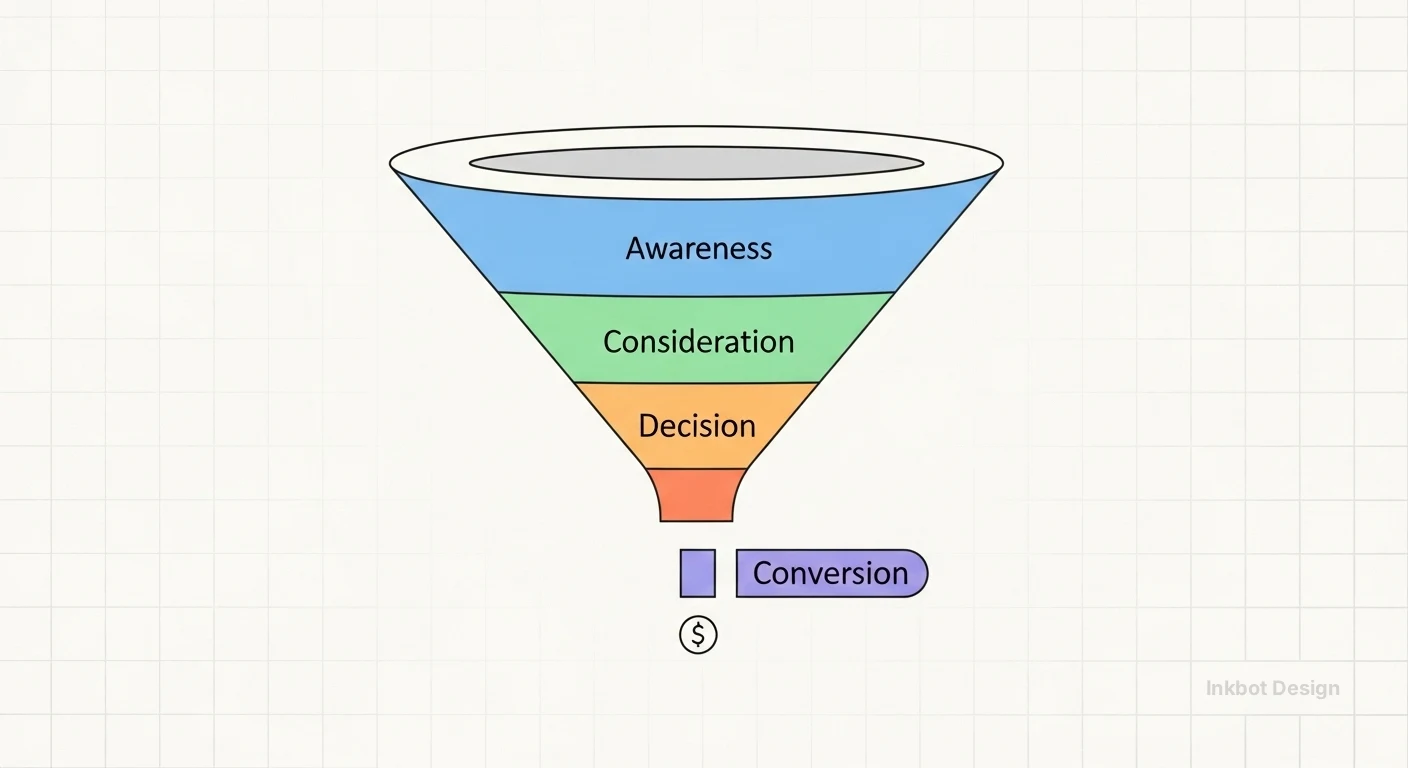
Give the buyer a short route from a consequential question to something that can be checked. Then offer an action that fits what the buyer has just learned.
The following map is a proposed briefing framework, not a set of tested conversion results.
Buyer question | Evidence to provide | Appropriate next action |
|---|---|---|
Do you handle organisations like ours? | Approved engagement examples showing sector, scale and scope | Read a relevant engagement |
Can we afford this? | Charging model and meaningful scope assumptions | Review investment guidance |
Who will deliver the work? | Named delivery roles and relevant experience | Review the proposed team structure |
What will our team need to contribute? | Client responsibilities and delivery checkpoints | Read the delivery outline |
Can I explain this choice internally? | A shareable service summary with evidence links | Share the evaluation summary |
Does our situation fit your service? | Service boundaries and exclusions | Request a scope conversation |
Gartner’s 2025 research found that buyers preferred self-service for general information but preferred seller input for contextual tasks, such as assessing fit with their organisation.
A useful website should therefore distinguish information that a buyer can check independently from questions that require a conversation.
Should a professional services website publish investment guidance?
Publish a fee range only when the assumptions make that range meaningful.
For work priced after discovery, explain the charging model, the factors that change scope and what information is needed before an estimate can be prepared.
“We cannot price this without understanding the situation” may be entirely reasonable. Leaving the buyer with no explanation of how pricing works is a separate choice.
For example, a consultancy could explain whether fees depend on the number of business units, access to internal data or the amount of implementation support required.
Those are illustrative scope factors, not a price quotation.
Keep exclusions beside the guidance. If implementation is separate, say so where the buyer reads about the diagnostic. Do not leave a partner to correct the impression later.
Will additional evaluation routes distract buyers from contacting us?
Keep one visually dominant contact action, with quieter evidence links for visitors who are still evaluating the firm. A clear hierarchy does not require every useful route to end at a booking calendar.
The case for a dominant call to action is sensible: a page with several equally prominent demands does not indicate priority.
The mistake is assuming that every visitor has already resolved the questions necessary to make contact.
Gartner’s 2026 rep-free preference finding supports accommodating self-directed research, but does not establish which page layout or number of links will perform best.
Treat the proposed hierarchy as something to assess with buyers, not a universal formula.
For a hypothetical 100-person consultancy pursuing larger transformation engagements, the service page might offer “Discuss your programme” as the primary action.
Beside the relevant evidence, quieter links could explain investment assumptions and client responsibilities.
The hypothetical finance director can inspect the commercial basis.
The hypothetical operations lead can assess the workload. Neither visitor needs a sales conversation merely to obtain information the consultancy can publish.
Assess the draft by asking a prospective buyer to locate those answers and explain what remains unclear. Finding the page is one checkpoint. Being able to use the answer is another.
Put the agreed requirements into a website design brief, including who supplies and approves each evidence asset.
When appointing a supplier, ask how the agency would build those paths; the guide to choosing a web design agency covers the wider selection decision.
What must stay consistent when a buyer makes contact?
Review the transition from service page to enquiry response, proposal and first conversation.
The buyer should not discover that the published service and the offered engagement have different boundaries.
Gartner reported on 25/06/2025 that 69% of B2B buyers encountered inconsistencies between website information and information provided by sellers.
The announcement drew on a survey of 632 buyers conducted during August–September 2024. The finding measures reported inconsistency, not abandonment caused by that inconsistency.
For a professional firm, check specific promises:
- Does “partner-led” accurately describe who attends and who delivers?
- Does investment guidance include the same work as the proposal?
- Does the enquiry confirmation explain the actual next step?
- Does the delivery outline reflect current capacity and responsibilities?
If the website offers a written assessment, do not quietly replace that assessment with a mandatory discovery call.
Assign an owner to the service description and the corresponding proposal material. Review both when the offer changes.
Otherwise, a revised scope can reach the sales team while an old promise remains on the website.
This is a governance task. Design can make a promise visible; leadership must make the promise accurate.
How do you measure progress without rewarding empty activity?
Separate evaluation actions, enquiries and accepted opportunities.
A buyer opening investment guidance has accessed information.
That action does not establish understanding, agreement or readiness to purchase.
For this framework, use the following reporting definitions:
Category | Record | Do not assume |
|---|---|---|
Evaluation | Relevant evidence pages opened; guidance accessed | The visitor has become a qualified lead |
Enquiry | A contact request associated with a service | The request is suitable work |
Accepted opportunity | A request the firm agrees is worth pursuing | The website caused the eventual sale |
Define suitability before reviewing results.
For the hypothetical consultancy, the definition might include an appropriate programme type, organisational scale and a need the delivery team can actually serve. Those criteria are illustrative; the partners must agree the real boundaries.
Gartner’s finding about unhealthy buying-group conflict helps explain why an individual visitor’s activity cannot describe the whole appointment decision.
A page view does not reveal whether colleagues agree with the recommendation.
What should a qualified-enquiry dashboard include?
Record enquiry volume by service, the share accepted as suitable opportunities, and the reasons requests are declined.
Where available, associate the enquiry with relevant website activity through the customer relationship management system, or CRM.
Keep the denominator explicit.
“Qualified enquiries divided by service-page sessions” measures something different from “accepted opportunities divided by submitted enquiries”.
Label both rather than calling both “conversion rate”.
Add one question to the first conversation: “What did you still need to know before contacting us?”
Record answers alongside the dashboard.
The answer may expose a missing delivery explanation even when form completion looks healthy.
Do not claim that a content change caused better enquiries simply because both happened in the same month.
Record changes to traffic sources, targeting and the service offer as well. If the data is sparse, report the uncertainty.
Start with the question your website leaves unanswered
Choose one priority service page and inspect the route from the buyer’s question to the evidence, then to the next action.
Keep the contact option visible.
Give buyers who are still assessing the firm somewhere useful to go.
If the gap concerns positioning or how expertise is presented, request Inkbot Design’s free Brand Equity Audit™, a written diagnostic identifying priority brand issues and corrective actions.
A broken form or isolated technical fault may need a developer rather than a rebrand.
Start today by naming the single unanswered question most likely to block a suitable buyer from shortlisting your firm.
Questions people ask
Should we gate the material buyers need to evaluate our firm?
No — keep essential fit, investment and delivery information accessible without requiring contact details. Gartner’s rep-free preference finding supports allowing self-directed evaluation. Separate optional subscriptions or tailored assessments from basic supplier information, and state what submitting details will trigger. Do not count every download as a qualified enquiry.
When does conversion work require a full website redesign?
A full redesign is a scope decision, not a prerequisite for the framework above. Start with page-level changes when the existing platform can present the evidence and support the required actions. Consider wider work when the structure or publishing system prevents those changes. Assess positioning separately from technical faults.
What can we publish if client names are confidential?
Use material the firm is authorised to publish: approved anonymised examples, delivery explanations, qualifications and clearly defined service boundaries. Preserve enough context to explain relevance without implying permission to disclose more. If no client example can be approved, state that limitation rather than inventing a composite success story.
Who should own conversion-path maintenance?
Assign a commercial owner to each priority service path. The service lead approves scope and delivery claims; marketing maintains the published content; the website team maintains functionality. Give each change a named approver so a revised proposal, fee model or team structure prompts a corresponding website review.