Meet the Team Page Design: 5 Examples That Build Buyer Trust
Most team page designs obsess over quirky headshots and staff hobbies. For a 50–200-person UK professional services firm, that misses the point. Prospective clients visit your team page to verify competence, delivery accountability, and leadership depth. Here is how five real firms structure trust.



On this page9 min left
- What Makes a Meet the Team Page Convert B2B Buyers?
- Five Meet the Team Page Designs Judged by the Buyer Doubt Each Resolves
- What Should a Professional Services Team Profile Include?
- Should a 50–200 Person Firm List Every Employee or Only Partners?
- How Do You Know Whether Your Team Page Is Working?
- Build a Risk-Reduction Asset, Not a Staff Yearbook
- Questions people ask
A prospective client considering a £50,000 consultancy engagement wants to know who will actually do the work.
A photograph of your managing director smiling at the camera does not answer that question.
The Meet the Team page design should help potential clients evaluate the people behind a business: their expertise, responsibilities, experience and accountability.
Personality has a place, but it cannot replace evidence of professional competence.
For a professional services firm preparing a rebrand, the team page deserves more attention than it usually receives. It sits within the wider professional services website design experience and helps connect the firm's positioning to the actual people delivering its services.
Consider the difference. A law firm can claim specialist expertise in corporate transactions, but can its website show which solicitors handle those transactions? An accountancy practice can promise senior-level attention, but can a prospective client identify the partner responsible for their account?
Those are design questions with commercial consequences.
What Makes a Meet the Team Page Convert B2B Buyers?
A high-converting meet-the-team page design systematically addresses a prospective client's unspoken commercial doubts before they book a discovery call.
While visual polish establishes baseline credibility, conversion depends on showing who leads the work, why their credentials fit the brief, and how teams collaborate across offices.
- Role clarity beats job titles: Buyers need to know which specific client problem a leader solves, not just where they sit on an internal org chart.
- Credentials precede character: Regulatory accreditations, sector tenure, and tangible project accountability must take precedence over personal anecdotes.
- Structure mirrors delivery: Separating executive leadership from wider practice specialists shows a buyer both strategic oversight and operational depth.
Effective meet-the-team page design reduces B2B buyer risk by pairing verifiable leadership credentials with clear delivery accountability, rather than relying on staff hobbies.
Five Meet the Team Page Designs Judged by the Buyer Doubt Each Resolves
Rather than ranking pages by visual trendiness, the five examples below are evaluated on the specific commercial hesitation each layout resolves for a prospective client.
Each demonstrates a distinct architectural choice relevant to growing UK firms preparing for a wider web design services overhaul.
IDEO: Resolving "Who Has the Exact Expertise for My Problem?"

IDEO, the global design and innovation consultancy, structures its leadership page around functional capability rather than corporate hierarchy.
Instead of listing abstract executive titles in isolation, IDEO introduces leaders with their geographic locations, first-person statements explaining what they help clients achieve, and specific industry specialisms.
Visitors immediately see how an individual leader's background maps to a live commercial challenge. IDEO also includes direct prompts inviting prospective clients to connect with a specific leader rather than routing everyone through a generic contact form.
For consultancies where buyers are purchasing direct access to specialist thinking, pairing a short "I help..." capability statement with sector focus turns a passive directory into a targeted routing tool.
HITT Contracting: Resolving "Are They Serious Enough to Deliver Yet Easy to Work With?"
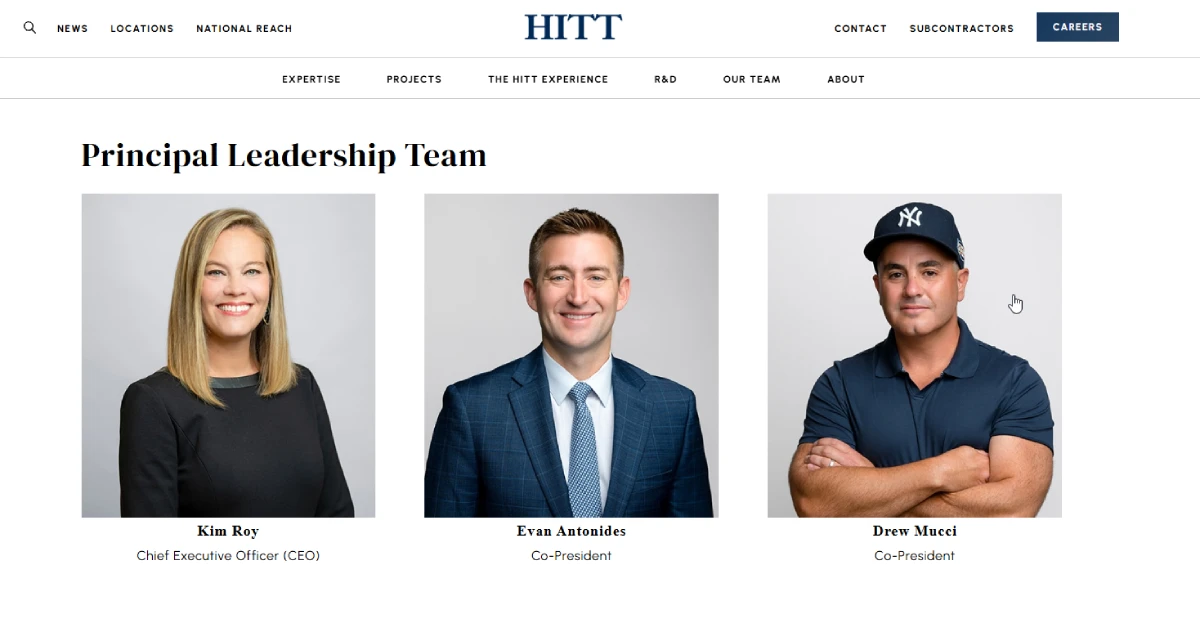
HITT Contracting, a major commercial construction firm, solves the tension between institutional gravitas and human warmth through a two-state portrait mechanic.
On initial load, the HITT Contracting leadership page presents polished, formal executive portraits alongside practical filters for market, office, and practice area.
When a visitor hovers over an executive's portrait, the image transitions to a second photograph showing personal interests or life outside the office.
That sequence matters. HITT Contracting establishes serious commercial authority first, then rewards curiosity with approachable human detail on interaction.
Conservative UK sectors such as legal, property, and financial advisory can adopt this dual-image pattern to soften corporate stiffness without undermining boardroom credibility.
Humaan: Resolving "Does This Team Actually Collaborate as One Unit?"

Humaan, a digital product agency, uses visual contrast between individual portraits and candid group photography to prove internal cohesion.
Every team member on the Humaan About page appears in a consistently lit individual portrait with clear name and role labels, establishing individual accountability.
Throughout the surrounding layout, Humaan weaves candid group shots and subtle motion effects that reinforce its "Digital Products. Human Experiences." positioning.
Clients hiring a multi-disciplinary firm often worry that strategy, design, and technical teams operate in disconnected silos.
Showing both sharp individual profiles and genuine collective chemistry reassures buyers that the people on the page actually work together in the same room.
Major Tom: Resolving "What Will the Day-to-Day Working Relationship Feel Like?"

Major Tom, a full-service digital marketing agency, keeps its visual grid deliberately restrained while using employee-led video to demonstrate working methodology.
The Major Tom team section relies on clean, uniform headshots paired with names and titles, avoiding visual clutter or gimmicky hover effects.
Directly alongside that restrained directory, Major Tom embeds concise videos in which staff explain the agency's values, service standards, and client collaboration process.
Buyers moving from a boutique provider to a 100-person firm frequently fear becoming a small account lost inside a rigid machine.
Pairing a disciplined headshot grid with short operational videos lets prospects hear how the team thinks and communicates before a pitch ever takes place.
Kaas Wilson Architects: Resolving "Do They Have Licensed Bench Strength Across Locations?"

Kaas Wilson Architects, a multi-office architecture practice, separates professional credential verification from cultural personality so neither dilutes the other.
On the Kaas Wilson Architects team page, visitors filter staff by leadership tier and office location, scanning cards that display names, roles, and formal architectural credentials upfront.
Rather than mixing jokes into licensed professionals' biographies, Kaas Wilson Architects isolates its lighter cultural touch in a separate "Chief Morale Officers" roster that introduces employees' pets.
Multi-office UK firms with chartered surveyors, engineers, or accountants face a strict credibility test: buyers want immediate confirmation of regional coverage and professional accreditation.
Keeping credentials clean at the top and compartmentalising lighter culture below satisfies both technical procurement teams and human stakeholders.
What Should a Professional Services Team Profile Include?
An effective professional services biography should explain a person's responsibilities, relevant experience and contribution to the service being offered.
A headshot and job title are a starting point. They are rarely enough for a firm selling specialist knowledge.
The profile should contain information that helps a potential client evaluate the individual.

Name, job title and professional responsibility
Start with the basics.
Include the person's full name, current position and principal responsibilities.
Avoid internal job titles that mean very little outside the organisation.
A title such as Client Solutions Executive may sound impressive internally, but a prospective client may not understand what that person actually does.
Be specific.
Qualifications and professional credentials
Professional qualifications can provide important reassurance, particularly in regulated industries.
A solicitor's biography might identify their practising credentials, specialist area and relevant experience.
An accountancy firm's profile might include appropriate professional qualifications and membership information.
Credentials must be accurate and current. Where professional registration or regulatory requirements apply, the information should be checked before publication.
Relevant experience and specialisms
Experience should relate to the services the person delivers.
A corporate finance director's biography should explain relevant transaction experience, industry knowledge or areas of specialist responsibility.
A generic statement such as "experienced professional with a passion for excellence" tells a prospective client almost nothing.
Specificity wins.
A human introduction
Personality belongs in the profile, too.
A short introduction, a professional interest, or a relevant personal detail can make someone easier to approach.
However, a biography should not become an employee questionnaire full of favourite films, coffee preferences and weekend hobbies.
A prospective client choosing a £100,000 consultancy engagement needs more useful information.
A clear contact route
Where appropriate, include a professional email address, telephone number or LinkedIn profile.
Make sure contact details are maintained and that employees are comfortable having their information published.
A profile that introduces a specialist but provides no obvious way to contact them creates unnecessary friction.
A useful team biography answers three questions:
- Who is this person?
- Why should I trust their professional judgement?
- What role will they play in my relationship with the business?
Should a 50–200 Person Firm List Every Employee or Only Partners?
"We employ 140 people across three UK offices—if we put everyone on the website, competitors will use it as a shopping list to poach our best senior managers."
Every Managing Director of a mid-sized professional services firm raises this objection during a rebrand, and it is completely valid.
Publishing a flat, unsegmented grid of 140 identical headshots creates two commercial problems.
First, it turns your website into a free recruitment database for headhunters targeting your mid-level fee-earners.
Second, it overwhelms prospective buyers who cannot tell who actually leads client accounts versus who joined six weeks ago.
Hiding everyone behind a six-partner wall creates the opposite problem.
When an enterprise buyer sees only six board directors on a site that claims 140 staff, they suspect the firm either outsources delivery or lacks senior project leads.
The solution is tiered architecture.
Feature Partners, Directors, and Practice Heads with full biographies, sector credentials, and direct contact routes.
Present the wider delivery team—such as project managers, senior consultants, and technical specialists—in a compact, filterable practice overview or collective group photography without direct email links or LinkedIn scraping hooks.
If your firm has recently completed an acquisition, group newly integrated specialists under unified practice filters rather than leaving legacy sub-brands isolated.
The Default Approach | What It Costs | The Better Approach | Why It Works |
|---|---|---|---|
Flat grid of 120+ identical headshots | Invites recruiter poaching and obscures senior accountability | Tiered layout: full profiles for Partners/Leads, compact roster for wider staff | Protects mid-level talent while proving real delivery bench strength |
Generic corporate job titles only | Forces buyers to guess who handles their specific sector | Role titles paired with "I help..." capability statements (IDEO model) | Connects individual expertise directly to a prospect's live problem |
Quirky personal bios replacing credentials | Erodes institutional trust during £50k+ procurement reviews | Credentials and sector experience upfront; personality via secondary hover or group shots | Satisfies risk-averse buyers first before adding human warmth |
Single unfilterable page for multi-office firms | Frustrates regional buyers checking local presence | Office and practice-area filters (Kaas Wilson / HITT model) | Proves geographic reach and specialist depth in two clicks |
Team page isolated from client proof | Leaves capability claims unverified on the page | Inline client testimonials or case-study links beside practice leads | Anchors human introductions in documented commercial outcomes |
When you are scoping this structure with an external partner, knowing how to choose a web design agency that understands B2B buyer psychology prevents your team section from becoming a purely cosmetic exercise.
Capture these exact tiering rules in your website design brief template before design mockups begin, so that photography budgets and CMS fields are scoped accurately from day one.
How Do You Know Whether Your Team Page Is Working?
A visually attractive page is not automatically a commercially useful page.
The better test is whether a prospective client can find the information needed to assess the people behind the business.
Start with five practical checks.
Test | What to examine |
|---|---|
Leadership visibility | Can visitors identify the people responsible for the business? |
Expertise | Are specialisms, qualifications and relevant experience visible? |
Accountability | Can visitors understand who handles client work? |
Consistency | Do photography, biographies and job titles follow a coherent standard? |
Accessibility | Can visitors find and contact the appropriate people? |
Then examine actual website behaviour.
Look at:
- Visits to the team page.
- Clicks from team profiles to contact pages.
- Clicks on professional email addresses and LinkedIn links.
- Enquiries mentioning individual employees.
- Assisted conversions involving the team page.
These measures provide different information. A high number of team-page visits does not prove that the page is converting visitors into clients.
You should also compare website behaviour before and after a redesign, allowing for changes in traffic sources, campaign activity and other website modifications.
If your firm is preparing a wider redevelopment, the website design brief template can help document the required content, functionality and responsibilities before the design work begins.
Build a Risk-Reduction Asset, Not a Staff Yearbook
I treat a team page as a commercial sales filter rather than an internal HR trophy.
Good design starts with simplicity, and on a team page, that means removing everything that distracts a buyer from verifying your competence.
Personality matters, but only after a prospective client knows who leads the work, why they are qualified, and who takes responsibility when stakes are high.
Audit your current team page this week: count how many clicks it takes a buyer to verify your leadership credentials and match a partner to a sector problem.
If your leadership team looks smaller, less specialised, or less cohesive online than it is in the boardroom, your website is costing you tenders before the shortlist is drawn up.
Request a free Brand Equity Audit™ from Inkbot Design to identify exactly where your digital presence is losing commercial ground and how to reposition your firm ahead of your next growth phase.
Questions people ask
How many people should a 50–200-employee firm show on its "Meet the Team" page?
A 50–200-employee firm should display full individual profiles for its 8-20 partners, directors, and practice heads, while representing the wider delivery team through department summaries or group photography. This tiered structure demonstrates genuine operational scale to prospective buyers without handing competitor recruiters a complete directory of mid-level staff.
Should a B2B team page include personal hobbies and fun facts?
No — personal hobbies should not sit in primary biography copy on a B2B professional services website. Prospective clients evaluating high-value advisory or technical contracts prioritise regulatory credentials, sector experience, and delivery accountability first. Introduce human warmth through secondary hover portraits or a separate culture section once competence is established.
What information belongs on each leadership profile card?
Each leadership profile card needs five concrete elements: a consistent portrait, full name, functional role title, formal accreditations or sector specialisms, and a direct route to connect or view relevant case studies. Omitting sector focus or credentials forces prospective buyers to leave the page to verify whether the leader fits their brief.
Should you link directly to employees' LinkedIn profiles from your team page?
Yes — link to LinkedIn profiles for partners, directors, and client-facing practice leads whose public profiles reinforce your firm's authority. Omit outbound LinkedIn links for junior and mid-level delivery staff, as external links pull prospective buyers away from your conversion funnel and simplify headhunter poaching.
How often should a growing firm update its meet the team page?
Review your meet the team page quarterly and immediately following any partner appointment, office opening, or acquisition. Outdated leadership rosters or mismatched photography styles signal internal disorganisation to buyers conducting due diligence ahead of a major contract award.