Signalling Theory: How Credibility Shapes Market Decisions
Signalling theory offers a disciplined way to evaluate credibility under uncertainty. It explains why some credentials, commitments, disclosures, and brand choices influence decisions while others create little more than noise.



On this page7 min left
Signalling theory explains how people and organisations make decisions when one party knows more than the other. A candidate knows more about their abilities than an employer does. A firm knows more about its future prospects than investors.
A professional services business knows more about the rigour behind its advice than a prospective client can determine before engagement.
That gap is information asymmetry. The better-informed party, or signaler, sends an observable cue. The less-informed party, or receiver, interprets it and decides how to respond. The central question is not whether a message is visible. It is whether it credibly reveals something that cannot be directly observed.
For decision-makers, this distinction matters. Markets reward signals that reduce uncertainty, but they also punish signals that look polished without carrying evidence.
A prestigious credential, a voluntary disclosure, a specialist certification, or a clearly articulated position can influence choice only when receivers believe it is meaningfully connected to underlying quality.
A signal is not simply a claim. It is an observable action, attribute, or message that changes a receiver’s belief about an otherwise unobservable quality.
The Mechanics of Signalling Theory
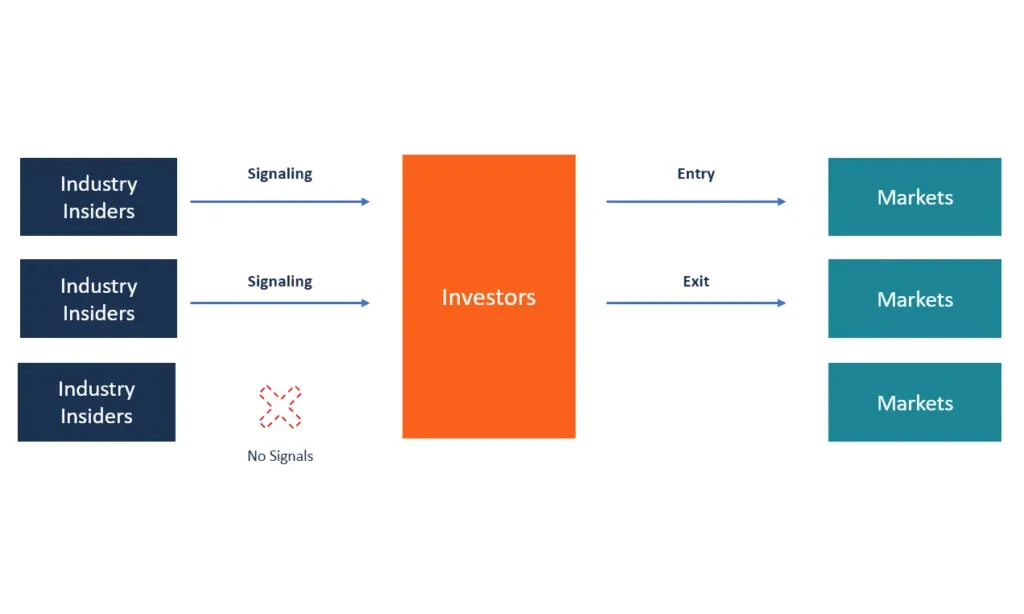
The basic sender, receiver, and hidden-quality model
At its core, signalling theory examines how observable signals convey information about unobservable qualities, as outlined in the Journal of Management’s current review of the field. The structure is simple, though its implications are not.
Element | Meaning | Professional services example |
|---|---|---|
Signaler | The party with private information | A consultancy that knows the depth of its expertise |
Receiver | The party deciding under uncertainty | A prospective client selecting an adviser |
Hidden quality | The attribute the receiver cannot easily verify | Technical capability, reliability, or judgment |
Signal | An observable cue interpreted as evidence | A credential, case methodology, specialist publication, or fee structure |
Response | The receiver’s resulting action | Shortlisting, paying a premium, investing, or declining |
A signal works only if the receiver uses it to update a belief. A firm can publish a detailed report, for example, but that report is not automatically a meaningful signal. If prospective clients cannot judge its relevance, do not trust the publisher, or see identical reports from every competitor, its informational value may be limited.
This is why signalling should not be confused with ordinary communication. Communication transfers messages. Signalling theory asks whether the message changes inferences about hidden quality and whether those inferences affect behaviour.
Costly does not automatically mean credible
A common shortcut is to assume that expensive signals are inherently honest. They are not. The decisive issue is differential cost: whether a high-quality signaler can produce the signal more easily, cheaply, or beneficially than a low-quality signaler.
The Collège de France discussion of signalling theory explains this condition clearly: a signal can transmit information when it is relatively inexpensive for one type but relatively costly for another. In other words, the signal separates types because copying it is not equally worthwhile for everyone.
Consider two advisory firms seeking premium engagements. Both can commission an expensive visual identity. That expense alone does not reveal advisory quality because either firm can pay for it. By contrast, consistently publishing precise, technically defensible analysis may be easier for a firm with genuine subject expertise than for one without it. The relevant cost is not just money. It may be time, reputational exposure, opportunity cost, or the difficulty of sustaining the behaviour.
We can distinguish three related forms of evidence:
Form | What it means | Credibility condition |
|---|---|---|
Signal | A cue deliberately sent to influence inference | Must be interpreted as connected to quality |
Costly signal | A cue requiring effort, resources, risk, or sacrifice | Cost or benefit must differ by sender type |
Index | A cue inherently correlated with a trait | The relationship exists whether or not the sender intends it |
A professional qualification may serve as a signal when an individual chooses to acquire it, influencing employers' judgment. It may also function partly as an index if completing it correlates with capabilities that employers value. In practice, many real-world cues contain both elements.
Separating, pooling, and failed signals
Signalling models often describe two broad outcomes.
- Separating equilibrium occurs when different sender types choose different actions. A receiver can distinguish stronger from weaker types with some confidence.
- Pooling equilibrium occurs when multiple sender types choose the same action. The receiver cannot reliably infer the signal's quality.
- Signal failure occurs when receivers no longer trust, notice, or correctly interpret the cue.
Education illustrates the distinction. If completing a demanding qualification is materially easier for applicants with certain capabilities, employers may treat it as a separating signal. If nearly every applicant obtains the same qualification, its differentiating power can decline. The credential may still have educational value, but its signalling value is reduced.
This is signal inflation. It often appears when a once-rare badge becomes commonplace, standards become unclear, or low-quality senders can purchase superficial equivalents. A signal can be widely visible and still convey little information.
How Signals Work in Markets and Organisations

Signalling versus screening: identify who does the work
Signalling and screening are connected but not interchangeable. The diagnostic test is straightforward: who initiates the information-revealing action?
Question | Signalling | Screening |
|---|---|---|
Who acts first? | The sender | The receiver |
Main purpose | To influence another party’s inference | To classify or assess another party |
Example in hiring | A candidate earns a credential | An employer uses structured interviews or work samples |
Example in procurement | A firm voluntarily publishes its methodology | A buyer requests evidence and evaluates proposals |
A candidate who earns a difficult certification is signalling. An employer who requires a technical assessment is screening. A serious selection process often combines both: applicants signal, and receivers use screening tools to assess whether those signals merit trust.
The signalling theory perspective published on PubMed Central notes that screening processes and differences among receivers are important extensions to basic models. That point matters because receivers are rarely identical. One buyer may treat a credential as decisive; another may prioritise referrals, specialist evidence, or a demonstrated understanding of their sector.
A signal therefore has no universal meaning. Its value depends on the institutional context, the receiver's knowledge, and the available alternatives.
Hiring, investment, and organisational reputation
In labour markets, qualifications, employment history, portfolios, and references may help employers infer qualities they cannot observe before hiring. Yet decision-makers should be cautious about interpreting any one cue as proof of productivity. Education can develop skills, signal persistence or ability, and reflect access to opportunities. These explanations can coexist.
For investors, voluntary disclosure may function as a signal when a company provides information beyond what is required and receivers interpret that disclosure as evidence of confidence or quality. The same principle applies to professional firms that disclose their process, service standards, or areas of specialisation. Specificity can reduce uncertainty; vague statements rarely do.
Political communication also fits the model. The Collège de France account discusses applications involving foreign-policy intentions, political quality, mediation, terrorism, and ethnic mimicry. These settings show why stakes matter. Signals are often costly because they create commitments, narrow future options, or expose the signaler to reputational consequences.
In biology, evolutionary signalling theory asks a related question: how can signals remain informative when organisms may benefit from deception? A display, call, or physical trait can persist as a reliable cue when cheating does not pay off equally across types. The model is useful, but decision-makers should not treat biological and commercial examples as identical. Human institutions add regulation, deliberate reputation management, contracts, cultural norms, and strategic audience segmentation.
Branding as a system of coordinated signals
A brand is not one signal. It is a system of signals interpreted together: positioning, specialist language, pricing, design, proof, customer experience, and the choices a firm makes about where it competes.
For professional services firms, enhancing brand credibility requires more than making a confident claim. It requires alignment between what the firm says, what it can demonstrate, and what clients experience after engagement. If a firm claims specialist authority but uses generic language, broad unfocused services, and interchangeable proof, the signals conflict.
Clear brand differentiation works when it helps a buyer infer a relevant difference that competitors cannot easily imitate. A distinctive colour or slogan may improve recognition, but recognition alone is not evidence of capability. A sharply defined sector focus, proprietary process, or disciplined body of specialist knowledge is harder to mimic when it is tied to real operating choices.
The strongest brand positioning makes the receiver’s decision easier. It tells a prospective client not merely what a firm wants to be known for, but why that claim is plausible and relevant to a specific problem.

How to Evaluate a Signal Before Investing in It
A practical evidence test
Before investing in credentials, thought leadership, visual identity, awards, or public commitments, we should test whether the activity is likely to operate as a signal rather than a decorative expense.
- Define the hidden quality. State the exact uncertainty to reduce. “Quality” is too vague; expertise in cross-border tax disputes is more useful.
- Identify the receiver. Specify whose interpretation matters: procurement teams, managing partners, founders, investors, or referral sources.
- Name the observable cue. Identify what the receiver will actually see, hear, or verify.
- Explain the mechanism. Why should this cue indicate the hidden quality rather than merely marketing effort?
- Test imitation risk. Ask whether a weaker competitor can quickly and cheaply copy the cue.
- Measure the receiver response. Track qualified inquiries, shortlist rates, conversion, referral quality, fee resistance, or procurement outcomes.
This approach prevents a frequent error: calling every visible activity a signal. A social post is not necessarily a signal of expertise. It may become one if it demonstrates scarce knowledge, creates accountability, reaches informed receivers, and is difficult to sustain without substance.
Failure modes and recovery steps
Signals degrade for predictable reasons. The most common are imitation, ambiguity, inconsistency, and receiver mismatch.
Failure mode | What happens | Recovery step |
|---|---|---|
Imitation | Lower-quality competitors copy the visible cue | Add proof that is harder to replicate, such as demonstrable process depth or specific expertise |
Ambiguity | Receivers cannot tell what the cue means | Tie the signal to a clear client problem and outcome |
Inconsistency | Claims conflict with experience, price, or delivery | Align brand promise, operating model, and evidence |
Receiver mismatch | Different audiences interpret the same cue differently | Segment audiences and validate messages with the decision-makers who matter |
Inflation | The cue becomes common and loses distinction | Reassess whether the signal still separates the firm from alternatives |
Fair warning: not every high-cost activity should be pursued. A costly signal is strategically poor if the relevant receiver cannot observe it, does not value it, or cannot distinguish it from routine market behaviour. A firm may invest heavily in an industry award, for instance, while procurement teams continue to choose suppliers based on evidence of compliance and sector references.
The better response is not simply to signal more. It is to signal with greater diagnostic value. Choose cues that are visible to the right audience, linked to a meaningful hidden attribute, and difficult to sustain without the capability being claimed.
Conclusion
Signalling theory offers a disciplined way to evaluate credibility under uncertainty. It explains why some credentials, commitments, disclosures, and brand choices influence decisions while others create little more than noise.
For leaders, the practical standard is clear: invest in signals that reveal a real underlying capability, matter to a defined receiver, and remain difficult to imitate without substance. When claims, evidence, and experience reinforce one another, market confidence becomes easier to earn and harder for competitors to counterfeit.
Questions people ask
What is signalling theory in simple terms?
Signalling theory explains how a person or organisation uses observable cues to communicate hidden qualities to someone making a decision under uncertainty. A receiver interprets the cue and updates their judgment.
What makes a signal credible?
A signal is credible when receivers believe it is meaningfully connected to the claimed quality. Cost can help, but the key condition is that weaker or lower-quality senders face greater relative difficulty, cost, or risk in copying it.
What is the difference between signalling and screening?
Signalling is initiated by the party with private information, such as an applicant presenting a qualification. Screening is initiated by the receiver, such as an employer using an assessment to evaluate applicants.
Is education a signal of ability or a way to increase productivity?
It can be both. Education may build knowledge and skills while also giving employers a visible cue about persistence, capability, or other attributes. The balance varies by qualification, occupation, and employer.
How does signalling theory apply to hiring?
Employers use observable indicators such as qualifications, portfolios, references, and work history to infer hidden qualities before hiring. Strong hiring systems avoid relying on signals alone and combine them with screening methods such as structured interviews and relevant work samples.
Can signals be misleading or deceptive?
Yes. A sender may benefit temporarily from a misleading signal, especially when verification is difficult. But widespread deception can weaken trust in the entire signalling system, making receivers rely on stricter screening or different cues.
What happens when low-quality competitors can imitate a signal?
The signal can lose its ability to separate. When the same badge, claim, or design convention becomes easy to copy, receivers may stop treating it as evidence of quality. Firms then need more difficult-to-imitate proof.