Buying Professional Services: The Expertise Buyers Actually Pay For
A finance director at a 120-person accountancy firm once told me, after losing a merger-advisory mandate to a smaller competitor, that the winning firm “wasn’t better — they were just easier to say yes to.”
That sentence is the whole of professional services buying compressed into eight words.
He had the credentials. He lost anyway.
- Buyers purchase confidence and the ability to defend decisions under uncertainty, not raw knowledge.
- Reputation gets you shortlisted; published legibility and a clear point of view gets you hired.
- Make expertise understandable to the whole buying group, including 13 stakeholders and procurement involved early (Forrester).
- Prove visible judgement and pattern recognition, not just credentials or volume content; AI makes information cheap.
- Publish risk-specific thought leadership before pitching so sponsors can defend choosing you without the expert present.
How Buyers Choose a Professional Services Firm
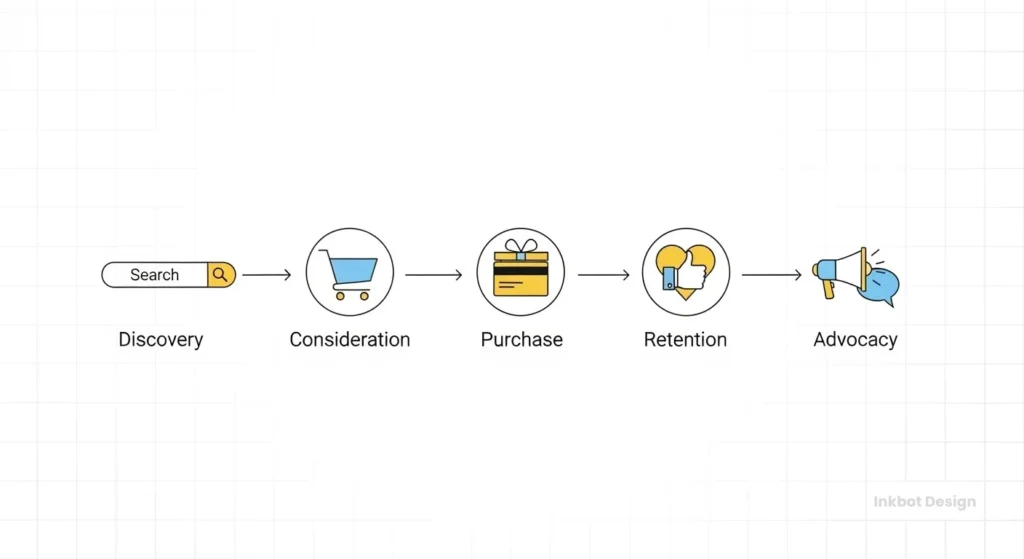
Buying professional services is the process of selecting an expert to make a defensible decision under conditions that the buyer cannot fully evaluate on their own.
The choice is won in five stages: the buyer forms a shortlist from reputation and search, tests each firm’s grasp of their specific risk, makes that expertise legible to a wider buying group, validates it against trusted human sources, and selects the option they can defend internally.
- Reputation gets a firm shortlisted; legibility gets it hired.
- The named expert who reduces the most uncertainty wins, not the one with the longest CV.
- The final choice is almost always the one the buyer can justify to people who have never met the expert.
Buyers of professional services purchase confidence that a specific expert can make a defensible decision under uncertainty, not knowledge itself.
This is one facet of a larger subject — how purchase decisions are shaped by perceived risk, trust, and internal justification, which is the territory of brand psychology.
What You Need in Place Before Any of This Works
Before a firm can influence how it’s bought, three things must already be true, and most guides skip all three.
- First, your reputation has to be strong enough to reach the shortlist — the Hinge Research Institute’s study of 822 buyers found 71% arrive at a new firm through referral, meaning the buying process often begins before you know it exists.
- Second, your public-facing expertise and your salesperson’s account of it must match; Forrester found 69% of buyers report inconsistency between website and seller information, and that gap reads as risk.
- Third, you need a specific point of view on a particular risk, not a list of capabilities.
If those three aren’t in place, the stages below improve nothing. You’re optimising a decision you were never in.

Stage One: Getting Recognised for the Right Risk
Recognition is not visibility. A firm can be well-known and still not be recognised as the answer to a particular problem.
Wolters Kluwer’s Future Ready Lawyer 2026 survey found 44% of respondents cite rising demand for specialist expertise in narrow areas — sanctions, export controls, international arbitration, cross-border transactions.
“Experienced commercial lawyers” is a capability claim. “Advisers to UK manufacturers exposed to shifting export-control and sanctions risk” is a purchase trigger because it names the buyer’s actual fear.
The failure mode here is breadth. Firms list everything they can do, which forces the buyer to work out relevance themselves — and busy buyers don’t do that.
They move to the firm that has already done that work for them.
Stage Two: Making Expertise Legible to the Whole Buying Group
The single largest change in how professional services are bought is that there is no longer one buyer.
Forrester’s State of Business Buying, 2026 reports that a typical B2B purchase now involves 13 internal stakeholders and nine external influencers, with procurement acting as a decision-maker in 53% of cycles and involved from the outset.
Your expertise may thoroughly convince the general counsel or finance director in the room. It then has to survive translation to twelve people who weren’t.
“Expertise that only one person in the buying group understands is not an asset. It is a liability disguised as a strength, because the moment that person has to defend the choice to procurement, finance, and risk, your firm becomes the hardest option to justify rather than the easiest.”
This is where more than 40% of deals reportedly stall on internal misalignment. The expert impresses the evaluator; the evaluator can’t carry the room.

Stage Three: Proving Judgement, Not Just Access to Information
The standard for proof of expertise has moved.
Thomson Reuters’ 2026 research found that almost one-third of corporate legal professionals are reconsidering relationships with firms that cannot explain their AI-enabled value within the next 12 months — yet only 3–6% believe most firms actually deliver it.
That gap is the opening.
In a market where AI has made information itself cheap, “we have deep experience” proves nothing, because so does everyone.
What buyers test for now is judgement they can see working.
Not “we advise on export controls” — but a published teardown of why a specific 2025 sanctions change caught three UK manufacturers off guard and what their advisers should have flagged first.
That kind of material shows pattern recognition. A capability list shows only that you own a website.
Stage Four: Passing the Human Validation Test
Buyers now start with AI and finish with people.
Forrester identifies generative AI search as an increasingly common starting point for B2B discovery. Still, he finds that buyers treat AI-generated information as potentially incomplete or unreliable, so they validate it through trusted sources and human contact.
AI can surface your firm. It cannot establish why you should be trusted with a merger, a regulatory investigation, or a cross-border restructuring.
This is why volume backfires. A litigation practice that publishes forty interchangeable “5 tips” posts hands the human validator nothing to hold onto.
One partner’s honest account of a case that nearly went wrong — and the judgement call that saved it — survives the human check. The forty posts don’t.
Stage Five: Being the Defensible Choice
The buyer rarely selects the objectively best firm, because they usually can’t tell which one that is — that’s the whole reason they’re buying expertise.
So they select the firm whose choice they can most easily defend if it’s questioned later.
This is the mechanism most content misses.
Forrester found that 94% of buyers in groups of six or more reported benefits from broader participation — better validation, budget support, and a higher likelihood of approval — which means the buying group isn’t an obstacle to clear.
It’s the environment in which your expertise has to be made intelligible.
Cost, notably, is rarely the deciding factor — the Hinge Research Institute found price tips the decision only 8% of the time.
What tips it is defensibility: the option a sponsor can put in front of finance and risk without having to fill in the gaps themselves.
“The firm that wins is not the one that proved it was best. It is the one that made itself the easiest choice to defend — because in a decision no single person can fully evaluate, defensibility is the only form of proof a buying group can actually act on.”
Where This Stops Being a Checklist
Everything above can be systematised until the last stage, and then it can’t.
Knowing which risk to lead with for a specific buyer — when to name a weakness before the buyer finds it, when a broad claim reassures and when it dilutes — is judgement. It’s the part where AI-generated competitor content is thin precisely because it can’t be pattern-matched from published material.
Wolters Kluwer reports 62% of legal department respondents expect AI-driven efficiency to reduce the significance of the billable hour, shifting value toward fixed fees.
As routine work is automated, the expertise that retains its value is the hard-to-automate kind: diagnosis, prioritisation, negotiation, risk assessment, and accountability.
The firms that win will be those that most clearly explain where human judgement still changes the client’s outcome.
In 17 years of brand work, the pattern I see most often is a firm with genuinely deep expertise that has never once made that expertise legible to anyone beyond the partner who holds it.
The Step Almost Every Firm Does Last — and Should Do First
Here is the sequence error that separates firms that win winnable work from those that don’t. Most firms treat “make our expertise legible and defensible” as something that happens in the pitch — after the shortlist, in the room, to the people present.
By then, it’s too late.
The buying group has already formed its impressions, procurement is already involved, and twelve of the thirteen deciders will never be in your room.
Intelligent practitioners hold the opposite view for a good reason: the pitch feels like the moment of decision, because it’s the moment they’re present for. It’s where they’ve always felt they win or lose.
But Forrester’s data on 13 stakeholder groups and 53% procurement involvement from the outset show that the decision architecture is largely set before the pitch.
The legibility work — the point of view, the risk-specific positioning, the published judgement — has to be public before the shortlist is formed so it can travel through a buying group you’ll never address directly.
The replacement directive is blunt: stop treating expertise as something you demonstrate in the meeting. Build it as something the buying group can find, understand, and repeat about you before the meeting is ever scheduled.
79% of buyers are more likely to advocate internally for a vendor that consistently publishes high-quality thought leadership — that advocacy is the mechanism by which your one supporter carries the other twelve.
Two objections a sceptical MD will raise here.
First: “Our best work comes through referral, so this positioning effort is a distraction.” Referral gets you shortlisted — but the Hinge data shows 75% of clients who never refer simply weren’t asked, and even a warm referral still enters a 13-person buying group that has to justify choosing you.
Second: “We’re specialists; over-narrowing our positioning will cost us work.” The evidence points the other way — 85% of buyers prioritise a firm’s understanding of their specific challenges, compared with 74% who cite recognition as a leading expert.
Specificity isn’t the risk. Being illegible is.
| The Default Approach | What It Costs | The Better Approach | Why |
| List every capability | Buyer has to work out relevance | Lead with one named risk | Removes buyer effort; triggers recognition |
| Impress the person in the room | Loses the other 12 deciders | Equip the sponsor to defend the choice | Survives the buying group |
| Prove credentials | Reads as generic in an AI market | Prove judgement and trade-offs | Meets the new 2026 proof standard |
| Legibility work during the pitch | Too late; shortlist already set | Legibility work published beforehand | Reaches the group before it forms |
| Compete on the fee | Only decides 8% of the time | Compete on defensibility | Matches how the decision is actually made |
The Verdict
The most-qualified firm loses often enough that it can’t be bad luck. It loses because expertise, on its own, doesn’t travel.
It sits with one partner in one room, unable to cross a buying group of 13 people, each of whom needs to justify the choice to one another and to procurement. Who knows the most was never the question buyers were answering.
They were answering a different one: whose knowledge can we see, understand, map to our own risk, and defend without the expert in the room?
That reframes the whole task.
You are not trying to be the best firm in the abstract. You are trying to be the firm a buyer can confidently choose in circumstances they can’t fully evaluate — which means your job is to reduce their uncertainty and hand them a decision they can defend. Reputation gets you shortlisted.
Judgement, made legible and published before the shortlist forms, gets you hired.
The single action worth taking today: pick your last three lost pitches and ask, honestly, whether the buying group could have defended choosing you without your help in the room.
If the answer is no, the problem isn’t your expertise — it’s that no one could see it.
If you want to know exactly where your firm is losing that ground, request a free Brand Equity Audit™ — a structured diagnostic that identifies where your brand is costing you winnable work and what to do about it.
FAQs
Why do the best-qualified firms often lose professional services work?
Because expertise held by one partner rarely survives translation to a buying group. Forrester’s 2026 research shows 13 internal stakeholders now shape a typical B2B decision. If twelve of them can’t understand or defend the choice, the best-qualified firm becomes the hardest to justify and loses to an easier yes.
How do buyers actually choose a professional services firm?
Buyers select the expert who most reduces their uncertainty and whose choice they can defend internally. Reputation forms the shortlist, but the final decision favours the firm that a sponsor can justify to procurement, finance, and risk — people who never met the expert directly.
How many people are involved in buying professional services?
Forrester’s State of Business Buying, 2026 reports that a typical B2B purchase involves 13 internal stakeholders and nine external influencers, with procurement acting as a decision-maker in 53% of cycles. Expertise must be legible to all of them, not only the person in the meeting.
Is cost the deciding factor when buying professional services?
No — cost tips the decision only 8% of the time, according to the Hinge Research Institute’s study of 822 buyers. Buyers pay for confidence and defensibility. Price becomes decisive mainly when firms are otherwise indistinguishable, which is itself a failure of positioning.
What’s the difference between demonstrating expertise and making it legible?
Demonstrating expertise proves you have it to the person present. Making it legible means the whole buying group can recognise, understand, and repeat it without you. The first wins the meeting; the second wins the decision, because most deciders never attend the meeting.
Do clients now expect AI capability from professional services firms?
Yes — Thomson Reuters’ 2026 research found nearly one-third of corporate legal professionals are reconsidering firms that can’t explain their AI-enabled value within 12 months. But only 3–6% believe firms deliver it well, so demonstrating genuine AI-augmented judgement is a differentiator, not table stakes.
When should a firm do its positioning and legibility work?
Before the shortlist forms, not during the pitch. Forrester shows procurement is involved from the outset, and buying groups form early. Positioning published in public lets your expertise travel through a buying group you’ll never address directly, where the decision is largely set.
How is AI changing what buyers value in professional services?
As routine work automates, buyers place more value on expertise that resists automation: diagnosis, prioritisation, negotiation, and accountability. Wolters Kluwer reports that 62% expect AI efficiency to reduce the significance of billable hours, shifting value toward judgement clients cannot get from a machine.
Why does inconsistency between a firm’s website and its salespeople matter?
Forrester found 69% of buyers report inconsistency between website and seller information, and that gap reads as risk. When a buying group is looking for reasons to eliminate options, a mismatch between public claims and personal ones is an easy reason to strike a firm off.
Does thought leadership actually influence professional services buying?
Yes — 79% of buyers are more likely to advocate internally for a vendor that consistently publishes high-quality thought leadership. That internal advocacy is the mechanism by which one supporter carries a decision across a buying group of thirteen who need justification.
Is narrow specialisation a risk when positioning a firm?
No — 85% of buyers prioritise a firm’s understanding of their specific challenges, versus 74% citing leading-expert recognition. Wolters Kluwer also reports 44% cite rising demand for narrow specialist expertise. Specificity triggers recognition; breadth forces the buyer to work out relevance and often move on.
What causes most professional services deals to stall internally?
More than 40% of deals stall on internal misalignment. Typically, the expert convinces the evaluator, but the evaluator cannot carry the wider buying group. The expertise never becomes legible enough for procurement, finance, and risk to align behind the choice.
