The ROI of Brand Strategy for SaaS & Tech Startups
Brand strategy is not a phase-two priority for SaaS founders — it is the single most misclassified expense in a startup’s entire go-to-market budget.
Founders who defer it until after product-market fit don’t save money; they pay a compounding CAC premium for every month they operate without one.
That premium, according to Benchmarkit’s 2025 SaaS Performance Metrics report, now sits at a median of £2 spent to acquire £1 of new ARR — and bottom-quartile companies are haemorrhaging £2.82 per pound.
The irony is that most of that inefficiency isn’t a product problem or a channel problem. It’s a brand problem dressed up as a conversion problem.
If you’re working with a brand agency worth their day rate, this is the argument they’re making to you. Not “trust matters” or “consistency builds recognition.” Those platitudes are true but useless.
The argument that actually lands is this: a clearly defined brand strategy compresses your sales cycle, raises the price your customers are willing to pay, and lowers the volume of leads you need to hit revenue targets.
The data exists. It’s just buried under years of marketing jargon that obscures it.
This guide unpacks exactly where brand investment generates measurable return in SaaS businesses, why the conventional wisdom about performance marketing versus brand investment is outdated, and what the numbers actually look like for startups operating in 2026.
- Brand strategy reduces CAC, increases pricing power 5 to 25 per cent, and lowers churn, per Benchmarkit's 2025 SaaS metrics.
- Invest in positioning before paid acquisition; early brand spend shortens sales cycles and compresses CAC payback.
- A clear brand creates inbound pull, referral growth about £150 CAC, and shorter demos; Slack and Basecamp are case studies.
- Performance marketing converts existing demand; long-term ROI requires brand building, per Interbrand and McKinsey research.
- AI parity and market consolidation make distinctive brand positioning essential for survival and agentic commerce procurement.
What Is the ROI of Brand Strategy?
Brand strategy ROI is the measurable financial return generated by investing in brand positioning, visual identity, messaging architecture, and audience clarity — calculated across pricing power, reduced customer acquisition costs, reduced churn, and revenue-per-customer growth.
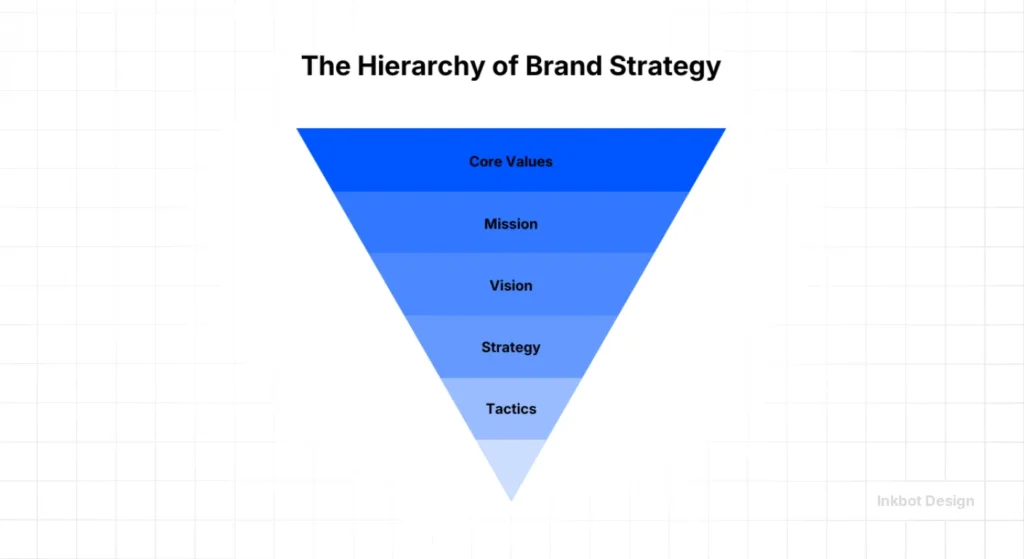
Key components:
- Pricing power — the ability to charge more than direct competitors without losing deal flow
- CAC compression — lower spend per acquired customer because inbound conviction replaces outbound persuasion
- Churn reduction — customers who bought the brand, not just the feature set, are harder to dislodge with competitor pricing.
Brand strategy in SaaS measurably reduces customer acquisition costs, increases pricing power by 5–25%, and lowers churn by establishing trust before the sales conversation begins.
Why Most SaaS Founders Get This Wrong Before They’ve Even Started
Brand strategy ROI is negative when founders treat it as a visual exercise. Done correctly — starting with positioning — it’s the highest-return investment a pre-revenue startup can make.
The standard objection is: “We’ll sort the brand when we have customers.” This misunderstands the causality. Your brand strategy is not what you show customers after acquisition.
It’s the mechanism that determines which customers come to you, what price they expect to pay, and how quickly they decide.
Running paid acquisition without a defined brand position means you’re paying to educate people who haven’t yet decided whether to trust you. That education cost is baked into your CAC — invisibly, persistently, expensively.
The average B2B SaaS company now spends £1,200 to acquire a customer across all marketing channels, with CAC rising 14% through 2025. That figure assumes your product is already known, trusted, or at minimum recognisable.
For a brand-undefined startup, the real cost is higher — because trust has to be built during the sales cycle itself, rather than built in advance.
The contrast is stark when you look at referral traffic. Referral programmes cost as little as £150 per acquired B2B SaaS customer — roughly one-eighth of the average paid acquisition cost.
Referrals only happen at scale when someone trusts your brand enough to stake their professional reputation on recommending it. That’s brand strategy generating CAC compression in the most direct way possible: by making your customers do your acquisition work for you.
Slack is the clearest case study in SaaS history. When Slack launched in 2013, HipChat was the incumbent in the category.
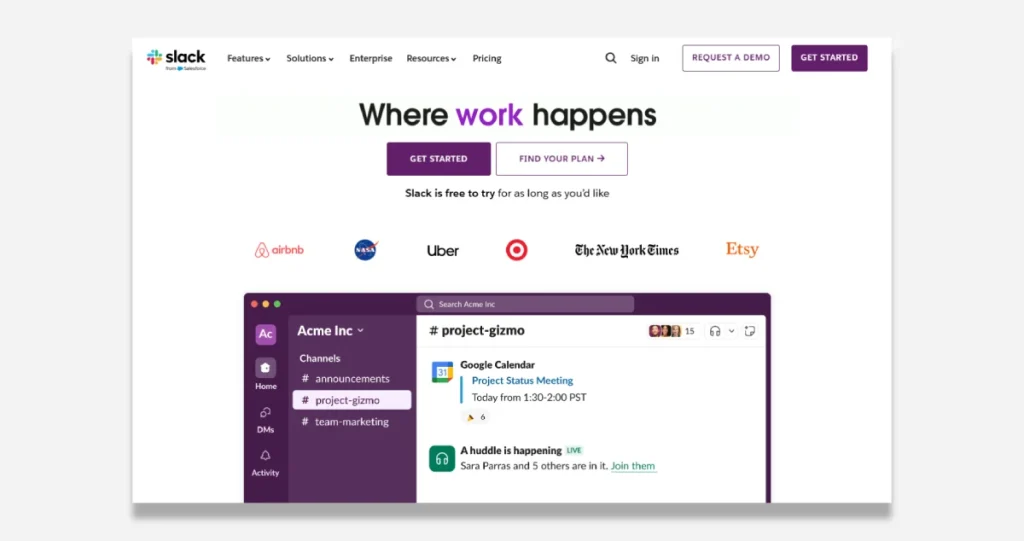
Slack didn’t win on features — the feature delta was marginal. It won on brand clarity: a defined voice, a deliberate aesthetic, and positioning that made it feel like the anti-enterprise tool in a market full of enterprise-feeling tools.
Within two years, Slack had accumulated over a million daily active users without a traditional enterprise sales motion.
HipChat, despite being a technically comparable product and having Atlassian’s considerable distribution resources, was eventually sunset in 2019. The brand was the moat, not the product.
Brand strategy doesn’t help SaaS companies stand out. It determines whether customers arrive pre-convinced or require expensive persuasion. The difference shows up directly in your CAC payback period — typically 9 months for well-branded businesses versus 24 months or more for companies that compete on features alone.
The Pricing Power Argument: Where Brand Strategy Generates the Cleanest ROI
A 1% improvement in price directly increases operating profit. That’s not a brand claim — it’s a McKinsey finding with a specific number attached.
According to the IPA (Institute of Practitioners in Advertising), a 1% increase in price improves operating profits by 8% — three times the boost generated by a 1% increase in volume sales.
This is the mathematical case for brand investment that most SaaS founders never see, because it comes from brand effectiveness research rather than growth marketing literature.
The implication is direct. If your SaaS product currently charges £99/month and you’re competing in a market where the category average is £79/month, your brand is doing one of two things: justifying that premium, or costing you deals. There is no neutral position.
A brand that fails to articulate differentiated value forces your sales team to defend the price gap in every single demo. A brand that establishes credibility, clarity, and trust before the demo converts the price gap from a liability into a signal of quality.
According to McKinsey & Company, companies with strong customer loyalty programmes — itself a product of brand trust — command prices 5% to 25% higher than competitors without losing market share.
For a SaaS product on an annual contract, that 25% ceiling is not marginal. On a £50,000/year enterprise deal, it’s the difference between £50,000 and £37,500 — recurring, compounding, every year.
Basecamp (now 37signals) is the proof of concept in the mid-market. In a project management category dominated by Asana, Monday.com, and ClickUp — all of which compete aggressively on feature parity and pricing flexibility — Basecamp charges a flat £99/month for unlimited users. The category average for comparable team sizes is 3–5x lower.
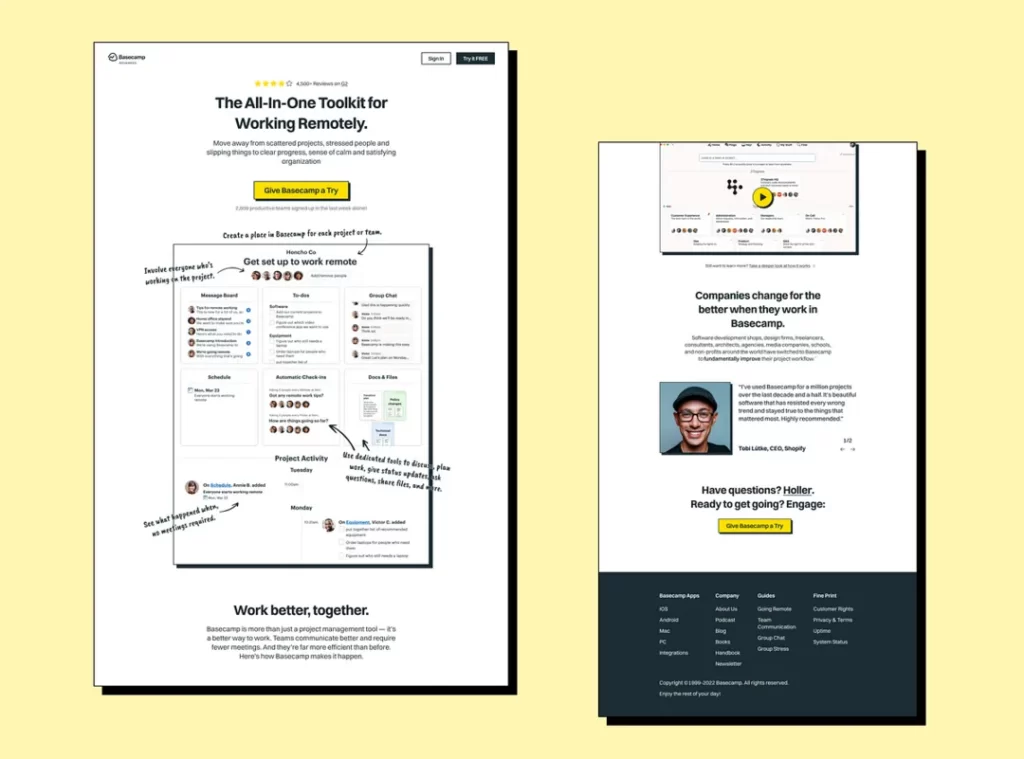
They sustain this not because the product is 3–5x better but because their brand position — “calm, profitable, opinionated software for teams that want less, not more” — attracts exactly the customer who is pre-qualified to pay it. Brand strategy did the qualifying. The sales team didn’t have to.
For a SaaS startup in 2026, the pricing power argument is increasingly urgent. Median annual revenue growth for private B2B SaaS startups hit 28% in 2025, down 40% from 2024’s benchmark of 47%.
Growth compression means the era of “raise prices later when you have leverage” is over. Startups that haven’t built brand-supported pricing power are now competing on margin in a slowing market.
The SaaS brands that survive the current contraction in growth rates will not be the ones with the most features. They will be the ones whose customers arrived pre-priced — brands that established what they charge and why before the demo ever happened.
The CAC Compression Effect: How Brand Strategy Lowers Your Acquisition Cost
Brand strategy directly lowers customer acquisition cost through three mechanisms that compound over time.
Mechanism 1: Inbound pull vs outbound push.
A defined brand with content, community, and positioning creates inbound demand. Inbound leads convert at higher rates and with shorter cycles than outbound leads, because conviction arrives before the conversation.
Organic channels in B2B SaaS cost between £480 and £942 per customer acquired, with long-term costs dropping to as low as £290 as content compounds — compared to paid B2B search, which averages over £800.
The content that drives this organic compounding is only coherent when there’s a brand strategy behind it. Without positioning, content is just articles. With positioning, content is brand infrastructure.
Mechanism 2: Sales cycle compression.
When a prospect arrives having already read your thinking, heard your point of view, and identified with your positioning, the sales cycle is shorter—fewer touchpoints, fewer objections, shorter time-to-close.
Every day shaved off a SaaS sales cycle has a direct impact on CAC payback — the metric that determines how quickly you can reinvest acquisition spend.

Mechanism 3: Reduced churn-driven CAC.
A 5% improvement in retention drives 25–95% profit increases, yet 75% of software companies saw declining retention in 2024. Customers who churn must be replaced with new-acquisition spend.
Every churned customer who was only there for the feature set — not for what the brand represents — is, in effect, a future CAC charge on your P&L. Brand strategy reduces brand-misaligned acquisition by narrowing the audience you’re targeting. That’s not a loss. It’s a reduction in the cost of customer turnover.
The underlying data from Benchmarkit’s 2025 SaaS Performance Metrics confirm that the median New CAC Ratio increased 14% in 2024 to £2.00, while fourth-quartile companies hit £2.82 — a 41% efficiency gap between median and bottom performers that continues to widen as digital channels mature.
The companies in that bottom quartile are not all building inferior products. Many of them are building fine products with no brand clarity — and paying for that omission in the most direct financial terms possible.
The CAC crisis in B2B SaaS isn’t primarily a channel problem or a conversion rate problem. It’s a trust problem. Brands that arrive in the buyer’s mind before the sales conversation starts their customer relationships from a position of credibility. Every company without that credibility pays a trust tax on every customer it acquires.
The Performance Marketing Myth: Why Short-Term Tactics Are Burning Brand Value
The advice that performance marketing delivers better ROI than brand investment was correct for a specific window of SaaS history. That window is closed.
Between roughly 2015 and 2022, paid acquisition was so cheap and conversion rates so high that “brand” was a luxury many VC-backed SaaS companies felt they could skip. They ran Google Ads, built PLG funnels, and iterated on messaging through A/B tests. It worked — for a while.
The problem is structural. Interbrand’s 2024 Best Global Brands report found that an increased focus on operational efficiency and short-term performance tactics over mid-term and long-term brand potential has cost the world’s most valuable brands $3.5 trillion in cumulative brand value since Interbrand began its study.
That finding comes from an analysis of the world’s 100 most valuable brands — companies with resources and sophistication far beyond those of most SaaS startups.
If the best-capitalised brands in the world have systematically destroyed value by over-indexing on performance marketing, the implication for resource-constrained startups is worse, not better.
Gonzalo Brujó, global CEO at Interbrand, stated in October 2024:
“Many of the world’s most valuable brands are missing out on significant earning potential by over-investing in short-term gains. Our analysis shows these gains, when tied predominantly to short-term tactics, can undermine a company’s mid- to long-term revenue potential.”
Gonzalo Brujó
The mechanism is simple. Performance marketing converts existing demand. It doesn’t create new demand. A well-branded SaaS company creates latent demand — the prospect who hasn’t started buying yet but has already decided they’ll buy from you when they do.
This is called Share of Mind at the Ehrenberg-Bass Institute (the University of South Australia’s marketing science institute), and it drives category entry-point salience—the likelihood that your brand is considered when a buyer decides to solve a problem. Performance marketing cannot buy this. Brand strategy builds it over time.
For a SaaS startup, the practical implication is how to allocate spending. The industry standard advice — “performance first, brand later” — is backwards for companies that want durable pricing power rather than a temporarily cheap acquisition.
Brand investment and performance marketing are not mutually exclusive. But the idea that brand strategy can wait until you have scale is precisely the thinking that produces the £2.82 CAC-to-ARR ratio that is currently killing bottom-quartile SaaS businesses.
The brands that dominated SaaS between 2020 and 2024 didn’t do so because their ads were better. They did so because they held a clear position in their category, so that no competitor could take it without starting from scratch. Performance marketing scales that position. It cannot create it.
What Brand Strategy ROI Actually Looks Like in Practice: A Comparison
| Decision Point | Without Brand Strategy | With Brand Strategy | Why It Matters |
| Pricing | Defaults to market average or competitive undercutting | Commands a 10–25% premium above category baseline | Direct margin impact on every deal, recurring annually |
| Inbound lead quality | Mixed; attracts price-sensitive and brand-agnostic buyers | Filtered; attracts buyers pre-aligned with positioning | Reduces sales cycle length and objection volume |
| CAC payback period | 18–24+ months for enterprise ACV | 9–15 months for equivalent ACV | Determines how quickly you can reinvest in growth |
| Churn rate | Elevated; customers leave for feature improvements in competitors | Lower; brand-loyal customers resist competitive switching | Every 1% churn reduction compounds into retention margin |
| Fundraising leverage | Valuation driven purely by ARR multiples | A brand acts as a qualitative moat signal to investors | Strong brands trade at higher P/E multiples |
| Referral rate | Low; customers refer to the product, not the company | High; customers refer to the brand as a signal of their own taste | Referral CAC runs at 80% below paid acquisition |
| Content marketing ROI | Disconnected; articles don’t compound | Topically authoritative; content builds brand credibility over time | Organic CAC continues falling while paid CAC rises |
Brand Strategy in SaaS in 2026
The context for brand strategy ROI in SaaS has shifted materially in the past 18 months, driven by three forces that are compressing the payback window for brand investment.
AI-generated feature parity.
The ability of AI coding tools — specifically GitHub Copilot and Cursor, both widely adopted by SaaS development teams through 2025 — has dramatically accelerated feature development cycles. A feature that differentiated your product in early 2024 can be replicated by a competitor in weeks, not quarters.
In this environment, product differentiation is a diminishing moat. Brand differentiation — the positioning, personality, and values that make your company what it is — cannot be replicated in a sprint cycle. This is making brand strategy more valuable, not less, precisely because product strategy is becoming more commoditised.
The category consolidation wave.
Companies in the US spent an average of $8,700 per employee on SaaS tools in 2024 — but the number of SaaS applications used per organisation dropped from 371 in 2023 to 220 in 2024, indicating a sharp trend towards consolidation.
Buyers are cutting their software stacks. They are keeping tools from brands they trust and eliminating tools from vendors they view as interchangeable. In a consolidating market, brand trust is a matter of survival.
The SaaS company with no clearly defined brand identity is the first to be cut when a CFO demands a rationalisation exercise.
The AI content flood and the collapse of trust.
By early 2026, the volume of AI-generated marketing content will have saturated most B2B SaaS acquisition channels.
Buyers have become acutely sensitive to content that sounds like everything else. Distinctive brand voice — a direct product of brand strategy — is now a meaningful signal of legitimacy.
Buyers who see a SaaS vendor with a consistent, opinionated, recognisable point of view across every channel interpret that consistency as evidence of a real company with real conviction. Buyers who see interchangeable content treat it as a commodity, regardless of what the product actually does.
The IPA’s research on B2B brand effectiveness — published in their 2024 effectiveness databank update — found that B2B brands which maintained long-term brand investment alongside short-term activation campaigns delivered 2.2x more profit growth than those focused on activation alone.
This ratio has been growing year on year since 2020. The case for brand investment in B2B SaaS isn’t just directionally correct; data also substantiates it. It’s becoming quantitatively stronger each year.
The most practical 2026 implication: the SaaS companies now allocating brand strategy budget early — in the first £50,000 to £150,000 of marketing spend — are building a compounding asset. Those treating brand as a phase-two priority are funding a perpetual trust deficit that shows up in every CAC calculation they run.

The Consultant’s Reality Check
The most expensive brand mistake I watch SaaS founders make is not skipping brand strategy entirely. It’s confusing brand strategy with brand execution.
I audit early-stage SaaS companies regularly, and the pattern is consistent: the founding team has spent money on a logo, a website, a colour palette.
They’ve briefed a designer. They have a brand. Except they don’t.
What they have is a visual output applied over an undefined positioning. The colours look fine.
The logo is professional. But when I ask: “Who specifically is this for, and why would they pay you instead of your closest competitor?” — the answer is either “everyone who needs [category]” or a features list dressed up as differentiation.
That’s not a brand strategy. That’s a design project.
The financial consequence is direct: every pound spent on paid acquisition is being applied to an undefined audience. The targeting might be precise. The ad copy might be tested.
But the underlying claim — “you should trust us and pay our price” — isn’t being answered before the click. So the sales team answers it during the demo. That extends the cycle. That raises the CAC. That delays payback.
What I recommend instead: spend the first £5,000–£10,000 of your brand budget on positioning before design. Define the specific competitor you are not, the specific customer you are for, and the specific belief you hold about your category that your competitors don’t hold publicly.
Everything else — the visual identity, the content strategy, the pitch deck — flows from that. Spend money on visuals only after you know what they need to say. The shortcut costs twice.
The 90-Day Brand Transformation Roadmap
To move from a feature-led startup to a brand-led market leader, companies must follow a structured Implementation Sequence. Attempting visual design before positioning is a guaranteed way to dilute the return on your investment.
Phase 1: The Positioning Sprint (Days 1–30)
- Objective: Define the “Category of One.”
- Key Action: Conduct Customer Friction Audits. Interview 10 lost prospects to understand exactly where the trust broke down.
- Deliverable: A Positioning Statement that passes the “Flip Test” (if you swapped your name for a competitor’s, would the statement still be true? If yes, it is not positioning).
Phase 2: Messaging Architecture (Days 31–60)
- Objective: Translate positioning into a scalable communication system.
- Key Action: Develop a Core Narrative Arc. This is the “big idea” that connects your product’s features to the buyer’s survival or success.
- Deliverable: A Messaging House with specific value propositions for each buyer persona (CFO, End-User, IT Manager).
Phase 3: Visual Identity & Market Activation (Days 61–90)
- Objective: Create a distinctive visual signal.
- Key Action: Build a Design System that prioritises “Recognition over Decoration.”
- Deliverable: Updated website, sales collateral, and a 12-month Thought Leadership Calendar based on the new brand position.
Investment vs. Payback Expectation
| Phase | Typical Spend | Expected Outcome | Payback Window |
| Positioning | £5k–£10k | Strategic clarity; team alignment. | Immediate (internal) |
| Messaging | £3k–£7k | Higher ad conversion; shorter demos. | 3–6 months |
| Identity | £10k–£25k | Market recognition; pricing power. | 6–12 months |
The AI Brands Will Beat the Feature Brands: Brand Strategy in the Agentic Commerce Era

One final shift worth naming explicitly: AI is changing who makes SaaS buying decisions.
The emergence of agentic commerce — AI agents researching, evaluating, and in some cases initiating SaaS purchases on behalf of buyers — means that your brand must now be legible to systems, not just humans. This is not distant.
Early enterprise procurement platforms are already using AI agents to shortlist vendors based on structured signals: website clarity, documented positioning, review site presence, content authority, named pricing, and case study availability.
A SaaS company with no coherent brand strategy produces incoherent signals. An AI agent evaluating twelve vendors cannot extract a positioning claim from a homepage that says “the all-in-one platform for growing teams.”
That phrase appears verbatim on thousands of SaaS homepages. It is invisible to algorithmic shortlisting.
This matters for brand strategy ROI in one very direct way: the companies with well-defined brand strategies — specific claims, named audiences, documented differentiation — will be preferentially selected by AI-assisted procurement as the category consolidates.
The ROI of brand strategy in 2027 and beyond will be partly measured by AI citation frequency in procurement research. That’s a new metric. But the input is old: be specific, be credible, and say something that no one else is saying in the same way.
The Verdict
Brand strategy is not a soft cost in a SaaS business. It is a mechanism that directly affects pricing, acquisition cost, churn, and sales cycle length — four of the six metrics that determine whether a SaaS startup survives the current contraction in growth rates.
The founders who treated brand as a phase-two priority between 2020 and 2024 are now facing a compounding problem: rising CAC, thinning margins, and a market that is actively consolidating around trusted brands.
The intervention they need — positioning clarity, distinctive voice, credible differentiation — takes 6–12 months to compound into measurable commercial advantage. Every month they delay is a month added to that timeline.
The contrarian case at the start of this article was that brand strategy is not what you do after product-market fit — it’s part of how you find it.
The data holds.
Interbrand’s $3.5 trillion in destroyed brand value confirms what happens at scale when performance tactics replace brand investment. Benchmarkit’s CAC data confirms what happens at startup scale when brand clarity is absent. McKinsey’s pricing power research confirms the margin upside when it’s present.
None of this requires a six-figure brand identity project. It requires a clear answer to a hard question: who exactly is this for, and why should they pay you instead of paying anyone else? Get that answer right, and every pound you spend on acquisition goes further.
Leave it unanswered, and you’ll keep paying the trust tax on every customer you ever acquire.
If you want to understand where your brand is creating or destroying commercial value, Inkbot Design’s brand strategy services are designed to answer exactly that question. Start with what you know about your positioning, and we’ll tell you what the market actually hears.
Frequently Asked Questions
What is brand strategy ROI, and how do you measure it?
Brand strategy ROI is the financial return generated by investing in positioning, messaging, and identity — measured across four primary outputs: a pricing premium over competitors, reduced customer acquisition costs, improved net revenue retention, and accelerated sales cycle velocity. Attribution is tracked through CAC payback period, LTV: CAC ratio, and average contract value trends over 12–24 months post-brand investment.
How much does brand strategy cost for a SaaS startup?
A foundational brand strategy engagement — covering positioning, audience definition, messaging architecture, and visual identity — typically ranges from £8,000 to £35,000 for early-stage SaaS businesses, depending on scope and agency seniority. The relevant benchmark is CAC payback: if your current CAC is £1,200 and the brand strategy reduces it by 20%, the investment pays back on 40 new customers.
When should a SaaS company invest in brand strategy?
Before paid acquisition spend, not after. Brand strategy defines who you’re targeting and why they should pay your price — information that makes every subsequent acquisition investment more efficient. Founders who wait for product-market fit before investing in brand strategy are, in many cases, making product-market fit harder to achieve because undefined positioning attracts the wrong buyer segment.
Does brand strategy really lower customer acquisition cost?
Referral programmes — which operate almost entirely on brand trust — cost an average of £150 per acquired B2B SaaS customer, versus £800 or more for paid search. Organic content, when built on a defined brand position, compounds into a channel that continues reducing CAC year on year. Both effects are directly attributable to brand clarity, not channel spend.
What is the relationship between brand strategy and churn?
Customers who subscribe to a SaaS product because of brand alignment — who share the company’s values, who identify with its positioning, who chose it over alternatives on principle rather than purely on price — are significantly more resistant to competitive switching. The fintech vertical illustrates this clearly: security, trust, and brand reputation drive retention in a category where customers tolerate higher prices but demand absolute reliability.
Is the ROI of brand strategy measurable for early-stage startups?
Yes, through two leading indicators available before scale: demo-to-close conversion rate (which rises when brand strategy pre-qualifies inbound leads) and average contract value (which rises when a clearly communicated value position backs pricing). Both are trackable within 90 days of consistent application of the brand strategy.
What is the difference between brand strategy and brand identity?
Brand strategy is the positioning, audience definition, and messaging architecture — the thinking behind the brand. Brand identity is the visual execution: logo, colour palette, typography, and design system. Most SaaS companies skip strategy and buy identity. The result is a polished design applied over undefined positioning, which converts poorly because it says nothing specific to anyone.
How does brand strategy affect SaaS valuation?
Strong brands trade at higher valuation multiples. McKinsey’s research shows that brands with strong reputations generate 31% more return to shareholders than the MSCI World average. For SaaS specifically, brand clarity is increasingly seen by investors as a signal of disciplined product-market fit. This company knows exactly who it’s for and why, which reduces the risk of burning CAC on misaligned customer segments.
Is performance marketing a better ROI than brand investment for SaaS?
In the short term, performance marketing generates faster, measurable returns. Over a 3–5-year horizon, brands that invest in long-term brand building alongside activation consistently outperform those focused solely on performance. Interbrand’s 2024 data found that over-indexing on performance tactics has cost the world’s 100 most valuable brands $3.5 trillion in cumulative brand value — a finding with direct implications for any SaaS company planning to sustain premium pricing amid intensifying competition.
What happens to SaaS companies that skip brand strategy during the current market contraction?
They compete on features and price in a market that is consolidating around trusted brands. The evidence is in the CAC data: bottom-quartile SaaS companies spending £2.82 per pound of new ARR are not all building inferior products. Many are building credible products with no brand differentiation — forcing their sales teams to justify pricing in every single conversation rather than arriving at deals where buyers have already decided they want them.
How does brand strategy interact with SEO and content marketing?
Brand strategy determines what content a company can credibly own. A SaaS company without a clear positioning produces content on generic topics that every competitor also covers. A company with defined positioning can produce content that reflects a specific, documented point of view — which is more distinctive, more linkable, and more likely to attract the specific buyer persona the brand is designed for. Content marketing ROI is higher, not lower, when brand strategy precedes it.
Can a startup build a brand strategy without an agency?
Yes — the core exercise is answering three questions with ruthless specificity: Who exactly is this for? What do they believe before they’ve heard of you? What does our product enable that they cannot get elsewhere? A founder who can answer all three without using category language or competitor language has the foundation of a brand strategy. Everything else — messaging, visuals, content — is the expression of those answers.


