Buying Committee Psychology: Why Good Deals Stall
Buying committee psychology is the study of how multiple stakeholders interpret value, risk, authority, and personal accountability when making a shared B2B purchasing decision. It focuses on collective behaviour, not simply individual buyer preferences.



On this page8 min left
Buying committee psychology explains why a strong commercial case can still lose to indecision, delay, or a familiar incumbent.
In complex B2B purchasing, the committee is not simply comparing features, fees, and return on investment. It is distributing accountability for a decision that may affect budgets, workflows, reputations, compliance obligations, and internal political capital.
For decision-makers, the practical implication is clear: a purchase is rarely approved because a single person is persuaded. It moves forward when enough stakeholders believe the problem is worth solving, the proposed route is defensible, and the personal downside of supporting the decision feels manageable.
A technically superior option can therefore lose to a less ambitious alternative that is easier to explain, easier to implement, and less likely to expose an individual sponsor if results disappoint. That is not irrational. It is a predictable response to shared risk.
Risk Aversion and Decision Defensibility

A committee distributes accountability, not just work
A buying committee is a group of internal stakeholders who influence, evaluate, approve, or stop a purchase. The familiar roles matter: users, functional leaders, finance, procurement, IT, security, legal, and executive sponsors may all shape the outcome. But role coverage is only the visible structure.
The psychological structure is more consequential. Each stakeholder often asks, implicitly, "What happens to me if this decision fails?"
An operations leader may worry about workflow disruption. Finance may worry that projected benefits cannot be demonstrated. IT may worry about integration burden or security exposure. Procurement may need a commercially defensible process. A senior executive may worry about endorsing a visible initiative that produces limited strategic value.
Buying committee mapping should therefore examine stakeholder priorities, perceived risks, required proof, and internal consensus, rather than treating the exercise as a contact list.
That distinction changes how a decision should be managed. If you only identify titles, you may know who attends meetings. If you understand risk ownership, you can identify who needs reassurance, who needs evidence, and who needs permission to support the recommendation.
Why “good enough” often wins
Committees do not always select the option with the highest theoretical value. They often prefer the option with the strongest decision defensibility.
Decision defensibility means that a stakeholder can explain the choice to colleagues, senior leaders, auditors, or future reviewers using evidence that appears reasonable and complete. It protects the person who supported the decision as much as it protects the organisation.
Consider two advisory firms responding to a strategic project. Firm A proposes a distinctive approach with potentially stronger upside but an unfamiliar delivery model. Firm B offers a more conventional approach, clear milestones, recognisable references, and a low-disruption implementation plan.
If the committee cannot confidently explain Firm A’s approach internally, Firm B may win even when the committee believes A has more potential.
This is why positioning matters in buying professional services. Buyers are not simply evaluating expertise.
They are evaluating whether recommending a provider is safe, explainable, and compatible with the organization’s decision process.
Professional risk is real, even when it is not spoken aloud
Professional risk is the perceived possibility that a decision damages someone’s credibility, standing, or future influence.
It is difficult to quantify, and there is limited primary research that establishes its precise impact across B2B categories. Still, it is a useful working explanation for a common pattern: stakeholders can agree that a problem exists while remaining reluctant to advocate for a particular solution.
Professional risk, regret avoidance, and implementation concerns can shape complex B2B buying decisions. The practical response is not to dramatise risk. It is to make risk visible, specific, and manageable.
A strong proposal should answer questions such as:
- What will change for users in the first 30, 60, and 90 days?
- What resources will the client need to provide?
- What happens if adoption is slower than expected?
- Which assumptions sit behind projected value?
- Who owns each implementation decision?
- What evidence supports the recommendation over alternatives?
Generic reassurance rarely resolves professional risk. A credible contingency plan often does.
Diagnosing Where Committee Alignment Breaks Down
Separate disagreement about the problem from disagreement about the solution
A stalled deal does not always indicate that buyers dislike the proposed solution. Often, the committee has failed to agree at an earlier stage.
For example, a managing partner may see inconsistent market positioning as a revenue issue, while department heads see it as a cosmetic marketing project. Both groups may agree that the website and identity look dated, but they disagree on whether the issue justifies investment, urgency, or organisational change.
That is a problem-definition gap, not a solution objection.
Use the following diagnostic before supplying more materials, arranging another demonstration, or discounting fees.
Committee stage | Core question | Typical signal of failure | Useful response |
|---|---|---|---|
Problem recognition | Is the issue serious enough to address? | “This is not a priority.” | Clarify commercial, operational, or strategic consequences of inaction. |
Urgency | Why act now rather than later? | “Let’s revisit next quarter.” | Establish a credible timing trigger, not artificial pressure. |
Solution fit | Is this the right route? | “We need to compare options.” | Explain criteria, trade-offs, and relevant alternatives. |
Implementation confidence | Can we make this work? | “We lack capacity.” | Provide responsibilities, sequencing, and resource requirements. |
Approval confidence | Can this decision survive scrutiny? | “We need more sign-off.” | Build a defensible decision record and identify approvers. |
Internal alignment | Will the group support the next step? | Meetings occur without commitment. | Surface unresolved disagreements directly. |
The value of this model is diagnostic discipline. A finance objection about budget may actually be an urgency problem.
A legal review may be a legitimate compliance requirement, or it may be the organisation’s way of slowing a decision that lacks executive backing. Treating every delay as procurement friction obscures the real issue.
Find silent stakeholders before they become veto-holders
The visible contact is not always the full committee. Silent stakeholders may include downstream users, an information security leader, a data protection specialist, a regional partner, a board-level approver, or a finance team that sees the final business case only after months of discussion.
They may not attend vendor meetings. They may still change the decision.
Ask process questions early and without assuming a standard hierarchy:
- Who will be affected if this is approved?
- Who must validate the commercial, technical, legal, or operational assumptions?
- Who can request further review after a preferred option has been selected?
- What would make this decision difficult to approve internally?
- Has a similar initiative been delayed or rejected before? Why?
These questions are more useful than asking, “Who is the decision maker?” A formal decision maker may approve only after several others have reduced the perceived risk enough to make approval comfortable.
Test a champion’s influence instead of assuming it
A champion is not simply someone who likes your offer. A useful champion has credibility, access, motivation, and enough political capital to advocate for the recommendation when you are absent.
This distinction matters because enthusiasm without influence can create a false sense of progress. A sympathetic manager may praise the proposal, schedule meetings, and request documents, yet lack the authority or confidence to move the organisation toward a decision.
A practical test is whether the champion can do three things:
- Explain the decision process and its informal dynamics.
- Introduce or secure input from stakeholders who carry approval risk.
- Use your materials to make a specific internal recommendation.
If none of these happens, treat the champion as an interested contact rather than a risk-bearing advocate. The recovery is not confrontation. Ask what they need to make an internal case and whether another stakeholder should help shape it.
Building Consensus Instead of Pursuing Isolated Persuasion

Give each stakeholder evidence they can transfer
Consensus-building is different from persuading every individual separately. A committee needs shared confidence, a legitimate process, and evidence that can travel between functions.
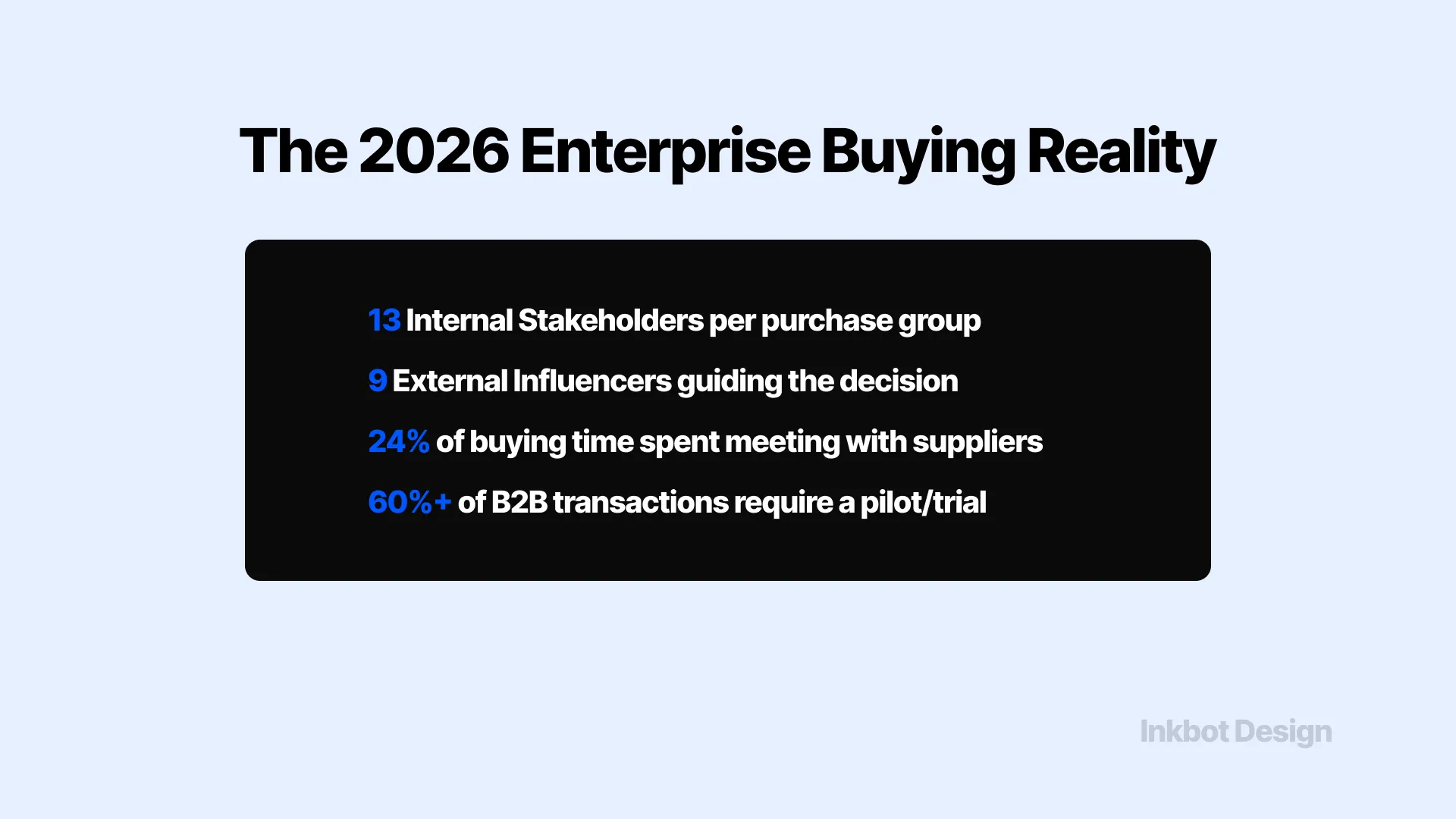
Buying groups need reusable internal evidence such as a business case, peer comparison, and a clear “why now” argument. This is especially important when stakeholders research independently or join the process late.
An evidence hand-off is material designed for one stakeholder to use with another. It reduces information asymmetry inside the buyer’s organisation.
Evidence hand-off | Primary user | Internal recipient | What it should accomplish |
|---|---|---|---|
Commercial case | Sponsor or finance lead | Executive approver | Explain investment logic, assumptions, and downside protection. |
Implementation plan | Operations or project lead | Users and leadership | Show workload, ownership, timing, and adoption safeguards. |
Security or compliance summary | IT or legal contact | Procurement or risk team | Clarify controls, requirements, and unresolved issues. |
Competitive comparison | Champion | Wider committee | Make selection criteria explicit without relying on vague claims. |
Positioning rationale | Marketing or managing partner | Partners or board | Connect the work to authority, differentiation, and commercial relevance. |
For professional services firms, competitive intelligence can make these hand-offs more concrete.
It helps a committee evaluate not only whether a provider is credible, but also whether maintaining the current position creates a measurable competitive disadvantage.
Match proof to the committee’s actual decision criteria
Different stakeholders use different filters. Different buying committee members evaluate the same purchase through different filters and trust thresholds. That does not mean creating six disconnected versions of the same story.
The aim is a single coherent argument with multiple points of entry.
A user needs to see that a new system or service will improve daily work rather than add friction. Finance needs assumptions that can be challenged without collapsing the business case.
Legal and procurement need clarity on obligations, terms, and process. Executives need strategic relevance and confidence that the decision can be defended.
When the messages conflict, the committee notices. For instance, promising rapid transformation to executives while presenting a high-resource implementation plan to operations creates distrust. Consistency is part of risk reduction.
More proof can create more friction
Fair warning: adding more stakeholders and more evidence does not always improve a deal.
Too many case studies can look like a substitute for relevance. A lengthy technical pack can raise new concerns that were not material to the decision. Bringing in every possible stakeholder too early can turn a focused commercial discussion into an unfocused discovery exercise.
Use additional proof when uncertainty is blocking progress. Avoid it when the committee already agrees on the decision criteria and simply needs a clear route to approval.
The same restraint applies to brand decisions. A committee considering a new name may not need twenty creative routes. It may need a documented method for judging distinction, credibility, legal feasibility, and future fit.
Clear brand-naming frameworks can reduce subjective debate by making decision criteria explicit before preferences take over.
Build a decision record, not just a sales presentation
The most useful document in a complex sale is often not a pitch deck. It is a decision record the buyer can take into an internal meeting.
A concise decision record should include:
- The business problem and cost of maintaining the status quo.
- The decision criteria agreed by the committee.
- The preferred option and relevant alternatives.
- Material trade-offs and risks.
- Implementation responsibilities and dependencies.
- Commercial assumptions and approval requirements.
- The specific decision needed next.
This is particularly valuable in UK procurement environments, where procedural legitimacy can be as important as stakeholder preference.
Requirements will vary by organisation and sector, so it is unwise to assume that a private-sector process applies to public bodies or regulated firms.
Ask what documentation, approvals, and competition requirements apply before positioning a preferred route as inevitable.
Conclusion
Buying committee psychology is best understood as a problem of collective risk management. The committee does not need every stakeholder to be equally enthusiastic.
It needs enough people to agree that the problem matters, that the proposed route is credible, that implementation is manageable, and that the decision can withstand internal scrutiny.
For decision makers, the goal is not to create more meetings or more collateral. It is to establish a clear decision process, expose hidden risks early, and give each stakeholder the evidence needed to support the recommendation with confidence.
Questions people ask
What is buying committee psychology?
Buying committee psychology is the study of how multiple stakeholders interpret value, risk, authority, and personal accountability when making a shared B2B purchasing decision. It focuses on collective behaviour, not simply individual buyer preferences.
How is a buying committee different from a single buyer?
A single buyer can make a decision using their own priorities and authority. A committee must create sufficient agreement across stakeholders with different incentives, levels of expertise, and exposure to failure. The result is often a greater need for process, evidence, and defensibility of decisions.
Why do buying committees delay decisions when everyone agrees there is a problem?
Agreement on the problem does not guarantee agreement on urgency, solution fit, budget, implementation capacity, or approval risk. A committee may also delay because no stakeholder is willing to publicly own the recommendation.
How can I identify the real decision maker?
Look beyond job title. Identify who controls the budget, who can veto the decision, who validates the risk, and who can authorise the next step. Ask how similar decisions were approved in the past and who would need to defend the purchase if it were questioned later.
How can I tell whether a champion has real influence?
A credible champion can explain the internal process, gain access to relevant stakeholders, and make an active recommendation based on your materials. Enthusiasm without these behaviours may indicate interest, but not influence.
What evidence helps a buying committee reach consensus?
The most useful evidence is transferable: a business case, an implementation plan, comparison criteria, a risk summary, and a clear rationale for acting now. Each item should help one stakeholder explain the decision to another.
What should I do when a hidden stakeholder blocks the deal?
Do not treat the objection as an inconvenience. Identify the stakeholder’s decision criteria, determine whether the concern is substantive or a proxy for wider uncertainty, and create a direct evidence hand-off. If access is impossible, ask the visible sponsor to validate the concern in writing and confirm what would resolve it.