Post-Merger Brand Identity Continuity: A 7-Point Trust-Transfer Test
A merged professional-services business can integrate its finance system, leadership team and sales pipeline on day one. Client trust does not work to the same timetable.
McKinsey & Company reported that global M&A value reached US$4.7 trillion in 2025, up 43% on the prior year, while deal volume stayed flat and the number of transactions worth at least US$10 billion reached 60.
That is a market that rewards visible scale, which is precisely why leadership teams feel pressure to unveil one new identity quickly.
That pressure can be expensive when the acquired firm’s name still reassures referrers, when its mark helps clients recognise familiar advisers, or when a local specialist reputation is doing work the combined business has not yet earned.
A logo is not a merger announcement. It is a recognition device.
For firms considering professional services logo design, the proper first question is not “what should the combined logo look like?”
It is “which trust signals can we afford to interrupt while the new business proves its promise?”
- Map legacy brand equity by audience and touchpoint before changing marks; identify which cues support commercial decisions.
- Use a staged transitional identity with explicit rules, owners, dates and use cases to preserve recognition where buyers feel risk.
- Retire legacy names only after measured equity transfer; set a retirement scorecard, metrics and owners to prove recognition and choice.
What does brand identity continuity protect after a merger?
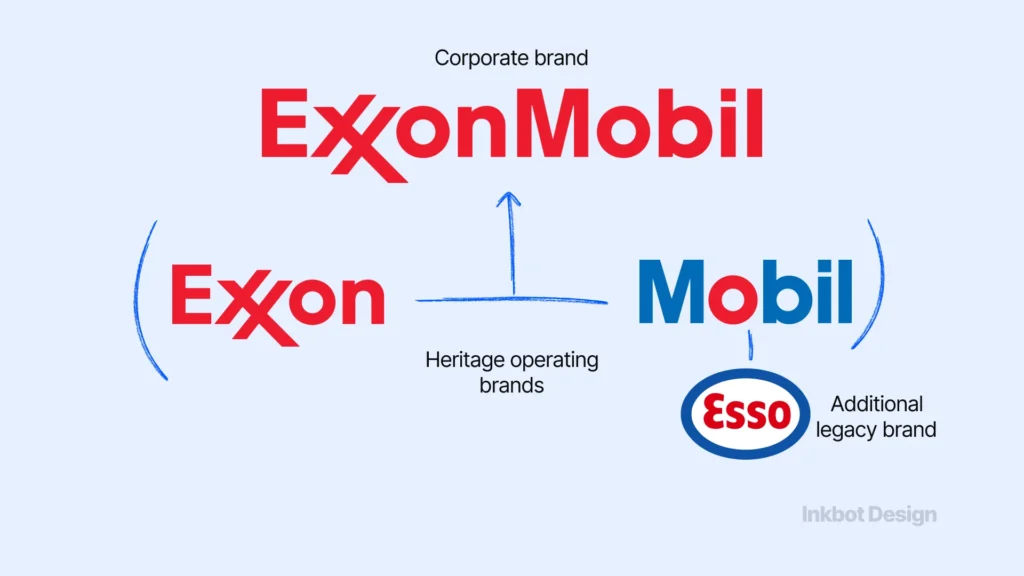
Brand identity continuity protects the associations that clients, referrers, candidates and employees already connect to competence, familiarity and lower perceived risk. It lets a combined business change its corporate promise without forcing every audience to relearn who the business is overnight.
- Brand identity continuity starts with externally held recognition, not the leadership team’s affection for an old logo.
- Brand identity continuity can retain a name, endorsement, colour, descriptor, symbol or partner-level cue while other parts of the identity change.
- Brand identity continuity ends only when the new business has earned recognition in the places where commercial decisions occur.
Brand identity continuity preserves earned recognition while a merged business transfers client trust from legacy brands to a new corporate promise.
Bain & Company estimated that global M&A deal value reached US$4.9 trillion in 2025, a 40% increase, with transactions worth more than US$5 billion contributing over 73% of the year’s increase in value.
Large transactions naturally create demand for a single investor narrative and a single operating model. The data does not say that every market-facing identity must disappear at the same speed.
A combined business may need a single legal entity, one CRM and one commercial plan from the closing date. Leadership should not mistake those operating milestones for evidence that a buyer, referrer or candidate has already transferred trust to the new name.
Map the equity before changing the mark
“Fine, but surely we know which brand is stronger.” Perhaps.
Senior partners tend to know which brand they prefer; that is not the same as knowing which associations buyers rely on when they shortlist, refer or renew.
Identify who holds the legacy equity.
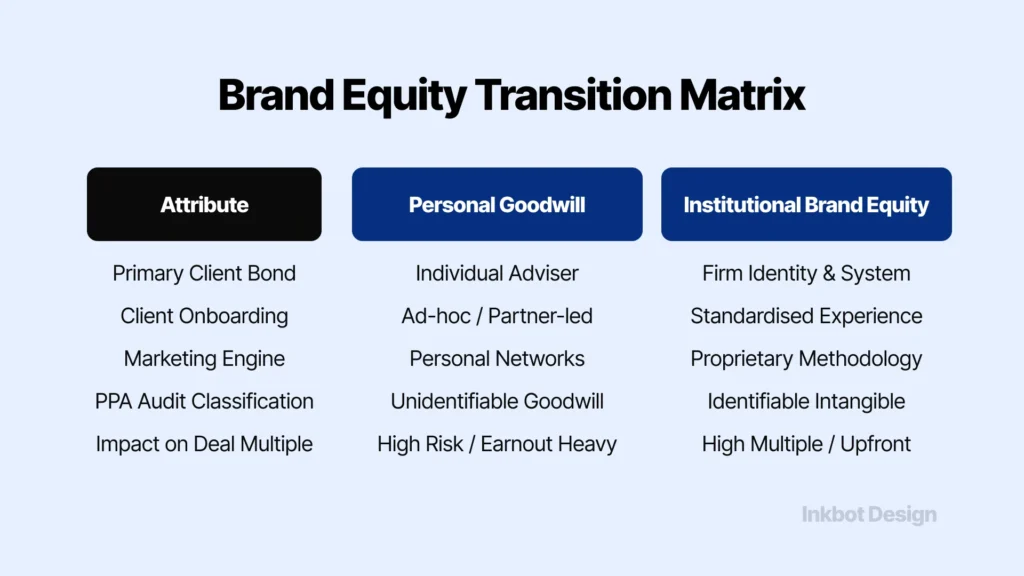
A post-merger equity map should name the audience, the commercial behaviour affected, the legacy cue that supports confidence, and the proposed replacement cue.
Start with clients, referral sources, prospective hires and existing employees. A corporate buyer may care about scale and breadth; a private client may care about the continuity of a trusted adviser; a referrer may care whether a specialist team still exists under the new name.
Do not average those views into one “brand score”. That muddies the decision.
A legacy identity can be weak with graduate recruits and highly valuable with the accountant who sends the firm ten instructions a year.
| Audience and situation | Equity likely to matter | Transitional identity decision |
| Existing retained client of a 12-partner tax practice | Familiar adviser names, specialist tax reputation, confidence that service remains personal | Keep the legacy practice descriptor beside the combined masterbrand on client communications |
| Referral partner introducing corporate work | Recognised specialist name and proof of sector expertise | Use an endorsement line and retain specialist proof points in referral materials |
| Procurement buyer assessing a national tender | Scale, governance, coverage and one accountable provider | Lead with the combined masterbrand and make the operating integration visible |
| Lateral senior hire | Career reputation, quality of colleagues and market standing | Explain the combined proposition, leadership model and practice-group continuity |
| Existing employee after acquisition | Team identity, role clarity and status | Use internal communications that show what remains, what changes and who decides it |
A useful equity map distinguishes recognition from preference.
Recognition asks whether an audience knows what a signal means.
Preference asks whether that meaning helps the firm win work, retain people or receive referrals.
A favourite internal logo can score highly on partner preference while holding little commercial value outside the boardroom. Happens more than anyone likes to admit.
Audit the places where trust is judged.
Professional-services buyers rarely form confidence from a homepage alone.
They see a proposal PDF, an engagement letter, a LinkedIn profile, an office sign, an industry event badge, a client portal login, or an introduction email from a referrer.
Each is a moment where the old and new promises either connect or conflict.
Map the top revenue and relationship touchpoints before any identity system is approved. Record the following for each one:
- The audience encounters it.
- The decision or reassurance it supports.
- The existing visual and verbal cues carry recognition.
- The new identity treatment that retains the mental link.
- The owner and date for transition.
Logo placement deserves more scrutiny than it receives.
In a tender cover sheet, a small legacy endorsement may reassure a buyer who knows the acquired specialist team; on a new-business campaign, that same endorsement may make the combined business look fragmented. The right answer changes by context.
A logo placement system should specify that hierarchy rather than leaving it to whichever colleague opens PowerPoint five minutes before the meeting.
Treat evidence as evidence.
Client interviews, referral-partner conversations, win/loss analysis, search-query data, CRM source data and recruitment feedback can all show whether a legacy identity carries commercial weight.
A partner saying “everyone knows us by that name” is a hypothesis. Test it.
“A merger creates a new corporate story, but a logo cannot force an audience to believe it. Trust transfers when the new business repeatedly proves that the people, expertise and standards associated with the legacy name still exist, now with a credible reason to choose the combined firm.”
Change the identity in layers, not with one reveal
“Surely a phased identity makes the merger look unfinished.” Only if it is unmanaged.
A poorly designed transition looks temporary because nobody has explained what is changing, why it is changing and when the old cue will leave. A deliberately staged system looks like governance.
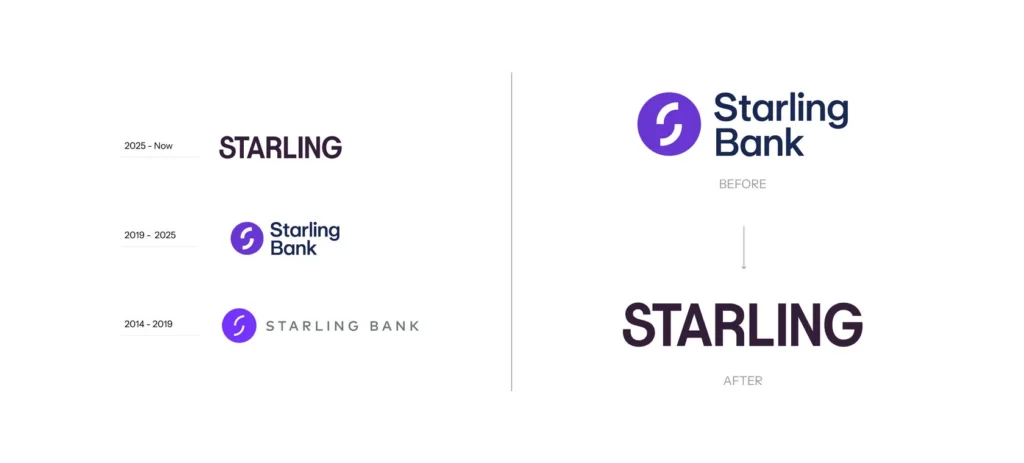
Decide what changes now.
Change the elements that need a unified commercial signal immediately: the corporate narrative, website architecture, leadership proposition, legal identity where required, and sales materials used to introduce the combined offer.
A shared masterbrand can make scale and expanded capability legible from the first announcement.
The visual system should then decide what remains visible as a bridge.
That might be an acquired specialist name in an endorsement line, a retained practice descriptor, an explicit “formerly” statement for a defined period, or familiar adviser and office-level cues.
The choice depends on the equity map, not on a universal formula.
A new masterbrand paired with a readable endorsement usually transfers equity more cleanly than a logo fusion trying to preserve every historic symbol.
Two marks squeezed together can communicate political compromise rather than a coherent offer. Design is not diplomacy.
Use a transitional identity with rules.
A transitional identity needs dates, owners and use cases. Without those, “temporary” becomes a three-year accumulation of mismatched email signatures, old templates and staff improvisation.
Create a transition register that specifies:
| Identity component | Change now | Retain temporarily | Retirement condition |
| Corporate name | Adopt the combined legal and commercial name | Use “formerly [legacy name]” where recognition is proven to matter | The new name is recognised in client and referral feedback |
| Logo | Introduce the masterbrand mark | Retain the legacy mark only where an endorsement is approved | Touchpoint audit confirms consistent masterbrand recognition |
| Practice descriptors | Standardise practice naming | Retain specialist descriptors that identify real capability | Clients understand the new service architecture |
| Digital estate | Launch the combined site and redirect priority pages | Preserve legacy URLs and search pathways during migration | Search and referral traffic reach the intended combined pages |
| Templates and proposals | Replace core new-business templates | Keep approved legacy-to-new bridge templates for relationship teams | Revenue teams no longer need legacy recognition to explain the firm |
| Physical estate | Update high-visibility reception and event material | Sequence lower-risk local assets by cost and audience exposure | Local client and employee communication is complete |
This is also where a broader logo design system matters. The mark must work alongside typography, colour, templates and digital components across the actual operating environment.
A beautiful symbol that becomes unreadable in a client portal favicon or awkward in a co-branded event backdrop is a design problem with commercial consequences.
Put continuity where buyers feel risk.
Continuity should be most visible where a buyer is deciding whether the transaction has changed the service they receive.
Existing-client communications, referrer introductions, proposal cover pages, team biographies and practice pages usually deserve more care than a celebratory social-media reveal.
Consider the causal chain. A long-standing client recognises the acquired firm’s specialist name. The combined business removes that name from a renewal proposal without explaining the relationship.
The client spends time working out whether the advisers’ expertise or service model has changed. That uncertainty adds friction. The competitor’s proposal now feels easier to accept.
The answer is not to preserve every old artefact indefinitely. The answer is to place an approved bridge at the points where uncertainty would otherwise be created, then measure whether it remains necessary.
For digital use, the same logic applies to dynamic logos: variation is useful only when the core recognition cues survive across contexts. A post-merger identity should not ask clients to decode a different version of the firm at every interaction.
“Won’t a phased identity make us look indecisive?”
A phased identity makes a firm appear indecisive when the phase lacks a declared purpose.
It looks disciplined when leadership can state: “The combined business is operating under one masterbrand from today; this legacy descriptor remains in client and referral communications until the recognition transfer is complete.”
McKinsey & Company found that the 2025 M&A value was driven by larger transactions even as total deal volume remained flat. That pattern gives leadership teams a rational reason to demonstrate integration. It does not turn speed into proof of brand value.
The intelligent case for rapid consolidation is straightforward:
- A single name can reduce sales friction when the combined offer is genuinely integrated.
- A single identity can reduce duplicated marketing and technology costs.
- A unified brand can reassure investors, national procurement teams and future recruits that the transaction has strategic intent.
Those benefits matter. The error is treating them as evidence that a local specialist’s reputation, acquired practice name, or referral signal has no remaining work to do.
Use a fast corporate transition and a measured market-facing transition where the equity map requires it. That is not hesitation. It is risk management with visible rules.
Retire legacy signals only after equity has transferred.

“Then how long do we keep the old identity?” Until the business can demonstrate that the new identity performs the recognition job without it. Not until the launch-party photographs have been uploaded.
Set a retirement scorecard before launch, with named owners and decision dates.
For example, the commercial director can review renewal feedback and referral-source questions each quarter; the digital lead can monitor whether searches for the acquired practice reach the combined site and relevant experts; the people lead can track candidate questions about practice continuity.
The actual thresholds must reflect the firm’s revenue mix and available data. The rule does not change: a legacy name leaves only after priority audiences can find, understand and choose the combined business without using it as a decoding aid.
Logo design costs in the UK should therefore be assessed as part of the transition cost, not merely the price of creating a new mark.
Budget for template replacement, signage sequencing, website migration, client communication, governance and the time needed to make the new promise credible.
The logo follows the transfer of trust.
A merger can require one business to act quickly. It does not automatically require one visual identity everywhere on the same date.
McKinsey & Company and Bain & Company both describe a 2025 M&A rebound powered heavily by larger deals, which helps explain the pressure to present a unified organisation.
The better leadership question is narrower and more useful: whose trust currently depends on the legacy identity, where they encounter it, and what bridge will enable the combined firm to earn that trust under its new name?
Start with an equity-transfer map before anyone presents logo concepts.
If you need an external view of where recognition is helping (or costing) the business, request a free Brand Equity Audit™. It identifies where the brand is losing commercial ground and what to do about it.
FAQs
Should a professional-services firm rebrand immediately after a merger?
No — not automatically. A combined business may need a single corporate name and operating model immediately, while clients and referrers still rely on the acquired firm’s identity as a trust signal. Rebrand at the pace that transfers recognition, using approved endorsements or descriptors where evidence shows the legacy cue still reduces buyer uncertainty.
How do you measure brand equity transfer after an acquisition?
Brand equity transfer is measured by whether priority audiences recognise, understand and choose the combined firm without relying on legacy identity cues. Use client and referral feedback, branded-search performance, proposal conversion, retention signals, recruitment response and recurring questions from relationship teams. Set these measures before launch so legacy assets are retired against evidence rather than opinion.
What should remain from an acquired firm’s identity during a transition?
The acquired firm should retain only the identity elements that support a documented commercial behaviour: a specialist descriptor that reassures referrers, a practice name that helps clients locate expertise, or a “formerly” endorsement that preserves recognition. Every retained element needs a use case, owner and retirement condition; otherwise, temporary identity becomes unmanaged clutter.
Is a “formerly” endorsement bad for a merged brand?
No — a “formerly” endorsement is useful when a recognised legacy name helps clients or referrers understand continuity of people, expertise or service. A “formerly” endorsement becomes harmful when it lacks an end date, appears at every touchpoint regardless of audience, or distracts from a combined proposition that is already understood and trusted.
Does a new logo help communicate post-merger integration?
Yes — a new logo can make a combined business visibly coherent when it sits within a clear name, proposition and identity system. A new logo cannot, by itself, establish that advisers, specialist knowledge, or service standards remain dependable. The logo should express an integration story that the operating business can substantiate in proposals, client meetings and delivery.
When can a firm remove the acquired company’s name?
A firm can remove an acquired company’s name when priority audiences recognise the combined business, find the right expertise without the legacy cue, and show no material confusion in client, referral or recruitment feedback. The timing should follow pre-agreed retirement criteria, not an arbitrary anniversary or the last remaining piece of stationery.
Why does logo placement matter after a merger?
Logo placement determines which identity a client sees first and which identity supplies reassurance in a high-stakes moment. A combined masterbrand may lead a new-business proposal, while a legacy specialist descriptor appears as a secondary cue for an existing client. Placement rules prevent colleagues from creating contradictory transitions across documents, websites and events.
