B2B Website Architecture Framework for Professional Services Firms
A B2B website architecture framework is the wrong starting point for most law firms.
The brand positioning entirely determines the architecture, and most firms do not have a clear enough positioning to make a single architecture decision answerable to it.
Managing partners frequently commission website rebuilds costing five figures and then, six months later, face the same problem: the site looks newer but still fails to communicate why the firm deserves the mandate over its equally credentialled competitors.
The rebuild was the wrong intervention. The website is a symptom.
The architecture question is unanswerable until the positioning question is answered first.
That said, once positioning is established, the architectural decisions follow a clear sequence.
This guide covers that sequence – the specific layers of a strategic web design framework built for professional services firms in a buying environment where AI systems are increasingly shaping which firms’ clients ever consider.
- Resolve Positioning architecture first; it determines every downstream decision and prevents visually new but commercially foggy websites.
- Prioritise visible authority signals above the fold, clear multi-persona navigation, and a staged conversion architecture matched to buyer intent.
- Implement entity architecture: schema, atomic claims, and focused site structure; fewer than twenty deep pages to win AI citations and shortlists.
What Is a B2B Website Architecture Framework?
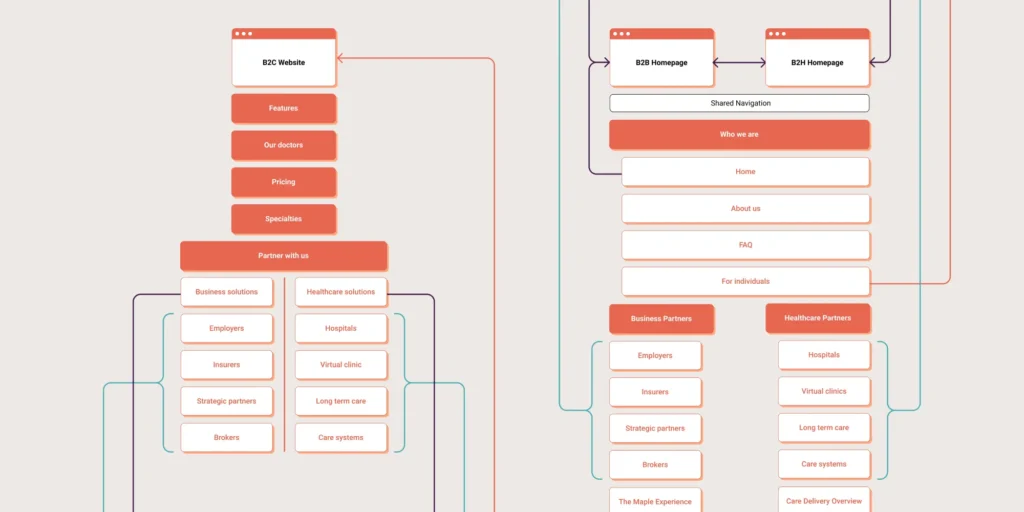
A B2B website architecture framework is the structural system that determines how a professional services website organises its content, navigation, and conversion pathways to serve the buying process of a multi-stakeholder commercial client.
Key components:
- Positioning layer – The foundational architecture decision: what the firm stands for, whom it serves, and what it will not do
- Authority signal hierarchy – The structural communication of credentials, sector expertise, and matter type experience before a visitor reads a single word.
- Intent-based navigation – Page structure and linking are designed around the specific questions a buying committee asks at each stage of evaluating a professional services firm
- AI citation architecture – Schema markup, entity signals, and content structure that allows AI systems to extract and surface the firm’s expertise in response to client queries
A B2B website architecture framework for professional services firms structures a website around buyer intent, authority signals, and entity positioning to support commercial decisions – not just page navigation.
The Brand Positioning Problem That Architecture Cannot Fix
Architecture decisions are downstream of positioning decisions. Full stop.
A law firm that cannot answer “why should a mid-market manufacturing company with an international dispute instruct us over Eversheds Sutherland?” cannot structure a website around that answer. The homepage headline, the service page structure, the case study selection, and the expertise signalling – every architectural decision requires a prior positioning decision to make it answerable.
This is the specific failure mode that produces the endless cycle of website rebuilds in professional services. The agency presents wireframes. The partnership debates navigation labels. Nobody asks the prior question. The site goes live looking different but communicating the same fog.
According to research by 6Sense (2025), as reported by Corporate Visions, typical B2B purchases involve teams of approximately 10 people, with 10 distinct decision-maker roles represented. 52% of buying groups include VP-level decision-makers or above. 79% of purchases require CFO approval.
In a law firm context, this means the website is being evaluated not by one individual but by a buying committee – and each member of that committee is asking a different question. Architecture serves those questions. But only positioning can answer them.
A professional services website that cannot communicate a clear positioning claim within three seconds of arriving on the homepage has failed its primary architectural test. The question is never “does the site look professional?” Every firm’s site looks professional. The question is “Does the site communicate what kind of firm this is?” Most cannot answer yes. That is a positioning failure wearing a design costume.
The 5-Layer Architecture for Professional Services Websites
A B2B website architecture framework for professional services firms operates across five distinct layers. Each layer depends on the one below it.
Building the layers out of sequence produces the most common failure mode: technically correct sites that commercially underperform.
Layer 1: Positioning Architecture – The Foundation No One Builds First
Positioning architecture answers the question every visitor is implicitly asking: “Is this the kind of firm that handles my kind of problem?” It is not a tagline. It is the total structural signal communicated by the combination of sector focus, matter type emphasis, case outcome prominence, and client type specificity visible before any navigation occurs.
Most law firm homepages communicate “full-service firm” positioning by default – not by design. The result is a site that appeals to nobody specifically.
Positioning architecture requires a deliberate narrowing: which sectors, which transaction types, which client size, which geographic reach. These decisions determine every downstream architecture choice.
Layer 2: Authority Signal Hierarchy – What Gets Seen Before It Gets Read
Authority signal hierarchy is the structural decision about what a visitor sees and processes before they read a word. Visual weight, placement, and prominence of specific elements – deal values, sector credentials, individual partner expertise, award recognition, client logos – communicate authority before conscious evaluation begins.
Nielsen Norman Group (NN/g), the UX research consultancy, has documented extensively that users form first impressions within milliseconds of page load and spend the majority of their viewing time above the fold.
For professional services websites, this means the authority signals in the top half of the homepage determine whether the visitor proceeds to evaluate the firm at all.
The wrong approach: generic “expertise” claims with stock imagery—the right approach: a specific, named, quantified signal of what the firm has actually done.
“Acting for the acquirer in a £340m manufacturing sector cross-border M&A transaction” is architecture. “Deep expertise across multiple sectors” is not.
Layer 3: Multi-Persona Navigation – Serving Three Audiences Without Diluting One
Law firm websites serve at least three distinct audiences with incompatible needs: direct commercial clients evaluating the firm for a current matter, referrers (other professional advisers) assessing whether to send work, and prospective lateral hires evaluating the firm as an employer.
Most sites attempt to serve all three from a single navigation structure and end up serving none of them well.
Multi-persona navigation addresses this by creating separate journey architectures for each audience – not by creating separate sites, but by structuring content and linking paths that allow each visitor type to self-select their journey within the first two clicks.
The structure required: a homepage that speaks to the direct client as the primary audience (since this audience has the highest commercial value), with clearly signposted secondary paths for referrers and talent audiences.
Each path should resolve to audience-specific proof: client outcomes for direct clients, referral case stories for professional advisers, culture and career signals for lateral hires.

Layer 4: Conversion Architecture – The Next Step Must Match the Buyer’s Position
Conversion architecture in professional services is not about call-to-action button placement. It is about ensuring that the next step offered to a visitor is appropriate to where they are in their evaluation process.
A first-time visitor arriving from an AI Overview result has not yet established trust. Asking them to book a call is premature. It signals a sales-first culture that many managing partners of boutique firms regard with suspicion.
The appropriate conversion for early-stage visitors is a lower-commitment signal: a diagnostic tool, a written briefing, or a direct email option that does not require a call.
The conversion ladder for professional services websites runs: awareness contact (email or enquiry) → scoping call → formal proposal.
Each stage requires different architecture decisions. A site that offers only “get in touch” – the most common call-to-action in professional services – has collapsed the conversion ladder into a single rung and is losing a substantial proportion of buyers who are not yet ready for a conversation but would be within thirty days.
Layer 5: Entity Architecture – The Layer That Determines Whether AI Systems Find You
Entity architecture is the newest and least understood layer of B2B website architecture frameworks for professional services firms.
It determines whether AI systems – Google’s Knowledge Graph, AI Overviews, Perplexity, ChatGPT – can accurately identify, describe, and surface the firm in response to prospective client queries.
Entity architecture operates through schema markup (structured data that tells AI systems what the organisation is, what it does, who leads it, and what credentials it holds), internal linking patterns (which communicate topical authority through the relationship between pages), and content structure (atomic claims that AI systems can extract as standalone answers).
A firm without an entity architecture in 2026 is effectively invisible to the AI-mediated discovery process, which is now accounting for a significant and growing proportion of professional services research activity.
Entity architecture is not a technical add-on to a professional services website. It is the parallel communication layer through which AI systems form their understanding of what a firm is and whom it serves. A firm that has not deliberately structured its entity signals has allowed AI systems to draw their own conclusions – and those conclusions are almost always a reversion to generic, undifferentiated descriptions that do not support premium positioning.
The Myth That More Pages Build More Authority
Building out a large volume of content pages was once a legitimate growth strategy for professional services websites. Between 2010 and 2020, Google’s ranking systems rewarded sites with large content footprints, treating volume as a proxy for expertise.
This is now wrong. It is not nuanced. It is wrong.
Google’s Helpful Content System, strengthened significantly through its 2024 core updates, now penalises sites where a large proportion of content is assessed as written primarily for search engines rather than genuine readers.
For professional services firms – where the typical content footprint consists of thin practice area descriptions, generic legal commentary, and near-identical “our team” profiles – this penalty is structural, not marginal.
The replacement directive is straightforward: a professional services website should have fewer than 20 pages, each of which can answer the question “what does this page communicate about what kind of firm this is?” If a page cannot answer that question, it should be consolidated or removed before any new content is created.
A single, deeply authoritative practice area page – with named matter experience, named partners, named client outcomes, and structured schema – outperforms twenty thin sub-pages for both search visibility and commercial conversion.
B2B Website Architecture in 2026: The AI Search Reality
The search environment in which professional services firms need to perform has changed more significantly in the past eighteen months than in the previous decade. The architectural implications are not optional additions to a standard framework. They are the framework.
According to data compiled by Digital Applied, 64.82% of Google searches now end without a click – a figure that has climbed from approximately 50% in 2019.
AI Overviews now appear in 18% of global searches and, according to Marketing Agent, reduce organic click-through rates by 18% in searches where they are present. When AI Mode is active on a search, the zero-click rate reaches 93%.
This means the majority of prospective clients researching professional services firms are now forming their evaluation – including which firms they consider – without visiting any website at all. The AI system’s answer is the first impression. The website is the second.
For a B2B website architecture framework in 2026, this has three direct implications.
Implication 1: The website must win the AI citation first. A firm whose website is not structured to be extracted and cited by AI systems is not competing in the primary channel through which prospective clients now form shortlists. Entity architecture, schema markup, atomic content claims, and structured FAQ content are not technical SEO considerations. They are the first layer of business development.
Implication 2: Authority signals must be communicable without a click. The content that AI systems extract and surface in Overviews and AI Mode answers is drawn from structured, atomic claims on the website. A firm whose expertise is communicated only through dense, unstructured paragraphs, PDF brochures, or gated content is invisible to AI extraction. Named matter experience, named credentials, and named sector expertise – structured as standalone declarative sentences – is what gets cited.
Implication 3: SEO strategy is now shifting from keyword-based to entity and intent-based. Ranking content across the professional services sector is now determined less by keyword frequency and more by whether the site is recognised as an authoritative entity for a defined topical area. Clean internal linking, topic depth, and consistent entity signals (firm name, practice areas, partner names, sector expertise) matter more than exact keyword matching.
Law firm websites that were built on the standard agency brief – responsive design, practice area pages, partner profiles, news section – are structurally unequipped for this environment.
Not because the design is wrong. Because the architecture was designed for a search environment that no longer exists.
The firms that will win premium mandates through digital channels in 2026 and beyond are those whose websites are built as entity communication systems first, content repositories second, and visual presentation third.
B2B Website Architecture: Decision Table
| Decision Point | The Wrong Way | The Right Way | Why It Matters |
|---|---|---|---|
| Homepage positioning | “Full-service firm offering advice across all areas of law” | Named sector focus + specific matter type + client size signal | Buyers self-select; vague positioning produces vague enquiries |
| Authority signal placement | Testimonials buried in a case studies section | Named deal values / matter outcomes above the fold on the homepage | First impression is formed before scrolling; authority signals must be visible immediately |
| Navigation structure | Single navigation serving all visitor types equally | Primary path for direct clients; signposted secondary paths for referrers and talent | Each audience evaluates on different criteria; merged navigation serves none well |
| Conversion CTA | “Get in touch” as sole call to action | Staged conversion ladder: low-commitment diagnostic → scoping call → proposal | Most first-time visitors are not ready for a call; removing the intermediate step loses them |
| Content volume | 150+ pages including thin sub-practice descriptions | Fewer than 20 deeply authoritative pages with named matter experience | Google’s Helpful Content System penalises thin content volume; depth beats breadth |
| Schema markup | None, or auto-generated from plugin defaults | LegalService, Organization, Person schema with named credentials and explicit service scope | AI systems read schema before page content; no schema means AI defaults to generic descriptions |
| Internal linking | Navigational links only | Topic-cluster linking communicating entity relationships between practice areas, partners, and sectors | Internal link patterns communicate topical authority to both Google and AI crawlers |
The Compliance and Accessibility Layer
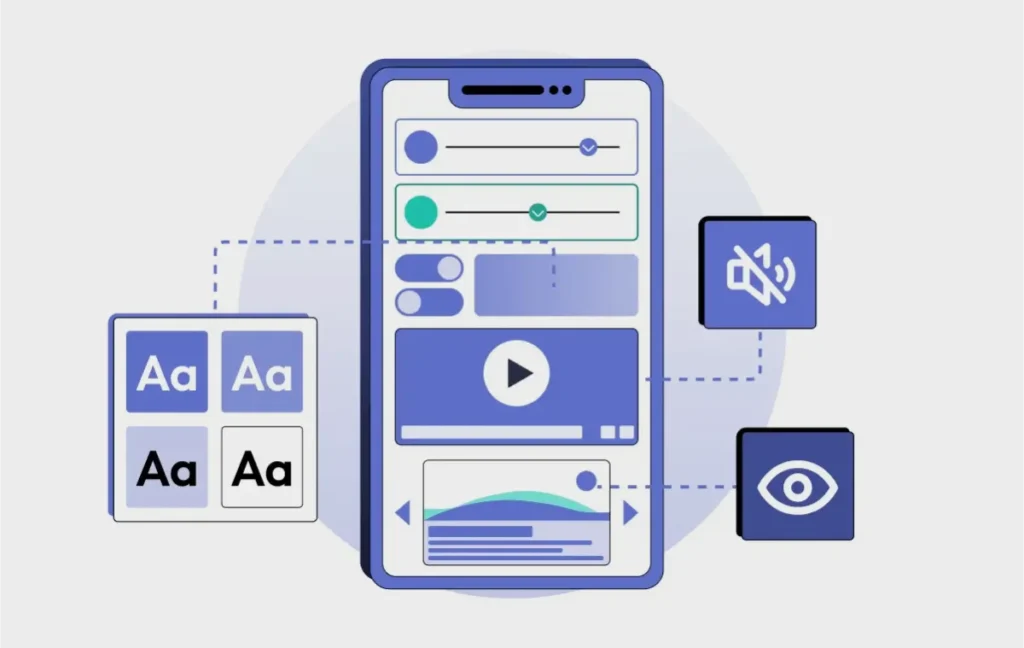
An ADA-compliant website design is not a separate project appended to the architecture process. Accessibility requirements shape fundamental architectural decisions: heading hierarchy, navigation structure, form labelling, colour contrast, and alternative text protocols.
For UK law firms, this is not only a user experience consideration. The Equality Act 2010 applies to digital services, and a firm whose website is demonstrably inaccessible to disabled clients faces reputational and legal exposure incompatible with the authority the architecture is designed to support. A firm claiming expertise in employment law or discrimination matters, whilst operating an inaccessible website, faces a specific credibility problem.
Accessibility architecture should be specified at the information architecture stage, not retrofitted during QA. The cost of getting it right from the start is substantially lower than the cost of addressing accessibility failures after build.
The Verdict
Most law firms are in the wrong conversation about their websites. They are debating navigation labels, homepage layouts, and content strategy when the prior question – what does this firm stand for and for whom – has not been answered.
Architecture built on unresolved positioning produces websites that look different and perform identically to their predecessors.
The B2B website architecture framework outlined here is not a template. It is a sequence.
Positioning architecture first.
Authority signal hierarchy second.
Multi-persona navigation third.
Conversion architecture fourth.
Entity architecture fifth.
Building the layers out of sequence is the single most reliable way to produce a website that satisfies its agency brief and fails its commercial purpose.
In 2026, there is an additional imperative. The search environment has shifted to the point where a significant majority of prospective clients are forming their evaluation of professional services firms through AI-mediated answers – without visiting any website.
A firm whose site is not structured for AI citation is not only failing at digital marketing; it is also failing at AI. It is absent from the primary channel through which premium-mandate buyers now form their shortlists.
If the firm’s current website cannot answer, within three seconds of landing on the homepage, what kind of firm it is and what kind of client it serves best, the architecture problem is the least of its concerns.
The brand work comes first. Then the architecture. Then the website.
If you want to know precisely where your firm’s brand is losing commercial ground – before commissioning another rebuild – request a free Brand Equity Audit™.
It is a structured diagnostic that identifies the positioning gaps, authority signal failures, and entity architecture deficiencies that no website project can solve on its own.
Frequently Asked Questions
What is a B2B website architecture framework for a professional services firm?
A B2B website architecture framework for a professional services firm is the structural system that governs how the website organises content, navigation, and conversion pathways to support a multi-stakeholder buying process. It operates across five layers: positioning architecture, authority signal hierarchy, multi-persona navigation, conversion architecture, and entity architecture.
Why do law firm website rebuilds frequently fail to improve client acquisition?
Law firm website rebuilds fail because they address the symptom – the site’s appearance and navigation – rather than the underlying problem. When positioning is unclear, no architecture decision is answerable. The result is a visually updated version of the same commercial fog. Brand positioning must be resolved before architecture decisions can produce commercial results.
How many pages should a professional services website have?
A professional services website should have fewer than twenty deeply authoritative pages. Google’s Helpful Content System penalises large volumes of thin, undifferentiated content. A single, deeply structured practice area page with named matter experience, named credentials, and schema markup outperforms twenty thin sub-pages for both search visibility and client acquisition.
What is entity architecture in a B2B website context?
Entity architecture is the structured communication of an organisation’s identity, expertise, and credentials to AI systems through schema markup, internal linking patterns, and atomic content claims. For professional services firms in 2026, entity architecture determines whether AI Overviews, Perplexity, and other AI search systems can accurately identify and surface the firm in response to prospective client queries.
How should a law firm website handle multiple audience types?
A law firm website should serve direct commercial clients as the primary audience – since this audience has the highest commercial value – with clearly signposted secondary navigation paths for professional referrers and prospective lateral hires. Each path should resolve to audience-specific proof rather than generic firm information.
What is the correct sequence for B2B website architecture decisions?
The correct sequence is: (1) resolve brand positioning, (2) establish authority signal hierarchy, (3) design multi-persona navigation, (4) build conversion architecture, (5) implement entity architecture. Building layers out of this sequence – most commonly starting with visual design before positioning is resolved – produces the most common website failure mode in professional services.
How does AI search change B2B website architecture requirements in 2026?
AI search changes B2B website architecture requirements in three ways: websites must be structured for AI citation first (since the majority of research now occurs without a click), authority signals must be communicable through atomic, extractable content claims, and SEO strategy must shift from keyword-based to entity and intent-based to remain competitive.
What schema markup should a law firm website use?
A law firm website should implement the LegalService schema (identifying the firm’s practice areas and service scope), the Organisation schema (firm name, location, founding date, jurisdiction), and the Person schema for named partners (credentials, areas of practice, professional history). The auto-generated schema from plugin defaults is insufficient; it should explicitly reflect the firm’s positioning and expertise.
When should a professional services firm rebuild its website versus reposition its brand?
When a professional services firm’s website is generating insufficient or low-quality enquiries, the priority should always be brand positioning work, not a website rebuild. If the firm cannot articulate its positioning clearly enough to write a specific, differentiated homepage headline, a new website will not solve the commercial problem.
What does accessibility architecture mean for a law firm website?
Accessibility architecture means integrating WCAG compliance requirements – heading hierarchy, navigation labelling, colour contrast, form accessibility, and alternative text – at the information architecture stage rather than as a retrofit. For UK law firms, the Equality Act 2010 applies to digital services; an inaccessible website exposes them to reputational and legal risks.
How should conversion architecture differ for professional services firms versus SaaS companies?
Professional services conversion architecture must account for longer sales cycles, higher deal values, and the relationship-sensitivity of instructions. Aggressive conversion mechanisms (timed pop-ups, chat widgets, high-pressure CTAs) signal a sales-first culture that most premium-fee professional services buyers regard with suspicion. Conversion architecture should offer a staged ladder: low-commitment diagnostic or direct email → scoping call → formal proposal.
What is the single most important architectural decision for a law firm website in 2026?
The single most important architectural decision for a law firm website in 2026 is the positioning architecture – the explicit commitment to whom the firm serves, what type of work it does, and what it will not do. Every other architectural decision flows from this one. A firm without a clear positioning architecture cannot make any other architectural decisions that produce commercial results.
