
Logo Design Cost in the UK: Why the Number Is the Wrong Question
A logo does not cost “£X.” It costs whatever it takes to make the right decision before anyone opens design software, produce a mark distinctive enough to own, and deploy it consistently everywhere your firm meets a client.
Ask 10 UK designers what a logo costs and you will get answers between £500 and £100,000+ — all honest, all describing genuinely different purchases.
The number is not a useful question. The useful question is what the investment is meant to solve, and what it costs your firm if it fails.
That distinction matters most to the buyer with the most at stake: a professional services firm about to spend heavily on a rebrand.
If you lead a 60- or 150-person practice preparing for a growth phase, an acquisition, or a repositioning, the logo is the cheapest line on the invoice and the one that constrains every other expensive line.
Get the cheap decision wrong, and you have pre-committed the costly ones to a mistake.
- Price alone is the wrong question; focus on what the investment must solve and the cost if it fails.
- Different prices buy different jobs: AI or DIY produce files; agency projects buy research, differentiation, accountability and rollout.
- Resolve positioning before design; readiness not budget dictates appropriate spend.
- Underspend constrains costly rollouts; overspend formalises unvalidated decisions. Match spend to commercial stakes.
- Design fees exclude legal costs. Budget for clearance searches and UK IPO trade mark registration to protect ownership.
How Much Does Logo Design Cost in the UK?
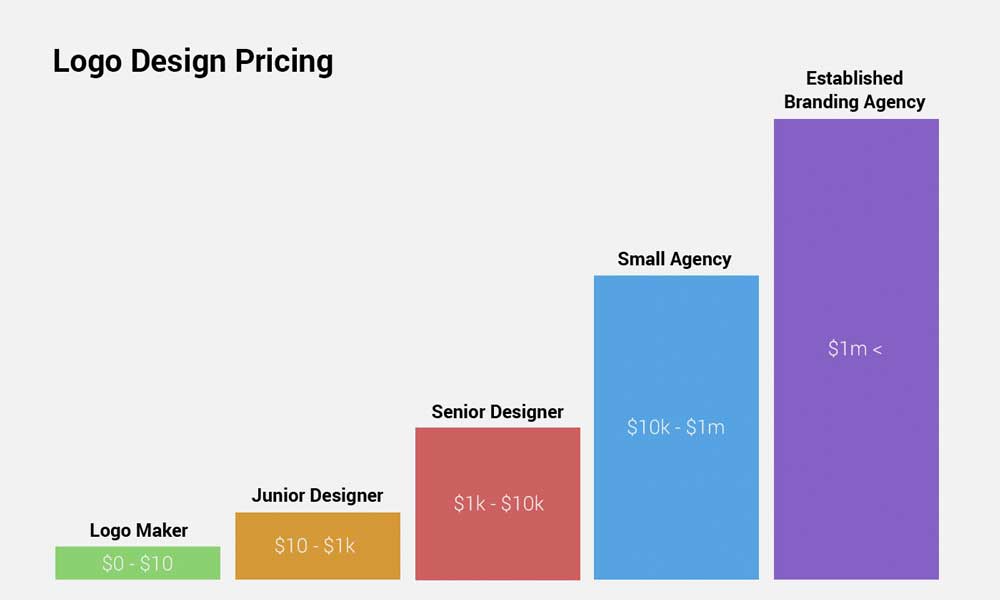
Logo design cost in the UK runs from £0–£100 for DIY or AI-generated marks to £500–£3,000 for a custom standalone logo, with full brand identity systems reaching £2,000–£10,000+ in 2026.
There is no official UK dataset that records what businesses actually pay — the ranges come from published 2026 market guides, not from a survey.
- A basic bespoke freelance logo typically sits at £500–£1,000.
- An agency-led logo project with research and strategic input runs £2,000–£3,500+.
- A strategic rebrand or complex rollout — positioning, architecture, governance — starts around £10,000 and climbs with scope.
Logo design in the UK typically costs £500–£3,000 for a standalone custom logo and £2,000–£10,000+ for a full brand identity system in 2026.
If you want the professional-services-specific view of what that buys, our professional services logo design guide breaks it down by firm type.
Why the Price Range Is So Wide It Looks Broken
The prevailing explanation is a supplier ladder, and it is worth stating at its strongest because intelligent buyers rely on it.
- DIY tools cost £0–£50.
- A marketplace designer runs £50–£300.
- A freelancer sits at £300–£1,500.
- An agency charges £2,000–£50,000+.
A named brand agency starts higher still. Searchers expect these bands, and they are broadly accurate as an orientation. If all you need is to know roughly where you sit, the ladder does its job.
Here is where it stops working.
That spread of £0 to £10,000-plus is not one product at different quality settings. The Office for National Statistics offers a clue as to why the bottom rung collapsed: by June 2026, around 35% of UK businesses with 10 or more employees reported using at least one AI technology, and 16% reported using AI for visual content creation.
AI compressed the cost of producing a first visual idea to near zero. It did nothing to the cost of deciding what a brand should stand for, checking it is genuinely distinctive, or preparing a mark to reproduce across a website, signage and print.
So the ladder measures the wrong axis. It sorts by who makes the file.
What actually varies across that range is the amount of thinking, differentiation and accountability behind the file — and those are the things that determine whether the mark survives contact with your market.
Two logos at £800 and £8,000 are not the same object priced differently. They are different jobs.
The Mistake Isn’t Overpaying — It’s Mispricing the Risk
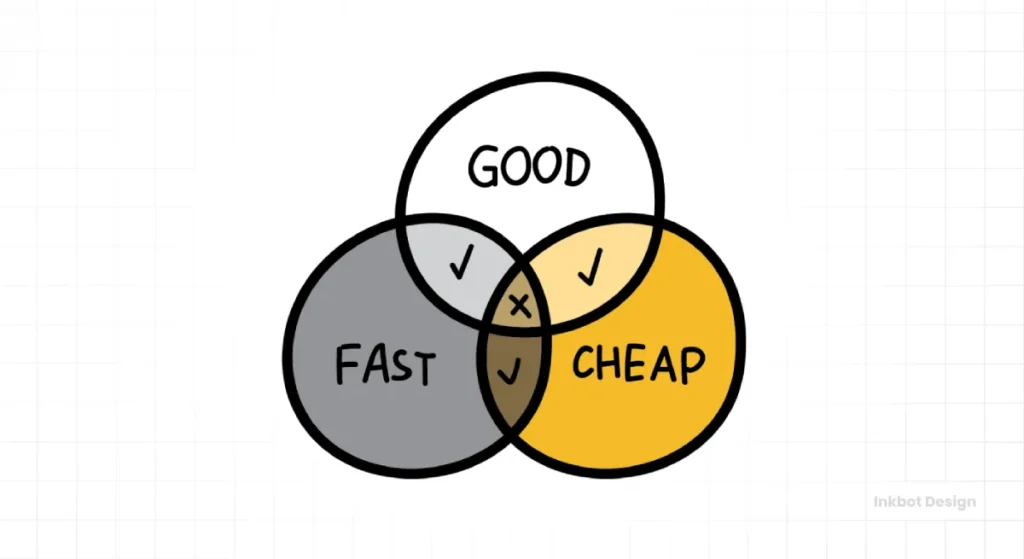
The expensive error in logo buying is rarely paying too much for a nice mark. It is spending the wrong amount for the commercial stakes involved — in either direction.
Consider the direction nobody warns you about: underspending when the brand has to carry weight.
A £150 logo is entirely rational for a one-person side project that needs a credible presence by Friday. It becomes irrational the moment a firm commits £20,000 to signage, vehicle livery, a new website, sales collateral and exhibition graphics — because the cheapest decision in the project now governs every costly application built on top of it.
You do not discover the mark was wrong until it is printed on the office wall and stitched into the pitch deck. The logo was £150. Unwinding it costs a rebuild.
The reverse error is just as real, and this is where honest advice has to run counter to a designer’s own commercial interests.
A £10,000 identity programme is not automatically better value for a business that has not yet resolved itself. If a firm has not validated its audience, its offer, its name or its market position, it is paying to formalise decisions that will move within six months.
Overinvestment does not buy insurance. It buys a beautifully documented version of a question the business has not answered.
“A logo is the cheapest component of a rebrand and the one every expensive component depends on. Firms do not overpay for logos nearly as often as they underpay for the decision the logo is supposed to settle — and then pay for that decision three times over in signage, print and lost pitches.”
The sceptical reader will object here: this is a branding agency telling me branding matters — of course it does. Fair. So test it against the mechanism rather than the messenger.
A logo’s job is to reduce the risk that a client misreads who you are at the moment they decide whether to trust you with a high-stakes instruction. If your positioning is clear and the mark expresses it, the client’s perceived risk drops and your fee premium becomes defensible.
If the positioning is unresolved, no amount of spending on the mark fixes it — you are decorating an unanswered question.
That is why readiness, not budget, is the first variable. The money follows the decision; it cannot replace it.
What Inkbot Design Charges — and Why There’s No Standalone Logo Price
Inkbot Design does not sell logo design as a standalone purchase, and that omission is the argument of this article made into a pricing model.
A logo arrives as part of a fixed-fee strategy engagement, not as a standalone line item. The reasoning is the one running through everything above: a mark produced before positioning is resolved is a decision made in the wrong order, so we price the decision, not the file.
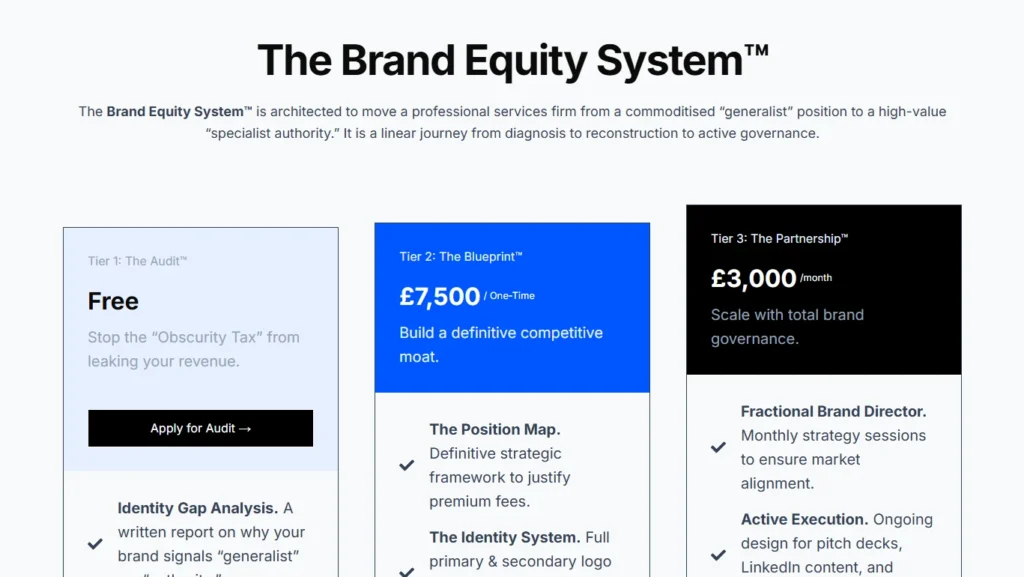
We operate transparent, fixed-scope engagements designed specifically for ambitious professional-services practices and growing UK businesses:
- Brand Equity Audit™ (Complimentary): A written diagnostic delivered within 48 hours from a brief analysis, identifying where current brand touchpoints may be undermining client trust or deflating fee positioning.
- Brand Equity Blueprint™ (£7,500 fixed fee): A complete 4–6 week strategic and visual transformation. Includes core market positioning, primary and secondary logo architecture, typography, colour systems, verbal identity, and digital master assets.
- Brand Equity Partnership™ (£3,000/month): Dedicated ongoing brand governance, rollout support, and design leadership for established firms scaling across multiple sectors.
That £7,500 figure is the honest answer to “what does Inkbot Design charge for a logo,” and it deliberately refuses the question’s framing.
You are not buying a £7,500 logo. You are buying the strategic architecture that tells the logo what to say — the difference, in my terms, between a beautiful mark that loses pitches and one engineered to justify a premium fee.
For a professional services firm at the £20,000 rollout stage, that is the level the earlier decision table points to: agency-led work where research and senior oversight reduce the risk that the cheapest asset constrains every expensive one.
Which Level Does Your Firm Actually Need?
The right spend is the one aligned with the commercial stakes and your business’s readiness, not with your revenue.
A settled microbusiness with a clear offer may need £800. A 120-partner firm about to reposition ahead of acquisition may need a full identity system because counterparties, not just clients, will scrutinise the mark.
| The Default Approach | What It Costs | The Better Approach | Why |
| Buy the cheapest mark that looks fine | £0–£150 upfront; a rebuild later | Match spend to downstream rollout value | The logo constrains £20k of applications; pricing it as the smallest line ignores its leverage |
| Buy the most expensive package available | £10,000+ | Confirm the business is resolved first | Formalising an unvalidated offer documents a decision that will change |
| Pick a supplier by day-rate comparison | Variable | Pick by decision-making depth included | Two quotes at the same price fund different amounts of discovery and accountability |
| Treat logo and identity as one purchase | One conflated fee | Separate the mark from the system | A standalone logo suits a settled small firm; a system suits a business needing consistency at scale |
| Defer positioning until after design | Rework fees | Resolve positioning before design opens | Positioning is the input to design, not an output of it |
I watched this play out with Northbrook & Co., a wealth management firm that came to Inkbot Design wanting to shed a faceless, big-bank image for something that read as a personal powerhouse — serious financial expertise with boutique care.
Rather than diving straight into logo concepting, the engagement prioritised positioning:
- Strategic Reframing: Moving away from standard financial clichés (candlestick charts and generic shields) toward a visual identity grounded in architectural stability and legacy.
- Asset Suite Deployment: Developing an authoritative typography hierarchy, deep navy and slate-gold colour palettes, and a comprehensive master mark suite adapted for executive pitch decks and physical investor memorandums.
- Outcome: By formalising their brand assets before their full digital launch, the partners secured two institutional relationships during pre-launch networking. The strategic visual identity gave them immediate parity with established market competitors.
The temptation with three founders from different corporate backgrounds is to design first and argue about it later.
We did the opposite: resolved the positioning — away from the aggressive graphs-and-pound-signs cliché, toward the grounded permanence you see in architecture and law — before committing to a wordmark.
Deep navy and slate gold for authority, warm white for transparency.
The system was delivered two months ahead of the launch schedule, and Northbrook went on to secure early-stage partnerships before their website was even live.
I won’t claim the wordmark closed those deals — three credible founders and their networks did most of that. What the identity did was let them walk into those rooms already looking like a firm that belonged there, rather than a start-up asking to be taken seriously.
The lesson was not that they spent more. It was spent in the right order.
I’ve led brand identity projects for professional services firms across 21 countries for more than 17 years. The pattern is consistent: firms rarely regret the amount they spent on a logo. They regret the sequence in which they spent it.
What Changed in 2026: AI at the Bottom, Trade Marks at the Top

The UK logo market split in two this year, and a professional services buyer needs to budget for both ends. AI hollowed out the bottom. Trade-mark filings hit records at the top.
AI is real but shallower than the coverage implies. The ONS reports that among AI-using UK firms, the average number of AI technologies used rose only modestly to around 1.6 by June 2026, and just 10% described their use as extensive.
AI can provide a rough starting point more cheaply. It cannot make the result distinctive, legally clear or ready to reproduce across every channel a firm actually uses.
“I generated a logo in ten minutes” and “I own a distinctive, protectable brand asset” are different claims.
At the top, protection activity hit records. The UK Intellectual Property Office received 203,195 trade-mark applications in 2025, up from 107,526 in 2019 — a rise of roughly 89% in six years.
March 2026 alone saw 22,506 applications, the highest monthly total on record. The market for brand assets is getting more crowded, which raises the stakes on distinctiveness.
A mark that merely looks acceptable is a weaker commercial position when 200,000 firms a year are staking claims to their own.
What the Design Quote Doesn’t Include
The design fee is rarely the whole bill, and the line people forget is legal.
Trade-mark registration is a separate process from design, not a substitute for it, and not compulsory for every microbusiness.
A design invoice covers the creation of visual intellectual property, but statutory ownership requires registration through the UK Intellectual Property Office (UK IPO).
With UK trade mark filings reaching record volumes, conducting clearance searches and securing formal registration is essential before committing capital to major physical and digital rollouts.
Official UK IPO Fees (from 1 April 2026)
- Standard Online Application (Single Class): £205
- Additional Class Fee: £60 per Nice classification class
- Paper Application (if applicable): £250 for the initial class
- Right Start Examination Service: £125 upfront (+ £30 per additional class) with balance due upon formal progression.
Note: UK IPO fees are statutory government charges payable directly to the IPO and are separate from agency creative fees or independent trade mark attorney search disbursements.
The UK IPO raised its fees on 1 April 2026. Online filing now costs £205 for one class, plus £60 for each additional class. That sits entirely outside any design quote.
For a firm about to put a name on signage, tenders and a national rollout, budgeting for clearance searches and, where appropriate, registration is not overhead — it is the difference between owning your identity and hoping nobody else claimed it first.
The Verdict
Spend is not the variable that separates firms that regret their rebrand from those that don’t. Sequence is.
Across every band from £150 to £10,000-plus, what you are buying is a level of decision-making, differentiation and implementation matched — or mismatched — to what your firm has at stake.
For a professional services firm heading into a rebrand, the first move is not requesting quotes. It is about establishing whether your positioning is sufficiently resolved to design against.
Start there with a free Brand Equity Audit™ — a written diagnostic that identifies exactly where your brand is losing commercial ground before you commit a pound to design.
FAQs
How much does a professional logo cost in the UK in 2026?
A custom standalone logo typically costs £500–£3,000 in the UK, according to published 2026 market guides. Basic freelance work sits at £500–£1,000; agency-led projects with research and strategy run £2,000–£3,500+. Full brand identity systems reach £2,000–£10,000+. No official UK average exists.
Why do UK logo prices vary so much?
The range reflects different jobs, not different quality settings on one product. A £150 mark funds file creation; a £5,000 project funds discovery, differentiation, a usable logo suite and accountability. AI compressed the cost of a first visual idea, widening the gap between generating a mark and owning a distinctive brand asset.
Is it worth paying for an agency over a freelancer?
Yes — when the commercial stakes justify it. An established firm competing in a crowded category or preparing for acquisition benefits from strategic input and senior oversight that a solo freelancer rarely provides. A settled microbusiness with modest needs usually does not. Match spend to stakes, not to available budget.
Do I need to trademark my logo in the UK, and what does it cost?
No — registration is not compulsory for every business. It is a separate legal process from design. The UK IPO online filing fee is £205 for one class plus £60 per additional class from 1 April 2026. Firms investing heavily in a name and rollout should budget for clearance separately from the design fee.
When should a firm invest in a full brand identity rather than just a logo?
When the business needs consistency across many touchpoints and its positioning is resolved. A standalone logo suits a settled small firm; a full identity system suits a business rolling out across websites, signage, tenders and collateral. If the offer or audience is still unvalidated, formalising it early risks paying to document decisions that will change.
