Accounting Firm Branding Strategy: Start With the Clients You Want
Accountancy firm branding should start with the clients you want to serve. This guide explains how partners can define their preferred client portfolio, establish a credible market position, develop a recognisable identity, implement the strategy and measure commercial progress. The aim is better-fit work, not simply more enquiries.
 By Stuart Crawford
 Reviewed by Tabitha Ayers
16 min read

On this page16 min left
- What should an accounting firm branding strategy achieve?
- Which clients and engagements should your accountancy practice attract?
- How should an accountancy practice turn its strengths into market positioning?
- What should an accountancy firm's brand communicate?
- How should an accountancy practice implement its branding strategy?
- How can partners measure whether their branding investment is working?
- How much should an accounting firm invest in branding, and when is a rebrand unnecessary?
- The client portfolio is the real measure of a successful accountancy brand
- Questions people ask
An accountancy practice can have amazing partners, experienced staff and a reputation built over decades, yet still lose work to a competitor that looks more credible before the first meeting.
That gap deserves attention.
An accounting firm's branding strategy should establish which clients the practice wants, what expertise makes it relevant to those clients, and how the firm's identity and communications should demonstrate that value. The commercial objective is a better-fit client portfolio, not simply more enquiries.
Hinge Research Institute's 2020 accounting and financial services buyer study reported an association between high client relevance ratings and an 82% higher likelihood of being highly recommended.
For partners considering accountancy firm branding, the order of decisions matters. Decide what kind of practice you intend to build first. Then determine how the market should recognise it.
What should an accounting firm branding strategy achieve?

An accounting firm branding strategy should define the practice's intended market position, identify the clients it wants to attract, establish the evidence supporting its expertise and translate those decisions into a consistent identity and client experience.
The strategy should help partners answer three commercial questions:
- Which clients and engagements are worth pursuing?
- Why should those clients choose this practice over an alternative?
- What must change in the firm's presentation to communicate that difference?
The distinction matters because a practice can look more modern without becoming more attractive to its preferred clients.
A new logo does not automatically communicate specialist tax knowledge. A redesigned website cannot resolve disagreement between partners about whether the practice wants to serve owner-managed businesses or larger corporate groups.
The strategy must first resolve those commercial questions.
The five components of a commercially useful accountancy brand
A working strategy connects five elements:
- Commercial direction: The type of practice the partners intend to build.
- Client selection: The organisations and decision-makers the practice wants to serve.
- Market positioning: The particular expertise and value the practice can credibly claim.
- Brand expression: The visual identity, language and digital presentation communicating that position.
- Client experience: The way the practice meets the expectations set by its brand.
Each component has a different job. Confusing them leads to expensive work being commissioned in the wrong order.
A practice with a weak proposition needs strategic clarification. A practice with a clear proposition but inconsistent design may need an identity refresh. A practice with both may simply need better implementation.
The appropriate investment follows the diagnosis.
Which clients and engagements should your accountancy practice attract?

An accountancy practice should choose its preferred client portfolio before commissioning a new brand identity. The decision should reflect the practice's capabilities, commercial objectives, available capacity and the types of engagement partners want to deliver.
This is the most consequential part of the process.
A practice might generate a healthy volume of enquiries but still struggle to increase profitability. The problem could be the composition of its client base rather than its visibility.
Consider a hypothetical 12-partner chartered accountancy practice.
The partners have historically served owner-managed businesses across general compliance, bookkeeping, payroll and year-end accounts. The practice now wants to increase its proportion of advisory engagements with established businesses.
The branding project cannot begin with a discussion about colours.
It needs a commercial brief.
Start with the work the partners want more of
List the services the practice currently provides and assess each against the direction the partners want to pursue.
A useful starting matrix looks like this:
Engagement type | Commercial question | Branding implication |
|---|---|---|
Annual accounts and tax returns | Is this still a desired core service? | Communicate reliability and compliance expertise. |
Management accounts | Does the practice want more recurring advisory relationships? | Explain the value of timely financial information. |
Virtual finance director services | Does the practice have the people and capacity to deliver? | Demonstrate strategic financial expertise. |
Corporate tax planning | Does the practice have a credible team of specialists? | Present specific tax capabilities and relevant evidence. |
Business sale and succession advice | Does the practice want larger, more complex engagements? | Communicate transaction experience and senior partner involvement. |
Payroll administration | Does this support the intended client relationship? | Present it as a supporting service where appropriate. |
Payroll might be a profitable, strategically important service for one practice. For another, it may consume capacity that partners would rather allocate to advisory work.
The partners need to make that distinction themselves.
Identify the clients behind the preferred engagements
Service categories alone do not provide enough direction.
A practice offering corporate tax planning needs to know which organisations it is equipped to serve. A technology start-up approaching its first funding round has different requirements from an established manufacturing business preparing for an acquisition.
Define the preferred client in terms of operational and commercial characteristics.
Selection criterion | Questions for the partners |
|---|---|
Business stage | Start-up, established SME, expanding group or corporate? |
Sector | Which industries can the practice genuinely serve well? |
Complexity | What level of financial, tax or reporting complexity suits the team? |
Decision-maker | Owner-manager, finance director, CFO or board? |
Engagement | Compliance, recurring advisory, project work or transaction support? |
Capacity | Can the practice deliver the work without compromising existing clients? |
Commercial fit | Does the expected engagement justify the resources required? |
The last question is uncomfortable in some partnership discussions.
A long-standing client might be commercially attractive because of its history, relationship or referral potential. Another might generate recurring work while requiring disproportionate attention from the partner.
Branding cannot resolve those economics. The partners need to decide what the practice values.
Use client evidence rather than partner preference alone
Partner opinions are useful starting points, but they are not sufficient evidence of market demand.
Review existing client records, proposal outcomes, engagement profitability and referral sources. Speak with clients who represent the kind of relationship the practice wants to develop.
Ask questions that expose the buying decision:
- What prompted you to appoint the practice?
- Which alternatives did you consider?
- What made the practice credible?
- Which services do you value most?
- What would make you consider moving to another accountant?
- What additional support would be commercially useful?
A practice may discover that clients value a particular partner's sector knowledge more than the firm's general reputation.
That finding has branding implications. The expertise needs to become visible in the firm's positioning, content and sales material rather than remaining hidden in individual relationships.
Decide which enquiries the practice should stop pursuing
This is the part many branding projects avoid.
A practice cannot communicate a clear market position while trying to appeal equally to every possible buyer. The website ends up listing every service, the messaging becomes generic, and the identity has no clear commercial audience.
That does not mean publicly rejecting clients.
It means deciding where the practice should concentrate its resources.
A 12-partner practice targeting established businesses with complex financial needs may decide that very small, price-sensitive bookkeeping enquiries are no longer a priority.
Its marketing should reflect that decision through the services emphasised, the language used and the examples presented.
The partners should record three categories:
- Priority clients: The organisations the practice actively wants to attract.
- Acceptable clients: Relationships that remain commercially and operationally suitable.
- Deprioritised enquiries: Work that no longer supports the intended direction.
“A brand attracts attention, but its commercial value depends on whose attention it attracts. A practice that increases enquiry volume without considering the suitability of engagement can make its sales process busier while leaving the underlying business problem untouched. The partners should judge the brand against the work they want to win, not the number of people who fill in a contact form.”
When should the practice not narrow its audience?
A newly established practice, a generalist regional firm or a practice with substantial unused capacity may need a broader market position.
Specialisation should follow actual expertise, demand and delivery capability. A firm should not invent a sector speciality because a competitor appears to be doing well with one.
The detailed considerations involved in accountancy niche specialisation deserve their own examination.
How should an accountancy practice turn its strengths into market positioning?

An accountancy practice should translate its preferred client profile into a specific market position supported by demonstrable expertise. The position must explain why the practice is relevant to its intended buyers and provide a credible reason for them to consider it.
A list of services is not a position.
Neither is a statement about being professional, approachable or trusted. Those qualities are expected of an accountant. They do little to distinguish one practice from another.
The work is to connect a specific client problem with a capability the practice can prove.
Find the difference between what the practice does and what clients value
Consider two hypothetical descriptions.
Description A:
A chartered accountancy practice offering accounts preparation, taxation, payroll, bookkeeping and business advisory services to businesses across the UK.
Description B:
A chartered accountancy practice helping established manufacturing businesses improve financial control, prepare for growth and make better-informed investment decisions.
The first describes a service catalogue.
The second describes a client, a business context and the expertise being offered.
Description B is not automatically better. The practice must actually possess the manufacturing knowledge, advisory capacity and relevant evidence to support the claim.
That is the important test.
Build a proposition using four pieces of information
A practical positioning statement can follow this structure:
Element | What the partners must establish |
|---|---|
Intended audience | Which type of organisation is the practice addressing? |
Client problem | What specific financial or commercial problem does that organisation face? |
Practice capability | What expertise can the practice bring to that problem? |
Supporting evidence | What proves that the practice can deliver? |
A hypothetical example:
We help established manufacturing businesses improve financial visibility and prepare for expansion through management accounting, corporate tax advice and strategic financial support.
The proposition becomes credible only when supported by evidence such as relevant partner experience, service delivery examples, demonstrable qualifications and appropriate client outcomes.
Do not publish claims about savings, growth or transaction success without substantiation.
Make expertise visible rather than relying on adjectives
A prospective client cannot independently assess a practice's technical capabilities from a homepage that describes the team as experienced and dedicated.
Specific evidence is more useful.
For example:
- A named partner's relevant professional qualifications.
- Demonstrable experience within a defined industry.
- A documented case study with client permission.
- The types of business problems the team is equipped to address.
- The services provided at different stages of business development.
- Clear descriptions of the people responsible for delivering engagements.
This is particularly relevant when a smaller practice competes against larger accountancy brands.
A larger competitor may have greater market recognition, but recognition is not identical to suitability. A smaller practice can make its particular expertise, partner involvement and service model easier to evaluate.
The brand must give buyers enough information to make that comparison.
Establish a consistent position across the practice
Partner alignment is a practical requirement.
If one partner describes the practice as a traditional regional accountant, another promotes it as a corporate advisory specialist, and a third wants to become a technology-sector consultancy, the market receives conflicting signals.
The solution is a documented positioning decision.
The partners should agree:
- The primary client audience.
- The priority services.
- The principal commercial proposition.
- The evidence supporting the proposition.
- The secondary audiences the practice remains willing to serve.
- The claims the practice will not make.
The positioning statement should be short enough for partners to use consistently, but detailed enough to guide design and communications.
For a deeper examination of the advisory transition and how the practice communicates that change, see accounting firm brand positioning.
Do not confuse relevance with an invented specialism
The Hinge Research Institute study supplied in the brief associates high relevance ratings with stronger recommendation and loyalty outcomes.
The strategic lesson is narrower.
“Buyers need to recognise why a particular accountancy practice is relevant to their circumstances. A proposition that identifies a genuine client problem provides more information than a generic claim about quality.”
A practice should therefore prioritise relevance it can substantiate over specialisation it cannot deliver.
What should an accountancy firm's brand communicate?

An accountancy firm's brand should communicate its market position through a recognisable visual identity, clear language, relevant proof and a client experience consistent with the promises made before appointment.
The visual identity is important. It is simply not the first decision.
Once the partners have agreed their commercial position, the design system needs to express it.
Visual identity should support the chosen position
A chartered accountancy practice competing for established corporate clients may need a different presentation from a small local practice serving individuals and microbusinesses.
The difference should be grounded in the audience and service model, not a designer's personal preference.
The identity system should establish:
- Logo and brand marks.
- Colour palette.
- Typography.
- Graphic language.
- Photography and imagery.
- Document and presentation templates.
- Digital design principles.
- Rules governing consistent application.
A professional identity should be recognisable across the firm's website, proposals, engagement documents, reports, presentations and physical communications.
A logo that works beautifully on a website but becomes illegible on a proposal cover has not been properly considered.
The same applies to typography, colour contrast and document layouts. Accountancy firms produce a substantial amount of information-heavy material. Readability matters.
Brand messaging should explain the commercial value
The language should help a prospective client understand what the practice does and whether it is relevant to them.
Compare:
Providing professional accountancy services with a personal touch.
With:
Helping owner-managed businesses understand their financial position, manage tax obligations and plan their next stage of growth.
The second communicates more about the relationship and work involved.
The actual proposition should reflect the practice's capabilities. Advisory services should not be advertised simply because they sound more attractive than compliance work.
The Thomson Reuters Institute's 2025 State of Tax Professionals Report, as summarised in the supplied evidence, reports that 75% of surveyed tax professionals perceived strong client demand for additional tax and business advice.
Make partner expertise part of the brand
Professional services brands have an important characteristic: buyers often appoint people as much as they appoint an organisation.
A practice's partners, directors and senior specialists should be visible where their involvement supports the proposition.
This could include:
- Partner biographies explaining relevant expertise.
- Articles addressing specific client problems.
- Commentary on relevant tax or business developments.
- Documented case studies.
- Speaking engagements and professional contributions.
- Clear explanations of the people responsible for client relationships.
A partner biography should communicate what that individual knows and the work they are qualified to undertake.
A photograph and a list of professional letters after someone's name are not enough.
The website must reflect the brand, not carry the entire strategy
The website is an important point of evaluation, but it cannot compensate for an unclear commercial position.
A prospective client should be able to identify the practice's audience, relevant expertise, service offering, partner credentials and next step without working through a maze of generic service pages.
The detailed requirements for accounting firm website design are covered in the dedicated digital-presence article.
The same principle applies to LinkedIn profiles, proposal documents, email signatures and printed material.
The brand is experienced across the relationship. Consistency makes it easier for a prospective client to recognise the practice and understand what it offers.
How should an accountancy practice implement its branding strategy?

An accountancy practice should implement its branding strategy through an agreed project brief, a defined identity and messaging system, controlled rollout and internal adoption.
Existing client recognition and professional obligations should shape the implementation plan.
A project should have a named decision-maker.
Without one, every design decision becomes a partnership discussion. That can become expensive very quickly.
Establish ownership and approval before design begins
Agree the following:
Project area | Required decision |
|---|---|
Commercial direction | Managing partner or agreed partnership leadership |
Positioning | Partner group approval |
Brand strategy | Agreed strategic brief |
Visual identity | Design approval by designated decision-makers |
Website and digital content | Named marketing or project owner |
Client communications | Partner and compliance review |
Rollout | Defined implementation responsibility |
A 50-partner firm will probably need more formal governance than a five-partner practice. The underlying requirement is the same: everyone should know who has authority to approve the work.
Develop the identity before commissioning every application
The core identity and messaging should be agreed before producing dozens of templates.
A sensible order is:
- Approve the positioning and brand proposition.
- Approve the visual identity.
- Establish brand guidelines.
- Design priority client-facing materials.
- Update the website and digital channels.
- Roll out internal and external communications.
- Review adoption and consistency.
The practice should prioritise materials that influence prospective-client decisions.
For example, a corporate accountancy practice competing for larger engagements may prioritise its website, proposal documents, partner presentations and case studies before updating internal stationery.
A small regional practice may have different priorities.
Protect existing recognition during a refresh or rebrand
A full rebrand is not automatically necessary when an identity looks dated.
The partners should establish what recognition already exists, what clients value and whether the problem is visual presentation or a more fundamental positioning issue.
A refresh may be appropriate where the existing name and position remain relevant, but the identity needs improvement.
A full rebrand may be justified where the practice has changed its ownership, service mix, audience or commercial direction sufficiently that the existing brand creates confusion.
If the practice has merged with another accountancy firm, the decision becomes more complicated.
Brand architecture, legacy recognition and client communication need their own consideration. See accountancy firm rebranding.
Give employees a reason to use the new brand
Employees need to understand the proposition, not simply receive a PDF of brand guidelines.
A practice might introduce a new advisory position but continue using old proposal templates that describe the business primarily as a compliance provider.
The inconsistency weakens the investment.
Staff should understand:
- Which clients the practice is targeting.
- What the practice wants to be recognised for.
- How to describe the priority services.
- Which claims are supported by evidence.
- How the new identity should be applied.
The brand needs to work in everyday communications, not just in the launch announcement.
How can partners measure whether their branding investment is working?
Accountancy partners should measure branding against the commercial objectives established before the project begins.
Relevant indicators include enquiry suitability, proposal conversion, engagement mix, client retention and the proportion of work coming from the intended target market.
The correct measurement depends on the original problem.
If the practice wants to attract larger advisory engagements, website traffic alone is a poor indicator of success.
A rise in visits does not tell partners whether the right organisations are considering the practice.
Establish a baseline before changing the brand
Record the existing position.
At a minimum, the partners should establish:
Metric | What it tells the practice |
|---|---|
Qualified enquiries | Whether prospective clients match the preferred profile |
Proposal conversion | Whether suitable opportunities progress to appointment |
Average engagement value | Whether the mix of work is changing |
Advisory revenue share | Whether the intended service mix is developing |
Client retention | Whether existing relationships remain stable |
Referral source | Which relationships generate suitable opportunities |
Website conversion | Whether relevant visitors take the intended next step |
Define each metric before collecting data.
For example, a qualified enquiry should have an agreed definition. It might require a target-sector organisation, an appropriate decision-maker and a service requirement the practice can deliver.
Without a consistent definition, the figures become difficult to compare.
Connect the measurement to engagement economics
Partners should go further than counting suitable enquiries.
A practice targeting more advisory work needs to understand whether those engagements are actually being won and delivered profitably.
A useful measurement chain is:
Brand exposure → relevant enquiry → qualified opportunity → proposal → appointment → engagement value → client retention.
Each stage provides different information.
A rise in relevant enquiries, accompanied by poor proposal conversion, might indicate a pricing issue, a weak sales process, or insufficient evidence of expertise.
Strong proposal conversion accompanied by low engagement profitability might indicate that the practice is winning the wrong type of work or underpricing delivery.
Branding is only one part of the commercial system.
Give the measurement period enough time
Do not judge a brand project solely by the first few weeks after launch.
Some changes, such as improved proposal consistency, can be assessed relatively quickly. Others, such as referral patterns and engagement mix, may require longer observation.
Compare equivalent periods where possible and account for seasonal differences in tax, accounts and business advisory demand.
The partners should agree review points before the project begins.
Otherwise, the temptation is to interpret every positive movement as evidence of success and every disappointing figure as a temporary problem.
Neither is a serious measurement method.
How much should an accounting firm invest in branding, and when is a rebrand unnecessary?
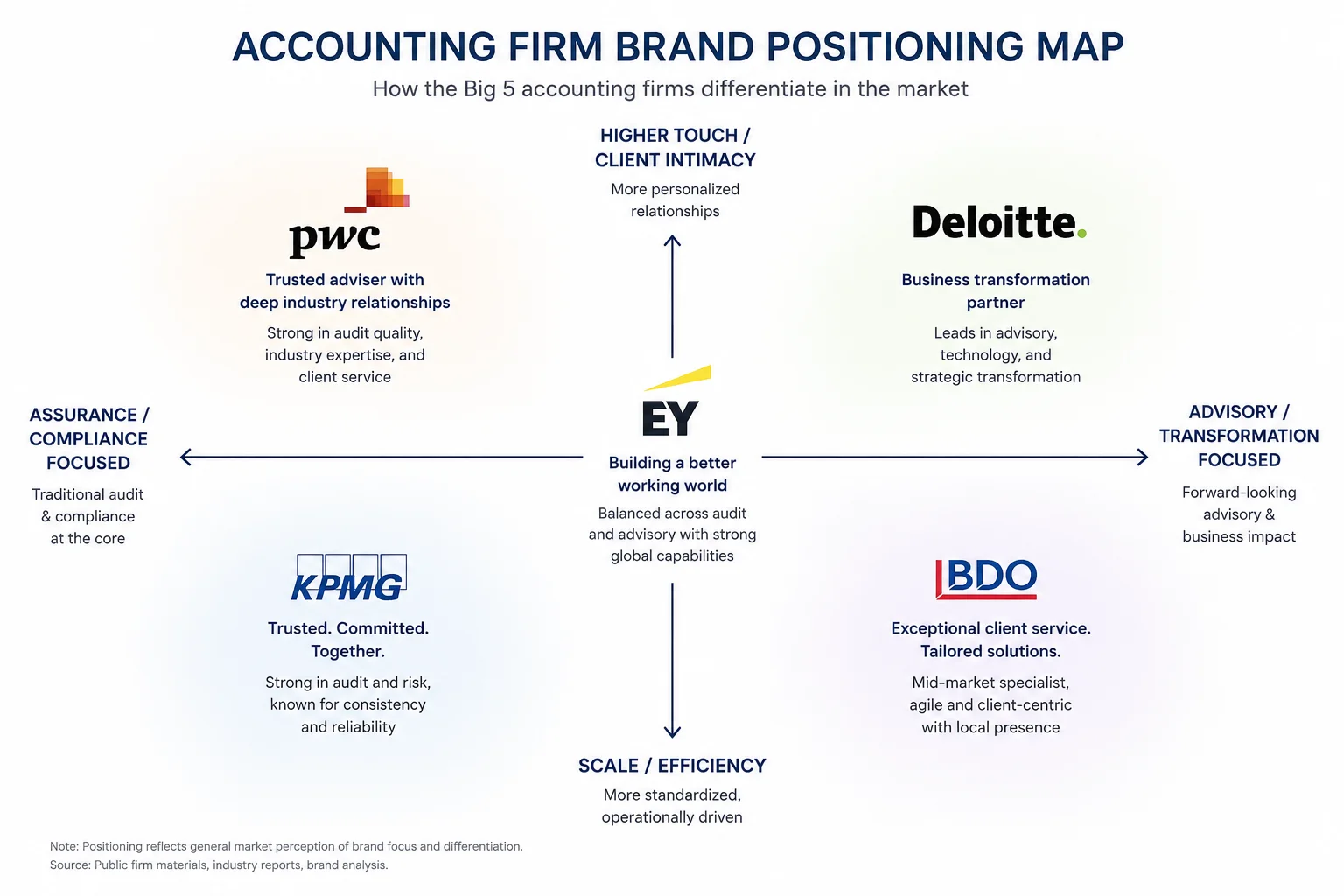
An accountancy firm should determine its branding budget from the commercial scope, complexity and implementation requirements of the project rather than applying an arbitrary percentage of annual turnover.
A five-partner practice refreshing its identity has different requirements from a 50-partner firm repositioning after a merger.
The project brief should define what is included.
Possible cost components include:
- Research and stakeholder interviews.
- Brand strategy and positioning.
- Naming and brand architecture, where required.
- Logo and visual identity development.
- Brand guidelines.
- Website design and development.
- Photography and content.
- Proposal and presentation templates.
- Implementation and rollout.
- Ongoing brand management.
These are separate workstreams. A quote covering logo design should not be compared directly with a project covering research, strategy, identity and website implementation.
Decide whether the problem requires strategy, a refresh or a rebrand
Situation | Appropriate starting point |
|---|---|
Partners disagree about target clients | Brand strategy and positioning |
The practice has a clear position but an inconsistent identity | Identity refresh |
The firm has changed its service model substantially | Positioning review followed by identity work where necessary |
A merger has created conflicting identities | Brand architecture and consolidation review |
The website looks dated, but the brand remains recognisable | Digital and visual refresh |
The firm is attracting unsuitable enquiries | Review positioning, messaging and acquisition channels before redesigning |
The important distinction is between a communication problem and a commercial direction problem.
A new logo will not resolve a disagreement about the practice's intended market. A strategy project will not necessarily require changing a recognisable name.
Build an investment case around measurable objectives
A partner group can assess the proposed expenditure by identifying:
- The commercial problem the project is intended to address.
- The work and client relationships the practice wants to develop.
- The changes required to communicate the new position.
- The internal resources needed for implementation.
- The indicators that will be monitored.
- The risks of doing nothing or choosing a smaller intervention.
There is no defensible universal branding budget for every UK accountancy practice.
The appropriate expenditure depends on the scope, existing assets, implementation requirements and business objectives.
Some practices should handle straightforward updates internally.
Others need independent strategic and creative support, particularly where partner alignment, market positioning or a significant change in business direction is involved.
The important point is to commission the work that solves the diagnosed problem.
The client portfolio is the real measure of a successful accountancy brand
An accountancy practice should not adopt a new identity until its partners agree on the kind of client portfolio they intend to build.
That decision determines the position the practice needs to communicate, the expertise it must demonstrate and the design work required to make its proposition recognisable.
A modern logo might improve presentation. A clearer website might make services easier to understand. Neither establishes whether the practice is attracting the engagements it actually wants.
Start with three decisions: identify the preferred clients, establish the work the practice wants to win and document the evidence supporting its market position.
Then assess whether the existing brand communicates those decisions.
If you cannot identify where your practice is losing commercial ground, Inkbot Design offers a free Brand Equity Audit™. The diagnostic identifies weaknesses in brand positioning, identity and market communication, together with practical priorities for improvement.
Do not start with the logo. Start with the client portfolio.
Questions people ask
How long does an accountancy firm branding project take?
The duration depends on whether the practice needs strategic positioning, a visual identity refresh or a full rebrand with website and collateral implementation. Partner approvals, research and content production also affect timing. Establish the scope and decision-making process before agreeing on a delivery schedule.
Should a small accountancy firm invest in professional branding?
Yes — when identity and messaging influence how prospective clients evaluate the practice. A small accountancy firm does not need the same project scope as a national practice, but it still needs a recognisable identity and a credible explanation of its expertise.
Can an accountancy firm specialise in one industry without losing other clients?
Yes — provided the practice communicates its specialism accurately and retains clear information about other services it offers. Sector positioning can help the intended audience recognise relevance without requiring the firm to reject every organisation outside its primary market.
Is branding more important for advisory firms than compliance-focused practices?
No — both require a recognisable and credible market position. The difference is the proposition being communicated. A compliance-focused practice needs to explain reliability and technical competence, while an advisory-led practice must also demonstrate its ability to support business decisions.
How can accountancy partners agree on a new brand position?
Partners should review existing client profitability, service demand, sector experience and future capacity before agreeing on the intended audience. A documented positioning brief gives the partnership a shared reference point for approving messaging, identity and marketing decisions.
Does an accountancy firm need a new logo to improve its branding?
No — a new logo is unnecessary when the existing identity remains recognisable, and the underlying problem concerns positioning, messaging or implementation. A strategic review should establish whether the practice needs a new identity or simply needs to communicate its existing strengths more effectively.
How often should an accountancy firm review its brand strategy?
An accountancy firm should review its positioning whenever its target market, service mix, ownership, competitive position or commercial objectives materially change. Routine performance reviews can identify smaller communication problems without requiring a complete rebrand.