Accounting Firm Brand Positioning: The Advisory Pivot
Corporate positioning built on generic trust suppresses the market valuation of UK accounting firms. Ambitious practices must abandon legacy compliance-first messaging, adopt the 2026 Remarkabrand Index principles, and reposition their commercial identities around premium advisory retainers to permanently break through the systemic sub-£1m fee barrier.
 By Stuart Crawford
 Reviewed by Tabitha Ayers
Updated 9 min read

On this page9 min left
- What Is Accounting Firm Brand Positioning?
- The Advisory Pivot: Repositioning Beyond Compliance
- The State of Accounting Firm Brand Positioning in 2026
- The Death of the “Trusted Generalist” Positioning Myth
- The 2026 Reality Check
- Strategic Implementation: Right Way vs Wrong Way
- The Verdict
- Frequently asked questions
Corporate positioning built on generic trust and compliance accuracy actively suppresses the market valuation of UK accounting firms.
True commercial scale in 2026 belongs exclusively to firms that treat brand identity as a rigid filtering mechanism to reject low-margin compliance work.
Managing Directors who continue to market their practices as “trusted, proactive partners for all your tax needs” are inadvertently capping their growth.
They are anchoring their fees to commoditised software tasks that clients increasingly expect AI to handle for pennies.
According to the Hinge Research Institute 2025 High Growth Study, high-growth accounting firms grow 4× faster than slower-growing peers and are up to 30% more profitable than lower-performing counterparts.
These high-performing firms do not rely on local goodwill or generalist messaging. Their growth is driven by clear, aggressive market separation.
When a practice remains locked within the sub-£1m fee bracket, the root cause is rarely technical incompetence.
The cause is almost always invisible differentiation. Referred prospects visit the firm's website, encounter an identity identical to every competitor in their postal code, and instantly default to price negotiations.
To secure premium advisory retainers, firms must fundamentally overhaul how their business is perceived in the market by investing in dedicated accounting firm branding.
What Is Accounting Firm Brand Positioning?
Accounting firm brand positioning is the strategic positioning of a practice's core value proposition within the competitive market to secure high-margin advisory retainers rather than commoditised compliance services. It defines who the firm serves, how it delivers distinct value, and why it commands a premium fee.
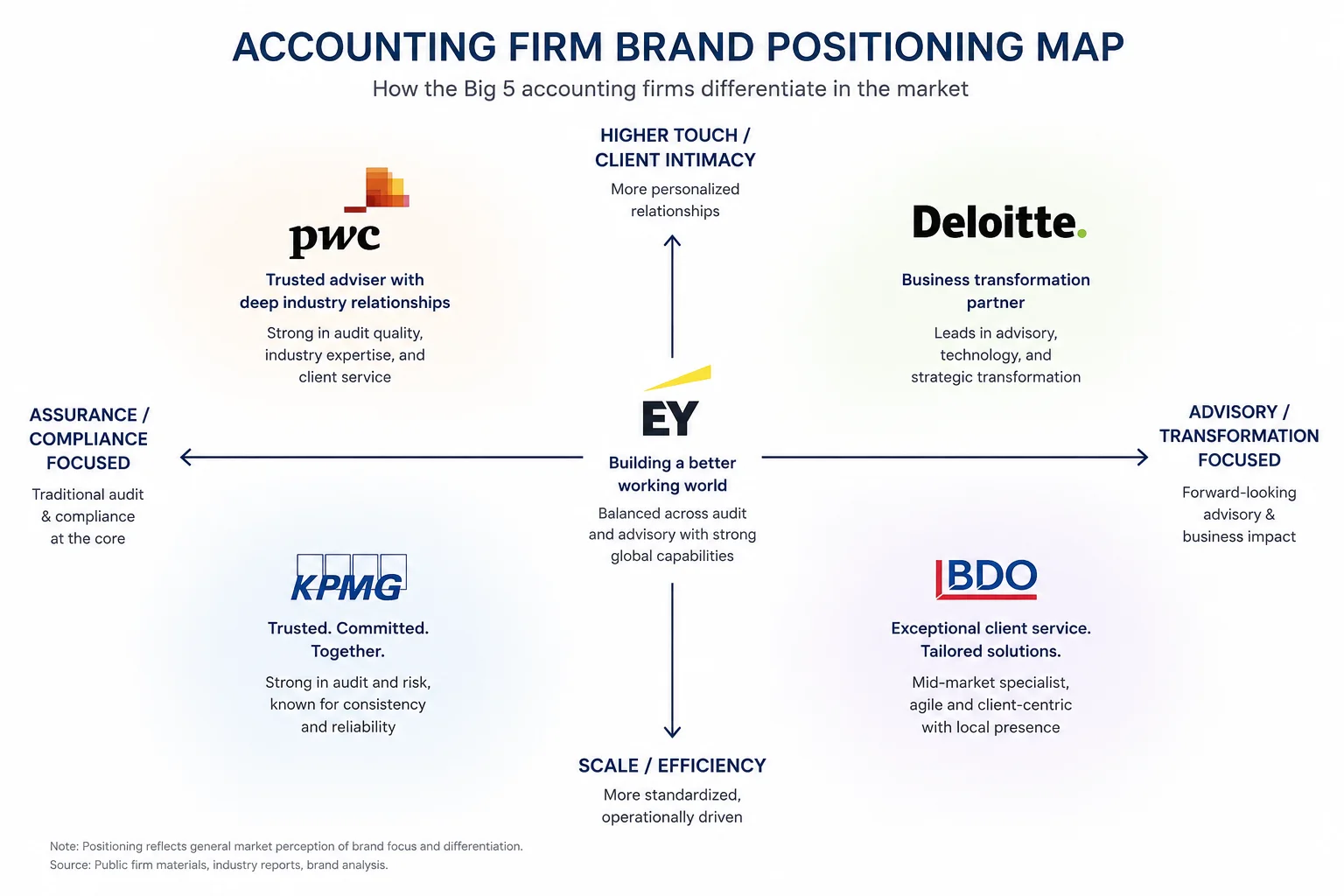
- Niche Specialisation: Dedicating the entire brand message to a clear, narrow sector or corporate lifecycle stage.
- Alternative Value Architecture: Replacing legacy hourly billing narratives with transparent subscription, fixed-fee, or value-based pricing structures.
- Technological Authority: Displaying advanced operational efficiency and automated governance as a core competitive advantage.
Accounting firm brand positioning defines how a practice structures its core messaging to secure high-margin advisory retainers over commoditised compliance services.
The Advisory Pivot: Repositioning Beyond Compliance
The structural landscape of public accounting has fractured. Compliance work has become a low-margin commodity, meaning firms must reposition around deep advisory services to survive.
Why is compliance branding losing commercial viability?
Compliance branding loses commercial viability because automation has stripped the perceived value from standard tax returns and statutory accounts.
When a UK accounting firm markets itself primarily on its ability to submit accurate filings, it is positioning itself against automated software platforms rather than alternative strategic advisors.
Data published by Inside Public Accounting (Jan 2026 Report) confirms that advisory has become the strategic core of high-growth practices, forcing a comprehensive market repositioning around client decisions, commercial insight, and forward business direction.
Practices that fail to execute this transition find their margins eroded by rising staff costs and falling client fee tolerances.
How does positioning drive premium advisory retainers?
Positioning drives premium advisory retainers by shifting the client conversation from a necessary administrative cost to an ROI-positive investment. When an accounting practice establishes a distinct market position, clients no longer view the firm as a utility provider.
The Aybben micro-branding research (2025–2026) indicates that 73% of consumers choose brands that recognise their personal needs, while 86% prioritise clear corporate authenticity over polished, generic messaging.
By framing the firm's identity around sector-specific problem-solving, the practice earns the structural authority required to command monthly advisory retainers that far exceed traditional annual compliance fees.
What role does alternative pricing play in brand perception?
Alternative pricing models act as a direct signal of operational maturity and modern brand positioning. The billable hour shows severe structural cracks in 2026, with forward-thinking firms deploying subscription models, fixed fees, and advisory retainers to capture value effectively.
According to research from the Minnesota CPA Society, which analysed data from Hinge and Michael Kitces, high-growth professional services firms often allocate over 12% of revenue to sophisticated marketing and positioning strategies.
Aligning your pricing model with your brand identity proves to the market that your practice sells strategic outcomes rather than internal staff time.
True brand differentiation requires a firm to actively alienate the general market. If an accounting firm's positioning strategy does not explicitly state which client profiles, sectors, and revenue brackets it rejects, it is not practising positioning; it is practising wishful thinking. Scale requires a clear commercial exclusion.
The State of Accounting Firm Brand Positioning in 2026
Market data shows that professional brand presentation is no longer optional for mid-market practices. It is the primary filter through which buyers validate human recommendations.

How does the 2026 Remarkabrand Index measure brand equity?
The 2026 Remarkabrand Index measures brand equity by analysing 1,400+ accounting firms across 50+ distinct performance indicators.
This extensive study provides the first objective benchmark for professional practice brand equity, proving that brand strength directly correlates with commercial performance.
The Index explicitly maps the top industries served and top services ranked across the UK, allowing ambitious practices to identify exactly where the market is oversaturated and where massive, underserved positioning niches exist.
Why is your website considered the digital handshake?
Your website is considered the digital handshake because referred prospects use it to instantly validate or disqualify personal introductions. Research cited by CPA.com confirms that 75% of users judge a company's overall business credibility solely on its website design.
An outdated, text-heavy website creates instant professional doubt, neutralising the value of a warm peer referral. Modern positioning requires a clean, authoritative digital interface that reflects the firm's contemporary operational standards.
How does organic search visibility impact brand trust?
Organic search visibility impacts brand trust by positioning your firm as the natural authority at the exact moment a prospect seeks a solution. Industry benchmarks published by CPA.com reveal that the top 3 organic Google results capture nearly 54% of all clicks.
A firm that occupies these premier semantic positions enjoys immediate institutional credibility. This visibility converts organic search presence into a powerful, automated engine for attracting premium businesses.
How does AI adoption function as a positioning signal?
AI adoption serves as a positioning signal, demonstrating to sophisticated corporate buyers that your firm operates at peak modern efficiency.
A study by RightWorks (Feb 2026) revealed that firms using advanced AI workflows report 37% higher revenue per employee, with 66% citing significant time savings.
By highlighting responsible AI governance and automated oversight, an accounting practice positions itself as a forward-looking enterprise capable of delivering real-time financial insights.
The modern corporate buyer rejects the legacy ‘trusted generalist' model. When a Managing Director presents an outdated digital presence, they give prospects a reason to question their technical competence, regardless of their actual advisory skills. Brand presentation has become an absolute proxy for professional execution.
The Death of the “Trusted Generalist” Positioning Myth
The long-standing industry directive to position an accounting firm as a “trusted generalist for all businesses” is completely obsolete.
For decades, this was standard advice because local market isolation protected generalist practices from distant competition.
In 2026, this approach fails because cloud infrastructure and automated platforms have democratised geographic access, turning un-positioned practices into easily replaced commodities.
Data from the Hinge Research Institute 2025 High Growth Study shows that the second-highest marketing priority for high-performing practices is actively differentiating their business from competitors. Firms must completely abandon generalist messaging and adopt narrow, sector-specific positioning.
Practices must state exactly who they serve, the precise structural problems they solve, and the specific client profiles they refuse to take on. This clear separation is what allows a firm to break out of local price wars and claim premium market share.

The 2026 Reality Check
A mid-sized accounting firm came to us at Inkbot Design with a strong technical team but a weak, stagnant market position.
Their website sounded exactly like every other practice in their region, leaving prospects completely unable to identify why they should pay a premium.
The core mistake was generic positioning.
The practice tried to appeal to “everyone,” relied on safe, forgettable language about accuracy, and buried the one attribute that actually differentiated them: deep, specialised expertise in owner-managed logistics businesses and proactive tax restructuring.
The financial consequence was severe: they were trapped in the sub-£1m fee bracket, constantly battling local competitors for low-margin compliance work.
We stepped in and ruthlessly tightened their messaging around that specific logistics niche, rebuilt their digital presence to speak directly to that audience, and aligned their core services with common sector pain points.
Within months, the firm saw a definitive improvement in lead quality, an influx of high-value advisory enquiries, and far stronger local search visibility.
Stuart Crawford has led brand identity projects for professional services firms across 21 countries for over 17 years. If your practice is invisible online, your commercial growth is dead before the sales conversation even begins.
Strategic Implementation: Right Way vs Wrong Way
The following comparison table outlines the critical strategic decision points that separate commoditised UK practices from high-growth advisory firms.
The Verdict
Accounting firms cannot scale while clinging to legacy compliance branding and generalist messaging.
The market data from the 2026 Remarkabrand Index and the Hinge Research Institute proves that financial growth belongs exclusively to practices that treat brand identity as a precise strategic tool.
General trust and baseline accuracy are no longer differentiators; they are basic table stakes.
To break through the sub-£1m fee barrier, your practice must stand for a specific solution tailored to a clearly defined audience.
Managing Directors must take immediate ownership of their market positioning. Continuing to accept any client who walks through the door destroys your operational capacity and dilutes your brand equity.
True market authority requires the commercial courage to narrow your focus, deploy transparent value-based fees, and project a modern digital presence.
Your immediate next step is to evaluate exactly where your practice is losing ground. Request a free Brand Equity Audit™ at /services/brand-audits/./
This structured diagnostic identifies the strategic gaps in your messaging, benchmarks your digital presence against the 2026 standards, and provides a clear roadmap to secure high-margin advisory retainers.
Frequently asked questions
Why is generalist brand positioning harmful for mid-sized accounting firms?
Generalist brand positioning forces mid-sized firms to compete entirely on price against automated software platforms and large-scale aggregators. This systemic lack of differentiation traps the practice in low-margin compliance work and suppresses overall profitability.
How does the 2026 Remarkabrand Index help an accounting firm structure its positioning?
The 2026 Remarkabrand Index provides objective performance benchmarks across 1,400+ firms, mapping oversaturated verticals against underserved markets. This data allows progressive practices to identify and occupy highly profitable geographic and sector niches.
What is the measurable impact of web design on accounting firm referrals?
Industrial data shows that 75% of corporate buyers judge a firm's business credibility based on its website design. An outdated digital presence instantly creates professional doubt, often causing referred prospects to abandon the firm before contacting it.
How do alternative pricing models reinforce a firm's brand positioning?
Alternative pricing models, such as value-based retainers or transparent subscription tiers, signal that a firm sells strategic business outcomes rather than internal staff time. This approach dismantles the commoditised billable-hour model and justifies premium advisory rates.
What is the top marketing priority for high-growth accounting firms according to recent studies?
The Hinge Research Institute 2025 High Growth Study indicates that differentiating the business from competitors and producing high-quality educational thought leadership are the top two strategic priorities for high-performing professional practices.
How much faster do high-growth accounting firms expand compared to generalist peers?
Data from the Hinge Research Institute confirms that properly differentiated, high-growth accounting firms expand 4× faster and achieve up to 30% higher profitability margins than their lower-performing, generalist counterparts.
Why should an accounting firm highlight AI adoption in its brand messaging?
Showcasing advanced AI workflows demonstrates modern technical efficiency and robust operational data governance. According to RightWorks data, firms leveraging AI generate 37% higher revenue per employee, making automation a key positioning asset.
What percentage of search engine clicks are captured by the top three organic results?
Industry benchmarks cited by CPA.com show that the top 3 organic Google search results capture nearly 54% of all user clicks. This underscores the immense commercial value of aligning brand positioning with high-intent semantic SEO strategies.
How does sector-specific niche positioning affect client acquisition costs?
Focusing a brand entirely on a specific corporate sector lowers acquisition costs by making marketing content highly relevant to a defined audience. This targeted approach eliminates wasteful general ad spend and accelerates the sales cycle.
What is the commercial danger of using homepage buzzwords like proactive or trusted?
Using overused industry buzzwords causes a firm to blend directly into the competitive background, rendering its unique value invisible. Sophisticated B2B buyers reject generic language in favour of clear, authentic, and quantified value propositions.