
Brand Audit for Professional Services: The Fee-Defending Method
Ask three partners at the same firm to describe what the practice is for, and you will often get three answers.
Now imagine those three partners in a pitch, in front of a prospect who is deciding whether to pay a premium — that is where fees die, and it is precisely the failure a brand audit for professional services is meant to catch. Most don’t.
They inventory colours and fonts, note the messaging feels dated, and hand over a tidy deck while the thing actually depressing the fee — an incoherent story told by the people who sell the work — goes untouched.
Most audits catch the wrong things. They inventory colours, flag inconsistent fonts, note that the messaging feels dated, and produce a tidy deck. Then nothing about the firm’s ability to command a fee changes.
In a market where SPI Research’s 2026 benchmark records billable utilisation at a survey-record low of 66.4% and EBITDA is effectively flat at 9.9%, a cosmetic audit is an expensive way to feel productive.
The brand audits that earn their fee do something harder: they produce evidence you can use to defend your rates.
- A brand audit must produce defendable evidence, not a cosmetic design brief that fails to help you hold fees.
- Sequence matters: gather practice, partner, then proof points before touching visual identity.
- Interview fee-earning partners separately; partner incoherence creates perceived risk, which compresses fees.
- Catalogue every concrete proof point so each headline claim maps to a documented, commercial outcome.
- Confirm executive commitment, client access, and a decision to inform; otherwise the audit becomes a filed report.
How a Fee-Defending Brand Audit Is Achieved
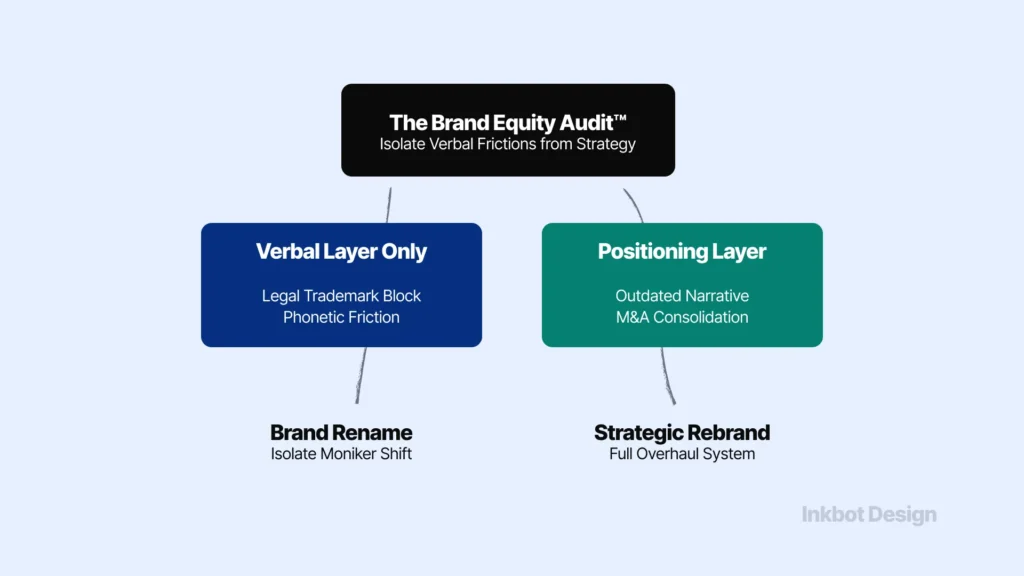
A brand audit for professional services is conducted in seven stages: set the entry conditions, gather practice-level perceptions, gather partner-level perceptions, inventory proof points, diagnose the gaps, apply expert judgement, and then sequence the fixes.
Run in that order, the audit converts vague reputation into defendable proof of value — the thing that lets you hold a fee when a cheaper competitor is in the room.
- The audit’s output is evidence, not a design brief — proof you can put in front of a sceptical buyer.
- It operates at three levels: the practice, the individual partners, and the specific proof points that substantiate claims.
- Sequence is load-bearing: gathering evidence of value before touching visual identity is what separates a working audit from a cosmetic one.
“A professional services brand audit is a forensic, partner-grade exercise that turns vague perceptions into defendable proof of value at three levels — practice, partner and proof points. Anything short of that is decoration, and decoration does not hold a fee when a cheaper competitor walks into the room.”
What You Need in Place Before You Start
You need executive commitment to act on the findings, or you should not start.
The Brand Auditors make this point, and it is the single most-skipped prerequisite: an audit that surfaces an uncomfortable truth about partner behaviour is worthless if the managing partner has no appetite to change it.
Before commissioning anything, confirm three things exist.
First, a decision the audit will inform — a rebrand, a merger, a growth push, a repositioning.
An audit without a pending decision produces a report that gets filed. Second, access to real clients for candid feedback, not just the ones who will flatter you. Third, a willingness to hear that the problem is internal.
In seventeen years of brand work, the pattern I see most often is that the perception gap sits between the partners, not between the firm and the market. If your leadership cannot tolerate that finding, spend the money elsewhere.
Stage One: Gather Practice-Level Perception
Start by establishing how the market actually perceives the practice as a whole, because everything downstream is measured against this baseline.
This means structured client interviews, a review of the stated reason for choosing you for every inbound enquiry, competitor mentions, and an honest read of your own analytics and search visibility.
You are looking for the gap between what the firm believes it is known for and what clients actually say when asked.
You know this stage is done right when you can state, in the client’s own words, the two or three things the firm is genuinely valued for — and the two or three it wrongly assumes it is.
The failure mode here is sampling only happy clients. A practice that interviews only its advocates learns nothing; the diagnostic value sits with the near-misses and the churned.
If you want a structured instrument for this, a brand audit questionnaire designed for professional services helps keep client interviews comparable rather than anecdotal.
Stage Two: Gather Partner-Level Perception

Audit how individual partners describe and represent the firm, because in professional services, the partners are the brand at the point of sale.
This is the level that competing audit guides skip entirely, and it is where fees quietly leak.
Interview each fee-earning partner separately and ask them to describe the firm’s positioning, its ideal client, and its differentiator — then compare the transcripts.
You know this stage is done right when you have documented, side by side, how far the partners’ accounts diverge.
The failure mode is treating the firm as a single voice when a buyer meets three. When three partners describe the same practice three ways in one pitch, the prospect notices before anyone internal does — and reads the inconsistency as risk.
Risk depresses the price a buyer will pay. That is the direct mechanism by which partner-level incoherence discounts your fee, and no visual refresh touches it.
“In professional services, the partners are the brand at the point of sale. If three partners describe the firm three different ways in the same room, the buyer gets confused, and you lose the fee before anyone mentions cost.”
Stage Three: Inventory Your Proof Points
Catalogue every concrete piece of evidence the firm can use to substantiate a claim of value, because claims without proof are just adjectives.
A proof point is a named outcome: a specific matter won, a quantified saving delivered, a named client retained through a difficult transaction. This is the forensic core of the audit, and the part cosmetic reviews never reach.
You know this stage is done right when every headline claim on your website maps to a documented proof point — and you have flagged the claims that do not.
The failure mode is confusing capability with proof: “we deliver commercial tax advice” is a capability; “we cut a manufacturing client’s effective rate by a documented margin across two years” is proof.
Buyers pay premiums for proof and discounts for unsupported capabilities.
The proof-point inventory is what later lets you analyse competitors on substance rather than on who has the glossier site.
Stage Four: Diagnose the Gaps
Cross-reference the three perception levels against the proof-point inventory to locate exactly where the brand is losing commercial ground.
The diagnosis is not “the brand feels tired.” It is specific: the market values you for insolvency work, the partners each emphasise different things, and the strongest proof points sit in a service line that the website barely mentions.
That is a diagnosis you can act on.
You know this stage is done right when the output is a short list of named, prioritised gaps, each tied to a commercial consequence.
The failure mode is the SWOT-and-perceptual-map ritual that competing guides love — analysis that describes the firm elegantly and directs nobody to do anything.
If the diagnosis does not tell a managing partner what to change on Monday, it has failed, however handsome the deck.
Stage Five: The Judgement Layer — What the Checklist Can’t Tell You
The stages above are procedural; deciding which gap to fix first is a matter of judgment, and this is where an experienced hand earns the fee. Not every gap is worth closing.
A firm with a fractured partner narrative but exceptional proof points has a very different order of priorities from one with tidy messaging and nothing to substantiate it.
Sequencing the fixes wrongly wastes the budget on the visible problem while the expensive one compounds.
You know you are exercising judgment rather than following a template when you can defend why one gap outranks another in commercial terms. A pretty deck is not a return on the audit.
A 12-Partner Advisory Firm
Run against a realistic case, the method exposes what a cosmetic audit hides. Take a 12-partner regional advisory firm planning to reposition ahead of a growth phase.
Practice-level interviews reveal the market values them for one thing — complex, contested valuations — while the firm markets itself as a generalist. Partner-level interviews show four different “ideal clients.”
The proof-point inventory holds three exceptional, documented valuation outcomes buried three clicks deep on the site.
The diagnosis writes itself: the firm is discounting its strongest asset by hiding it behind a generalist message that three partners contradict.
The judgment call is sequence — fix the positioning and surface the valuation proof before spending a penny on visual identity.
A brand audit that led with the logo would have repainted the wrong wall.
Understanding what that work costs before committing is worth checking against a realistic brand audit cost benchmark rather than a headline figure.
The Step Everyone Runs in the Wrong Order
Most firms audit their visual identity first and their evidence of value last — and that single sequencing error is why so many audits fail to protect a fee. It is an understandable instinct.
The logo is visible, the website is measurable, and design problems feel tractable in a way that partner incoherence does not.
Intelligent practitioners default to it because it is the part they can see. That does not make it right.
The reason the order matters is mechanical, not aesthetic. Your visual identity is the packaging for a claim of value; if you have not first established what the defendable claim is, you are designing packaging for a product you cannot yet describe.
Thomson Reuters’ 2025 study of more than 1,700 legal, tax and accounting professionals found that 59% of corporate legal clients want their firms to use generative AI, yet 71% of clients do not know whether their firm does — a live example of a value the firm can deliver but has not turned into proof.
Reverse the sequence. Establish the proof of value — practice, partner, proof points — and only then design the identity that carries it. The replacement directive is simple: never commission the visual work until the evidence audit is signed off.
The AI Perception Gap

A brand audit in 2026 must assess whether a firm’s public promise aligns with its actual AI-enabled delivery, as this has become a key driver of client perception.
Thomson Reuters’ 2025 research put the gap in numbers: 59% of corporate legal clients want their outside firms to use generative AI, but 71% of clients do not know whether their firm does.
By July 2026, 41% of law firms reported using GenAI, up from 28% a year earlier — the capability is arriving faster than communication.
This is a proof-point gap the audit should catch.
A firm may have materially changed how it delivers — Thomson Reuters estimated AI could free nearly 240 hours per legal professional per year — while its brand still says nothing about it.
Among architecture, engineering and consulting firms, 82% expect successful AI implementation to significantly affect profitability, per the same body of research. The audit’s job is not to chase the trend.
It is to check whether the firm’s public promise matches its actual delivery, and whether clients understand the difference. Where they don’t, that is a proof point going to waste.
Two Objections Worth Answering Honestly
“This sounds like consultancy dressed up as an audit.”
Fair. The distinction is the deliverable: a consultancy engagement sells you a strategy; this audit sells you evidence — a documented, prioritised list of where your brand loses commercial ground and the proof points you are underusing. If it ends in a strategy deck with no evidence attached, you have bought the wrong thing.
“Our clients come from referrals, so brand hardly matters.”
Referrals get you into the room. What happens next is priced on perceived risk, and perceived risk is exactly what partner incoherence and thin proof points inflate. PwC’s Global Business Services Index 2025 held at a score of 117, flat year-on-year against a 2019 baseline — growth exists, but margins are under pressure, and referral-led firms feel fee compression precisely because they never built the proof that justifies holding a rate.
The Verdict
A brand audit for professional services is worth commissioning only if it ends in evidence you can use — proof of value at the level of the practice, the individual partners, and the specific outcomes that substantiate your claims.
Every stage in this method bends toward that single output. Gather practice perception, then partner perception; inventory your proof points; diagnose the gaps against them; apply judgment to sequence the fixes; and hold the visual work until last.
Run in that order, the audit stops being a cosmetic exercise and becomes a commercial one.
The firms that struggle are not the ones with dated logos. They are the ones whose partners describe the practice differently, whose strongest proof sits buried, and whose fees erode a point at a time because the buyer cannot tell what they are paying a premium for.
With SPI Research recording utilisation at a record-low 66.4% and margins flat across the sector, the cost of an incoherent brand is no longer abstract — it is measurable in the rate you can no longer hold.
Start today with the cheapest, most revealing step: interview your partners separately and ask each to describe the firm’s ideal client.
If their answers diverge, you have found your first gap — and your first proof that the audit is working. To see exactly where your brand is losing commercial ground and what to do about it, request a free Brand Equity Audit™.
FAQs
What is a brand audit for professional services?
A brand audit for professional services is a structured assessment of how clients, prospects and partners perceive a firm, measured against the evidence it can produce to substantiate its value. Done properly, it identifies where the brand loses commercial ground and what to change to defend fees.
Why do professional services firms need a brand audit?
Because in a crowded market, unclear positioning and inconsistent partner messaging depress the price buyers will pay. SPI Research’s 2026 benchmark records billable utilisation at a record-low 66.4% and flat margins, making a coherent, evidence-backed brand a direct lever on fee protection rather than a cosmetic concern.
How is a brand audit different from a rebrand?
A rebrand is what you commission once you know what needs changing. A brand audit is how you find that out — and commissioning the rebrand first means paying a designer to package a claim of value you have not yet confirmed you can make. Audit, then rebrand. Not the reverse.
When should a firm conduct a brand audit?
Conduct one ahead of a merger, acquisition, rebrand, leadership change or growth push — any moment where a decision hangs on how the firm is perceived. Skip it if leadership has no appetite to act on uncomfortable findings, because an audit no one will act on is a filed report.
What does a professional services brand audit include?
It includes practice-level perception (how the market sees the firm), partner-level perception (how individual partners describe it), a proof-point inventory (documented evidence of value), a gap diagnosis, and a prioritised sequence of fixes. The evidence-gathering, not the visual review, is the core of the work.
How long does a brand audit take?
Timelines depend almost entirely on how fast you can schedule candid client and partner interviews, which is the rate-limiting step. Firms that compress the interview stage to hit a deadline hollow out the diagnosis and end up with a cosmetic result. Protect the interview time even if it extends the overall schedule.
Is a brand audit worth the cost for a smaller firm?
Yes — if it produces evidence you can use to defend fees, it pays for itself in a single held rate. A firm should proceed only when leadership will act on the findings; without that commitment, the spend yields a report rather than a return.
What is the biggest mistake in a brand audit?
Auditing visual identity first and evidence of value last. Your logo is packaging for a claim you have not yet established; designing it before confirming a defensible claim wastes the budget on the visible problem while the expensive one — partner incoherence, buried proof — goes untouched.
How does a brand audit protect fees?
It protects fees by removing the sources of perceived risk that make buyers discount. When partners describe the firm consistently and every claim maps to a documented proof point, the buyer has less reason to negotiate down. Incoherence and unsupported claims are what invite fee compression.
Should a brand audit assess our use of AI?
Yes. A 2026 audit should assess whether a firm’s public promise aligns with its actual AI-enabled delivery. Thomson Reuters found that 59% of corporate legal clients want their firms to use generative AI, while 71% do not know whether their firms do — a perception gap the audit can convert into a proof point.
Who should run the brand audit?
Whoever runs it needs two things: independence to report that partners contradict each other, and the experience to rank fixes by commercial impact rather than visibility. That can be an external specialist or a genuinely independent internal lead — the test is whether they can deliver an uncomfortable finding to a managing partner without softening it. Softened findings are worthless.
What should we do first after an audit?
Act on the highest-cost gap, not the most visible one. If the audit shows partners contradicting each other on positioning while strong proof points sit buried, fix the positioning and surface the proof before touching visual identity — sequence the fixes by commercial consequence.
