
How to Design a Brand Audit Questionnaire for B2B Leadership
Most brand audit questionnaires fail before they are ever sent. They treat internal executives, fee-earners, and external clients as brand consultants rather than behaviour witnesses.
When a B2B professional services firm asks stakeholders, “What do you think our brand stands for?”, it receives polished, generic opinions that hide real commercial friction.
A successful rebrand requires diagnosing operational realities, not collecting compliments. The recurring flaw in failed repositioning exercises is clear: leadership relies on consensus-seeking surveys that smooth over disagreement.
Before committing six figures to a strategic refresh, B2B leaders need a structured brand audit process that surfaces where transactions stall and where internal execution breaks down.
- Ask for specific recent actions and transaction friction; use behavioural forensics over sentiment.
- Segment respondents by operational role not hierarchy: Originators, Converters, Deliverers, Buyers.
- Do not launch until you guarantee staff anonymity, have a documented revenue baseline, and clear executive consent to act.
- Include four core forensic questions, measure internal alignment gaps, and test AI interpretability for machine-readable positioning.
How to Design an Effective Brand Audit Questionnaire
A B2B brand audit questionnaire evaluates organisational alignment and market positioning by collecting evidence of behavioural friction across leadership, fee-earners, and clients.
To execute a diagnostic brand audit questionnaire, follow four structured phases:
- Categorise Stakeholders by Operational Impact: Segment respondents by transaction role rather than seniority.
- Draft Action-Oriented Questions: Replace subjective sentiment queries with specific behavioural choices made during recent engagements.
- Audit Internal Alignment Divergence: Compare responses across organisational tiers to measure perception gaps between executives and staff.
- Test Machine Interpretability: Evaluate whether artificial intelligence engines extract consistent positional claims from stakeholder narratives.
What Must Be in Place Before You Launch
Do not distribute a single survey until three operational conditions are met:
- Anonymity Guarantees for Internal Staff: Fee-earning partners and associate staff will not report real sales friction if responses can be traced back to performance reviews. Use third-party response collection.
- A Documented Revenue Baseline: Know your current win rate, average sales cycle length, and primary loss reasons over the past four quarters. Survey data means nothing without commercial metrics to validate it.
- Clear Executive Consensus to Act: If managing partners are unwilling to change service delivery in response to hard diagnostic evidence, cancel the audit.
Stage 1: Categorise Stakeholders by Operational Impact (Not Hierarchy)
Traditional corporate surveys divide respondents by executive hierarchy: Board, Senior Partners, Junior Staff, and Clients. This structure hides operational truth.
Senior partners rarely interact with the day-to-day delivery friction that loses client accounts, while junior associates rarely understand why high-value proposals fail at the board level.
Group your questionnaire respondents by their role in the buyer and delivery lifecycle:
Stakeholder Matrix
Diagnose positioning & market promises
Diagnose deal friction & fee resistance
Diagnose execution & client reality
- Originators (Marketing & Business Development): Those who make initial promises to the market. Their questionnaire must test positioning clarity and prospective client confusion.
- Converters (Senior Partners & Pitch Teams): Those who close deals. Their questionnaire must focus on price resistance, competitive head-to-heads, and buyer hesitation.
- Deliverers (Operations & Senior Associates): Those who fulfil the contract. Their questionnaire must assess whether the brand promise aligns with daily service delivery.
- Buyers (Active & Lost Clients): Those who exchange capital for service. Their questionnaire must isolate the exact moment trust was built or tested.
Dividing stakeholders by behavioural exposure ensures your questions generate actionable data rather than polite commentary.
Stage 2: Draft Questions That Measure Action, Not Sentiment
The core flaw in traditional questionnaires is that they ask stakeholders for abstract analysis. When you ask a Senior Partner, “Is our brand positioning strong?”, they will say yes.
When you ask them, “Which slide in our pitch deck caused the prospect to pause or ask for clarification last month?”, you uncover immediate positioning debt.
Every question in a behavioural brand audit questionnaire must require the respondent to describe a real event, decision, or friction point.
| Questionnaire Focus | The Generic Approach (Avoid) | The Behavioural Forensics Approach (Use) |
| Market Positioning | “What three words best describe our firm?” | “When explaining our firm to a prospect, what distinction do you make to separate us from our main competitor?” |
| Value Proposition | “Do you think our fees reflect our value?” | “At what point in the sales process do prospects question our pricing structure?” |
| Brand Experience | “How would you rate our client service out of 10?” | “What specific client request last quarter required internal escalation to approve?” |
| Competitive Differentiation | “Why do clients choose us?” | “What was the explicit reason given by the last client who chose a rival practice over ours?” |
| Internal Culture | “Are our core values lived daily?” | “What internal behaviour is currently tolerated that directly contradicts our public positioning?” |
The Four Non-Negotiable Core Questions
Regardless of sector, every B2B professional services questionnaire must contain these four forensic diagnostic questions:
- For Internal Staff: “What promise do we make in marketing that takes the most operational effort to deliver in practice?”
- For Pitch Teams: “What is the single hardest objection you routinely face when presenting our fee structure to new prospects?”
- For Active Clients: “What specific problem did you expect us to solve that we have not yet addressed?”
- For Lost Prospects: “What specific risk did you feel was unmitigated when reviewing our final proposal?”
Stage 3: Audit Internal Alignment Divergence
The most critical data point in any brand audit is not what one group thinks—it is the distance between what leadership claims and what fee-earners experience.
According to the Axios HQ 2025 State of Internal Communications Report, surveying 813 employees and 457 leaders, only 9% of employees agree they are entirely aligned with their organisation’s business goals, whereas 27% of leaders believe staff are aligned.
This 18-percentage-point perception gap proves that consensus-seeking questionnaires actively obscure operational risk.
Leader Perception vs. Employee Reality Gap
When internal alignment breaks down, external commercial performance drops immediately.
Research from the LinkedIn + Edelman 2025 B2B Thought Leadership Impact Report indicates that more than 40% of B2B deals stall due to internal misalignment within buying groups.
If your sales team, pitch team, and leadership communicate different core value propositions, buyer hesitation spikes.
In 17 years of brand work, the pattern I see most often is managing partners assuming internal consensus exists simply because no one openly contradicts them in partner meetings.
Calculating Your Internal Alignment Gap Metric
To calculate internal alignment divergence:
- Run identical core positioning questions across both Executive Leadership and Mid-Level Fee-Earners.
- Categorise answers into discrete value pillars (e.g., Price Leader, Technical Specialist, Speed of Delivery, Full-Service Partner).
- Calculate the percentage of variance between executive claims and fee-earner realities.
If executive leadership claims the brand stands for “Technical Innovation” while 80% of fee-earners describe daily work as “Standardised Execution”, your firm suffers from severe positioning drift.
Stage 4: Test Machine Interpretability and AI Discovery Readiness
A modern B2B brand audit questionnaire must assess whether your firm’s positioning is clear enough to be interpreted by machine learning frameworks and artificial intelligence discovery layers.
Data from the Edelman 2025 Trust Barometer Special Report shows that 55% of consumers now use generative AI during commercial research, with 91% of those users using AI specifically to evaluate and compare brands. Furthermore, 80% of respondents trust the brands they use to do what is right, compared to just 55% trust in traditional institutions.
If potential clients use artificial intelligence engines to summarise your firm’s capability, and those engines return vague summaries, your questionnaire must identify why.
AI Machine Interpretability Test
“What specific commercial problem does [Firm Name] solve for UK professional services companies?”
“Firm X provides tax mitigation for UK law practices.”
“Firm X is a leading strategic consulting firm committed to driving holistic excellence.”
Add an AI interpretability section to your internal brand audit questionnaire:
- Ask five key internal partners to write a two-sentence summary answering: “What specific commercial outcome does our firm guarantee that no regional competitor can match?”
- Feed those five responses into an LLM engine to generate an entity summary.
- If the AI model produces generic generalisations (“a client-focused advisory firm driving success”), your positioning lacks semantic entity clarity.
Clear messaging carries a direct commercial return. Data cited in Lucidpress research demonstrates that organisations maintaining consistent brand messaging across channels achieve up to 33% higher revenue performance.
Interpreting Divergence Without Smoothing It Over
Once your questionnaire data arrives, the most dangerous step is synthesising the results into a presentation that makes everyone feel comfortable. The purpose of a diagnostic audit is to highlight tension, not smooth it away.
Data Synthesis Framework
⚠ Rule: Do not smooth over divergence with artificial consensus.
When reviewing survey responses, separate feedback into three distinct categories:
- Factual Execution Friction: Operations or delivery failures where the firm is failing to honour public promises (e.g., slow turnaround times, inconsistent communication templates). Fix these operationally immediately.
- Positioning Drift: Scenarios where pitch teams are using obsolete or rogue value propositions to close deals. This requires tightening brand guidelines and competitor analysis frameworks.
- Client Expectation Gaps: Instances where client perception directly contradicts internal beliefs. This indicates your external marketing is targeting the wrong buyer persona or setting inaccurate expectations.
Worked Example
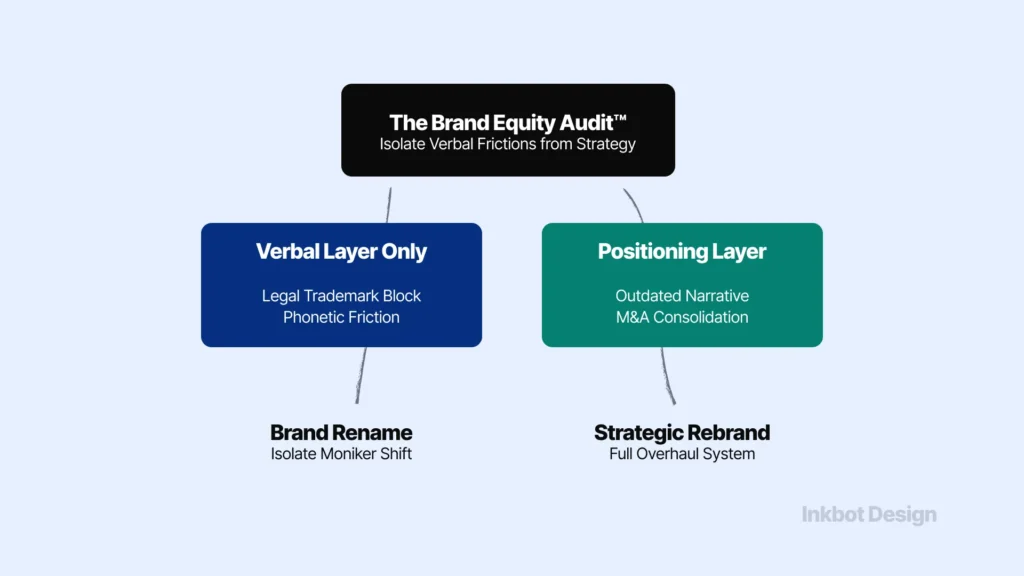
To understand how behavioural brand audit questionnaires reveal structural friction, consider a 120-person legal and advisory firm operating in Manchester.
The managing partner initiated a brand refresh because proposal win rates had dropped by 14% over 18 months.
The Initial Assumption
Leadership believed the visual identity looked dated and that prospects viewed the firm as traditional rather than modern.
The Behavioural Questionnaire Findings
Instead of asking for design opinions, the brand audit questionnaire focused on transaction friction across three groups:
- Pitch Team Questionnaire Result: 75% of partners reported that prospects asked for fee discounts during the second meeting. When asked why, partners revealed they spent the first meeting explaining the firm’s broad range of services rather than demonstrating specific sector expertise.
- Junior Associate Questionnaire Result: Associates reported spending an average of 4 hours per week creating custom pitch slides because the master presentation template lacked relevant case studies for niche sectors.
- Lost Prospect Questionnaire Result: 60% of lost prospects stated they chose a smaller competitor because the smaller firm presented a clear, specialised methodology in the initial pitch, whereas the advisory firm presented generic corporate slides.
The Strategic Outcome
The audit proved the firm did not have a graphic design issue—it had a messaging fragmentation problem.
The strategic rebrand focused entirely on repositioning the firm around three specialised sector practices, standardising the pitch narrative, and removing broad corporate jargon. Proposal win rates recovered within two quarters.
Stop Asking What Stakeholders Think—Ask What They Do
The traditional brand audit questionnaire is broken because it acts as an opinion poll.
It invites stakeholders to act as marketing consultants, returning subjective commentary that validates executive bias while obscuring commercial risk.
A B2B brand audit questionnaire must function as a behavioural forensics tool. By asking internal teams and external clients what decisions they made, where sales stalled, and what promises proved difficult to deliver, leadership surfaces the exact friction eroding fee margins.
Data published in Forbes reveals that 74% of S&P 100 companies undergo a rebrand or major brand refresh within their first seven years. Strategic repositioning is a standard business operational requirement. However, spending capital on new visual assets without diagnosing underlying operational friction guarantees that old sales problems return in new packaging.
Audit for action. Measure divergence. Fix operational friction before changing your logo.
The Verdict
If your firm is planning a strategic rebrand ahead of a growth phase or market repositioning, stop drafting open-ended sentiment surveys.
Take this single action today: Audit your last five lost proposals. Send a three-question behavioural survey to those buyers focusing exclusively on what specific risk caused them to hesitate. Use those answers to build your wider stakeholder diagnostic.
Request Your Professional Brand Audit
If you suspect your firm’s brand identity and positioning are creating deal friction or hiding internal misalignment, we can help. Inkbot Design delivers structured diagnostics that evaluate positioning, internal alignment, and market credibility.
Request a free Brand Equity Audit™ at Inkbot Design — uncover exactly where your brand is losing commercial ground and receive a clear strategic plan to fix it.
FAQs
What is a brand audit questionnaire?
A brand audit questionnaire is a structured diagnostic survey used to evaluate a company’s positioning, internal alignment, and market perception by collecting operational data from leadership, employees, and clients.
How does a brand audit questionnaire differ from a client satisfaction survey?
A client satisfaction survey measures retrospective happiness with past services, whereas a brand audit questionnaire diagnoses market positioning clarity, internal alignment gaps, sales friction, and competitive differentiation across all stakeholder groups.
Who should complete an internal brand audit questionnaire?
An internal brand audit questionnaire should be completed by executive leadership, sales and pitch teams, business development professionals, and fee-earning delivery staff to capture perception gaps across different operational tiers.
How many questions should a B2B brand audit questionnaire include?
A B2B brand audit questionnaire should include 12 to 15 focused, behavioural questions. Keeping the survey concise ensures higher response rates and detailed answers rather than vague feedback.
Why do traditional brand audit questionnaires produce misleading results?
Traditional brand audit questionnaires produce misleading results because they ask stakeholders for subjective opinions about aesthetics and mission statements rather than asking for concrete evidence of operational decisions and sales friction.
How often should a professional services firm conduct a brand audit?
A professional services firm should conduct a brand audit every 2 to 3 years, or immediately prior to a strategic growth initiative, merger, acquisition, or major brand repositioning.
What is the perception gap in internal brand alignment?
The perception gap refers to the divergence between how executive leadership views organisational strategy and how fee-earning staff experience it. Research shows an 18-point gap between leader perception and employee alignment.
Can a brand audit questionnaire help shorten the sales cycle?
Yes — by identifying the specific pitch slides, messaging confusion, or pricing objections that cause prospects to pause, a brand audit questionnaire allows firms to eliminate buyer friction and shorten sales cycles.
Should brand audit questionnaires be anonymous?
Internal brand audit questionnaires for fee-earners and associate staff must be anonymous to ensure honest feedback on sales friction and operational weaknesses, free from fear of internal management performance reviews.
How do you measure machine-interpretability in a brand audit?
Machine-interpretability is measured by testing whether artificial intelligence engines and LLM frameworks can extract clear, consistent positional claims and entity definitions from your firm’s documented brand positioning.
