Kapferer’s Brand Identity Prism: A Credibility Test for B2B Services Firms
Your Brand Identity Prism is probably a description of a firm you would like to be, not the one a client meets.
For a professional services business, that gap is where fees leak, pitches are lost, and rebrands fail.
Gartner found that 69% of B2B buyers report inconsistencies between what a supplier’s website says and what its sellers tell them, which is the claimed-versus-delivered gap, measured.
The Prism is the tool that finds it before the buyer does, if you use it correctly. Most firms don’t.
The correct use starts with understanding what the model was built to separate.
That runs through Inkbot Design’s brand semiotics framework, and it is where the standard reading goes wrong.
- The Prism forces firms to compare intended identity with client perception and treat any gap as a commercial liability.
- In services firms, facets map to delivery mechanisms rather than aesthetics; each facet is a promise clients will verify.
- Build two prisms: a current-state from real perception and a sharp target-state, then identify and close contradictions before publishing.
- Physique and Personality must work before contact; buyers shortlist early and AI means identities must be recognisable and verifiable.
- Trust and defensibility drive B2B buying; positioning must make the buyer feel safe defending their choice to internal stakeholders.
What Is Kapferer’s Brand Identity Prism?
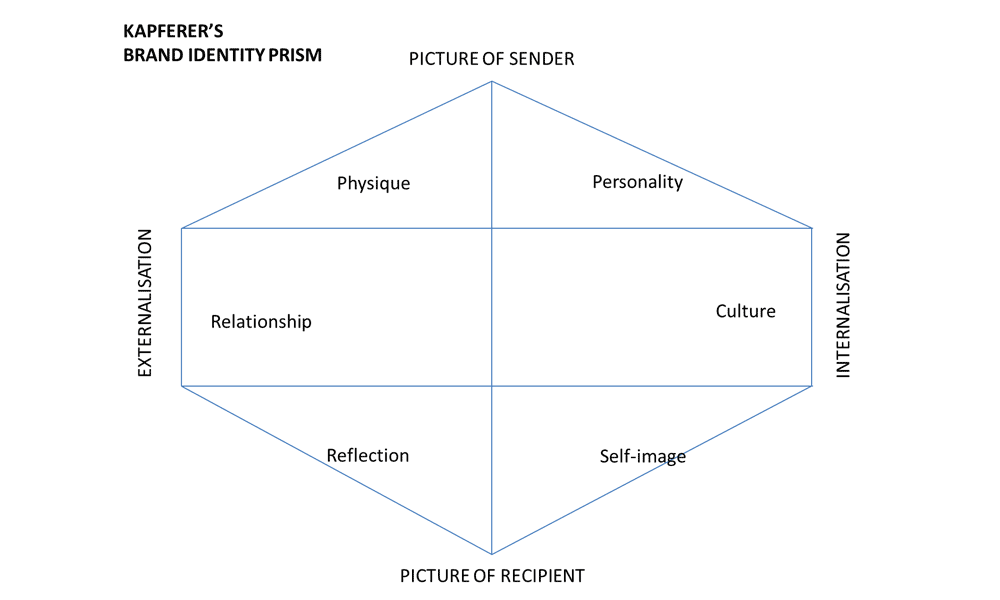
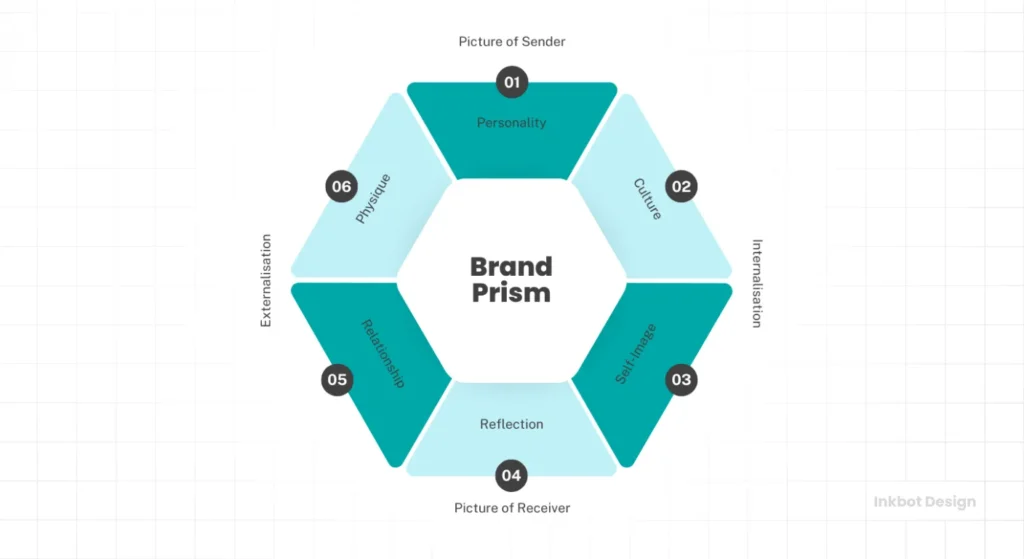
Kapferer’s Brand Identity Prism is a six-facet model separating a brand’s intended identity from how customers actually perceive it. Jean-Noël Kapferer published it in 1986 as a hexagonal structure with two axes: a sender/receiver split, and an internalisation/externalisation split.
- The six facets are Physique, Personality, Culture, Relationship, Reflection and Self-Image.
- Physique and Personality describe how the brand presents itself (the sender); Reflection and Self-Image describe how the buyer sees themselves through it (the receiver).
- Culture sits within the organisation; Relationship is the visible dynamic between the brand and the client.
The model’s real value lies in its design: it forces a firm to compare the identity it intends with the identity people actually receive. That comparison is the point most explanations skip.
Why the Standard Reading of the Prism Fails B2B Services
Intelligent people teach the Prism as a personality worksheet for good reason.
For a consumer product, the brand really is experienced through packaging, tone and a campaign — Physique and Personality do most of the work, and describing them well genuinely improves consistency.
The framework earned its reputation on brands like that.
A professional services firm does not work that way. Your brand is not experienced through a product on a shelf.
It is experienced through a sequence: the promise business development makes, the expertise shown in a pitch, the behaviour of the consultants who actually do the work, the consistency of the client experience, and the evidence that you delivered what you said you would.
Describe your Personality as “trusted and rigorous” all you like. If the third partner in the room contradicts the first, the description is fiction.
Gartner’s finding that 69% of B2B buyers already catch website-versus-seller inconsistencies tells you the buyer is auditing this, whether or not you are.
So the descriptive reading isn’t wrong. It’s insufficient. The Prism’s most useful feature for a services firm is the one nobody uses: its built-in gap between intended and perceived identity.
The 6 Facets, Rewritten for a Firm That Sells People
Each facet in a services firm maps to a delivery mechanism rather than an aesthetic. This is where the audit lives.

Physique: What Buyers Encounter Before They Call You
The physique of a services firm is not just the logo.
It is every recognisable asset a buyer encounters while researching you alone: the website, search visibility, case studies, expert content, and third-party mentions.
6sense’s 2025 B2B Buyer Experience research reports that buyers purchase from a vendor on their initial shortlist 95% of the time, and that most vendors land on that shortlist on day one.
Physique now works before the relationship even begins. If your visible assets don’t make the firm recognisable early on, no salesperson can recover the position later.
Personality: The Voice That Has to Survive a Room of Partners
Personality is how the firm speaks and behaves as if it were one person.
In a firm of 50–200, that “person” is actually many partners, each with their own pitch.
The test is not whether you can write a tone-of-voice guide.
It is whether three consultants describe the firm the same way to the same prospect.
Where they don’t, Personality is a claim the delivery can’t hold.
Culture: The Internal Compass Clients Feel Second-Hand
Culture is the belief system that decides what the firm does when no client is watching.
Clients never see it stated — they infer it from which deadlines slip and which corners get cut.
A firm that sells “client-first” but puts a junior on partner-sold work has already told its client what its Culture actually is, and the client updates the whole brand accordingly.
Culture is the facet you cannot write your way out of.
Relationship: The Role You Actually Play, Not the One You Claim
Relationship is the role the firm plays in a client’s working life — adviser, safe pair of hands, challenger.
Gartner reports that 61% of B2B buyers prefer a rep-free buying experience, yet still want seller input when judging fit.
So the role has to survive being read off your website with nobody there to explain it, and then hold up in the room when someone finally calls.
If your “trusted adviser” positioning only works when a charming partner is present, it isn’t a Relationship facet. It’s a personality.
Reflection: The Client the Firm Actually Understands
Reflection is the buyer that the firm outwardly depicts serving.
Getting it wrong is expensive.
Gartner found that 73% of B2B buyers actively avoid suppliers that send irrelevant outreach.
For a services firm, Reflection is not knowing the buyer’s industry — it is understanding the buyer’s role, and their commercial and political context, well enough that the firm’s content reads as written for their situation.
Self-Image: How Hiring You Makes the Buyer Feel About Their Own Judgement
Self-Image is how the client feels about their own judgement for choosing you.
For most professional services buyers — the ones accountable to a board — that feeling is defensibility: safe, justifiable, hard to second-guess.
Dentsu’s data makes this concrete, with “I feel safe signing a contract with them” the top decision driver for three years running.
A firm selling “bold, unconventional” as its Self-Image is selling the wrong emotion to a buyer who has to explain the decision upstairs.
How to Audit the Gap Between Claimed and Delivered Identity

The Prism becomes a credibility audit when you map two versions of it side by side: the identity you claim, and the identity you deliver.
Kapferer’s own method supports this.
You build a current-state prism based on how the firm is actually perceived, define a sharp target-state prism, and identify the contradictions between them.
The pitfall he warns against — using generic adjectives instead of specific proof points — is exactly where services firms fail.
“Trusted” is not a facet entry.
“Named partner leads every engagement, evidenced in three published client outcomes” is.
| Facet | The Claimed Identity (typical) | What It Costs When Undelivered | The Delivered-Identity Test |
| Physique | “Premium, established” | Absent from day-one shortlists (6sense) | Is the firm recognisable in independent research? |
| Personality | “Rigorous, trusted” | Website vs pitch mismatch (Gartner, 69%) | Do three partners describe the firm identically? |
| Culture | “Client-first” | Delivery contradicts the sale | Who actually staffs the work? |
| Relationship | “Trusted adviser” | Useless when the buyer self-serves | Does the role hold when you’re not in the room? |
| Reflection | “We serve firms like yours” | Irrelevant outreach ignored (Gartner, 73%) | Does the content read as written for their role? |
| Self-Image | “Choose the bold option” | Buyer feels exposed, not safe | Is the choice defensible to their board? |
In 17 years of brand work, the pattern I see most often is a firm with an immaculate target-state prism and no current-state prism at all — positioning defined in a vacuum, never checked against delivery.
The firms that rebrand successfully are the ones that treat the Prism as two documents rather than one.
This connects directly to the underlying brand semiotics framework that governs how meaning gets read, and to the psychology of how brands are perceived before a word is read.
“A Brand Identity Prism that records only what you intend to be is a wish list. The version that earns its place records what a client actually receives, sets it beside what you claim, and treats every gap between the two as a commercial liability the firm has to close before it publishes the positioning.”
Buyers Shortlist Before They Speak to You
The buying journey has moved the burden onto the facets that work without you in the room.
6sense’s 2025 research reports that buyers purchase from a vendor on their initial shortlist 95% of the time, with roughly four of five vendors shortlisted on day one.
Dentsu’s 2025 Superpowers Index — based on 6,107 B2B decision-maker interviews across 21 markets — reports that 77% of B2B buying processes now use AI, with 40% of buyers classified as heavier AI users.
Two consequences follow for the Prism.
First, Physique and Personality now have to be clear enough to be understood by search and recommendation systems, not only people — a firm whose identity is vague to a machine is invisible at the shortlist stage.
Second, and more importantly, Dentsu identifies trust as the top factor in winning B2B business, with the leading decision driver for the third year running being “I feel safe signing a contract with them.” That is the whole argument in one sentence.
Clients do not buy the most distinctive firm. They buy the one whose identity they can verify is safe.
The Prism’s job is to ensure the identity you project is one that your delivery can actually back up.
“Isn’t This Just Brand Consistency?” — The Objection Answered
No — and the difference matters commercially. Consistency asks whether your logo, tone and messaging match across channels.
That is a Physique-and-Personality question, and it is table stakes. The claimed-versus-delivered audit asks a harder question: whether the behaviour, staffing, and evidence behind the brand can substantiate what the consistent messaging promises.
A firm can be perfectly consistent and completely unsubstantiated — saying “trusted adviser” identically everywhere while staffing every engagement with juniors.
Consistency polishes the claim. The Prism, used for auditing, tests whether the claim is true.
Prove It Before You Publish It
For a B2B services firm, Kapferer’s Brand Identity Prism is worth far less as a creative worksheet than as a test of whether your reputation, behaviour and client experience can substantiate your positioning.
The six facets are not personality boxes. They are delivery mechanisms, each one a promise a client will check — and with 95% of purchases now going to a day-one shortlist, most of that checking happens before you know the buyer exists.
Build two prisms, not one: the identity you claim, and the identity you deliver.
The distance between them is your real brand problem.
Before you sign off on a rebrand, run the gap. If you want it to run independently, request a free Brand Equity Audit™. This structured diagnostic identifies exactly where your brand is losing commercial ground and what to do about it.
Frequently Asked Questions
What is Kapferer’s Brand Identity Prism used for?
Kapferer’s Brand Identity Prism is used to define a brand’s identity across six facets and, critically, to compare intended identity against how customers actually perceive the brand. For B2B services firms, its strongest use is diagnostic: exposing gaps between what a firm claims and what it delivers.
How do you apply the Brand Identity Prism to a professional services firm?
Map each facet to a delivery mechanism rather than an aesthetic: Physique becomes your researchable assets, Personality becomes what partners actually say, Culture becomes how work is staffed. Build a current-state prism from real perception and a target-state prism, then locate and close the contradictions between them.
What’s the difference between the Brand Identity Prism and brand consistency?
Brand consistency checks whether your messaging matches across channels. The Prism, used as an audit, tests whether your firm’s behaviour and proof can substantiate that messaging. A firm can be entirely consistent yet unable to deliver what it consistently claims — consistency polishes the promise; the Prism tests it.
Why does the Brand Identity Prism matter if buyers research before contacting us?
Because Physique and Personality now do their work before any conversation. 6sense’s 2025 research reports 95% of purchases go to a day-one shortlist, so a firm’s visible identity must be recognisable and verifiable during independent research, long before the Relationship facet becomes active.
Is the Brand Identity Prism still relevant in 2026?
Yes — arguably more so. With Dentsu’s 2025 index reporting 77% of B2B buying now involves AI and trust ranking as the top decision factor, a firm’s identity must be clear to both people and machines, and substantiated enough that choosing it feels safe—the Prism structures exactly that check.
Who created the Brand Identity Prism?
Jean-Noël Kapferer, a French branding academic, created the Brand Identity Prism in 1986. He structured it as a hexagonal model with a sender/receiver axis and an internalisation/externalisation axis, deliberately building the intended-versus-perceived comparison into the framework.
