
Rebranding Risks: Why Rebrands Fail as Migrations, Not Designs
Your logo goes live on a Tuesday.
Your clients, your referrers, Google, your reception signage, your proposal templates and your PA who still answers the phone with the old name do not update on Tuesday.
That gap (measured in months, not minutes) is where rebranding risk actually lives. Not in the design brief.
What are the risks of rebranding?
Rebranding risks are the commercial, reputational, and operational vulnerabilities a business faces when transitioning to a new brand identity. For professional services firms, the most critical rebranding risks are the loss of market recognition, the erosion of referral equity, drops in search engine rankings (SEO decline), and misalignment between a new brand promise and the existing customer experience.
According to Brand Finance’s Global 500, brands account for around 20% of enterprise value on average, so this is a live commercial asset you’re moving, not a coat of paint. Most firms brief the paint and ignore the move.
If you’re still weighing whether the change is warranted at all, that’s a separate question — start with when to rebrand before you read this, because this piece assumes the decision is made and the risk is now execution.
- A rebrand is a migration, not a reveal; the logo changes in a day but market understanding takes months.
- Most failures occur after launch during the coexistence window when customers, staff and search engines relearn the brand.
- Four failure modes: lost recognition, expectation inflation, SEO and entity decline, and wasted rollout spend, all stem from unmanaged transition.
- Fix: write a migration plan before approving visuals, include coexistence period, recognition bridge, internal owner and technical migration workstream.
What Actually Goes Wrong When You Rebrand
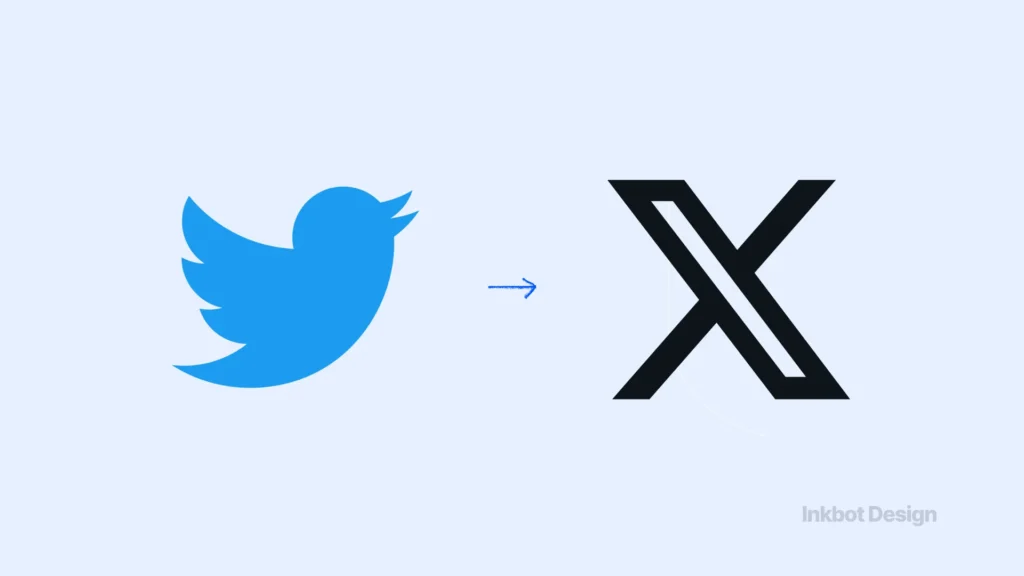
Rebrands rarely fail at launch. They fail in the months that follow, when the market is still learning about the new brand and the firm has stopped managing the change.
The visible symptoms — backlash, loss of recognition, inconsistent staffing, an SEO dip, wasted rollout spend — are not five separate mistakes. They make one mistake: treating a rebrand as a reveal rather than a migration.
- The design is rarely the point of failure; the transition is.
- Professional services firms have greater exposure because the brand is the partners’ names and referral equity, not just a mark.
- A new brand promise raises expectations that the operation must then meet — or the rebrand makes weakness more visible, not less.
Rebranding risks concentrate not in the design but in the transition period, when customers, staff and search engines have not yet relearned the new brand.
This is the pillar topic in full: Inkbot Design’s rebranding services exist because the migration, not the mark, is where firms lose money.
“Surely a Good Agency Just Designs It Well?” — Why Rebrands Fail
Here is the objection every managing partner raises first.
Brief a competent studio, approve strong work, and the risk is handled — isn’t it? Intelligent leaders hold this view for a good reason: the deliverable they can see and sign off on is the design.
It’s tangible, it’s on a page, it’s the thing the agency is visibly paid for. So that’s where attention and scrutiny go.
The evidence doesn’t support the assumption. A rebrand isn’t a document you approve; it’s a change the entire market has to absorb, and it does so slowly.
Look at how the companies that take this seriously actually behave. PepsiCo unveiled its first major corporate identity reset in 25 years in October 2025 and deliberately kept a recognisable “P” as a heritage cue, then rolled the identity out in phases across its website, social channels, packaging, workplaces and signage — not overnight.

Cooper Tires launched a new global look in March 2026. They moved their website, social channels and selected paid media first, while scheduling retail point-of-sale materials to transition over time. Neither treated launch day as the finish line. They treated it as the start of a migration.
The reason design quality doesn’t rescue a rebrand is mechanical. A design decision is resolved in an afternoon.
A market’s understanding of who you are resolves over months of repeated exposure — every proposal, every invoice, every referral conversation, every search result re-teaching the association.
Break that association faster than you rebuild it, and you’ve created friction exactly where the old brand had earned familiarity. That’s not a design flaw. It’s an unmanaged transition.
“A rebrand is not a reveal. It is a migration. The logo changes in a day; the market’s understanding of who you are changes over months — and the months are where the money is lost.”
The 4 Failure Modes, Named
The 4 things firms call “rebranding mistakes” are symptoms of one root cause: the transition wasn’t managed. Naming them separately is still useful, because each has a distinct tell and a distinct fix.
What follows is the pattern I see most often in brand work — presented as a mechanism rather than a warning.

Lost recognition.
The most expensive failure and invisible on launch day, because it costs you enquiries that never arrive. Here’s the mechanism a sceptic can’t wave away: in professional services, most good work comes by referral, and a referral is one person saying a name to another with confidence.
Change that name abruptly, and the referrer pauses — “I think they’re called something else now?” — and in that pause, the recommendation dies. You never see it. There’s no lost-deal report for the introduction that was never made.
Recognition rebuilds only through repeated exposure, and you cannot compress months of it into a launch week.
Expectation inflation.
A rebrand raises the promise. If the delivered experience doesn’t rise with it, the new brand makes the gap more conspicuous, not less.
According to PwC’s 2025 Customer Experience Survey, 52% of consumers stopped buying from a brand after a bad product or service experience, and 29% stopped after a poor customer experience.
Qualtrics’ Q3 2025 research across more than 20,000 consumers found consumers cut spending after 47% of bad experiences, with the firm estimating nearly USD 3 trillion in sales at risk globally in 2026.
A new identity that promises more, over an operation that delivers the same, converts those numbers from risk into loss.
SEO and entity decline.
A rebrand is a migration in the technical sense, too, and this is where “IT will sort the redirects” quietly costs you.
Google and AI models hold an association between your firm’s name and years of accumulated expertise — the articles, the mentions, the case results.
Move domains or change the named entity without deliberately preserving that association, and you don’t just drop a few rankings; you sever the link between the new name and the reputation the old name earned.
A prospect asks an AI model who the good litigation firms in Leeds are, and your fifteen-year track record is filed under a name that no longer exists.
Wasted rollout spend.
Everyone budgets for the reprint. Nobody budgets for the tell it sends.
When signage, templates and invoices update on different days, a client sees the new brand on your website and the old one on your bill — and the thought that follows isn’t “nice refresh.”
It’s “Does anyone over there know what’s going on?” For a firm selling judgement and control, looking briefly out of control of its own name is a worse cost than the print run.
| Failure mode | The tell you’re about to hit it | The fix |
| Lost recognition | The plan has a launch date but no “coexistence period” | Retain a heritage cue; phase the change |
| Expectation inflation | The new promise is aspirational, the operation unchanged | Fix the experience before you raise the bar |
| SEO/entity decline | Redirects and entity mapping are treated as “IT will handle it” | Plan the technical migration as a first-class workstream |
| Wasted rollout spend | Asset updates begin after launch, not before | Sequence and stage every touchpoint pre-launch |
“But We’ll Communicate It Properly” — The Coexistence Window
The second objection, and the more sophisticated one: we know it’s a change, we’ll announce it well. Announcement isn’t the problem.
The problem is the window after the announcement, when the old brand and the new brand are both live in the market simultaneously — on legacy documents, in a client’s memory, in a referrer’s phone contacts, in Google’s index, on the signage you haven’t replaced yet.
This is the question the mature rebrands are actually organised around. Not “when do we unveil?” but “how do we manage the period where customers encounter the old and new brand at the same time?”
Mirinda’s April 2026 global identity kept its distinctive colour palette while reshaping heritage cues for a phased, multi-market rollout. The colour was the bridge — the thing that let people recognise the brand mid-change.

Professional services firms rarely have a colour that famous, but they have equivalents: the partners’ names, a founding date, and a reputation attached to specific work.
Trust makes the window more dangerous, not just longer.
Edelman’s 2026 Trust Barometer, surveying nearly 34,000 people across 28 countries, put the UK Trust Index at 44 — among the lower-scoring developed economies — and its 2025 Brand Trust report found people now judge brands on personal relevance and proof, not corporate purpose.
Translated for your rebrand: a relaunch that leads with aspirational language invites the one question a low-trust buyer is already primed to ask — “what actually changes for me, and where’s the evidence?”
Answer it badly mid-transition, and you don’t read as ambitious. You read as a firm papering over something.
If your live question is whether the change even needs to be this large, that’s the rebranding versus brand refresh decision — and getting it wrong widens the coexistence window for no commercial return.
The Tell: How You Know You’re About to Get This Wrong
The single clearest warning sign: your rebrand plan has a launch date and no migration plan.
If the document you’re approving specifies when the new brand appears but not how the market moves from old to new — no coexistence period, no recognition bridge, no owner for internal rollout, no technical migration workstream — you are optimising the reveal and ignoring the risk.
The default mistake is to spend 90% of the budget and attention on the identity and 10% on the rollout, even though the failure modes above occur almost entirely in the rollout.
The tell that you’re making it is that everyone in the room can describe the new look, and no one can describe the six months after launch.
If you’re building the internal argument for the work, the business case for rebranding should budget the migration as explicitly as the design — a proposal that doesn’t is the same mistake in spreadsheet form.
The Verdict
Rebranding risk is not a design risk. It’s a migration risk.
Every failure firms dread — lost recognition, a dip in trust, staff who tell different stories, an SEO slide, money burned on a botched rollout — traces back to one decision: whether the firm managed the period when the market was still learning the new brand, or just unveiled it and hoped.
The design gets applause on launch day. The migration decides whether the applause was worth anything by Christmas.
The one thing to act on today: before you approve a single visual, write the migration plan — the coexistence period, the recognition bridge, the internal owner, the technical workstream. If it doesn’t exist, the rebrand isn’t ready, however good the logo is.
If you want to know exactly where your current brand is earning recognition and revenue — and where a rebrand would put that at risk — request a free Brand Equity Audit™.
It’s a structured diagnostic that shows where your brand is losing commercial ground and what to do about it before you move.
FAQs
What is the biggest risk of rebranding a professional services firm?
Lost recognition. For professional services firms, recognition drives referrals — a referrer who no longer recognises the name hesitates, and that hesitation is revenue you never see. It’s the most expensive rebranding risk and the least visible on launch day, because the enquiry simply never arrives.
Why do most rebrands fail?
Most rebrands fail because firms treat them as a reveal rather than a migration. The logo changes in a day, but customers, staff, referrers and search engines relearn the brand over months. When no one manages that transition window, recognition and trust leak away precisely where the old brand had earned them.
How do I rebrand without losing existing clients and referrals?
Retain a recognition bridge — a heritage cue such as the partners’ names, a founding date or a consistent colour — and phase the rollout rather than switching overnight. Brief every partner to tell one story, and update client-facing touchpoints in a planned sequence rather than a post-launch scramble.
Is it true that a good design brief removes the risk?
No — a strong design resolves in an afternoon, but the market’s understanding resolves over months. The risk lives in the transition, not the artwork. PepsiCo and Cooper Tires both phased their 2025–2026 rebrands across channels precisely because launch day marks the start of the risk period, not the end.
When should I worry that my rebrand is a mistake?
When your plan has a launch date but no migration plan, if everyone can describe the new identity and no one can describe the six months after launch — the coexistence period, the recognition bridge, the internal owner, the technical migration — you’re optimising the reveal and ignoring where rebrands actually fail.
Can a rebrand make my business perform worse?
Yes — if the new brand raises expectations that the operation can’t meet. PwC’s 2025 survey found 52% of consumers stopped buying after a bad experience. A rebrand that promises more while delivering unchanged makes the gap between promise and experience more conspicuous, converting latent risk into lost revenue.
